
5 A/B testing types that drive real conversions
TL;DR:
- Most A/B tests end inconclusive due to improper test selection or early stopping.
- Choosing the right test depends on clear hypotheses, traffic volume, and risk tolerance.
- Segmenting results improves insights and ensures tests genuinely enhance user experience.
Most marketing teams run A/B tests with confidence, then watch those experiments stall, end early, or produce results too murky to act on. The reality is that 70 to 80% of A/B tests end up inconclusive or get stopped before reaching statistical significance, with some costing businesses over $20,000 per test. The problem is rarely effort. It is almost always the wrong test type applied to the wrong situation. This guide walks you through five core types of A/B testing, how to choose between them, and how to run each one in a way that actually produces decisions you can act on.
Table of Contents
- How to choose the right A/B testing approach
- Classic A/B (split) testing
- A/B/n and multivariate testing: Expanding your experiments
- Split URL and redirect testing
- Bandit and adaptive A/B testing: Automation for efficiency
- Why test outcomes matter more than methods
- Take your A/B testing further with Stellar
- Frequently asked questions
Key Takeaways
| Point | Details |
|---|---|
| Choose tests strategically | Matching the method to your goals and resources ensures more actionable and cost-effective results. |
| Classic vs. advanced options | From simple split tests to adaptive and multivariate formats, each type has unique strengths and tradeoffs. |
| Analyze outcomes, not just wins | Even inconclusive or failed tests provide critical insights for future growth and iteration. |
| Segment and safeguard metrics | Go beyond headline results by segmenting data and watching secondary outcomes to avoid common pitfalls. |
How to choose the right A/B testing approach
Before you set up your first experiment, you need a framework for selecting the right test. Not all A/B tests are created equal, and using a multivariate test when a simple split test would do is a fast way to burn traffic and time.
Here is a practical sequence to follow before launching any test:
- Write a data-driven hypothesis. Start with a specific claim, such as "Changing the headline on our pricing page from benefit-focused to urgency-focused will increase free trial signups by 10%." Vague hypotheses lead to tests that answer nothing.
- Align your test type with your goal. Conversion rate improvements, user experience changes, revenue per visitor, and engagement metrics all call for different testing approaches. A UX overhaul is not a headline test.
- Audit your traffic volume. Some test types require ten times more traffic than others to produce reliable results. Running an underpowered test on low-traffic pages is one of the most common and most costly mistakes in growth marketing.
- Assess your risk tolerance. Changing an entire landing page layout is a high-risk change. Testing a CTA button color is low risk. Your test type should match your risk appetite and your timeline.
- Plan for full test cycles. One critical mistake is stopping tests the moment results look promising. Novelty effects fade, meaning early lifts can disappear as users adjust to the new experience. Always run tests through at least one full business cycle.
Pro Tip: Before finalizing your test design, use heatmaps versus A/B testing as complementary tools. Heatmaps reveal exactly where users click, scroll, and drop off, which gives you sharper hypotheses before you commit traffic to a formal test. Pair qualitative behavioral data with quantitative split testing for maximum signal.
Also consider secondary metrics and guardrail metrics throughout your test. Even if your primary conversion metric improves, a spike in bounce rate or a drop in time on page can signal that your variant is winning on a narrow metric while hurting the broader user experience. For more detailed guidance, the AB testing best practices every marketer should follow provides a solid foundation.
Classic A/B (split) testing
Classic A/B testing is the benchmark. You take one variable, create two versions of it, split your audience evenly, and measure which version performs better. Everything else in the world of experimentation is built on this foundation.
Where classic A/B testing works best:
- Email subject lines, where small wording changes can shift open rates by 20% or more
- Landing page headlines, especially for paid traffic campaigns where every click has a direct cost
- Call-to-action buttons, including text, color, size, and placement
- Form length and field order, which has an outsized impact on lead generation pages
- Pricing page copy, where framing can shift perceived value significantly
The simplicity is the strength. One variable means one clear answer. If version B outperforms version A, you know exactly what drove the result. This makes classic A/B testing ideal for teams that are building an experimentation culture for the first time or for pages where you have one clear hypothesis to validate.
The risk is also real. As the data on A/B testing in digital marketing consistently shows, 70 to 80% of tests end without a clear winner, often because the team tested too small a change, stopped early, or ran the test during a seasonal period that distorted results.
"The majority of A/B tests fail not because the idea was bad, but because the execution was rushed or the wrong metric was being tracked."
Pro Tip: Set your minimum detectable effect (the smallest improvement worth acting on) before the test starts. If you need a 5% improvement to justify a change, size your test accordingly. Running a test that can only detect a 20% improvement on a page where you realistically expect 5% gains is a guaranteed way to waste resources and end up with inconclusive data.
The most effective classic A/B tests focus on high-traffic, high-impact pages, test one meaningful change at a time, and run long enough to capture at least one full weekly cycle. This simple discipline separates teams that learn from testing and teams that just run tests.
A/B/n and multivariate testing: Expanding your experiments
When your goals are more complex, or when your traffic volume supports it, you can expand beyond two-variant testing into A/B/n or multivariate formats.

A/B/n testing extends the classic model by testing three or more variants against a single control at the same time. Instead of asking "Is B better than A?", you ask "Which of these five headlines performs best?" This is particularly useful when you have multiple strong creative directions and want to identify a winner without running sequential tests over several weeks.
Multivariate testing (MVT) goes further. Instead of changing one element across variants, you change multiple elements simultaneously and measure how combinations of changes interact. For example, you might test three headlines against two CTA buttons, generating six total combinations. MVT tells you not just which headline works, but which headline works best when paired with a specific CTA.
Here is a side-by-side comparison to help you decide:
| Factor | A/B/n testing | Multivariate testing |
|---|---|---|
| Number of variants | 3 or more | Combinations of elements |
| Traffic required | Moderate to high | Very high |
| Time to results | Medium | Long |
| Best for | Headline, CTA, or image tests | Full-page interaction analysis |
| Actionability | High | High, but complex |
| Recommended traffic | 10,000+ monthly visitors | 50,000+ monthly visitors |
How you prioritize these tests matters. Follow this sequence for maximum impact:
- Run A/B/n tests first if you have multiple strong hypotheses and need to identify the best direction quickly.
- Graduate to multivariate testing once your baseline conversion rate is established and you want to squeeze additional lift from element interactions.
- Always contextualize results against industry benchmarks. The average landing page converts at 2.35%, but headline tests alone have driven up to 34% conversion lifts in high-performing campaigns.
For targeted A/B test ideas for conversions that work across both A/B/n and multivariate setups, it helps to build a backlog of prioritized hypotheses before committing to either format.
Split URL and redirect testing
Split URL testing is what you reach for when you want to test something far more dramatic than a button color or a headline tweak. Instead of serving two variants of the same page, you send users to two entirely different URLs, each hosting a completely different experience.
This is the testing method for big bets. Think a complete page redesign, a new navigation structure, a fundamentally different content flow, or an entirely different value proposition. If the change is big enough to warrant its own URL, split URL testing is the right tool.
When to use split URL testing instead of classic A/B:
- You are redesigning a key landing page from scratch and want to validate the new design against the current one before deploying it site-wide
- You are testing two different checkout flows or onboarding sequences
- You are comparing a long-form sales page against a short-form version with a different structure entirely
- You want to evaluate different content strategies, such as a product-focused page versus a testimonial-driven page
- Your development team has already built the alternative page and you need a controlled way to test it at scale
The stakes are real. Industry conversion data shows just how much vertical and page type affect baseline performance. Legal verticals see conversion rates of 6.4%, while ecommerce pages average around 1.8%. A split URL test that moves an ecommerce page even half a percentage point can represent a significant revenue shift at scale.
| Vertical | Average conversion rate |
|---|---|
| Legal | 6.4% |
| Finance | 5.0% |
| SaaS / software | 3.0% |
| Ecommerce | 1.8% |
| Travel | 3.4% |
For a thorough walkthrough of when and how to use this approach, the A/B testing for landing pages complete guide covers redirect testing scenarios in depth. Split URL testing is not more complex than classic A/B in terms of statistical analysis. The main difference is implementation. You need two live pages, proper redirects, and a testing platform that can segment traffic cleanly between URLs without creating SEO issues.
Bandit and adaptive A/B testing: Automation for efficiency
Traditional A/B testing operates on a simple principle: split traffic evenly, run the test to statistical significance, then pick a winner. That process is reliable, but it can also be slow and expensive when every visitor sent to a losing variant represents wasted spend.
Adaptive testing, commonly called multi-armed bandit testing, solves this by automatically shifting more traffic toward the better-performing variant as data accumulates. The algorithm continuously updates traffic allocation in real time, so you spend less time showing users a weaker experience.
Where bandit and adaptive tests make the most sense:
- Ad campaigns where you need a winner fast and every click has a direct dollar cost
- Email sequences where send volume is limited and you cannot afford to split traffic evenly for weeks
- Time-sensitive promotions or seasonal campaigns where a traditional test cycle would outlast the campaign itself
- Personalization scenarios where multiple content variants need to be dynamically matched to user segments
The tradeoff is real. Because traffic allocation shifts during the test, the statistical assumptions behind traditional significance testing no longer apply cleanly. Bandit tests are optimized for short-term performance gains, not long-term learning. If your goal is to understand why one variant won, the adaptive approach often obscures the signal.
Given that most A/B tests fail due to insufficient traffic or premature stopping, bandit testing offers a practical workaround for smaller campaigns. But it works best as a complement to, not a replacement for, rigorous classic A/B testing. For a full breakdown of which metrics to track during any test format, the A/B test metrics guide is a useful reference point.
Why test outcomes matter more than methods
Here is something most A/B testing content gets wrong: it treats the method as the main event. Teams debate bandit versus Bayesian, multivariate versus split URL, and lose sight of what actually drives compounding improvement over time.
The real competitive advantage in experimentation is not the test type you pick. It is what you do with the result.
A test that reaches statistical significance and confirms your hypothesis is useful. A test that ends inconclusive because your traffic was too low is not a failure. It is a signal to redesign the hypothesis or redirect testing resources to a higher-traffic page. Teams that treat every result as data rather than judgment tend to build stronger testing programs over time.
The most durable insight from continuous A/B testing is that segmenting results by user type, device, source, and behavior consistently reveals patterns that overall averages hide. A variant that underperforms on desktop may be a clear winner on mobile. A headline that resonates with returning visitors may confuse new ones. These nuances only emerge when you look beneath the top-line number.
Secondary metrics matter just as much. A test that lifts your primary conversion goal but quietly drives up unsubscribes or support tickets is not a win. Monitoring guardrail metrics ensures your optimizations actually make the product better, not just the dashboard prettier. If you want to avoid the mistakes that quietly sabotage growth programs, the list of A/B testing pitfalls that marketers face is worth reviewing carefully.
Take your A/B testing further with Stellar
If you are ready to apply these testing strategies without months of technical setup, Stellar was built for exactly this situation.
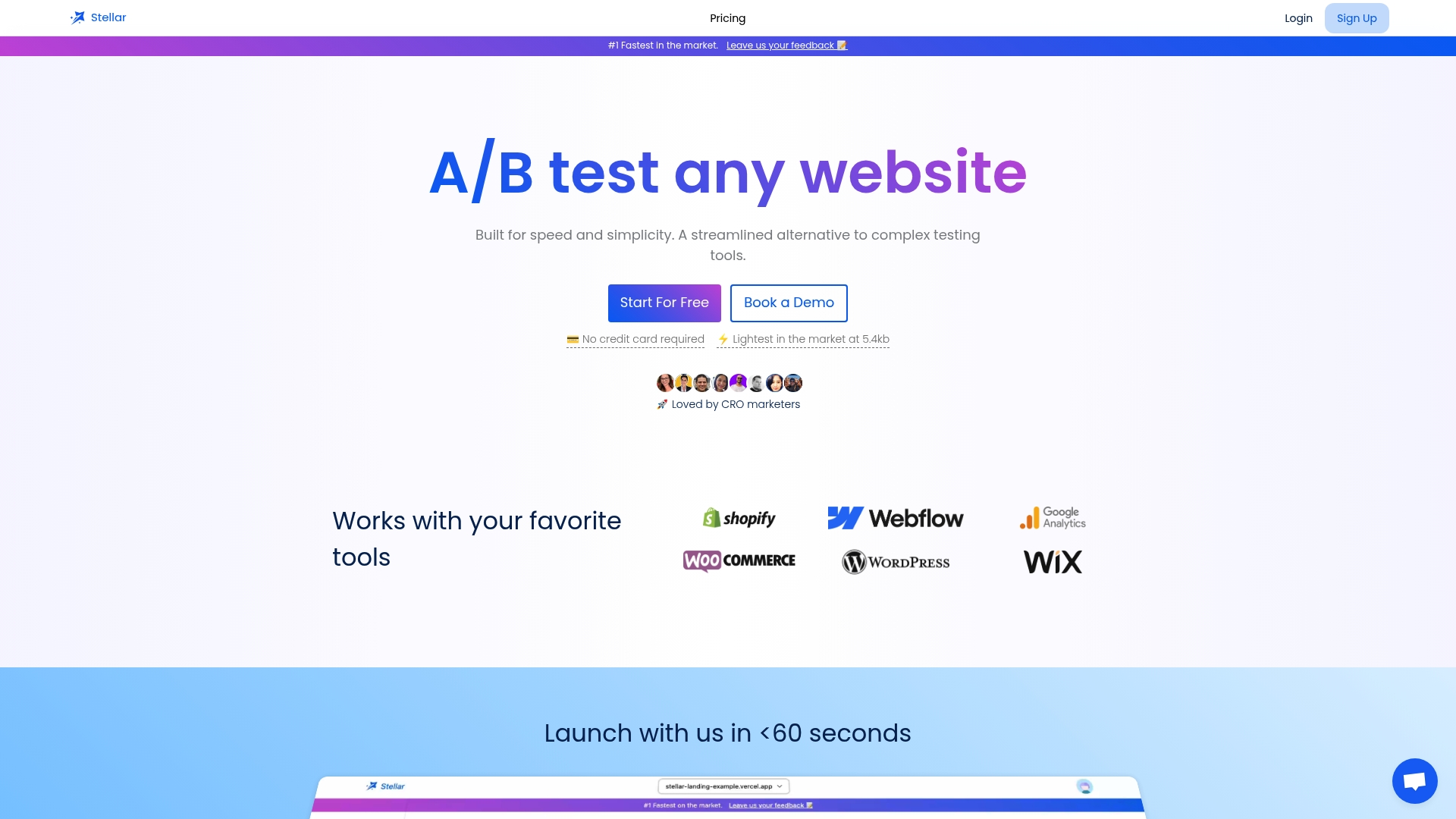
Stellar's no-code visual editor lets you create A/B test variants directly on your page without touching code, so your growth team can run experiments independently from engineering. The platform's 5.4KB script keeps your page speed intact while tracking real-time results through advanced goal tracking built for conversion-focused teams. Whether you are running classic split tests, dynamic keyword insertion tests for paid landing pages, or tracking multi-step funnel goals, Stellar makes the full testing workflow faster and easier. Explore the free plan and start your first experiment today.
Frequently asked questions
What is the most common reason for A/B test failure?
Most A/B tests fail due to unclear hypotheses, insufficient traffic, or cutting the test short before reaching valid results. Research shows that 70 to 80% of tests end inconclusively, often because teams prioritize speed over statistical rigor.
When should you use multivariate testing instead of A/B testing?
Use multivariate testing when you want to analyze the combined effect of changes to multiple elements and have enough traffic to support complex experiments. It is particularly valuable when headline tests alone can drive up to 34% conversion lifts and you want to measure how headline and CTA changes interact.
What are adaptive or bandit tests best for?
Adaptive tests are best for campaigns that need quick optimization with limited traffic, automatically shifting users toward the best-performing variant in real time.
Why should marketers segment A/B test results?
Segmenting results uncovers how different user groups respond to variants, revealing hidden wins or risks that overall averages obscure. According to best practices for segmenting results, secondary metrics and guardrail tracking are equally critical to any reliable test.
Recommended
Published: 4/26/2026