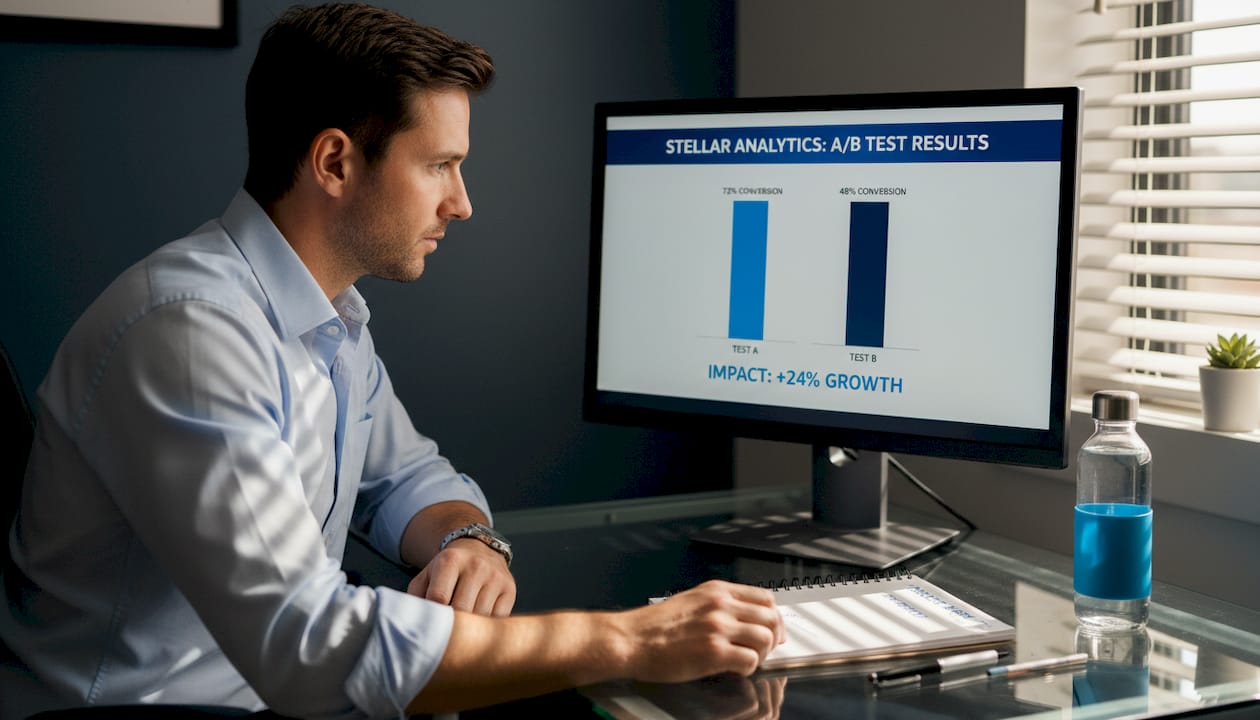
A/B testing and machine learning: Get better results
TL;DR:
- Most A/B tests fail due to outdated, fixed-split methods that don't adapt to user responses.
- Machine learning enables faster, segment-specific testing, reducing wasted traffic and improving insights.
- SMB marketers should focus on iterative, real-time experiments using tools like multi-armed bandits and AI-assisted generation.
Most A/B tests fail. Research suggests 80 to 90% of tests never produce a winning insight, which means the majority of marketers are investing time, traffic, and budget into experiments that go nowhere. For growth hackers at small to medium-sized businesses, that's a painful reality. But the problem often isn't the testing itself. It's the method. Machine learning is changing how marketers design, run, and interpret experiments, and the results speak for themselves. This guide breaks down exactly how you can apply ML approaches to shift the odds in your favor.
Table of Contents
- What's different about machine learning-powered A/B testing?
- Key methodologies: From fixed splits to intelligent test strategies
- Practical steps to apply machine learning in your A/B tests
- Best practices and common pitfalls for SMB marketers
- Why most marketers get machine learning in A/B testing wrong
- Next steps: Simplifying smarter marketing experiments
- Frequently asked questions
Key Takeaways
| Point | Details |
|---|---|
| ML boosts test impact | Machine learning unlocks more conversions by personalizing A/B test experiences and analyses. |
| Choose the right method | Pick your approach—such as bandits or S-Learner—based on traffic size and test goals. |
| Action beats perfection | Apply quick, actionable learnings instead of waiting for perfect data to drive bigger marketing gains. |
| Guardrails prevent failure | Set primary and safety metrics to avoid costly mistakes and ensure sustainable results. |
What's different about machine learning-powered A/B testing?
Traditional A/B testing is straightforward. You split your traffic evenly between two versions of a page or ad, let the test run until you reach statistical significance, then declare a winner. Clean, simple, and often slow. The real problem is that this method treats every visitor as if they respond to your content the same way, which they absolutely don't.
Machine learning introduces a fundamentally different approach to experimentation. Instead of waiting weeks for a fixed split to resolve, ML-powered methods adapt as data comes in. They can identify which segments respond best to which variants, allocate more traffic toward winning options automatically, and even help you generate test ideas in the first place. Core methodologies include traditional fixed-split testing for causal inference, multi-armed bandits (MAB) for traffic exploitation during live tests, AI-assisted setup tools like VWO Copilot and Optimizely AI for idea generation and metric selection, and ML models for estimating heterogeneous treatment effects (HTE), which means understanding how different types of users respond differently to the same change.
For marketers who rely on A/B testing basics to drive decisions, this evolution matters a great deal. You stop guessing what works for "the average user" and start discovering what works for specific, high-value segments.
Here's a quick comparison of how traditional and ML-powered testing stack up:
| Feature | Traditional A/B | ML-powered testing |
|---|---|---|
| Traffic allocation | Fixed 50/50 split | Adaptive, shifts to winner |
| Speed of learning | Slow (weeks) | Fast (days or continuous) |
| Segment targeting | Manual or post-hoc | Automated, real-time |
| Test idea generation | Manual | AI-assisted |
| Handles many variants | Poorly | Well (multi-armed bandits) |
| Traffic requirement | High | Lower with bandits |
Key advantages of ML-powered A/B testing over the traditional approach include:
- Faster iteration: You get directional data much sooner, especially with adaptive methods.
- Behavioral modeling: ML picks up on patterns in user behavior that humans miss entirely.
- Segment-level insights: Instead of one winner for all users, you find winners for specific audiences.
- Automation: Less manual setup, fewer errors, and more time spent on strategy.
- Reduced wasted traffic: Bandits automatically shift traffic away from underperforming variants.
Understanding the psychology behind testing helps reinforce why these differences matter. Users behave in nuanced, context-driven ways, and ML methods are built to account for that complexity rather than average it away.
Key methodologies: From fixed splits to intelligent test strategies
Once you see the main differences, it's worth understanding each method in more detail and knowing when to use each one. Not every ML approach fits every situation, and picking the wrong method for your traffic level or goal can waste your experiment entirely.
Multi-armed bandits (MAB) are the most accessible ML method for most SMB marketers. Think of a slot machine row where the bandit algorithm automatically pulls the arm that's paying out most frequently. In testing terms, it shifts traffic toward better-performing variants continuously, so you're not locking 50% of your users into a losing experience for weeks. MAB is excellent for ongoing optimization of ads, email subject lines, or landing page headlines where speed matters more than perfect causal isolation.

S-Learner models go deeper. They're a type of meta-learner used to estimate the individual-level effect of a change. Empirical benchmarks show the S-Learner is a top performer, achieving a Qini coefficient of 0.376, capturing 77.7% of incremental conversions from just the top 20% of customers, which is 3.9 times better than random selection. The practical implication is that you can identify and concentrate your testing budget on the users most likely to convert, rather than spreading your effort evenly.
AI-assisted test generation tools like VWO Copilot suggest test hypotheses, help define success metrics, and can even predict likely effect sizes before you run a single test. This is particularly useful if your team lacks a dedicated CRO strategist.
Here's a quick guide to matching the method to the situation:
| Method | Best for | Minimum sample size estimate |
|---|---|---|
| Fixed A/B split | Causal inference, compliance testing | 1,000+ per group |
| Multi-armed bandit | Ongoing ad/copy optimization | 500+ per group |
| S-Learner (HTE) | High-value segment targeting | ~4,000 per group for 2% baseline |
| AI-assisted setup | Idea generation, metric selection | Varies by tool |
To put this into a practical workflow, here's how to choose and execute the right method:
- Define your primary goal. Is it causal proof (use fixed A/B) or ongoing optimization (use MAB)?
- Estimate your traffic. If you're under 5,000 monthly sessions per variant, lean toward bandits or segment-focused methods.
- Identify your segments. Use your analytics to find groups with high purchase intent or engagement.
- Select the right tool. Match the method to your platform's capabilities.
- Set your sample size target. For a 2% baseline conversion rate, plan for roughly 4,000 samples per group to detect meaningful differences.
Pro Tip: If your SMB site doesn't have enough traffic for a clean fixed-split test, multi-armed bandits and segment-targeting models will deliver faster, more actionable results. Marketing automation can also help you run more tests simultaneously without stretching your team thin.
Practical steps to apply machine learning in your A/B tests
Having understood the methodologies, here's how you can put ML into action for your campaigns. The good news is that you don't need a data science degree to get meaningful results. You need a clear process and the right tools.
Follow these five steps to integrate ML into your testing workflow:
-
Start with a hypothesis grounded in data. Pull your analytics and identify your highest-traffic, lowest-converting pages. Don't guess what to test. Look at scroll maps, click data, and drop-off rates to pinpoint real friction points. AI tools can scan these signals and suggest test ideas automatically.
-
Segment your audience before you test. Break users into groups by traffic source, device type, purchase history, or behavioral stage. ML models perform best when your audience segments are well-defined. A visitor coming from a paid search ad behaves very differently from someone arriving through an organic blog post.
-
Choose adaptive allocation. Set your testing tool to use a bandit algorithm or adaptive traffic splitting rather than a rigid 50/50 split. This protects revenue during the test by funneling more traffic to better-performing variants as results accumulate.
-
Define your primary metric and guardrail metrics upfront. Your primary metric might be conversion rate. Your guardrail metrics, which are the limits you won't cross, might include page load time and complaint or churn rates. This is critical: ML models will optimize aggressively for whatever metric you give them, so if you only track CTR, you may win clicks but hurt purchases.
-
Analyze by segment, not just overall results. After the test, don't just read the top-line number. Look at how each user segment responded. You may find a variant that performs poorly overall but delivers a 40% lift for your highest-value segment. That's your real win.
A real-world example makes this concrete. AI-optimized ad testing has produced 30% CTR lifts and 22% lower CPA compared to manual methods. These aren't marginal gains. For a business spending $10,000 a month on paid ads, a 22% reduction in cost per acquisition means roughly $2,200 in recovered budget every single month.
Pro Tip: Set guardrail metrics before you launch any ML-driven test. If your bandit algorithm is optimizing for conversions but quietly increasing page load times, you could be trading short-term gains for long-term churn. Build in checks from day one.
Before you start, it also helps to practice validating test ideas rigorously so you're spending your limited traffic on hypotheses that are genuinely worth testing. Pair that with A/B testing best practices to make sure your execution matches your ambition.
Common pitfalls to avoid when implementing ML in your tests:
- Overfitting to noise: Running too many segments on too little data produces false patterns. Be selective.
- Misinterpreting segment outputs: A segment winning in one test doesn't mean it always behaves that way. Validate results.
- Ignoring the full funnel: Optimizing a landing page click-through rate without tracking downstream conversions gives you an incomplete picture.
- Stopping tests too early: Even bandits need time to learn. Pulling the plug after two days produces unreliable conclusions.
- Skipping documentation: Record every test hypothesis, result, and segment finding. Over time, this becomes a searchable asset worth more than any individual test.
Best practices and common pitfalls for SMB marketers
After concrete application steps, it's important to clarify what consistently works and what tends to silently kill your testing program before it produces any real value.
The most important practice you can build is defining metrics clearly before a test goes live. This sounds obvious, but most SMB teams skip it. They run a test, look at the results, and then decide which metric matters. That's backwards. It leads to cherry-picking and wasted effort. Set your primary conversion metric, decide on two to three guardrail metrics, and commit to them before anything launches.
Best practices worth building into your process:
- Focus your segments tightly. Instead of splitting users into ten groups, pick two or three that are strategically important: your highest-revenue cohort, your most engaged subscribers, or your most frequent returners.
- Run quality assurance checks before launch. ML-powered tools can expose implementation bugs faster than traditional tests because they react to data immediately. A broken form or a missing tracking event will skew everything.
- Use your test history. Every past test, including the ones that failed, contains signal. Build a record of what you've tested and what you've learned.
- Match test duration to your traffic reality. Don't rush. Even with bandits, you need enough data to be confident.
"For SMBs, focus AI and ML on multivariate and bandit approaches rather than pure A/B because traffic constraints make classic fixed-split testing slow and unreliable. Prioritize primary metrics like conversion rate and guardrail metrics like latency and user complaints to keep optimization pointed in the right direction."
Common pitfalls that quietly derail SMB testing programs:
- Neglecting sample size planning: Running a test with 200 visitors per variant and declaring a winner is statistically meaningless. Use a sample size calculator before you start.
- Misreading ML outputs: A model saying one segment responds better doesn't mean you should ignore everyone else. It means you've found a priority, not a universal truth.
- Ignoring page performance: Analyzing test results without checking load time impact is a common blind spot. A faster page almost always converts better, regardless of copy or design.
- Treating ML as a set-and-forget system: Adaptive algorithms still require human oversight. Check results regularly, not just at the end.
Getting comfortable with beginner marketing analytics gives you a much stronger foundation for interpreting what ML models are actually telling you, especially when segment-level outputs look surprising.
Why most marketers get machine learning in A/B testing wrong
Here's the uncomfortable truth: most marketers who claim to be "using machine learning in their tests" are really just using a fancier dashboard on the same old fixed-split logic. They add an AI-suggestion layer on top of a process that still assumes every user is the same. That's not machine learning. That's just automation with better UX.
The real mistake is obsessing over perfect, statistically pristine data before making any decisions. SMB marketers in particular get paralyzed waiting for significance. Meanwhile, your competitor is running ten smaller, directional tests and iterating fast. Directional results, meaning "this is probably better by about 15%," are often enough to act on when time and traffic are limited.
The mindset that drives real wins with ML is agile learning. Small, repeatable experiments where you test smarter, not harder, build institutional knowledge faster than any single perfect test ever could. Stop chasing the one breakthrough result. Start stacking small, confident improvements. ML is the tool. Iteration is the strategy. Marketers who get this right consistently outperform those who treat every test like a research paper.
Next steps: Simplifying smarter marketing experiments
Understanding ML in A/B testing is one thing. Actually running experiments without a team of data scientists is another challenge entirely.
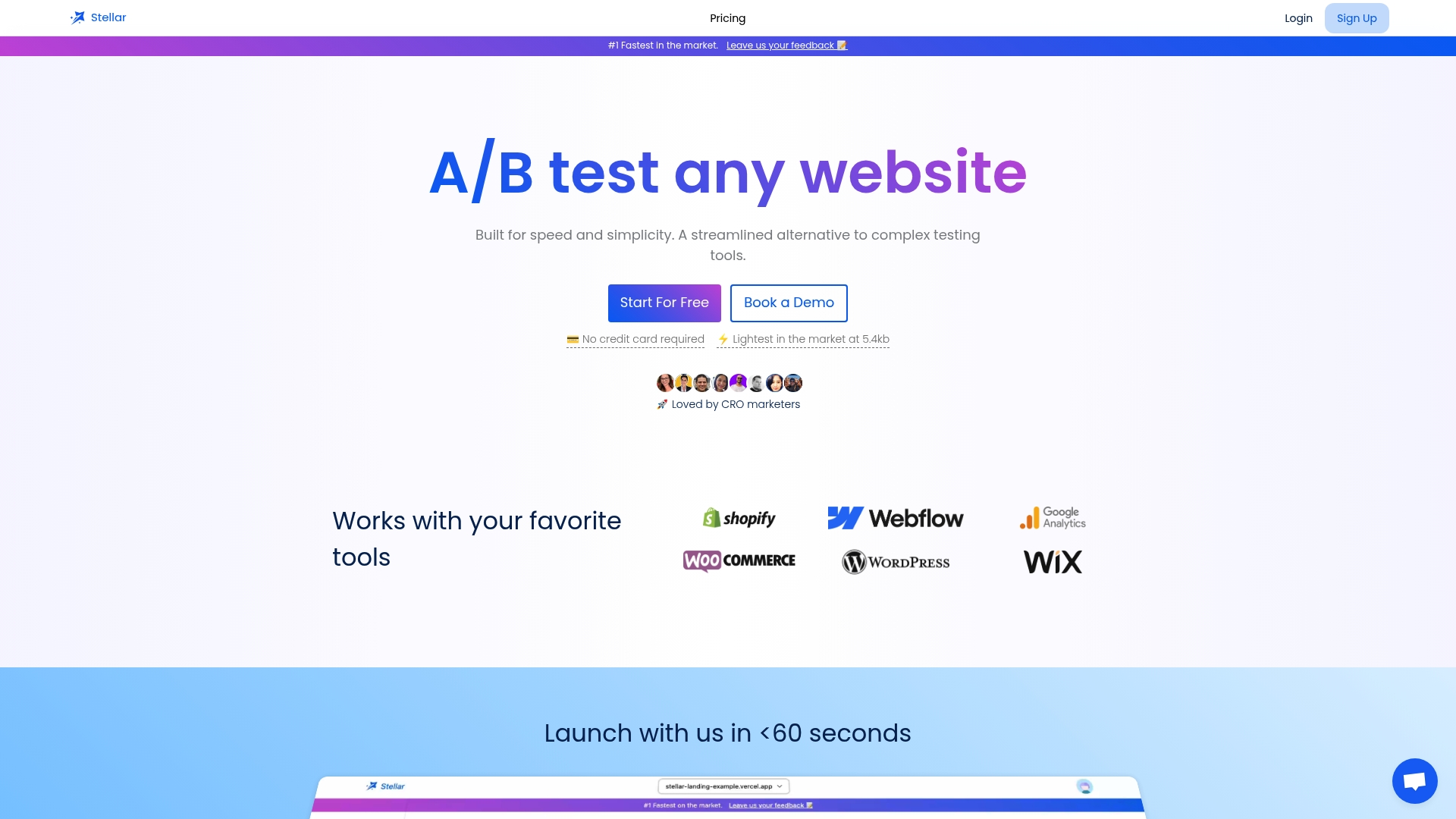
That's exactly where GoStellar comes in. Stellar is built for marketers and growth hackers who want the benefits of intelligent experimentation without the technical overhead. With a no-code visual editor, real-time analytics, and a lightweight 5.4KB script that won't slow your site down, you can set up and run optimized tests in minutes. Whether you're just starting out with A/B testing or ready to run multi-variant experiments across key audience segments, Stellar's free plan covers businesses with up to 25,000 monthly tracked users. No developers required. No complexity. Just clear, actionable results.
Frequently asked questions
What is the main advantage of using machine learning in A/B testing?
Machine learning enables real-time test optimization by identifying the highest-converting audience segments automatically, producing significantly larger and faster conversion lifts than traditional fixed-split methods.
Are machine learning-based A/B tests suitable for low-traffic websites?
Yes, methods like multi-armed bandits are particularly well-suited for SMBs with limited traffic because they adaptively shift traffic toward winning variants rather than locking into a rigid split that requires large sample sizes.
What results can marketers expect from AI-powered ad testing?
AI-powered ad testing has delivered 30% higher CTR and 22% lower cost per acquisition compared to manual testing approaches, representing substantial gains in campaign efficiency.
How do I select the right ML framework for A/B testing in marketing?
Match the framework to your goal: use S-Learner models when you want to target high-value user segments for maximum conversion impact, and use multi-armed bandits when you need continuous optimization of ads, copy, or landing page variants over time.
Recommended
Published: 4/26/2026