
A/B testing in data science: Boost conversions now
TL;DR:
- Small and medium businesses effectively use A/B testing to improve conversion rates and revenue.
- Running structured, hypothesis-driven tests with proper sample sizes and timing yields trustworthy insights.
- Prioritizing high-impact elements like headlines and call-to-action buttons maximizes testing results.
A/B testing isn't reserved for Google or Amazon. Small and medium-sized businesses are quietly using it to squeeze more revenue out of the same traffic, and the data backs it up. Landing pages average 2.35% conversion rates across industries, yet top performers hit five times that. The gap? Systematic experimentation. In data science, A/B testing is one of the most reliable methods for making decisions that actually improve results rather than just guessing. This article walks you through what it is, how to run it properly, what to test first, how to read your results, and what most SMBs consistently get wrong.
Table of Contents
- What is A/B testing in data science?
- Core steps to run a rigorous A/B test
- Choosing what to test: Impact, priorities, and common pitfalls
- Analyzing results: Statistical significance, effect size, and next steps
- A smarter, faster mindset for A/B testing success
- Level up your A/B testing with the right tools
- Frequently asked questions
Key Takeaways
| Point | Details |
|---|---|
| Test what matters | Focus your experiments on high-impact changes like headlines and calls-to-action for the best ROI. |
| Follow a scientific process | Always use a clear hypothesis, the right metrics, and proper statistical analysis to avoid misleading results. |
| Expect inconclusive tests | Most A/B tests will not yield a clear winner, so prioritize frequent improvements over perfect answers. |
| Data beats opinion | A/B testing lets you rely on real user behavior instead of gut instinct for business decisions. |
What is A/B testing in data science?
Now that you know A/B testing can move the needle for businesses of all sizes, let's define exactly what it is and how data science makes it smarter.
At its most basic, A/B testing means splitting your audience into two groups. Group A sees the original version of something (your control), and Group B sees a version with one change (your variant). You measure a specific outcome for both groups, then use statistics to determine whether the difference is real or just noise. That's it. Simple in concept, powerful in practice.
In a data science context, A/B testing is hypothesis-driven. You're not randomly swapping colors or button text. You're forming a structured prediction: if we change the headline on our pricing page then sign-ups will increase because the current headline doesn't speak to the visitor's specific problem. This if/then/because structure is foundational to good experimentation because it forces you to think before you act, and it gives you something concrete to learn from, even when a test fails.
Why does this matter for marketers and product managers at SMBs? Because data-driven decisions remove the loudest-voice-in-the-room problem. Instead of your CEO's gut feeling or the designer's aesthetic preference driving changes, you let user behavior decide. A/B testing explained at a practical level shows how even simple tests can override expensive assumptions.
Common elements businesses test include:
- Headlines and subheadings on landing pages and emails
- Call-to-action (CTA) button text and color
- Form length and field order
- Page layouts and image placement
- Pricing presentation and packaging
- Email subject lines and send times
Consider the difference between testing landing pages with structured variants versus making spontaneous updates. One approach produces evidence; the other produces hope.
| Approach | Basis for change | Outcome clarity | Learning value |
|---|---|---|---|
| Intuition-driven | Gut feeling or opinion | Low | Minimal |
| A/B testing | Data and hypothesis | High | Significant |
| No testing | Past habits | None | Zero |
"Good experimentation is not about finding wins. It's about building the organizational habit of learning faster than your competitors." This mindset separates teams that grow from teams that plateau.
Following key steps like forming a specific hypothesis, selecting a primary metric, calculating sample size using baseline rate, minimum detectable effect (MDE), statistical power, and significance level, randomizing users consistently, running for full cycles of two to four weeks, and then analyzing p-value and effect size is what transforms A/B testing from guesswork into a repeatable system. Landing page experiments that skip these steps often produce misleading data, which is worse than no data at all. Testing landing pages with this level of rigor is something any SMB team can do with the right process in place.
Core steps to run a rigorous A/B test
With the key concepts clear, let's break down how you can apply A/B testing step-by-step in your SMB context.
A well-run A/B test follows a predictable workflow. Skipping any step is where things go wrong, and unfortunately, most teams skip at least one. Here's the full process:
-
Form your hypothesis. Use the if/then/because structure. Be specific about what you're changing, what you expect to happen, and why you believe it. Vague hypotheses produce vague learning.
-
Select your primary metric. This is the one number you're optimizing for. It might be click-through rate, form submission rate, or revenue per visitor. Picking multiple primary metrics leads to cherry-picking results.
-
Calculate your required sample size. This step is non-negotiable if you want trustworthy results. Your sample size depends on four inputs: your baseline conversion rate, your MDE (the smallest improvement worth acting on), your desired statistical power (typically 80%), and your significance threshold (typically 95%, or a p-value below 0.05).
-
Randomize users consistently. Each user should always see the same variant throughout the test period. If someone sees version A on Monday and version B on Thursday, your data is contaminated.
-
Run for complete business cycles. A business cycle is at minimum one full week, capturing weekday and weekend behavior. Most tests need two to four weeks to reach statistical validity. Stopping early because "it looks like B is winning" is one of the most common and costly mistakes in A/B testing.
-
Analyze p-value and effect size. Statistical significance tells you the result is unlikely to be random. Effect size tells you whether the result is actually meaningful for your business. Both matter.
Here's an example sample size table to ground this in reality:
| Baseline conversion rate | MDE (relative) | Visitors per variant needed |
|---|---|---|
| 2% | 20% | ~19,600 |
| 5% | 15% | ~7,300 |
| 10% | 10% | ~7,800 |
| 15% | 10% | ~4,700 |
Lower baseline rates require much larger sample sizes to detect meaningful differences. This is why SMBs with lower-traffic pages need to be especially thoughtful about what they test and when.

You can use a solid testing checklist to make sure no step gets missed between experiments. And before you even start building variants, take time to properly formulate test hypotheses so your tests have a real chance of producing actionable learning.
Pro Tip: Only change one variable per test. If you update both the headline and the CTA button in the same test, and the variant wins, you won't know which change caused the improvement. Test one thing at a time, always.
Choosing what to test: Impact, priorities, and common pitfalls
After outlining how an ideal test works, it's crucial to pick the right battles. Let's discuss how to choose impactful elements and sidestep common traps.
Not every page element is worth testing. This is where many SMB teams waste time, money, and statistical power. Testing the color of your footer icon is not the same as testing the headline above your lead form. The expected lift from one is measured in fractions of a percent; the other can move conversions by double digits.
High-impact elements to prioritize:
- Headlines and value propositions directly above the fold
- CTA button text (action verbs, urgency cues, specificity)
- Form design (length, field labels, inline validation, single vs. multi-step)
- Hero images or videos that frame your offer
- Pricing page layout and structure
- Trust signals like testimonials, logos, and review counts placed near CTAs
Headlines can deliver 10 to 50% lifts in conversion when optimized, which makes them the single highest-return element most SMBs can test. Meanwhile, prioritizing high-impact elements like headlines, CTAs, and forms over cosmetic details is exactly what separates product teams that grow from those that spin their wheels.
The uncomfortable reality is that 70 to 80% of tests are inconclusive. This doesn't mean testing doesn't work. It means you need to run enough tests over time to find the ones that do move the needle. Volume matters enormously in building a testing culture.
Common pitfalls to avoid:
- Testing too many variables at once. This makes it impossible to isolate what caused any result.
- Testing cosmetic elements before functional ones. Swapping font weights before you've tested your main CTA is backwards prioritization.
- Peeking at results early and stopping. Stopping a test the moment it looks significant inflates false positive rates dramatically.
- Making post-hoc adjustments. Changing the success metric after the test starts is data manipulation, even if unintentional.
- Ignoring sample pollution. Bots, internal traffic, and technical anomalies can skew results significantly.
You can find more inspiration by reviewing specific testing ideas for landing pages, or review structured test best practices to keep your process clean.
Pro Tip: Only segment your results by user type (mobile vs. desktop, new vs. returning) if you hypothesized before the test that these segments would behave differently. Post-hoc segmentation almost always produces false positives because you're essentially running multiple comparisons without adjusting for it.
Analyzing results: Statistical significance, effect size, and next steps
Once you've run your test, extracting actionable insights matters more than simply finding a statistically significant effect.
Here's what to actually look at when your test ends:
-
Check your p-value. A p-value below 0.05 means there's less than a 5% probability the observed difference happened by random chance. This is your baseline for calling a result statistically significant. It doesn't mean the variant will perform exactly as tested forever, but it does mean the signal is real enough to act on.
-
Evaluate effect size. A p-value of 0.03 on a 0.2% conversion improvement might be statistically significant, but it's not practically meaningful if your business needs a 2% lift to justify the rollout effort. Effect size translates statistics into business terms. Ask: "Is this lift big enough to matter to our team and our goals?"
-
Review secondary metrics. Did your winning CTA increase clicks but decrease time on page? Did it boost sign-ups but increase churn? A variant can win on your primary metric while silently damaging secondary ones. Always sanity-check the full picture.
-
Decide on next steps clearly. If variant B wins decisively, ship it and document what you learned about your audience. If the result is inconclusive, don't call it a loss. Use it to refine your hypothesis. Sometimes an inconclusive result tells you that element doesn't affect behavior much, which is valuable information for prioritization.
-
Iterate or move on. A/B testing is a loop, not a one-time event. After shipping a winner, the next hypothesis should build on what you just learned.
Most tests will not produce clear winners, and that's not a failure. It's the system working. Understanding statistical significance lets you use inconclusive results productively instead of feeling like you wasted a month.
One common mistake is interpreting a failed test as a failed idea. Sometimes the idea is sound but the execution missed. A different headline phrasing, a different image, or a different form placement might tell a different story. Experienced testing teams document every result and use the library of evidence to build sharper hypotheses the next time.
A smarter, faster mindset for A/B testing success
Stepping back, it's worth reflecting on what actually separates high-performing organizations from ones that plateau despite running regular tests.
Most SMBs overcomplicate A/B testing in one of two ways. They either wait too long for "perfect" conditions before starting a test, or they invest huge effort in testing tiny, low-impact elements. Both habits kill learning velocity. The teams we see making genuine gains from experimentation share one trait: they run more tests per quarter, not more elaborate ones.
There's also a real debate about whether SMBs should adopt machine-learning-driven approaches like multi-armed bandits instead of classical A/B testing. Our perspective: traditional A/B testing wins for most SMBs, not because it's more sophisticated, but because it produces results stakeholders can understand and act on. Testing the wrong element has real costs. Focusing on a footer icon while ignoring an above-the-fold CTA is the kind of mistake that costs organizations significant revenue without anyone realizing it.
The right approach is to build a short, prioritized backlog of hypotheses based on where your users are dropping off, focus every test on something your team is actually willing to change if the result is significant, and commit to velocity. Read up on A/B testing best practices and use them to create an internal standard your whole team operates from, not just the one person who built the test.
Level up your A/B testing with the right tools
Armed with a new perspective on data-driven experimentation, you may be ready to power up your own A/B testing efforts.
If setting up rigorous tests still feels like a heavy lift, the right platform changes everything. Stellar is built specifically for marketers and product managers at SMBs who need to move fast without depending on developers.
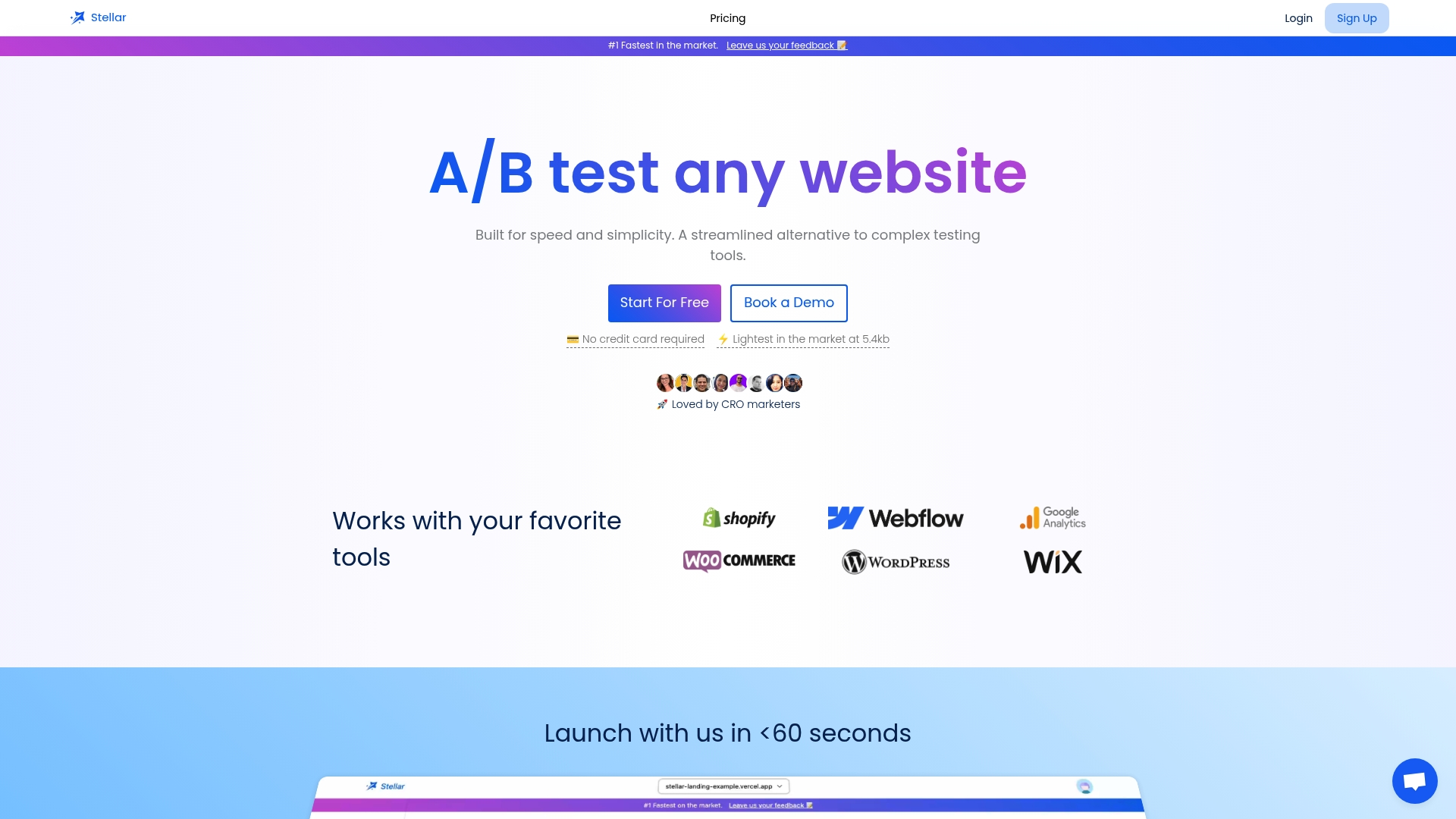
With Stellar's no-code visual editor, you can build and launch variants in minutes. Real-time analytics surface results as they come in, so you're never waiting days just to check progress. Advanced goal tracking ties your experiments directly to business outcomes, not vanity metrics. And at just 5.4KB, Stellar's script adds virtually no load to your site. There's even a free plan for businesses under 25,000 monthly tracked users. Start experimenting faster at gostellar.app.
Frequently asked questions
What is A/B testing in simple terms?
A/B testing means comparing two versions of something to see which one performs better for your users. You split your audience, show each group a different version, and let the data decide.
How long should you run an A/B test?
A solid A/B test typically needs at least 2 to 4 weeks to collect enough valid data, ensuring you capture full business cycles and reduce the risk of random variation skewing results.
What is a good sample size for A/B testing?
The right sample size depends on your baseline conversion rate and MDE. Lower baseline rates and smaller desired lifts require significantly more visitors per variant before results become trustworthy.
What should I test first for the biggest impact?
Start by testing headlines, CTAs, or forms. Prioritizing high-impact elements over cosmetic details gives you the best chance of finding meaningful conversion improvements early in your testing program.
What does statistical significance mean in A/B testing?
Statistical significance means your result is unlikely to be due to random chance. A p-value below 0.05 is the standard threshold, meaning you have at least 95% confidence the observed difference is real.
Recommended
Published: 4/26/2026