
Top A/B testing platforms for marketers: Boost your conversions
TL;DR:
- Choosing the right A/B testing platform is crucial to avoid wasting time, budget, and lost opportunities.
- The best tools for SMBs prioritize ease of use, quick setup, real-time analytics, transparent pricing, and seamless integrations.
Picking the wrong A/B testing platform costs more than money. It costs you time, momentum, and conversions you'll never get back. With dozens of tools competing for your budget, each promising faster results and smarter insights, the selection process can feel paralyzingly complex. Feature-heavy enterprise tools confuse marketers who just need simple, actionable experiments. Lightweight tools sometimes lack the analytics depth needed to prove ROI to stakeholders. This guide cuts through the noise, laying out clear evaluation criteria, a curated list of top platforms, and a straightforward comparison designed specifically for marketers and product managers at small to medium-sized businesses.
Table of Contents
- How to evaluate A/B testing platforms: Key criteria for SMBs
- Top A/B testing platforms for marketers in 2026
- Head-to-head comparison: Features and pricing overview
- Situational picks: Best platforms by SMB needs
- A smarter approach: Why tool features rarely outweigh testing discipline
- Find your ideal A/B testing platform with Stellar
- Frequently asked questions
Key Takeaways
| Point | Details |
|---|---|
| Essential selection criteria | Prioritize ease of use, integration, and transparent pricing when evaluating A/B testing platforms for your small business. |
| Best SMB platforms compared | You now have a side-by-side comparison of leading A/B testing tools to match your unique needs. |
| Strategic approach wins | Disciplined testing process matters more to results than platform features alone. |
| Tool fit trumps hype | Choose the platform that fits your current team and maturity—not just the most talked-about or feature-rich tool. |
How to evaluate A/B testing platforms: Key criteria for SMBs
Choosing an A/B testing platform is not a technology decision. It's a business decision. The wrong tool drains your team's time and adds friction to every experiment you try to run. The right one makes experimentation feel natural, fast, and repeatable.
Here are the most critical evaluation criteria you should use before committing to any platform:
- Ease of use: Can your marketing team set up and launch an experiment without filing an IT ticket? A visual editor that lets you change headlines, colors, and button text by clicking directly on your page is a must.
- Experiment setup speed: The faster you can go from hypothesis to live test, the more experiments you can run in a quarter. Look for platforms that support ready-made templates.
- Real-time reporting: Waiting days for results slows your iteration cycle. Platforms with real-time dashboards let you catch underperforming variants quickly and cut your losses early.
- Pricing transparency: Hidden fees and traffic-based overages catch growing SMBs off guard. Look for tools with published pricing tiers and free plans you can actually use.
- Customer support: When experiments go sideways (and they will), fast support saves campaigns. Check whether the platform offers live chat, documentation, or onboarding assistance.
- Integrations: A/B testing and marketing automation integration is essential for campaign-level optimization, allowing data to flow between your testing tool, CRM, and email platform without manual exports.
Integrations deserve more attention than most buyers give them. If your A/B testing tool doesn't connect with your email platform, ad manager, or CRM, you'll constantly be copy-pasting data between systems. Look for native connections with tools like HubSpot, Mailchimp, Google Analytics, and Meta Ads. Even a simple webhook or Zapier connection is better than a completely siloed tool.
Pro Tip: Start by mapping out the three or four tools your team uses daily. Then shortlist only the A/B testing platforms that integrate natively with at least two of them. This simple filter eliminates half the crowded market immediately.
Top A/B testing platforms for marketers in 2026
With evaluation criteria in hand, let's look at some of the best options for SMB marketing teams today. These platforms are ranked based on ease of use, pricing structure, integration depth, and their suitability for non-technical marketers.
1. Stellar
Stellar is purpose-built for SMB A/B testing tools use cases. Its 5.4KB script is the lightest in the market, meaning your pages load fast and your tests don't hurt site performance. Features worth noting:
- No-code visual editor that works directly on your live pages
- Dynamic keyword insertion for personalized landing pages tied to ad campaigns
- Free plan available for sites with under 25,000 monthly tracked users
- Real-time analytics dashboard with goal tracking built in
2. Optimizely
Optimizely is one of the most recognized names in the space. It shines for teams that want no-code A/B testing platforms with enterprise-level power. Its visual editor is polished and beginner-friendly. However, its pricing is better suited for teams with established testing programs and higher traffic volumes. If you're just starting out, the cost can feel steep relative to what you actually use.
- Strong audience segmentation features
- Robust third-party integrations
- Steeper learning curve for advanced features like multivariate testing
3. VWO (Visual Website Optimizer)
VWO blends a friendly interface with strong behavioral analytics. It's a favorite among CRO (conversion rate optimization) professionals who want heatmaps and session recordings alongside A/B testing. Good fit for marketers who want to understand why visitors behave as they do, not just what converts better.
- Heatmaps and session replay included
- Detailed funnel analysis
- Mid-range pricing with modular plan options
4. Google Optimize (successor tools)
Google deprecated Optimize in 2023, pushing many SMBs toward alternatives. If you relied on it, you've likely already migrated. Platforms like Stellar and VWO absorbed much of that audience because they offered comparable simplicity with better ongoing support.
5. AB Tasty
AB Tasty targets mid-market companies and positions itself around personalization alongside testing. It's a strong pick for marketers who want to move beyond basic A/B testing into behavioral targeting and AI-driven recommendations. The tradeoff is complexity and cost. Reviewing A/B testing basics before adopting a platform this advanced is a smart step for newer teams.
Marketers using A/B testing tools see campaign ROI increases of up to 30% compared to teams that don't run structured experiments. That's not a marginal gain. That's the difference between a campaign that breaks even and one that funds your next quarter's budget.
Pro Tip: Combine every A/B test with a clear ROI tracking mechanism. Assign a dollar value to your primary goal (form submission, purchase, demo request) before you launch the test. This way, the winning variant isn't just "statistically significant." It's measurably profitable.
Head-to-head comparison: Features and pricing overview
After reviewing these platforms individually, it's helpful to stack them up for a direct comparison. When evaluating your A/B testing platform comparison, pay close attention to how each tool handles different SMB-specific needs, because different platforms serve unique use cases with specialized features like visual editors and scalable plans.
| Platform | No-code editor | Real-time analytics | Free plan | Ease of use | Starting price |
|---|---|---|---|---|---|
| Stellar | Yes | Yes | Yes (up to 25K users) | ★★★★★ | Free |
| Optimizely | Yes | Yes | No | ★★★★☆ | Custom (enterprise) |
| VWO | Yes | Yes | Limited trial | ★★★★☆ | ~$199/month |
| AB Tasty | Yes | Partial | No | ★★★☆☆ | Custom |
| Convert | Yes | Yes | No | ★★★★☆ | ~$299/month |
Key takeaways from the comparison:
- Budget-first teams will find that Stellar's free tier and transparent pricing tiers are the most accessible entry point with zero compromise on core features.
- Teams wanting behavioral data alongside testing should look hard at VWO, which bundles heatmaps and session recordings with its testing suite.
- Growing teams that want to scale testing sophistication over time may find Optimizely or AB Tasty worth the investment once their monthly experiment volume justifies the cost.
- Ease of use matters most in the first 90 days. Teams that face a steep learning curve often stall before running enough tests to see meaningful results.
One dimension missing from most comparison tables is page speed impact. Heavier platform scripts can slow your site, which ironically hurts conversions before your test even starts. Stellar's 5.4KB script solves this problem directly, making it the strongest choice for speed-sensitive SMBs.
Situational picks: Best platforms by SMB needs
Once you understand your firm's specific constraints, picking a best fit becomes much easier. The mistake most marketers make is evaluating platforms against an abstract wish list instead of their actual situation. Here's a scenario-based breakdown to make the decision more concrete.
Lowest budget: Stellar. The free plan handles up to 25,000 monthly tracked users and includes the visual editor, goal tracking, and real-time analytics. There's no feature-crippling on the free tier.
Easiest setup for non-technical teams: Stellar or Optimizely. Both offer visual editors that require zero HTML or CSS knowledge. You click the element you want to change, type your new text or upload a new image, and set your goal. Done.
Most powerful reporting: VWO. If your team cares deeply about behavioral data, funnel visualization, and session-level analysis, VWO's reporting depth is hard to beat at the mid-market price point.
Best integrations: Optimizely or Convert. Both platforms maintain broad integration ecosystems with documented APIs and native connectors for most major marketing stacks.
Best for personalization alongside testing: AB Tasty. If you're ready to move into audience-level personalization and behavioral triggers, AB Tasty adds that layer on top of core A/B testing.
Reviewing A/B testing examples for CRO before you start your first experiments helps you understand which test types drive the biggest lifts in your vertical. Button color tests rarely move the needle. Headline and value proposition tests almost always do.
Expert tip: Match your tool's complexity to your team's current experimentation maturity. A bootstrapped team running their first five tests in a year needs simplicity and speed, not multivariate testing engines. Scale up your tool only when your process is already working at the lower level.
Knowing when to use advanced features is equally important. A/B testing best practices consistently show that marketers who run fewer, better-designed tests outperform those running many poorly structured ones. Focus on one clear hypothesis per test. Define your success metric before you launch. And never call a winner before you've reached statistical significance.
A smarter approach: Why tool features rarely outweigh testing discipline
Here's something the software vendors won't tell you: the most powerful A/B testing platform in the world won't save a weak testing program.
We see this pattern repeatedly with SMB marketers. They invest months evaluating platforms, negotiate pricing, onboard the team, and then run three tests in six months. Two of them were button color tests with unclear hypotheses. The results are flat. They blame the tool and start evaluating again.
The uncomfortable truth is that the return on A/B testing comes almost entirely from your experimentation discipline, not from your platform's feature set. A clear hypothesis, a well-defined primary metric, and a commitment to running tests to statistical completion will outperform a chaotic testing program running on the fanciest enterprise platform every single time.
This is especially critical for SMBs with limited traffic. Low-traffic sites need to be especially disciplined about test design because reaching statistical significance takes longer. Running underpowered tests and calling winners early is arguably more dangerous than not testing at all. It leads to decisions based on noise rather than signal.
The smarter investment is in validating marketing ideas for A/B testing before you even open the testing platform. The best marketers we've seen spend as much time crafting and validating their hypothesis as they do setting up the actual experiment. They use customer interviews, heatmap data, and funnel analytics to identify where the friction is before they start guessing at solutions.
Start with the simplest platform that removes friction from your workflow. Get 10 clean tests under your belt. Build a results log. Then, and only then, evaluate whether you need more sophisticated features. Most SMB teams discover they don't.
Find your ideal A/B testing platform with Stellar
As you consider your next test, here's one solution tailored for marketers like you.
Stellar was built specifically for marketers and product managers at small to medium-sized businesses who want fast, reliable A/B testing without the complexity that slows teams down. With a no-code visual editor, real-time analytics, dynamic keyword insertion for personalized landing pages, and a free plan that genuinely delivers results, Stellar removes every barrier between your hypothesis and your first data point.
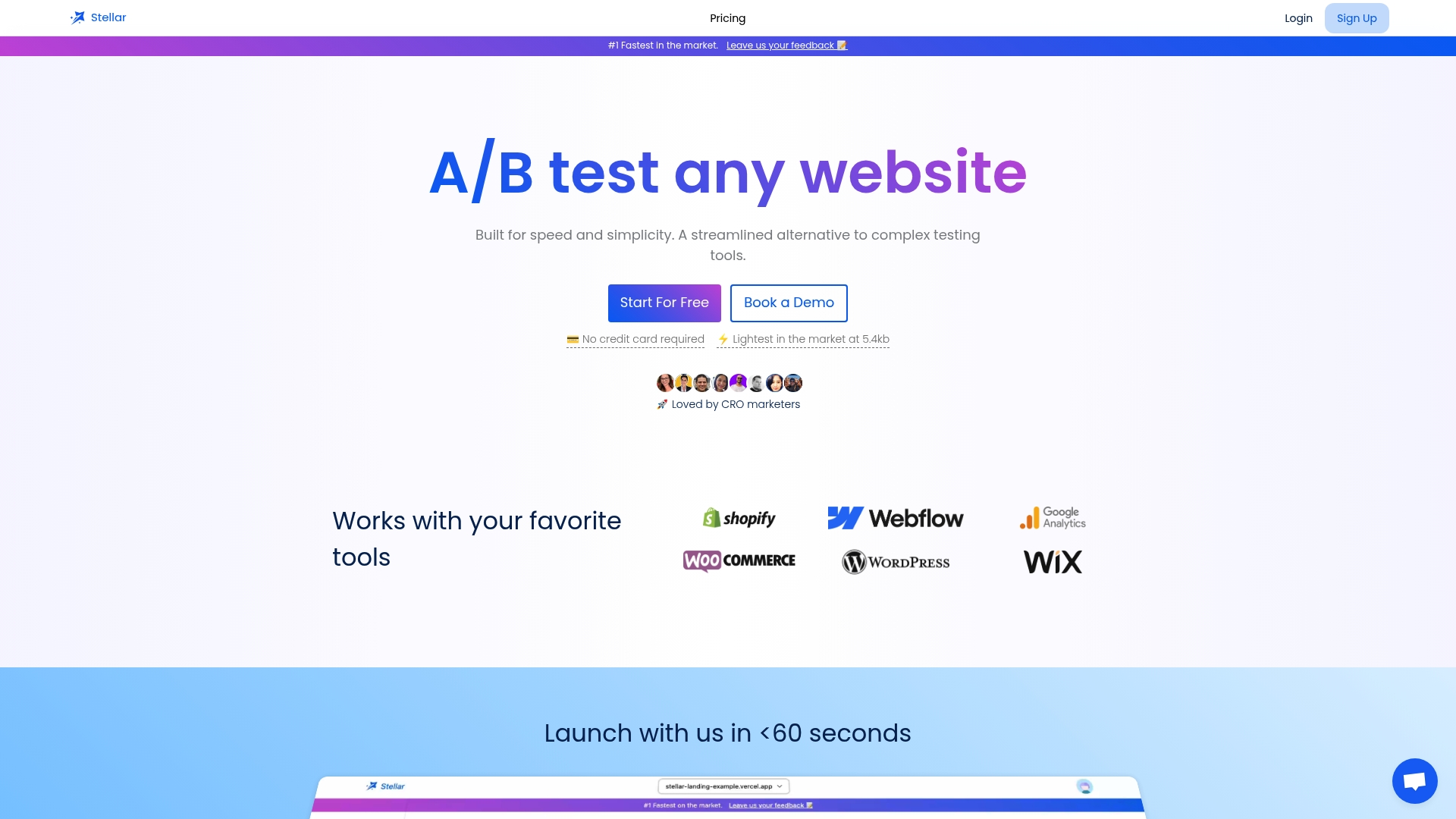
Whether you're running your first test or looking to replace a tool that's grown too complex or too expensive, Stellar gives you a clean starting point. The 5.4KB script keeps your site fast. The transparent pricing keeps your budget predictable. And the built-in goal tracking keeps your stakeholders informed. Try Stellar free and see how quickly your first experiment goes live.
Frequently asked questions
What is an A/B testing platform?
An A/B testing platform lets you compare two or more versions of digital experiences so you can choose the one that gets better results. These tools are used to improve conversion rates by systematically comparing content variations against a defined success metric.
How do I integrate A/B testing tools with my marketing automation?
Most leading A/B testing platforms offer plug-ins or native integrations for popular automation tools, making streamlined workflows possible. Integration between A/B testing and marketing automation is essential for campaign optimization because it lets your test results directly inform your email sequences, ad targeting, and lead nurturing flows.
Can I use A/B testing platforms without coding?
Yes, several modern tools offer no-code interfaces perfect for marketers and product teams without technical backgrounds. Platforms designed for no-code experimentation setup let you change headlines, images, and CTAs directly on your live pages without touching a single line of code.
Are there free or low-cost A/B testing platforms for small businesses?
Many platforms provide free tiers with core features or transparent pricing for budget-conscious SMBs. Stellar, for example, offers a fully functional free plan for businesses with under 25,000 monthly tracked users.
What's the fastest way to start getting A/B test results?
Use ready-made templates, start with high-traffic pages, and integrate your analytics for quick insights within days or weeks. Applying proven experimentation frameworks from documented CRO examples accelerates the time from test launch to statistically valid results.
Recommended
Published: 5/6/2026