
A/B Testing vs Multivariate Testing: 2026 Guide
TL;DR:
- A/B testing isolates a single variable to determine its direct impact with clear attribution, requiring moderate traffic. Multivariate testing evaluates multiple elements simultaneously to find optimal combinations but demands significantly higher traffic and longer durations. Most teams should prioritize A/B testing for foundational changes and reserve multivariate testing for high-traffic, well-optimized pages to avoid misleading results.
A/B testing is defined as a controlled experiment comparing two webpage versions that differ by a single element, while multivariate testing (MVT) evaluates multiple elements and their combinations simultaneously to find the highest-performing mix. Both methods are foundational to conversion rate optimization, but they serve different purposes, demand different traffic volumes, and produce different types of insight. Platforms like Optimizely, HubSpot, and UserTesting each support both approaches, yet most marketers apply them interchangeably and pay for it with wasted traffic and inconclusive data. This guide gives you a clear decision framework for ab testing multivariate testing so you pick the right method every time.
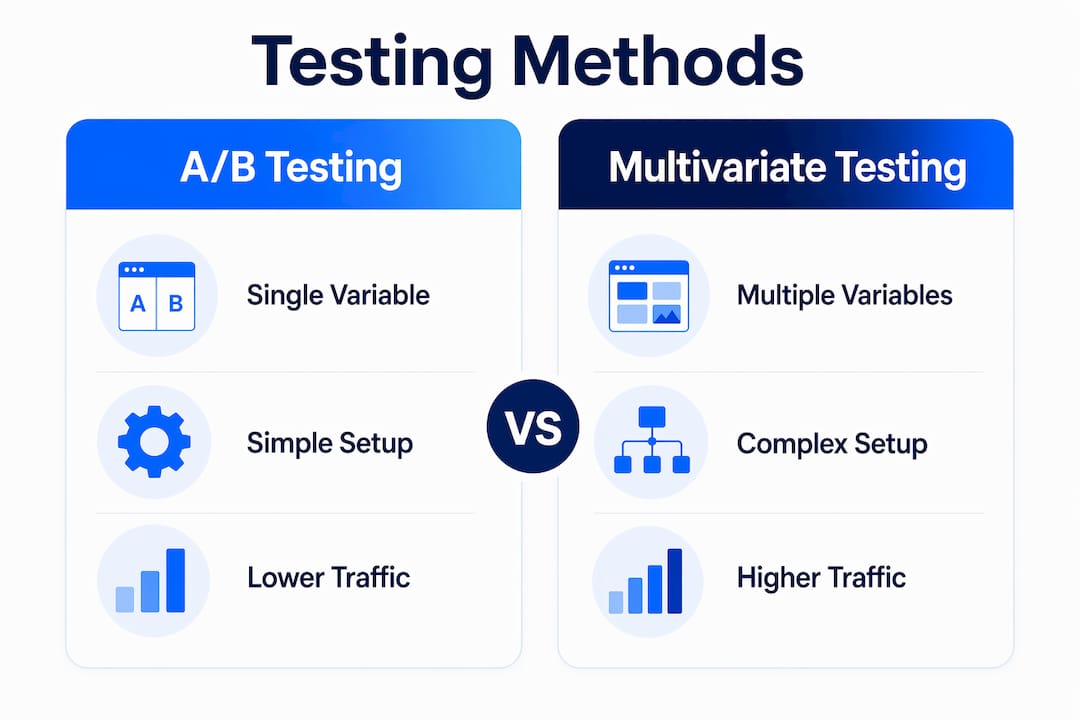
What is the difference between A/B and multivariate testing?
A/B testing isolates one variable. You change a headline, a button color, or a hero image, then split traffic between the original and the variant. The result is unambiguous: one version wins, and you know exactly why. Multivariate testing works differently. You define multiple elements with multiple variants, and the test engine serves every possible combination to your audience simultaneously.
The practical difference shows up in complexity and attribution. A/B testing isolates one change for clear attribution, while MVT produces a winning combination without revealing which individual element drove the improvement. That distinction matters when you need to apply learnings across other pages or campaigns.
| Factor | A/B testing | Multivariate testing |
|---|---|---|
| Variables tested | 1 | 2 or more simultaneously |
| Traffic required | Moderate | Very high |
| Result clarity | High (single variable impact) | Lower (combination winner only) |
| Best use case | Major layout or copy changes | Fine-tuning established pages |
| Time to significance | Weeks | Months at lower traffic |
The split testing versus multivariate distinction also affects how you interpret results. A/B gives you a clean causal story. MVT gives you a performance winner that can sometimes function like a black box, showing you what works without fully explaining why.
Pro Tip: Before choosing MVT, count your combinations. Three elements with two variants each produce eight combinations. Four elements with two variants each produce sixteen. Each combination needs its own statistically significant sample.
When should you use A/B testing versus multivariate testing?
Traffic volume is the single most reliable decision criterion. Sites under 50,000 monthly visitors should default to A/B testing for validating significant layout changes, while MVT is reserved for high-traffic pages where fine-tuning multiple validated elements is the goal. This is not a preference. It is a math constraint.
A/B testing fits these situations well:
- You are testing a fundamentally different page layout or value proposition
- Your site receives fewer than 50,000 monthly visitors
- You need results within a reasonable timeframe (two to four weeks)
- You want clear, transferable learnings for other pages
- You are early in your optimization program and still validating big hypotheses
Multivariate testing fits these situations instead:
- Your page already converts well and you want to squeeze out incremental gains
- You have a high-traffic page with hundreds of thousands of monthly sessions
- You suspect two or more elements interact with each other in ways sequential A/B tests cannot detect
- You have a stable design and want to optimize components, not rethink the layout
Mature optimization programs often use a hybrid strategy: begin with A/B testing for major changes, then follow with multivariate testing to optimize individual components on the winning layout. This sequence prevents you from running expensive MVT experiments on a page that still has fundamental conversion problems.
The Google Ads A/B testing community has long applied this same logic to ad creative. Validate the message with a split test first, then optimize individual elements once the core concept is proven.

How do traffic volume and sample size affect test reliability?
Traffic requirements for MVT grow exponentially, not linearly, with each additional variable. This is the most misunderstood aspect of multivariate split testing, and it is where most programs go wrong.
The numbers are stark. A 12-cell multivariate test requires 12 times the traffic of a two-cell A/B test to reach statistical significance. For a 2% conversion rate targeting a 10% relative lift, a standard A/B test needs roughly 850,000 sessions. That same scenario in a 12-cell MVT requires approximately 10 million sessions. That is not a rounding difference. It is the difference between a three-week test and a test that runs for two years.
| Test type | Cells | Sessions needed (2% CVR, 10% lift) |
|---|---|---|
| A/B test | 2 | ~850,000 |
| 4-cell MVT | 4 | ~1,700,000 |
| 8-cell MVT | 8 | ~6,800,000 |
| 12-cell MVT | 12 | ~10,000,000 |
Adding a third or fourth variable can push sample size needs from thousands to hundreds of thousands of sessions, making higher-variable MVT impractical without massive traffic. The consequence of ignoring this math is not just a longer test. It is a test that ends with a false positive or an inconclusive result that wastes the traffic you spent weeks collecting.
Pro Tip: Before launching any MVT, calculate your combinations, then divide your monthly traffic by that number. If each cell gets fewer than 1,000 sessions per week, you do not have enough traffic for a reliable result. Run an A/B test instead.
A reliable A/B test also requires discipline on duration. Running for at least two full weeks captures weekly behavioral cycles and avoids premature false positives. Tests that hit significance in three days almost always regress. Two weeks at 95% confidence is the minimum standard worth trusting.
What are the practical benefits and limitations of each method?
A/B testing and MVT each have genuine strengths, but they also have hard limits that no amount of tooling can overcome.
A/B testing advantages:
- Fast results with lower traffic requirements
- Clear causal attribution: you know exactly which change drove the lift
- Easy to communicate findings to stakeholders
- Works at almost any traffic level above a few thousand monthly sessions
- Ideal for testing bold, high-impact changes like new headlines, pricing structures, or page layouts
Multivariate testing advantages:
- Identifies interaction effects between page elements that sequential A/B tests cannot detect, such as a headline that only performs well paired with a specific image
- Tests multiple hypotheses in a single experiment, saving calendar time on high-traffic pages
- Produces a fully optimized combination rather than a series of incremental wins
A/B testing limitations:
- Cannot detect interaction effects between elements
- Running multiple sequential A/B tests on the same page can produce compounding errors if elements interact
MVT limitations:
- MVT can produce black box results that lack clarity about which individual elements drive success, complicating how you apply findings elsewhere
- Requires enterprise-scale traffic to produce valid results
- Longer test duration increases the risk of external factors (seasonality, algorithm changes) contaminating results
The practical implication is that A/B testing is the default choice for most marketers unless traffic is very high. MVT is a specialist tool, not a universal upgrade.
How to combine A/B and multivariate testing in a staged strategy
A staged approach extracts the most value from both methods without burning traffic on tests that cannot reach significance. Here is how to structure it:
- Audit your page. Identify the single biggest conversion barrier. Is it the headline, the offer, the layout, or the call to action? Start there.
- Run an A/B test on the biggest lever. Test a fundamentally different version of that element. Do not test button color when your value proposition is unclear.
- Validate the winner. Run the test for at least two weeks at 95% confidence before calling a result. Implement the winning variant.
- Identify secondary elements. Once the major layout is validated, list two or three supporting elements (subheadline, image, social proof placement) that could be optimized together.
- Run MVT only if traffic supports it. Calculate your combinations and confirm each cell gets sufficient weekly sessions. If not, run sequential A/B tests on each element instead.
- Never run both tests on the same page simultaneously. Cross-contamination from overlapping tests invalidates results. Run sequentially or isolate tests to different pages.
For deeper guidance on structuring individual experiments, the A/B testing best practices framework from Gostellar covers test sequencing, hypothesis writing, and result interpretation in detail.
Pro Tip: Pair your quantitative test results with qualitative feedback. UserTesting recommends combining quantitative results with user interviews and session recordings to understand why a variation performed better, not just which one won.
Key takeaways
A/B testing is the right default for most marketers, and MVT is a specialist tool that only delivers value when traffic volume and test design justify its complexity.
| Point | Details |
|---|---|
| Method selection by traffic | Use A/B testing under 50,000 monthly visitors; reserve MVT for high-traffic, established pages. |
| Traffic math for MVT | A 12-cell MVT needs roughly 10 million sessions for a 2% conversion rate at 10% lift. |
| Attribution clarity | A/B testing identifies which single change caused a lift; MVT reveals a winning combination only. |
| Staged hybrid strategy | Validate major layout changes with A/B first, then use MVT to fine-tune components. |
| Qualitative pairing | Combine test results with session recordings or user interviews to understand the why behind results. |
Why I think most teams misuse multivariate testing
The most common mistake I see is treating MVT as a sign of testing maturity. Teams graduate from A/B testing to multivariate testing the way they might graduate from a starter tool to an enterprise platform, as if complexity equals sophistication. It does not.
MVT is not simply a more advanced A/B test. It is a specialized instrument that only functions correctly under specific conditions, primarily very high traffic and a stable, already-optimized page. Using it on a page that still has fundamental conversion problems is like calibrating a precision instrument before you have built the machine it is supposed to measure.
The traffic math alone disqualifies MVT for the majority of marketing teams. Most small to mid-size businesses do not have the session volume to run a six-cell MVT to significance within a reasonable timeframe. Running it anyway produces either false positives or inconclusive results, both of which are worse than not testing at all because they create false confidence.
My recommendation: start with A/B testing fundamentals and build a track record of clean, well-structured experiments. Add MVT to your program only when you have the traffic to support it and a specific hypothesis about element interactions that sequential A/B tests cannot answer. And always pair your quantitative results with qualitative user feedback. The numbers tell you what works. Your users tell you why.
— Juan
Run smarter tests with Gostellar

Gostellar is built for marketers who want fast, reliable test results without needing a developer on call. The platform's no-code visual editor lets you set up A/B tests in minutes, while real-time analytics surface winning variants as data comes in. For teams ready to move into multivariate territory, Gostellar's A/B and multivariate testing tools give you the traffic analysis and combination tracking you need to run experiments that actually reach significance. Start free for sites under 25,000 monthly tracked users and scale as your program grows.
FAQ
What is the main difference between A/B and multivariate testing?
A/B testing changes one element and compares two versions to identify a clear winner with direct causal attribution. Multivariate testing changes multiple elements simultaneously to find the best-performing combination, but does not isolate which individual element drove the result.
How much traffic do you need for multivariate testing?
A 12-cell MVT requires approximately 10 million sessions for a 2% conversion rate targeting a 10% relative lift, compared to roughly 850,000 sessions for a standard A/B test. Sites under 50,000 monthly visitors should use A/B testing instead.
Can you run A/B and multivariate tests at the same time?
No. Running both tests on the same page simultaneously causes cross-contamination that invalidates results. Tests must run sequentially or be isolated to different pages to maintain data integrity.
When does multivariate testing make sense?
MVT makes sense when you have a high-traffic page that already converts well and you want to optimize multiple supporting elements together. It is particularly useful for detecting interaction effects between elements that sequential A/B tests cannot reveal.
How long should an A/B test run before you call a result?
A reliable A/B test should run for at least two full weeks at 95% statistical confidence to capture weekly behavioral cycles and avoid false positives from early significance spikes.
Recommended
Published: 6/9/2026