
The Art of Copy Testing: Boosting Conversions Fast
Juggling countless campaign variations can leave even the savviest marketer second-guessing which message will actually drive results. For tech teams aiming to improve conversion rates without a tangled setup, knowing how to efficiently test and refine copy is more than a nice-to-have. This guide unpacks the essentials of copy testing methods, showing you how to make smarter, faster decisions that speak directly to your audience’s needs.
Table of Contents
- Defining Copy Testing For Modern Marketers
- Different Approaches To Copy Testing
- Key Metrics And What They Reveal
- Integrating Copy Testing Into A/B Strategies
- Common Pitfalls And How To Avoid Them
Key Takeaways
| Point | Details |
|---|---|
| Understanding Copy Testing | Copy testing is essential for marketers to evaluate the effectiveness of advertisements and messaging via consumer insights and analytical methods. |
| Methodological Approaches | Various techniques like A/B testing and multivariate testing offer different insights into marketing communications, enabling better optimization. |
| Key Metrics | Tracking performance metrics such as conversion rates and click-through rates provides actionable data for refining marketing strategies. |
| Continuous Improvement | A systematic approach to testing that encourages iterative refinement helps marketers develop more effective communication strategies over time. |
Defining Copy Testing for Modern Marketers
Copy testing represents a strategic approach to evaluating marketing communications before they reach target audiences. At its core, this research method allows marketers to systematically assess how advertisements and messaging will likely perform by analyzing consumer responses and potential engagement. Comprehensive marketing research helps teams understand how different variations of copy might resonate with their intended audience.
The process involves collecting quantitative and qualitative data about how consumers perceive and interact with marketing messages. Modern copy testing goes beyond simple gut reactions, utilizing sophisticated statistical methods to determine which ad variations are most likely to drive desired outcomes. Marketers can test multiple elements like headline wording, emotional tone, call-to-action phrasing, and visual design to optimize communication effectiveness.
Successful copy testing integrates deep consumer behavior insights with data-driven methodologies. Marketing communication strategies must continuously adapt, using advanced testing techniques to refine messaging. This approach allows brands to create more targeted, resonant communications that speak directly to audience needs and preferences.
Pro tip: Start with small, focused copy tests that target specific elements of your marketing message to gradually build a comprehensive understanding of what truly connects with your audience.
Different Approaches to Copy Testing
Marketers have several sophisticated approaches to copy testing, each designed to provide unique insights into communication effectiveness. A/B testing remains the most straightforward method, allowing teams to compare two distinct versions of a single marketing element to determine which performs better. This approach works exceptionally well for testing specific components like headlines, call-to-action buttons, or email subject lines.
Multivariate testing offers a more complex and comprehensive strategy for evaluating marketing communications. Unlike A/B testing's binary comparison, this method simultaneously analyzes multiple elements to understand their combined impact on user behavior. Marketers can explore intricate interactions between different design and copy components, uncovering nuanced insights that simple split tests might miss. Research in digital content evaluation demonstrates how these advanced testing techniques enable precise, data-driven optimization of marketing materials.
Beyond traditional testing methods, modern copy testing incorporates advanced techniques like sentiment analysis, eye-tracking studies, and real-time user feedback mechanisms. These approaches provide deeper psychological insights into how audiences perceive and interact with marketing messages. By combining quantitative metrics with qualitative research, marketers can develop more sophisticated and targeted communication strategies that resonate more effectively with their intended audience.
Pro tip: Implement a systematic testing approach that starts with simple A/B tests and progressively moves to more complex multivariate experiments to build a comprehensive understanding of your marketing communications.
Below is a comparison of common copy testing methods and their main benefits for marketers:
| Method | Main Benefit | Typical Use Case |
|---|---|---|
| A/B Testing | Quick performance insights | Comparing two versions of a headline |
| Multivariate Testing | Detailed interaction analysis | Testing combinations of visuals and copy |
| Sentiment Analysis | Gauging audience emotions | Assessing tone of brand messages |
| Eye-Tracking | Visual attention mapping | Optimizing layout and creatives |
| Real-Time Feedback | Immediate user reactions | Refining live website or ad content |
Key Metrics and What They Reveal
Copy testing relies on a comprehensive set of performance metrics that provide deep insights into marketing communication effectiveness. Advanced analytics help marketers understand user behavior by tracking critical indicators like conversion rates, bounce rates, and engagement levels. These metrics serve as the foundation for evaluating how different messaging variations impact audience response and ultimate business objectives.

Conversion rates stand as the most critical metric, directly measuring the percentage of users who complete a desired action such as signing up, purchasing, or downloading. Statistical measurements in marketing analytics reveal that these rates are not just numbers, but powerful indicators of how well marketing messages resonate with target audiences. Marketers can dissect these metrics to understand which copy variations trigger more meaningful user interactions and drive tangible business results.
Beyond basic conversion tracking, sophisticated copy testing examines nuanced metrics like time spent on page, click-through rates, and user interaction patterns. These deeper analytics provide context about how audiences emotionally and intellectually engage with different marketing messages. By analyzing these comprehensive metrics, marketers can develop increasingly precise communication strategies that not only attract attention but also compel users to take desired actions.
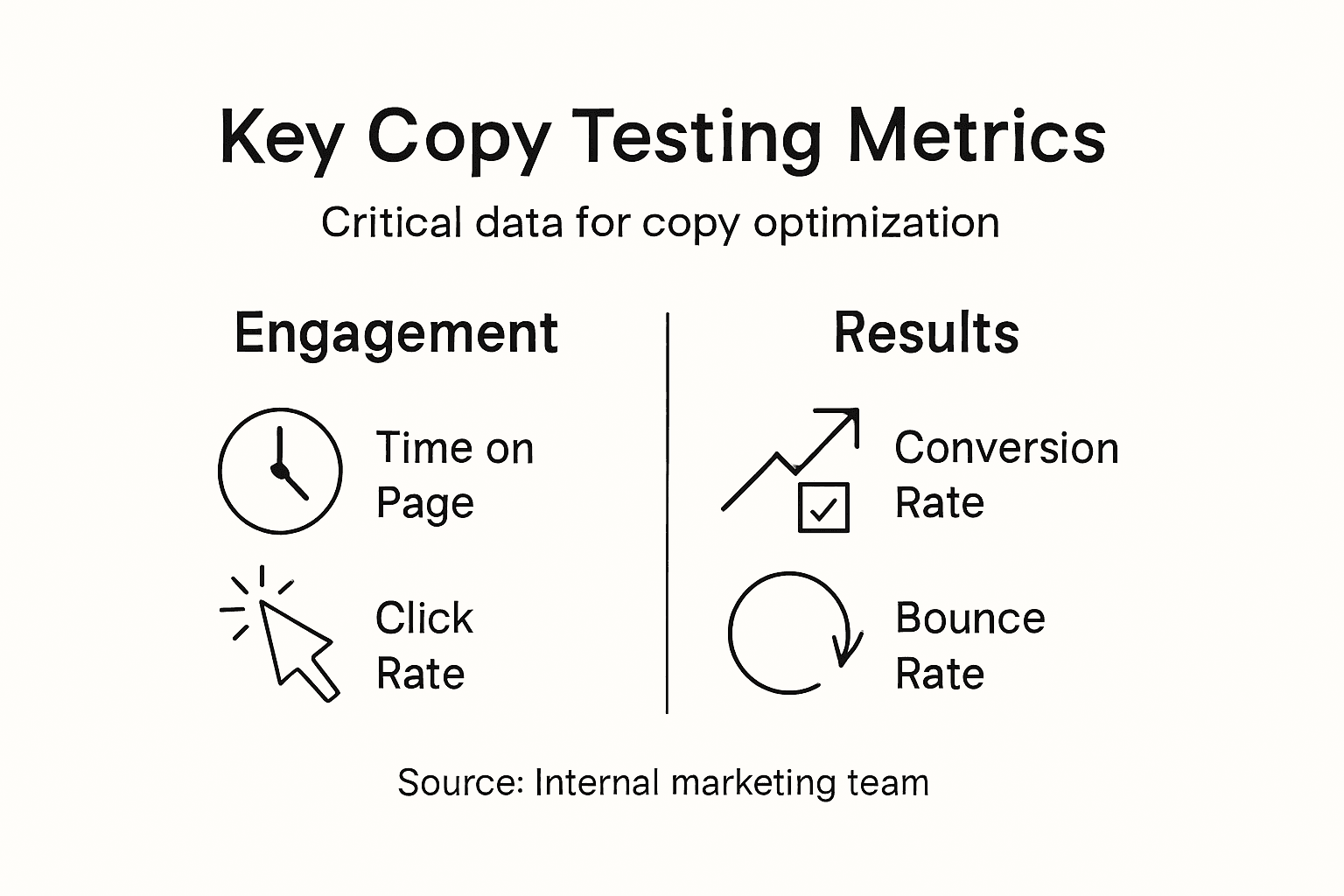
Pro tip: Create a standardized metrics dashboard that tracks at least five key performance indicators across your copy testing experiments to build a holistic view of your marketing communication effectiveness.
This table summarizes key copy testing metrics and what each reveals about audience behavior:
| Metric | What It Reveals | Strategic Implication |
|---|---|---|
| Conversion Rate | Effectiveness of messaging | Identifies persuasive copy elements |
| Bounce Rate | Initial audience interest | Highlights issues with relevance |
| Time on Page | Engagement depth | Suggests clarity or appeal of content |
| Click-Through Rate | Action prompted by copy | Indicates strength of CTAs |
| Interaction Heatmap | User navigation pattern | Informs design and layout decisions |
Integrating Copy Testing Into A/B Strategies
A/B testing provides marketers with a structured framework for systematically evaluating marketing communications. A/B testing framework enables strategic content comparison by creating multiple content variations and directing segmented audience groups to measure performance differences. This approach allows teams to implement improvements with minimal risk while maintaining a data-driven decision-making process.
Successful integration requires careful experimental design and precise audience segmentation. Quantitative user research methods help marketers randomly assign users to different content versions, ensuring statistically significant results. Marketers must establish clear hypotheses, define specific metrics for evaluation, and create variations that test meaningful differences in messaging, design, or user experience.
The most effective copy testing strategies involve continuous iteration and incremental refinement. This means developing a systematic approach where each test builds upon previous insights, creating a cumulative understanding of what resonates with target audiences. Successful marketers treat A/B testing as an ongoing optimization process, constantly exploring new variations and challenging existing assumptions about communication effectiveness.
Pro tip: Create a structured testing calendar that schedules regular A/B tests, allocating specific time and resources to systematically explore and validate different copy variations.
Common Pitfalls and How to Avoid Them
Copy testing presents numerous potential challenges that can derail marketing insights if not carefully managed. Common A/B testing pitfalls emerge from experimental design flaws such as insufficient sample sizes, misinterpreting statistical significance, and failing to account for external contextual factors. Marketers must develop a rigorous approach that systematically addresses these potential weaknesses to ensure reliable and actionable results.
One of the most critical mistakes involves testing multiple variables simultaneously, which can compromise the clarity and reliability of experimental outcomes. Proper A/B testing frameworks require precise variable isolation to understand exactly which elements drive performance changes. Successful marketers segment their audience carefully, establish clear hypotheses, and create controlled variations that allow for precise measurement of specific communication elements.
Qualitative and quantitative analysis must work in tandem to provide comprehensive insights. This means going beyond surface-level metrics to understand the underlying psychological and behavioral drivers of user engagement. Marketers should combine statistical rigor with deep contextual understanding, constantly challenging assumptions and remaining open to unexpected insights that emerge from systematic testing.
Pro tip: Implement a standardized pre-test checklist that validates experimental design, ensuring you control for variables, establish clear success metrics, and maintain statistical integrity before launching any copy testing initiative.
Elevate Your Copy Testing with Faster, Smarter A/B Solutions
The article "The Art of Copy Testing: Boosting Conversions Fast" highlights the challenge marketers face in designing effective, data-driven experiments that deliver clear insights without compromising website performance. Pain points like managing complex testing variables, needing real-time analytics, and continuously refining messaging require tools that are both powerful and easy to use. Embracing concepts like A/B testing frameworks, goal tracking, and audience segmentation can transform these challenges into opportunities to boost conversions quickly.
Stellar offers a seamless solution tailored to these exact needs. With its lightweight 5.4KB script, you will experience minimal impact on site speed while running multiple A/B tests. The no-code visual editor empowers marketers and growth hackers to launch and iterate experiments faster than ever before. Advanced goal tracking and real-time analytics provide actionable insights that help you understand which copy elements truly engage your audience. Explore how you can optimize your marketing communication strategies without technical barriers at Stellar.
Ready to transform your copy testing process and see conversion rates climb? Discover the future of marketing experimentation with Stellar’s A/B Testing Tool.

Take control of your marketing communications today and start making data-driven decisions that deliver results. Visit https://gostellar.app now and begin your journey toward faster, smarter copy testing and growth.
Frequently Asked Questions
What is copy testing?
Copy testing is a strategic approach used by marketers to evaluate how advertisements and messaging will likely perform by analyzing consumer responses and potential engagement before they are launched.
How does A/B testing differ from multivariate testing?
A/B testing involves comparing two distinct versions of a single marketing element to see which performs better, while multivariate testing analyzes multiple elements simultaneously to understand their combined impact on user behavior.
What key metrics should I track in copy testing?
Key metrics to track include conversion rates, bounce rates, time on page, click-through rates, and interaction heatmaps, all of which provide insights into how users engage with your marketing messages.
How can I avoid common pitfalls in copy testing?
To avoid pitfalls in copy testing, ensure you design experiments with isolated variables, maintain adequate sample sizes, and continuously validate your hypothesis and success metrics before launching tests.
Recommended
Published: 1/19/2026