
Avoiding False Positives in A/B Tests: Smarter Decisions
Nearly half of American marketers report making decisions based on faulty test results, a statistic that highlights just how easy it is to fall into common A/B testing traps. In a digital world shaped by endless experiments, overlooked errors like false positives or unchecked assumptions can lead to wasted budgets and missed growth opportunities. This guide breaks down the core misconceptions and risks around testing so you can uncover the real insights your data provides with confidence.
Table of Contents
- Core Definition And Misconceptions
- Risks From Peeking And Early Stopping
- Managing Multiple Comparisons Correctly
- Ensuring Proper Sample Size And Power
- Validating Statistical Assumptions In Practice
Key Takeaways
| Point | Details |
|---|---|
| Understanding False Positives | A/B testing requires awareness of false positives that mislead marketing decisions, stemming from small sample sizes and misinterpretation of significance. |
| Risks of Peeking and Early Stopping | Continuously monitoring results can inflate false positive rates; pre-established stopping rules are essential to maintain test integrity. |
| Managing Multiple Comparisons | Using appropriate statistical corrections is necessary to control for increased false positive rates when conducting multiple tests. |
| Sample Size Determination | Properly calculating sample size is crucial for reliable results, balancing statistical significance, effect size, and user variability. |
Core definition and misconceptions
In A/B testing, understanding false positives is fundamental to making reliable marketing decisions. A false positive occurs when a test incorrectly suggests a statistically significant result that does not actually reflect a genuine improvement. Type I errors represent the incorrect rejection of a true null hypothesis, which means marketers might mistakenly believe a change produces better outcomes when it really doesn't.
The probability of generating false positives is higher than many professionals realize. Research evaluating A/B graph data points reveals that nonrandom data can produce false positive results with alarming frequency. This means your conversion rate optimization efforts could be leading you down an incorrect path without proper statistical rigor. Common misconceptions about false positives include:
- Assuming small sample sizes provide reliable insights
- Believing statistical significance automatically means causation
- Failing to account for random variation in test data
- Overinterpreting marginal results as meaningful changes
To combat false positives, marketers must implement robust statistical methods. This includes setting appropriate significance levels, using adequate sample sizes, and understanding the nuanced difference between statistical significance and practical significance. Rigorous testing protocols help minimize the risk of drawing incorrect conclusions that could waste resources or misguide strategic decision making.
Risks from peeking and early stopping
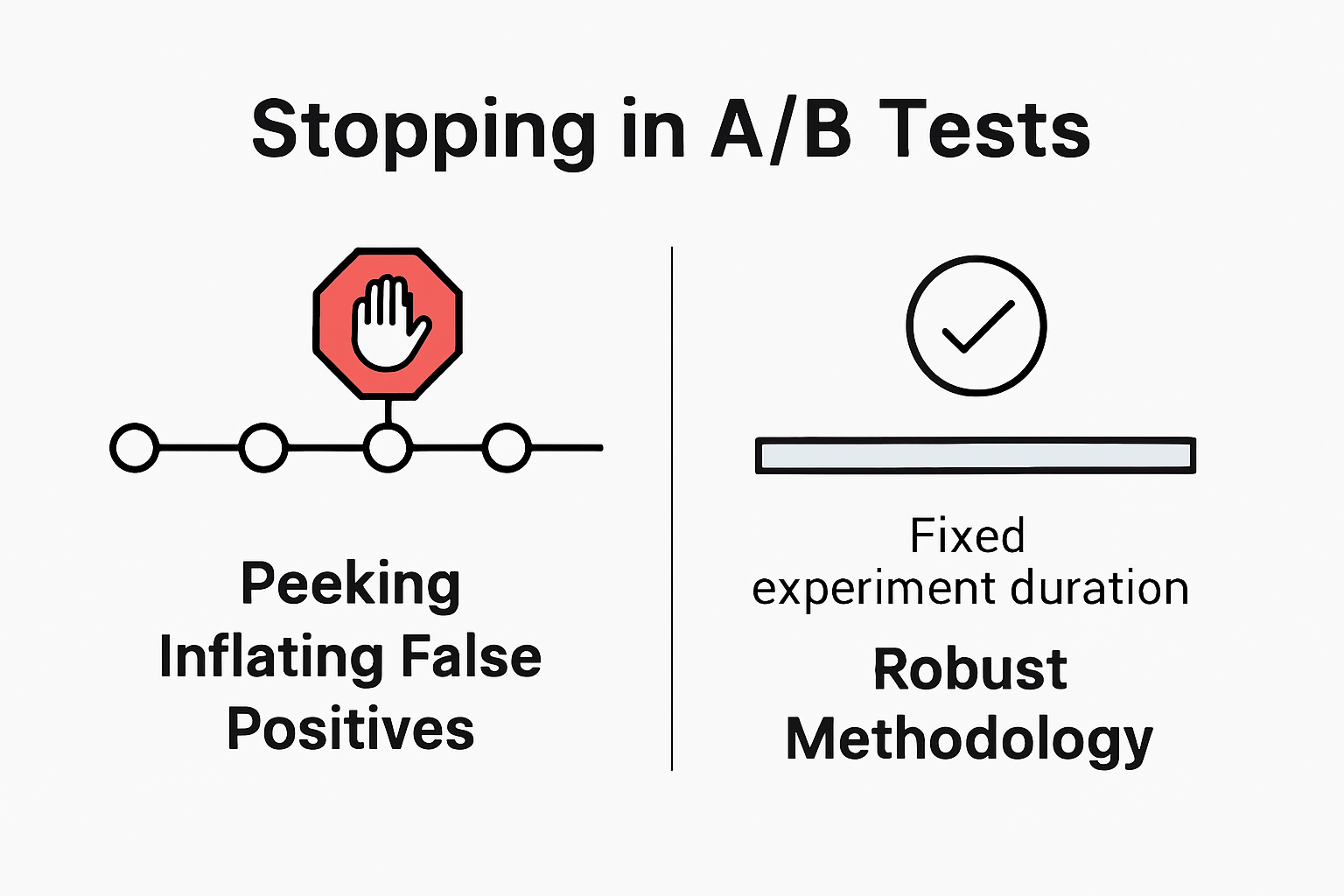
Peeking and early stopping represent significant statistical pitfalls that can dramatically undermine the integrity of A/B testing experiments. Randomized experiments are vulnerable when researchers prematurely examine results and terminate tests based on initial statistical significance, which can lead to uncontrolled type-1 error rates and misleading conclusions.

The core problem with peeking lies in its ability to inflate false positive rates. When marketers continuously monitor test results and stop experiments as soon as they appear statistically significant, they artificially increase the chance of drawing incorrect conclusions. This behavior essentially "cheats" the statistical model by multiplying the opportunities for detecting seemingly meaningful differences that are actually just random variations.
Existing experimental methods struggle to account for treatment effect heterogeneity when determining early stopping criteria, which means different population segments might be improperly evaluated. The risks associated with premature test termination include:
- Incorrectly rejecting valid null hypotheses
- Overstating the magnitude of potential improvements
- Generating misleading performance metrics
- Wasting marketing resources on statistically unsound decisions
To mitigate these risks, marketers must establish predefined stopping rules, use robust statistical techniques like sequential testing, and commit to complete experimental protocols before launching A/B tests. Implementing strict guidelines that prevent arbitrary test interruptions can help maintain the scientific rigor necessary for making truly data-driven decisions.
Managing multiple comparisons correctly
Managing multiple comparisons in A/B testing requires sophisticated statistical techniques to prevent inflated false positive rates. Principled sequential analysis procedures allow researchers to analyze data dynamically while maintaining control over type I error rates, effectively addressing the challenges of repeated statistical testing.
The fundamental problem with multiple comparisons is that each additional test increases the probability of detecting a statistically significant result purely by chance. This statistical phenomenon, known as multiple comparisons bias, means that as you run more variations or examine more metrics, the likelihood of encountering false positives rises exponentially. Marketers must implement strategic approaches to mitigate this risk, such as:
- Applying statistical corrections like Bonferroni or Holm-Bonferroni methods
- Predetermining primary and secondary metrics before testing
- Using hierarchical testing frameworks
- Implementing familywise error rate (FWER) controls
Advanced Bayesian decision frameworks offer sophisticated approaches for managing multi-variant experiments, addressing challenges like p-value peeking and over-reliance on proxy metrics. These methods provide more nuanced ways of evaluating experimental results, allowing marketers to make more robust statistical inferences while minimizing the risk of drawing incorrect conclusions from complex testing scenarios.
Ensuring proper sample size and power
Determining an appropriate sample size is critical for generating reliable A/B testing results. A/B testing relies on robust statistical methods to guide product development decisions, but treatment effect estimates can be inherently noisy due to short testing horizons and slowly accumulating metrics, making early conclusions potentially misleading.
Statistical power represents the probability of detecting a true effect when one exists, and it directly correlates with sample size. Insufficient sample sizes dramatically increase the risk of type II errors, where meaningful differences go undetected. Marketers must carefully balance several key factors when calculating sample size:
- Desired statistical significance level (typically 95%)
- Minimum detectable effect size
- Expected baseline conversion rate
- Acceptable statistical power (usually 80% or higher)
- Potential variability in user behavior
A comprehensive approach to sample size calculation involves understanding the potential impact on long-tail metrics and comprehensive testing strategies. Practical recommendations include running tests long enough to capture representative user behavior, avoiding premature conclusions, and maintaining rigorous statistical standards that prevent both false positives and false negatives. By meticulously planning sample sizes, marketers can ensure their A/B tests provide meaningful, actionable insights that drive genuine business improvements.
Validating statistical assumptions in practice
Validating statistical assumptions is crucial for ensuring the reliability and accuracy of A/B testing results. Researchers have developed advanced confidence sequences that provide robust type-1 error guarantees across sequential experiments, reducing reliance on rigid statistical assumptions, enabling more flexible and dynamic analytical approaches.
The process of assumption validation involves carefully examining multiple critical dimensions of experimental design. Statistical assumptions encompass various parameters, including normality of data distribution, independence of observations, homogeneity of variance, and appropriate sample randomization. Marketers must critically evaluate these assumptions through systematic diagnostic techniques:
- Conducting normality tests using quantile-quantile plots
- Checking for independence using autocorrelation analysis
- Examining variance homogeneity via residual diagnostic plots
- Verifying randomization through balance tests across experimental groups
- Assessing potential selection bias or confounding variables
Emerging causal machine learning techniques now offer sophisticated methods for addressing heterogeneous experimental conditions and early stopping challenges, providing more nuanced approaches to statistical validation. By implementing rigorous assumption-checking protocols, data scientists and marketers can increase confidence in their experimental results, reduce the likelihood of drawing incorrect conclusions, and make more informed decisions based on statistically sound evidence.
Make Smarter A/B Testing Decisions and Avoid Costly False Positives
The challenge of false positives in A/B testing can lead to wasted resources, misleading conclusions, and missed opportunities for growth. If you struggle with premature stopping, small sample sizes, or inflated error rates, you are not alone. This article highlights critical pain points like managing statistical significance, properly sizing your tests, and avoiding peeking biases that can derail your marketing experiments. Understanding these concepts is essential but putting them into practice requires a tool designed for accuracy and ease.

Discover how Stellar empowers marketers and growth hackers with a lightweight, no-code A/B testing platform that minimizes performance impact while maximizing data reliability. With features like a visual editor and advanced goal tracking, you can confidently run robust tests that respect statistical rigor without complexity. Start making truly data-driven decisions today and avoid the common pitfalls of false positives by visiting Stellar’s landing page and explore how our real-time analytics and flexible testing framework can transform your optimization efforts.
Frequently Asked Questions
What are false positives in A/B testing?
False positives occur when an A/B test indicates a statistically significant result that does not reflect a true improvement. This can lead to misguided marketing decisions.
How can I avoid false positives in my A/B tests?
To avoid false positives, use robust statistical methods, set appropriate significance levels, ensure adequate sample sizes, and differentiate between statistical significance and practical significance.
What are the risks of peeking at A/B test results?
Peeking at test results can inflate false positive rates and lead to premature conclusions. It increases the chances of incorrectly rejecting valid null hypotheses and wasting marketing resources.
Why is proper sample size important in A/B testing?
Proper sample size is critical because it helps generate reliable results. Insufficient sample size can lead to type II errors, where meaningful differences go undetected, ultimately skewing test outcomes.
Recommended
Published: 12/12/2025