
Bayesian vs Frequentist: Which A/B testing method wins?
TL;DR:
- Bayesian methods provide direct probabilities of one variant outperforming another, aiding quick decisions.
- Frequentist methods rely on p-values and fixed sample sizes, often requiring larger datasets.
- The choice depends on business needs, data volume, and stakeholder comfort with uncertainty.
Most marketers have ended a test early because the numbers "looked good," only to roll out a change that flopped in the real world. That gut-punch moment usually traces back to one root cause: a misunderstanding of the statistics behind the result. Choosing between Bayesian and Frequentist methods is not just an academic exercise. It directly shapes how you read A/B test data, how fast you make calls, and how much risk you carry into each decision. This guide breaks down both approaches in plain language, compares them head to head, and gives you a practical framework to pick the right one for your next campaign.
Table of Contents
- Understanding the foundations: What are Bayesian and Frequentist methods?
- Head-to-head: Key differences between Bayesian and Frequentist for A/B testing
- Bayesian methods: Benefits, challenges, and ideal use cases
- Frequentist methods: Benefits, challenges, and best-fit scenarios
- How to choose: Decision framework and action steps for marketers
- Our take: Why choosing a method matters less than you think
- Ready to level up your A/B testing?
- Frequently asked questions
Key Takeaways
| Point | Details |
|---|---|
| Two core frameworks | Bayesian and Frequentist statistics offer fundamentally different ways to interpret A/B test results. |
| Practical business impact | Your choice of method changes how and when you can act on marketing test data. |
| Bayesian is intuitive | Bayesian approaches are often easier for marketers to explain and use for rapid campaign decisions. |
| Frequentist is robust | Frequentist methods provide long-standing, objective thresholds but need more data and strict protocols. |
| Focus on test quality | Choosing a solid test design and learning mindset is more critical than the statistical method alone. |
Understanding the foundations: What are Bayesian and Frequentist methods?
Before you can pick a method, you need to know what each one is actually doing with your data. These are not just two flavors of the same thing. They answer fundamentally different questions.
Frequentist statistics is the approach most marketers learned first, even if they never called it that. It asks: "If there were truly no difference between variant A and variant B, how often would I see results this extreme just by chance?" That probability is your p-value. When the p-value drops below 0.05, the result is called statistically significant. The method assumes you could repeat the experiment many times under identical conditions, and it evaluates results based on that long-run frequency.
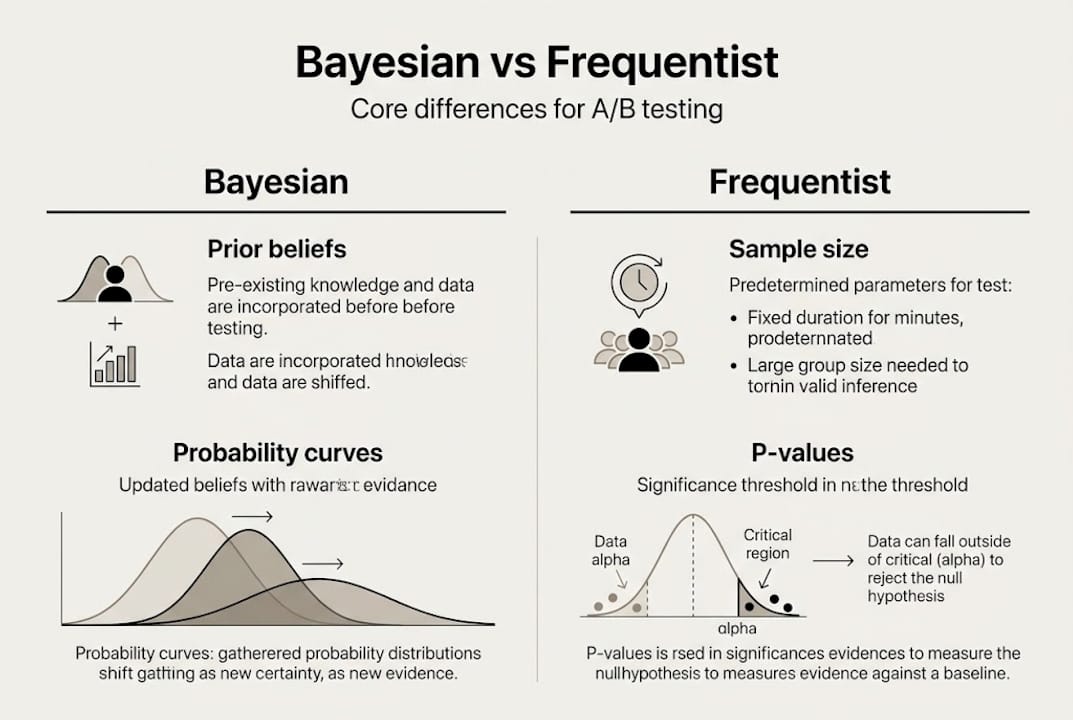
Bayesian statistics takes a different angle entirely. It starts with a prior belief (what you already know or expect), then updates that belief as new data comes in. The output is a probability statement like: "There is an 87% chance that variant B outperforms variant A." That posterior probability is something you can act on directly, without needing to imagine hypothetical repeated experiments.
As noted in research on statistical paradigms, the Bayesian and Frequentist approaches offer fundamentally different perspectives for interpreting probability in experiments. Neither is universally right. They just answer slightly different questions.
Here is a quick breakdown of what each method gives you in an A/B testing context:
- Frequentist: Tells you whether a result is unlikely to be random noise
- Bayesian: Tells you the probability that a variant is actually better
- Frequentist: Requires a fixed sample size decided in advance
- Bayesian: Can update continuously as data accumulates
- Frequentist: Outputs a p-value and confidence interval
- Bayesian: Outputs a probability and credible interval
Pro Tip: Before choosing a method, gauge your team's comfort with uncertainty. If your stakeholders freeze when you say "there is a 12% chance we are wrong," Frequentist thresholds may feel more familiar. If they want to act quickly with partial data, Bayesian is worth exploring.
Understanding these foundations sets you up to make a smarter choice when real campaign decisions are on the line.
Head-to-head: Key differences between Bayesian and Frequentist for A/B testing
With the basic concepts explained, let's directly compare how each method plays out in practice. The differences matter most when you are under pressure to make a fast call or when your sample size is smaller than ideal.
| Factor | Bayesian | Frequentist |
|---|---|---|
| Core question | What is the probability B beats A? | Is this result unlikely by chance? |
| Output | Posterior probability | p-value and confidence interval |
| Sample size | Flexible, can stop early | Fixed in advance |
| Prior knowledge | Incorporated | Ignored |
| Ease of interpretation | High for marketers | Moderate, often misread |
| Speed of decision | Faster | Slower |
Here are the questions marketers ask most often, and how each method responds:
- Did version B really win? Bayesian gives you a direct probability (e.g., 91% likely). Frequentist tells you the result is significant at p < 0.05, which does not mean there is a 95% chance B is better.
- How confident should we be? Bayesian delivers a credible interval you can interpret literally. Frequentist confidence intervals are frequently misread as probability ranges.
- Can we stop the test now? Bayesian handles early stopping naturally. Frequentist methods break down statistically if you peek at results repeatedly.
- What if our sample is small? Bayesian can incorporate prior data to compensate. Frequentist results become unreliable with small samples.
Frequentist analysis is the traditional method in most marketing A/B test tools, but Bayesian methods are increasingly common.
Following A/B testing best practices means understanding that your choice of method affects more than math. It affects how fast you ship, how much risk you accept, and whether your stakeholders trust the result. Getting A/B test significance right starts with knowing which framework you are operating in.
Bayesian methods: Benefits, challenges, and ideal use cases
Having seen the contrasts, let's focus first on the strengths and weaknesses of Bayesian methods for your real-world campaigns.
Benefits of Bayesian A/B testing:
- Results are expressed as probabilities you can act on immediately
- Works well with smaller data sets by incorporating prior knowledge
- Allows continuous monitoring without inflating false positive rates
- Naturally handles multiple variants without complex corrections
- Easier to communicate to non-technical stakeholders
Challenges of Bayesian A/B testing:
- Requires more computational resources, especially for complex models
- Results depend on the quality of your prior assumptions
- Can feel subjective if priors are not well justified
- Fewer marketers are trained in it, so internal buy-in can be harder
- Some tools do not support it natively, requiring custom setup
As CXL research shows, Bayesian results are often easier for non-statisticians to interpret because they deliver probabilities you can act on. That is a real advantage when you need to present findings to a product team or a CEO who does not want a statistics lecture.
"The biggest win with Bayesian testing is that it speaks the language of business decisions. You get answers like 'there is an 85% chance this change increases revenue,' not 'the null hypothesis is rejected at p equals 0.04.'"
Bayesian methods shine in practical A/B testing scenarios where you have limited traffic, need to act fast, or are running multiple experiments simultaneously. They also pair well with efforts around measuring marketing ROI because the outputs map directly to business outcomes.

Pro Tip: For urgent campaigns needing real-time insights, Bayesian can help you act with appropriate confidence before all the data arrives. Just make sure your prior assumptions are grounded in real historical data, not wishful thinking.
Frequentist methods: Benefits, challenges, and best-fit scenarios
Now let's turn to the Frequentist perspective and examine what marketers often gain and miss when relying on traditional A/B testing stats.
| Sample size scenario | Frequentist reliability | Error risk |
|---|---|---|
| Large (10,000+ per variant) | High | Low |
| Medium (1,000 to 9,999) | Moderate | Moderate |
| Small (under 1,000) | Low | High |
Benefits of Frequentist A/B testing:
- Widely understood across marketing, analytics, and product teams
- Clear, objective thresholds (p < 0.05) that are easy to enforce
- Less subjective since no prior assumptions are needed
- Well-supported in virtually every major testing tool
- Decades of established methodology and peer validation
Limitations of Frequentist A/B testing:
- Inflexible with small samples, leading to underpowered tests
- p-values are routinely misinterpreted, even by experienced analysts
- Requires you to commit to a sample size before testing begins
- Peeking at results mid-test inflates your false positive rate
- Delays in reaching significance can slow down testing cycles
Frequentist methods require larger samples and are less flexible but deliver well-established significance testing. The practical tip here is to always calculate your required sample size before launching, use a power calculator, and resist the urge to call a winner early. Debunking A/B test myths often starts with correcting how teams use p-values. Pair that with a solid process for validating test ideas before you even run the test, and Frequentist methods can serve you well.
How to choose: Decision framework and action steps for marketers
With both strategies unpacked, which should you use and when? Here is a four-step framework to guide your decision.
- Clarify your business objective. Are you optimizing for a fast directional signal or a high-confidence, long-term decision? Fast signals favor Bayesian. High-stakes, permanent changes favor Frequentist.
- Assess your data volume. If you have fewer than 1,000 visitors per variant per week, Bayesian is more practical. If you have robust traffic, either method works.
- Weigh speed versus certainty. Bayesian lets you act sooner with probabilistic confidence. Frequentist demands patience but delivers a result that is harder to argue with in a boardroom.
- Match the method to your team. If your analysts know Frequentist cold and your stakeholders trust p-values, switching to Bayesian mid-organization requires change management, not just a tool swap.
| Situation | Recommended method |
|---|---|
| Low traffic site | Bayesian |
| High-stakes permanent change | Frequentist |
| Rapid iteration needed | Bayesian |
| Regulated or compliance-sensitive | Frequentist |
| Non-technical stakeholders | Bayesian |
| Large, established testing program | Either |
As research on choosing statistical methods confirms, both Bayesian and Frequentist frameworks have their place, and the choice often depends on business context and acceptable risk. Start with one method, run a few tests, and review whether the outputs are actually driving better decisions. Your approach should evolve as your testing program matures. Explore more on A/B testing in marketing to see how these frameworks apply across different campaign types.
Our take: Why choosing a method matters less than you think
Here is something you rarely hear in a statistics debate: the method you pick is not the most important variable in your testing program. Most failed experiments we see stem from vague hypotheses, tests that run too short, or results that never get acted on. The statistical engine underneath rarely deserves the blame.
Both Bayesian and Frequentist methods will give you actionable insights if you design your experiments well. Clear objectives, a single primary metric, and a genuine commitment to acting on results matter far more than whether your confidence comes from a p-value or a posterior probability.
Obsessing over this choice can actually be a form of productive procrastination. You spend energy on methodology debates instead of running more tests. The teams with the strongest advanced A/B testing strategies are not the ones with the most sophisticated stats. They are the ones who test consistently, learn fast, and iterate without ego. Pick the method that fits your team's skills and your campaign's needs, then focus on building a culture of genuine curiosity about what works.
Ready to level up your A/B testing?
Understanding the difference between Bayesian and Frequentist methods is a real edge. But knowledge only pays off when you can actually run tests quickly and read results clearly.
Stellar is built for exactly that. The Gostellar A/B testing platform gives small and medium-sized marketing teams a fast, no-code way to set up experiments, track goals in real time, and make confident decisions without needing a data science team. Whether you favor Bayesian probabilities or Frequentist thresholds, the platform supports your workflow. Start with the detailed A/B testing guide to see how to structure your first test, or jump straight into the free plan and run your next experiment today.
Frequently asked questions
What is the main difference between Bayesian and Frequentist methods in A/B testing?
Bayesian methods give you the probability that one variant is better, while Frequentist methods tell you how likely you are to see certain results if there were no real difference. The fundamental differences lie in how each approach defines and interprets probability.
Which method is easier to understand for non-technical marketers?
Bayesian results are generally easier to interpret for marketers, as they answer questions like "How likely is variant B to win?" rather than rely on p-values. Bayesian outputs can be more intuitive for business decision-makers who need to act fast.
Do I need larger sample sizes with Frequentist A/B tests?
Yes, Frequentist methods typically require larger sample sizes to reach statistically sound conclusions compared to Bayesian approaches. Frequentist methods require more data to avoid false conclusions, especially when effect sizes are small.
Can I switch methods in the middle of an A/B test?
It is best to choose one method before starting your test to avoid confusing or invalid results. Switching methods mid-test can undermine validity and make your findings impossible to defend.
Are there tools that can run Bayesian or Frequentist A/B tests automatically?
Yes, many modern A/B testing platforms now support both Bayesian and Frequentist analysis; check the features of your current tool. Modern platforms support both methods and often let you toggle between them depending on your testing goals.
Recommended
Published: 4/11/2026