
Best Metrics for Growth Marketers in SaaS Success
Running an A/B test without clear metrics often feels like guessing in the dark. For growth marketers at small to medium-sized SaaS companies, measuring the right indicators reveals which experiments actually move the needle on user engagement and conversion rates. By focusing on actionable SaaS metrics like Customer Acquisition Cost, Monthly Recurring Revenue, and churn rate, you gain the practical insight needed to fine tune your campaigns and prioritize strategic growth rather than chasing vanity numbers.
Table of Contents
- Defining Growth Marketing Metrics In SaaS
- Core Metric Types: Acquisition To Retention
- Intent Signals And Buyer Quality Tracking
- Real-Time Goal Tracking And Analytics Methods
- Common Pitfalls And Vanity Metrics To Avoid
Key Takeaways
| Point | Details |
|---|---|
| Focus on Comprehensive Metrics | Successful SaaS growth marketing relies on a blend of Acquisition, Engagement, Revenue, and Retention metrics to drive informed decision-making. |
| Track Intent Signals and Lead Quality | Identifying Marketing Qualified Leads (MQLs), Sales Qualified Leads (SQLs), and Product Qualified Leads (PQLs) is essential for understanding customer potential and optimizing marketing resources. |
| Prioritize Actionable Metrics | Focusing on actionable metrics over vanity metrics enables companies to measure genuine performance indicators that correlate with revenue and growth. |
| Implement Real-Time Analytics | Utilizing real-time data tracking and visualization techniques allows for rapid adjustments and strategic decision-making based on current market trends. |
Defining Growth Marketing Metrics in SaaS
Growth marketing in Software as a Service (SaaS) requires a strategic approach to measuring performance through carefully selected metrics. Unlike traditional marketing metrics, SaaS metrics focus on sustainable revenue generation, customer acquisition, and long-term business health.
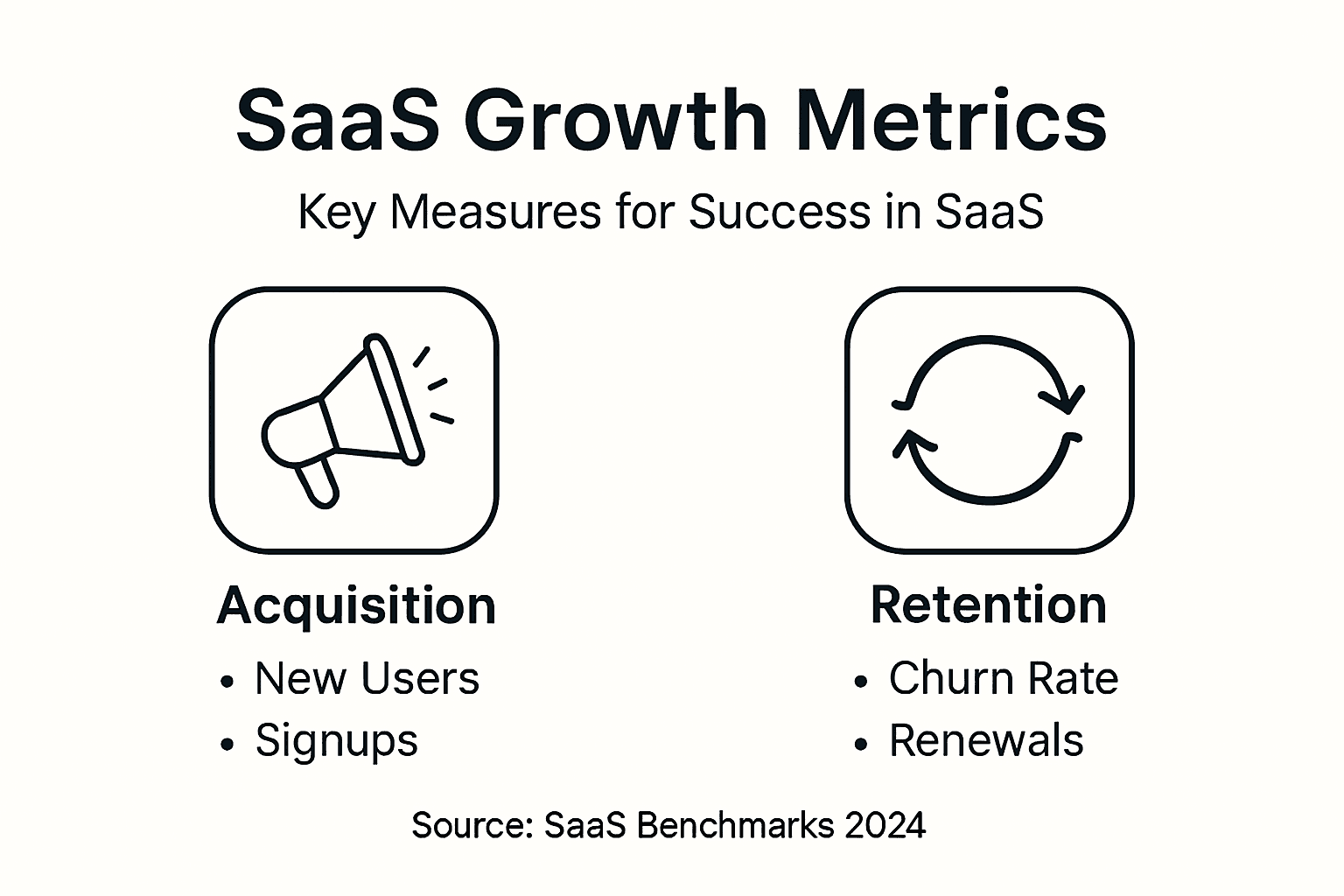
When examining growth marketing metrics, successful companies concentrate on several core measurements that provide comprehensive insights into their business performance. Comprehensive SaaS metrics frameworks typically emphasize the following critical categories:
- Acquisition Metrics
- Customer Acquisition Cost (CAC)
- Lead Conversion Rate
- Marketing Qualified Leads (MQLs)
- Revenue Metrics
- Monthly Recurring Revenue (MRR)
- Annual Recurring Revenue (ARR)
- Customer Lifetime Value (LTV)
- Retention Metrics
- Churn Rate
- Net Revenue Retention
- Customer Satisfaction Score
These metrics work together to create a holistic view of a company's growth trajectory. Each category provides unique insights into different aspects of business performance, allowing marketers to make data-driven decisions.
Understanding the interconnectedness of these metrics is crucial. For instance, a low Customer Acquisition Cost paired with a high Lifetime Value indicates an efficient and scalable growth strategy. Conversely, high churn rates might signal underlying product or market fit issues that require immediate attention.
Pro tip: Regularly track and benchmark your key SaaS metrics against industry standards to maintain a competitive edge and identify areas for strategic improvement.
Core Metric Types: Acquisition to Retention
In the dynamic world of SaaS marketing, understanding the progression of key performance indicators from acquisition through retention is crucial for sustainable growth. SaaS marketing metrics provide a comprehensive roadmap that tracks a company's performance across multiple stages of the customer lifecycle.
The core metric types can be categorized into distinct yet interconnected stages:
-
Acquisition Metrics
- Customer Acquisition Cost (CAC)
- Marketing Qualified Leads (MQLs)
- Conversion Rate
- Channel-specific Acquisition Rates
-
Engagement Metrics
- Product Activation Rate
- User Onboarding Completion
- Feature Adoption Rates
- Session Frequency
-
Revenue Metrics
- Monthly Recurring Revenue (MRR)
- Annual Recurring Revenue (ARR)
- Customer Lifetime Value (LTV)
- Revenue Expansion Rate
-
Retention Metrics
- Churn Rate
- Net Revenue Retention
- Customer Satisfaction Score
- Renewal Rates
Each metric type offers unique insights into different aspects of business performance. Acquisition metrics reveal how effectively a company attracts potential customers, while engagement metrics demonstrate how well the product meets user needs. Revenue metrics track monetary growth, and retention metrics indicate long-term customer satisfaction and product value.

Here's a summary of how key SaaS growth metrics interconnect and impact business outcomes:
| Metric Category | Core Focus | Primary Business Impact |
|---|---|---|
| Acquisition | Attracting new customers | Expands user base |
| Engagement | User product interaction | Drives product adoption |
| Revenue | Monetizing user actions | Increases financial growth |
| Retention | Keeping existing users | Reduces churn, boosts LTV |
Successful SaaS companies view these metrics as an interconnected system, not isolated data points. A low customer acquisition cost paired with high lifetime value suggests an efficient growth strategy, whereas high churn rates might signal underlying product or market fit challenges that require immediate strategic intervention.
Pro tip: Create a dynamic dashboard that tracks these metrics holistically, allowing real-time insights into your SaaS business performance and enabling rapid, data-driven decision-making.
Intent Signals and Buyer Quality Tracking
Tracking buyer intent and lead quality is a critical aspect of SaaS marketing that transforms raw lead data into actionable insights. Precise lead qualification strategies help marketers distinguish between potential customers with genuine interest and those unlikely to convert.
The primary intent signals and lead qualification metrics include:
-
Marketing Qualified Leads (MQLs)
- Demographic matching
- Content engagement
- Website behavior
- Initial interaction quality
-
Sales Qualified Leads (SQLs)
- Direct product interest
- Budget confirmation
- Decision-making authority
- Specific solution requirements
-
Product Qualified Leads (PQLs)
- Free trial usage
- Feature exploration
- Depth of product interaction
- Frequency of product engagement
Successful lead tracking involves understanding the progression of leads through different qualification stages. Conversion velocity becomes a key indicator of lead quality, measuring how quickly potential customers move through the sales funnel. This helps marketers identify and prioritize high-potential prospects while optimizing resource allocation.
Effective intent signal tracking requires a nuanced approach that goes beyond simple demographic data. Advanced marketers look for behavioral indicators, engagement patterns, and alignment with ideal customer profiles to assess true buying potential. The goal is not just collecting leads, but identifying those most likely to become long-term, high-value customers.
Pro tip: Develop a sophisticated lead scoring system that combines multiple intent signals, creating a comprehensive view of potential customer quality and purchase likelihood.
Real-Time Goal Tracking and Analytics Methods
Real-time goal tracking transforms how SaaS marketers understand and optimize their performance. Strategic metrics tracking enables faster decision-making, allowing companies to respond quickly to emerging trends and potential risks.
Effective real-time analytics methods encompass several critical approaches:
-
Data Collection Strategies
- Automated tracking systems
- Event-triggered monitoring
- Multi-source data integration
- Continuous performance logging
-
Visualization Techniques
- Interactive dashboards
- Dynamic performance charts
- Real-time metric comparison
- Customizable reporting interfaces
-
Performance Monitoring
- Conversion rate tracking
- User behavior analysis
- Funnel progression monitoring
- Anomaly detection systems
-
Decision Support Tools
- Predictive analytics
- Trend forecasting
- Comparative performance metrics
- Actionable insight generation
The most successful analytics approaches recognize that raw data means little without context. Contextual interpretation becomes crucial, transforming numeric metrics into strategic insights that drive meaningful business decisions. Advanced marketers look beyond surface-level numbers to understand the underlying patterns and potential opportunities.
Integrating multiple data sources creates a more comprehensive view of performance. By connecting website analytics, user engagement metrics, conversion data, and customer feedback, marketers can develop a nuanced understanding of their growth strategies that goes far beyond traditional reporting methods.
Pro tip: Implement a centralized dashboard that aggregates real-time metrics from multiple sources, enabling instant visibility and rapid strategic adjustments.
Common Pitfalls and Vanity Metrics to Avoid
SaaS growth marketers frequently encounter deceptive metrics that create an illusion of progress without driving meaningful business outcomes. Dangerous vanity metrics can mislead strategic decision-making, potentially diverting resources from truly impactful initiatives.
Common vanity metrics growth marketers should be skeptical about include:
-
User Acquisition Metrics
- Total user count
- Pageviews
- Social media followers
- Superficial engagement numbers
-
Misleading Performance Indicators
- Signup rates without conversion
- Unqualified lead volumes
- Raw traffic numbers
- Temporary traffic spikes
-
False Engagement Signals
- Surface-level app downloads
- One-time website visitors
- Passive content consumption
- Low-intent interactions
-
Unreliable Growth Signals
- Gross revenue without profitability context
- Cumulative user metrics
- Unfiltered conversion percentages
- Metrics lacking segmentation
Successful SaaS marketers distinguish themselves by focusing on actionable metrics that directly correlate with revenue, customer retention, and sustainable growth. These meaningful indicators provide genuine insights into business performance, unlike vanity metrics that merely create temporary excitement.
The table below compares actionable metrics to vanity metrics, highlighting why actionable data matters for SaaS growth:
| Metric Type | Example | Business Relevance |
|---|---|---|
| Actionable Metric | Net Revenue Retention | Directly linked to profitability |
| Actionable Metric | Customer Lifetime Value | Predicts long-term stability |
| Vanity Metric | Social Media Followers | Weak indicator of revenue |
| Vanity Metric | App Download Count | May not reflect active users |
Contextualizing metrics requires a holistic approach that connects individual data points to broader strategic objectives. Advanced marketers develop nuanced tracking systems that reveal underlying patterns of user behavior, product engagement, and potential revenue generation.
Pro tip: Establish a rigorous metric evaluation framework that prioritizes quality over quantity, focusing on metrics with demonstrable impact on long-term business sustainability.
Unlock Data-Driven SaaS Growth with Stellar's A/B Testing Platform
Understanding the right growth marketing metrics such as Customer Acquisition Cost, Churn Rate, and Lifetime Value is vital to scaling your SaaS business effectively. The article highlights how real-time goal tracking and insightful analytics can transform raw data into actionable strategies. If you are tired of juggling vanity metrics and want to focus on meaningful, revenue-driving indicators you need tools designed to streamline experimentation and provide instant insights.
Experience how Stellar’s advanced goal tracking and real-time analytics empower marketers and growth hackers with a lightweight, easy-to-use platform tailored for small to medium-sized businesses. Gain full control over your growth experiments, make confident decisions based on measurable results, and reduce the guesswork from SaaS marketing. Don’t wait to optimize your key metrics. Visit https://gostellar.app now and accelerate your SaaS growth journey.
Frequently Asked Questions
What are the essential metrics for tracking growth in SaaS marketing?
The essential metrics for tracking growth in SaaS marketing include Customer Acquisition Cost (CAC), Monthly Recurring Revenue (MRR), Customer Lifetime Value (LTV), and churn rate. These metrics provide insights into acquisition, revenue generation, and customer retention.
How can I improve my Customer Acquisition Cost (CAC) in SaaS?
To improve your Customer Acquisition Cost (CAC), focus on optimizing your marketing strategies, improving lead conversion rates, and investing in high-performing channels. Streamlining your sales funnel and reducing wasted marketing spend can also help lower CAC.
What are vanity metrics in SaaS marketing, and why should I avoid them?
Vanity metrics are metrics that may appear impressive but do not directly correlate with business success, such as total user count or social media followers. Avoiding these metrics ensures you focus on actionable data that impacts revenue and growth.
How do I calculate Customer Lifetime Value (LTV) for my SaaS business?
Customer Lifetime Value (LTV) can be calculated by multiplying the average revenue per user (ARPU) by the average customer lifespan. A higher LTV indicates that each customer provides significant value, making it essential for understanding long-term profitability.
Recommended
Published: 2/17/2026