
7 Best Practices in AB Testing Every Marketer Should Know
Roughly 80 percent of digital experiments fail to deliver clear results because they lack structured planning and sharp focus. Without a thoughtful approach, A/B tests often turn into wasted effort with confusing data and missed opportunities. Whether you want to drive up sales, improve user experience, or find out what actually works on your website, knowing the most effective A/B testing best practices gives you a powerful advantage. This guide covers proven steps to turn every test into a source of meaningful growth.
Table of Contents
- 1. Define Clear Goals for Each AB Test
- 2. Segment Your Audience for Accurate Insights
- 3. Start with Simple Hypotheses and Variations
- 4. Use a Lightweight Tool to Avoid Performance Impact
- 5. Run Tests Long Enough for Statistically Valid Results
- 6. Track Key Metrics with Advanced Goal Tracking
- 7. Analyze Data and Apply Learnings to Future Campaigns
Quick Summary
| Takeaway | Explanation |
|---|---|
| 1. Define specific A/B test goals | Clear, measurable goals transform tests from random experiments into strategic tools for improvement. Aim for specific metrics and targets. |
| 2. Segment your audience wisely | Effective segmentation allows for deeper insights into user preferences, enabling better-targeted testing strategies that enhance results. |
| 3. Start with simple hypotheses | Focus on single, clear changes in your tests to gather actionable insights and improve user engagement without added complexity. |
| 4. Use lightweight testing tools | Select tools with minimal script sizes to avoid performance issues while ensuring accurate tracking and data collection. |
| 5. Analyze data to inform future campaigns | Thoroughly analyzing test results helps identify key performance trends and guides future marketing strategies based on user behavior. |
1. Define Clear Goals for Each AB Test
Successful A/B testing begins with crystal clear objectives that transform vague intentions into precise measurement targets. Without specific goals, your testing efforts become a scattered shooting exercise with no real direction.
When defining goals for an A/B test, you need to move beyond generic statements like "increase conversions" and articulate exactly what you want to improve. According to research from AWA Digital, your objectives should be specific and measurable. For instance, instead of saying "boost landing page performance," aim to "increase landing page conversion rate from 2.5% to 3.5%."
Here are practical steps to define robust A/B testing goals:
- Identify the specific metric you want to improve
- Set a precise numerical target for that metric
- Ensure the goal is directly connected to a business outcome
- Make the goal time bound and realistic
The key is connecting your design changes directly to measurable improvements. Without clear goals, measuring test success becomes challenging. As research from Mold Stud highlights, establishing specific objectives is crucial for accurately assessing test outcomes.
A well defined goal transforms your A/B test from a random experiment into a strategic tool for systematic improvement. Your goals act as the north star guiding your entire testing process.
2. Segment Your Audience for Accurate Insights
Audience segmentation transforms A/B testing from a generic experiment into a precision-driven analysis. By breaking down your user base into distinct groups, you unlock deeper insights that generic testing simply cannot reveal.
Research from SAGEScience Journals highlights that effective segmentation involves categorizing interactions across multiple dimensions including demographic, geographic, psychographic, and behavioral attributes. This nuanced approach enables targeted content strategies that resonate with specific user groups.
When segmenting your audience for A/B testing, consider these critical categories:
- Behavioral patterns (purchase history, engagement level)
- Demographic characteristics (age, income, profession)
- Geographic location
- Technology preferences
- User experience level
According to research from arXiv, data-driven behavioral segmentation allows you to create user segments closely related to product features. This method provides actionable insights by analyzing how different user groups interact with specific product components.
The real power of audience segmentation lies in its ability to reveal nuanced user preferences. Instead of treating all users as a monolithic group, you can design tests that speak directly to unique user subsets, dramatically improving the accuracy and relevance of your insights.
3. Start with Simple Hypotheses and Variations
A/B testing success hinges on crafting clear, focused hypotheses that transform abstract ideas into measurable experiments. Complexity is the enemy of clarity when designing effective tests.
According to AWA Digital, a powerful hypothesis connects specific design changes directly to anticipated user behavior improvements. For instance, instead of a vague goal, articulate a precise statement like "removing the lead magnet popup on the blog homepage will increase time on page by 15%."
Key principles for developing simple hypotheses:
- Focus on one specific variable at a time
- Connect the change to a measurable outcome
- Use clear language that anyone can understand
- Ensure the hypothesis is testable and realistic
Research from Mold Stud warns against testing too many variations simultaneously. Complexity dilutes insights. By isolating individual variables, you can accurately determine which specific change drives user behavior.
Think of your A/B test hypothesis like a scientific experiment. Start small. Understand how a single change might impact user experience. This approach transforms guesswork into strategic, data-driven decision making. With 10 AB Test Hypothesis Examples for CRO in 2025, you can learn to craft hypotheses that turn subtle changes into significant improvements.
4. Use a Lightweight Tool to Avoid Performance Impact
Choosing an A/B testing tool is more than just comparing features. The script size and performance impact can make or break your website experience. Your testing solution should enhance insights without compromising user experience.
According to research from Unib Science, implementing accurate tracking requires strategic code deployment. Performance matters. A lightweight testing tool ensures minimal script overhead while maintaining precise data collection.
Critical considerations for selecting a performance friendly testing tool:
- Minimal script size (under 10KB)
- Fast loading times
- Server side rendering capabilities
- Efficient data tracking mechanisms
- Low computational resource requirements
Research from Khangiay Hanoi emphasizes the importance of data privacy alongside performance. Your chosen tool should anonymize personally identifiable information and limit data collection to essential attributes.
Pro tip: Check the tool's script size before implementation. 5 Lightweight A/B Testing Platforms That Won't Slow Your Site can help you identify solutions that deliver powerful insights without web performance penalties.
5. Run Tests Long Enough for Statistically Valid Results
A/B testing is not a sprint. It is a strategic marathon where patience and precision determine the quality of your insights. Rushing to conclusions can lead to misguided decisions that harm your marketing performance.
Research from arXiv reveals that traditional A/B test analysis using frequentist p-values can be unreliable if sample sizes are not carefully managed. Statistical significance requires time. Implementing always valid p-values ensures reliable inference at any decision point.
Critical factors for determining test duration:
- Total sample size
- Current conversion rates
- Minimum detectable effect
- Statistical significance level
- Traffic volume
- Audience variability
Additional research from arXiv highlights a critical challenge in A/B testing: divergent delivery. Ad delivery algorithms can target different variants to different audience segments, potentially skewing results. This means your test must run long enough to minimize these algorithmic biases.
For those seeking more guidance, What is Test Duration? Understanding its Importance provides deeper insights into structuring experiments that deliver meaningful, actionable results. Remember: good data takes time.
6. Track Key Metrics with Advanced Goal Tracking
Measuring the right metrics transforms A/B testing from a guessing game into a strategic decision making process. Not all metrics are created equal and understanding which ones truly matter can make or break your optimization efforts.
Research from Alias Links emphasizes the importance of strategic metric selection. If your goal is increasing sales, track conversion rate as your primary metric while simultaneously monitoring additional indicators like average order value to gain deeper insights.
Key metrics to consider tracking:
- Conversion rate
- Average order value
- Bounce rate
- Time on page
- Revenue per visitor
- Customer lifetime value
Research from Unib Science suggests integrating A/B testing platforms with analytics tools like Google Analytics for comprehensive tracking. This approach allows you to create custom dimensions and set up goals that provide a holistic view of user behavior.
For marketers seeking to master multichannel tracking, Complete Guide to Multichannel Conversion Tracking offers advanced strategies to elevate your measurement capabilities. Remember: good tracking is about quality over quantity.
7. Analyze Data and Apply Learnings to Future Campaigns
A/B testing is not just about running experiments. It is about extracting meaningful insights that transform future marketing strategies. The real value emerges when you translate test data into actionable improvements.
Research from Mold Stud emphasizes the importance of detailed metric analysis. Focus on key performance indicators such as open rates, click-through rates, and conversion rates to understand what truly resonates with your audience.
Strategies for applying A/B test insights:
- Segment findings by demographic characteristics
- Identify statistically significant patterns
- Create targeted content based on winning variations
- Develop persona specific marketing approaches
- Continuously refine experimental designs
Research from arXiv highlights how data-driven behavioral segmentation provides deep insights that inform product decisions. By analyzing user engagement with specific components, you can craft more precise and effective future campaigns.
For marketers looking to master data interpretation, Understanding How to Use Test Data Effectively offers additional strategies to transform raw numbers into strategic marketing gold. Remember: data without action is just noise.
This table provides a comprehensive summary of key strategies and considerations for effective A/B testing as discussed in the article.
| Strategy | Implementation | Expected Results |
|---|---|---|
| Define Clear Goals | Identify specific metrics, set precise targets, connect goals to business outcomes, and ensure goals are time-bound and realistic. | Transform vague intentions into precise measurement targets, guiding the testing process. |
| Segment Your Audience | Categorize users by behavior, demographics, geography, and technology preferences. | Obtain precise insights and design tests tailored to specific user subsets. |
| Start with Simple Hypotheses | Focus on one variable; ensure hypotheses are measurable, understandable, and testable. | Isolate individual variables to determine which changes influence user behavior. |
| Use a Lightweight Tool | Choose tools with minimal script size, fast loading times, and efficient tracking. | Enhance insights without compromising user experience. |
| Run Tests Long Enough | Consider sample size, conversion rates, statistical significance, and traffic volume. | Ensure reliable and valid test results by avoiding premature conclusions. |
| Track Key Metrics | Focus on conversion rates, order value, bounce rate, and integrate with analytics tools. | Transform testing from guessing to strategic decision-making by selecting relevant metrics. |
| Analyze Data and Apply Learnings | Segment data, identify patterns, and develop tailored content. | Convert test data into actionable strategies, improving future campaigns. |
Elevate Your A/B Testing with Stellar for Clear Results
Struggling to define clear goals and test variations without slowing down your site? The article on 7 Best Practices in AB Testing Every Marketer Should Know highlights the importance of precise hypotheses, audience segmentation, and tracking key metrics while avoiding performance pitfalls. If performance impact and complex setups have held you back, Stellar addresses these critical pain points with its ultra-lightweight 5.4KB script and no-code visual editor designed specifically for marketers and growth hackers.
Experience real-time analytics and advanced goal tracking that lets you measure conversions precisely while your site stays fast and seamless. With features like dynamic keyword insertion and a user-friendly interface tailored to small and medium-sized businesses, Stellar lets you run statistically valid tests without guesswork or technical hurdles.
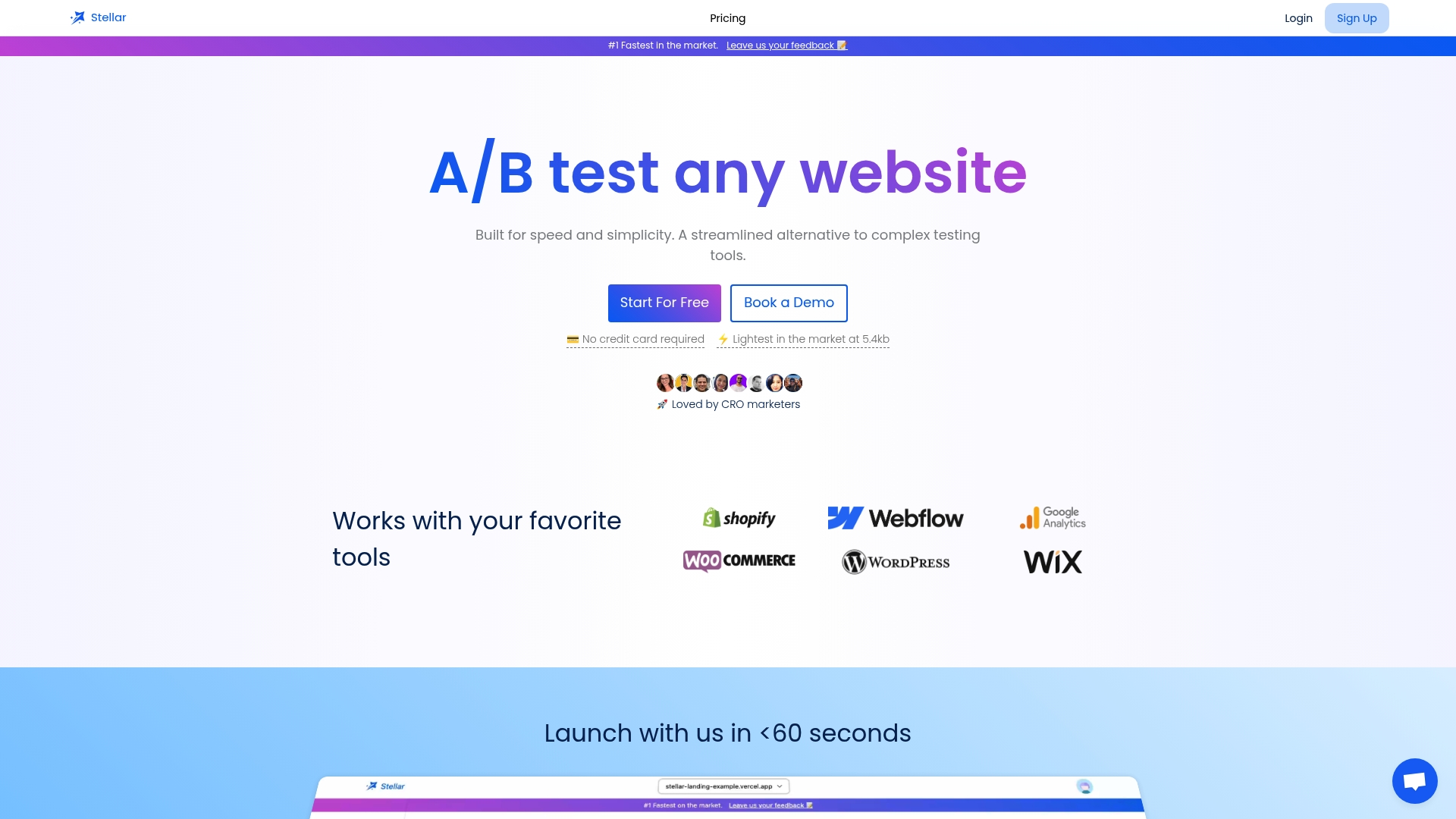
Start transforming your A/B testing from guesswork into data-driven success. Visit Stellar now to discover how our A/B Testing Tool and Advanced Goal Tracking can help you deliver meaningful insights that drive growth. Don’t wait—make your next campaign your best one by testing smarter today.
Frequently Asked Questions
What are the specific goals I should define for my A/B testing?
To ensure successful A/B testing, clearly define specific objectives such as "increase landing page conversion rate from 2.5% to 3.5%." Identify the specific metric to improve, set a precise target, and ensure the goal ties back to a business outcome. Start with at least one clear goal before testing begins.
How do I segment my audience for more effective A/B testing?
Segment your audience by categorizing them based on factors like behavior, demographics, and user experience. Create distinct groups that share similar traits and preferences to tailor your tests, improving accuracy and relevance. Start by analyzing existing user data to identify the key segments.
What is the best way to formulate a hypothesis for my A/B test?
Craft a simple and clear hypothesis that connects a specific design change to a measurable user behavior outcome. For example, state that "removing the lead magnet popup will increase time on page by 15%." Focus on one variable at a time to maintain clarity and testability.
How long should I run my A/B tests to get reliable results?
Run your A/B tests long enough to gather statistically significant data, typically measured by total sample size and traffic volume. A good guideline is to let the test run for at least two to four weeks depending on your site traffic to ensure conclusive results. Monitor conversion rates consistently throughout this period.
What key metrics should I track during A/B testing?
Focus on important metrics that align with your goals, such as conversion rate, average order value, and bounce rate. These metrics can provide valuable insights into user behavior and campaign performance. Aim to track at least three key metrics to get a comprehensive view of the experiment's impact.
How can I use the insights gained from A/B testing in future campaigns?
Analyze the data from your A/B tests to identify successful patterns and apply these learnings to future marketing strategies. Create targeted content based on winning variations and continuously refine your experimental designs. Set aside specific time frames to revisit insights and integrate them into your strategies.
Recommended
- A/B Testing Digital Marketing: Strategies and Best Practices 2025
- Google AB Testing: Strategies for Higher Conversions in 2025
- Top 10 AB Testing Examples for CRO Marketers in 2025
- A/B Testing Checklist 2025: Essentials for Marketers
- How to Segment Email Lists for Effective Targeting|CS
- Revolutionizing Marketing with the Agile Advantage
Published: 11/20/2025