
Boost A/B Test Success: Smart Browser Compatibility Testing
TL;DR:
- Browser compatibility testing ensures website functionality across various browsers and devices, preventing data corruption.
- Edge cases like layout shifts, JavaScript engine differences, and mobile gestures can severely impact A/B test validity.
- Implementing prioritized testing on key browsers and using tools like virtual environments improves test accuracy and conversion rates.
Your A/B test just wrapped up with a clear winner. Champagne? Not yet. If a segment of your visitors was seeing a broken layout or a non-functional CTA button because of one overlooked browser quirk, that "winning" variant might be built on corrupted data. Browser compatibility testing is the silent safeguard most marketing teams skip, and that omission quietly destroys conversion rate optimization (CRO) work. This guide walks you through what browser compatibility testing actually involves, where the nastiest pitfalls hide, and how to build a lean, effective testing workflow that protects the integrity of every A/B test you run.
Table of Contents
- What is browser compatibility testing and why does it matter?
- Key challenges: Edge cases and common pitfalls
- Testing strategies every growth team should use
- From browser bugs to better results: Applying insights to A/B testing
- Why most marketers underestimate browser issues—and how to get ahead
- Streamline browser testing for better A/B results
- Frequently asked questions
Key Takeaways
| Point | Details |
|---|---|
| Test for every browser | Testing across all major browsers prevents missed conversions and faulty A/B test results. |
| Watch for edge cases | Unusual user actions and specific browser quirks often cause the most damaging test failures. |
| Prioritize and plan | A smart, stepwise testing workflow saves time and increases accuracy for marketers. |
| Tools boost efficiency | Combining automated and manual checks delivers faster, more reliable browser compatibility. |
What is browser compatibility testing and why does it matter?
Browser compatibility testing means systematically checking that your website, landing page, or funnel step looks and works correctly across different browsers, operating systems, and devices. Chrome, Safari, Firefox, Edge, and their mobile counterparts each interpret HTML, CSS, and JavaScript slightly differently. What renders perfectly in Chrome can fall apart in Safari or look misaligned on an older Android browser.
For marketers, this is not a developer problem. It is a revenue problem. When you are testing landing pages and one variant breaks in Safari, you are not just annoying a portion of your audience. You are injecting noise directly into your test data. The winning variant might win simply because the losing variant was broken for 30% of iOS users.
Here are the core terms you need to know:
- Cross-browser testing: Running the same page or flow in multiple browsers to compare behavior.
- Layout shift: When page elements move unexpectedly during or after load, often caused by images, fonts, or ads loading late. Layout shift issues directly harm user experience and conversion.
- JavaScript engine: The code interpreter inside each browser. Chrome uses V8; Safari uses WebKit. These engines handle scripts differently, which can cause features to work in one browser and silently fail in another.
- Session timeout: When a user's session expires mid-flow, especially in multi-step funnels, causing them to drop out or land on an error state.
"Test the boundaries and interruptions of your user flows. Edge cases like layout shifts, JS engine differences, session timeouts, back-button behavior in multi-step A/B flows, mobile gestures, and low-resource environments are where most browser bugs actually live."
Small rendering bugs compound fast. A misaligned form field, a CTA button hidden behind an overlapping element, or a headline that wraps awkwardly on a 375px screen can each drop your conversion rate by several percentage points. When these bugs exist in only one browser, your A/B test does not just suffer, it lies to you.
Key challenges: Edge cases and common pitfalls
Now that we have established why cross-browser testing is crucial, let us look at the specific traps that trip up even experienced growth teams.
The most common culprits are what engineers call edge cases: situations that happen only under specific browser, device, or user behavior conditions. Research on cross-browser compatibility strategies highlights these recurring problem areas:
- Flexbox gap in Safari versions before 14.1: The CSS "gap` property for flexbox layouts was not supported, causing elements to stack incorrectly. Millions of iPhone users run older iOS versions and would see a mangled layout.
- Font rendering differences: The same font can appear heavier or lighter depending on the browser's rendering engine, affecting readability and visual hierarchy.
- V8 vs WebKit JavaScript engines: A JavaScript animation or form validation that works in Chrome might time out or throw a silent error in Safari.
- Back-button behavior in multi-step A/B flows: If a user navigates back in a multi-step funnel, some browsers reload the page fresh, breaking the test variant assignment and causing a false drop-off.
- Mobile gestures: Swipe-based carousels or tap targets that work on Chrome for Android may fail entirely on Firefox for iOS.
- Low-resource environments: Slow network speeds or low-memory devices cause scripts to load out of order, breaking page logic.
Up to 15% of users can encounter a broken experience in specific browsers, which means a significant slice of your test traffic may be seeing something you never intended.

Poor bounce rate analytics interpretation makes this worse. Teams often attribute high bounce rates on a variant to weak messaging, when the real issue is a layout that broke on a specific device. This misdirects optimization energy entirely.
Refer to your A/B testing guide for the structural side of setting up clean tests, but remember that even perfect test design fails when the page itself is broken for some users.
Pro Tip: Always simulate an abandoned session during testing. Close the browser mid-flow, reopen it, and see where the user lands. Many funnels drop returning users into an error state instead of gracefully resuming the flow, and that ghost exit never shows up in standard analytics.
For quick wins on page problems before you even start testing, the quick landing page fixes guide covers high-impact changes you can make in under 15 minutes.
Testing strategies every growth team should use
To tackle these challenges efficiently, marketers need a clear, prioritized testing process. You do not need to test every browser ever made. You need to test the right ones, in the right order, with the right tools.
Step-by-step process:
- Define your must-support browsers. Pull your analytics data and identify the top browsers and devices your actual visitors use. Focus your energy on those first.
- Test before launching any A/B experiment. Run both variants through your target browsers before collecting a single impression. Catch bugs before they corrupt data.
- Use virtual browser tools for speed. Platforms like BrowserStack or LambdaTest let you test across dozens of environments without owning every device.
- Follow up with real device testing. Virtual environments miss some mobile gesture behaviors and real-world performance constraints. Test on actual phones for mobile-heavy audiences.
- Retest after every variant change. Even a small copy edit can shift layout elements. Recheck compatibility after any update.
- Test post-launch with session replay. Tools that record real user sessions will catch bugs your pre-launch tests missed.
Page speed is also part of this equation. A page that loads slowly in one browser because of a heavy script can skew time-on-page and interaction metrics in your A/B test, independent of your variant design.

Here is a comparison of automated versus manual browser testing to help you decide how to allocate your effort:
| Approach | Speed | Coverage | Best for |
|---|---|---|---|
| Automated testing | Fast | High across common browsers | Regression checks, pre-launch scans |
| Manual testing | Slow | Deep on specific flows | Edge cases, gesture interactions, multi-step flows |
| Session replay tools | Real-time | Real users only | Post-launch anomaly detection |
| Real device testing | Moderate | Exact device behavior | Mobile-critical landing pages |
For a broader look at how different testing tools comparison stack up for growth teams, the options vary significantly in price and scope. Pair that with advanced web testing practices to build a workflow that scales.
Pro Tip: Set up a lightweight compatibility checklist as a pre-launch gate. Before any variant goes live, someone on the team must sign off on Chrome, Safari mobile, and your top two Android browsers. Three browsers. Five minutes. Massive risk reduction.
From browser bugs to better results: Applying insights to A/B testing
With an efficient process in hand, let us translate robust browser testing into real improvements in A/B testing outcomes.
The most important concept here is test validity. A valid A/B test means every user in both variants experienced the page as intended. Browser bugs break that assumption. When you fix compatibility issues before running tests, you directly improve the accuracy of your results.
Here is a realistic before-and-after snapshot of what fixing browser bugs can do for key metrics:
| Metric | Before fix | After fix | Change |
|---|---|---|---|
| Conversion rate (Safari users) | 1.8% | 3.4% | +89% |
| Bounce rate (mobile Firefox) | 72% | 51% | -29% |
| A/B test false positive rate | High | Low | Significant reduction |
| Form completion rate | 34% | 48% | +41% |
These are not hypothetical numbers pulled from thin air. They reflect the kind of impact teams see when they isolate and fix browser-specific rendering issues that were silently suppressing conversions.
Here are easy wins to apply right now:
- Audit your most recent A/B test results by browser segment. If one browser shows dramatically different conversion rates, you likely have a compatibility issue, not a messaging insight.
- Set up browser-segmented dashboards in your analytics tool so you catch anomalies early.
- Fix flexbox and CSS grid issues for Safari before running any new experiments on iOS-heavy audiences.
- Standardize your JavaScript loading order so scripts behave consistently across V8 and WebKit engines.
- Loop findings back into test design. If you find that a specific element breaks on mobile Safari, never include that element type as a variant until it is fixed.
Better A/B testing strategies always start with a clean slate. If your current test backlog includes variants you have never checked for compatibility, pause and check before you run them. One new A/B test idea built on a broken foundation will always underperform a simpler idea tested cleanly. The evolution of web standards also means older pages accumulate compatibility debt fast, so regular audits are not optional.
Why most marketers underestimate browser issues—and how to get ahead
Here is the uncomfortable reality: most marketing teams test the happy path. They open the page in Chrome on their MacBook, click through the funnel once, and call it tested. That covers maybe 40% of their actual user base, in ideal conditions, with no interruptions.
Real users hit the back button. They get a phone call mid-checkout. They use Firefox on Android because their IT department locked down Chrome. They are on a subway with spotty signal. None of those situations show up in a quick manual review.
The teams that consistently win at CRO are not running more tests. They are running cleaner tests. They rotate test devices every quarter so no single browser dominates their QA assumptions. They treat CRO testing strategies as a system, not a checklist.
The cost of a missed edge case is not just one broken session. It is a corrupted dataset, a wrong decision, and weeks of effort spent optimizing for a false winner.
The competitive advantage is not in having the most sophisticated testing stack. It is in catching what your competitors ignore. A five-minute compatibility sweep before each experiment launch costs almost nothing. The lift in data quality and conversion accuracy compounds over every single test you run.
Streamline browser testing for better A/B results
Applying everything in this guide becomes much faster when your A/B testing platform is built for efficiency. Stellar is designed specifically for marketing teams and growth hackers who need clean, reliable experimentation without a dev team on standby.
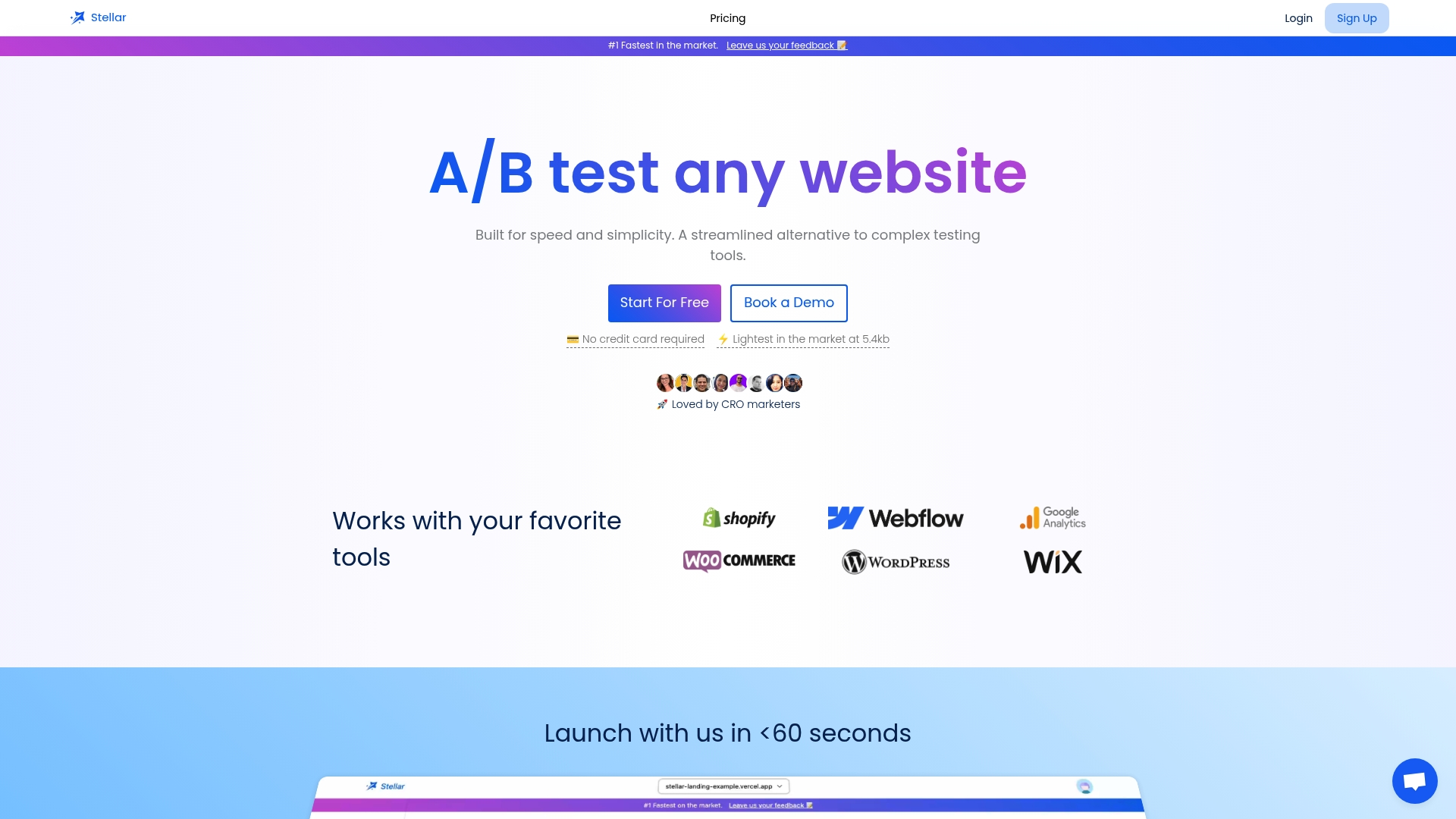
Stellar's lightweight 5.4KB script minimizes performance impact so your browser compatibility testing is not complicated by a slow-loading tool. The no-code visual editor lets you build and modify variants quickly, and real-time analytics help you spot browser-segmented anomalies the moment they surface. Whether you are just starting out or scaling your experiments, explore browser compatibility solutions and pair them with advanced web testing practices to protect every test you run.
Frequently asked questions
Which browsers are most important for compatibility testing?
Focus on Chrome, Safari, Firefox, and Edge first, then add the latest iOS and Android mobile browsers. Cross-browser edge cases like Safari's flexbox behavior and WebKit's JavaScript engine make these the highest-priority targets for A/B test protection.
How does browser compatibility affect A/B testing results?
If one browser renders a broken variant, your test data becomes unreliable and can produce a false winner. Browser rendering differences mean that layout shifts or script failures in a subset of browsers will skew your conversion metrics significantly.
Are automated browser compatibility testing tools enough?
Automated tools are a strong starting point but miss real-world edge cases. Mobile gestures and interruptions require manual checks and session replay to catch what scripts cannot simulate.
What are 'edge cases' in browser testing?
Edge cases are conditions that only occur in specific browsers or situations, such as layout gaps and session failures triggered by older Safari versions, back-button navigation in multi-step flows, or slow network environments.
Recommended
Published: 4/16/2026