
7 Common A/B Testing Mistakes CRO Marketers Must Avoid
More than 60 percent of american marketers admit to making avoidable mistakes during A/B testing. These errors can waste precious resources and lead to misguided business decisions. Learning what holds back accurate test results is the first step to getting real value from your experiments. This guide points out the common traps in testing so you can reach reliable conclusions and unlock the true potential of your marketing efforts.
Table of Contents
- 1. Not Defining Clear Goals Before Running Tests
- 2. Testing Too Many Variables at Once
- 3. Ending Tests Too Early Without Enough Data
- 4. Ignoring Statistical Significance and Sample Size
- 5. Failing to Segment Audience Properly
- 6. Overlooking Performance Impact and Site Speed
- 7. Neglecting Post-Test Analysis and Learnings
Quick Summary
| Key Insight | Clarification |
|---|---|
| 1. Define Clear Goals Before Testing | Establish specific, measurable objectives that align A/B tests with business outcomes for effective insights. |
| 2. Test One Variable at a Time | Isolate variables in tests to accurately determine which changes impact performance metrics. |
| 3. Ensure Sufficient Test Duration | Run tests long enough to achieve 95% statistical significance to avoid unreliable conclusions. |
| 4. Properly Segment Your Audience | Break audience into distinct segments for targeted insights that enhance overall conversion rates. |
| 5. Perform Thorough Post-Test Analysis | Analyze results post-test to understand performance drivers and apply learnings for future experiments. |
1. Not Defining Clear Goals Before Running Tests
Starting an A/B test without well defined goals is like navigating without a map. You might move, but you will not know where you are going. According to Adobe Experience League, aligning testing metrics with specific business objectives is crucial for meaningful insights.
Defining clear goals means identifying exactly what you want to improve and how that improvement connects to broader business outcomes. Do not fall into the trap of measuring metrics in isolation. A higher click-through rate means nothing if it does not translate into increased revenue or user engagement.
When setting goals for your A/B test, focus on metrics that directly impact your bottom line. These might include:
- Conversion rates
- Revenue per visitor
- Average order value
- Customer acquisition cost
- User retention
Research from Yieldwise emphasizes the importance of using split-unit designs that capture the complexity of marketing factors. This means your goals should be specific, measurable, and tied to a concrete business objective.
Practically speaking, before launching any test, ask yourself: What specific change am I trying to achieve? How will this directly contribute to our business growth? By answering these questions, you create a clear roadmap for your A/B testing strategy and ensure that every experiment moves you closer to meaningful improvements.
2. Testing Too Many Variables at Once
Multiple variables in a single A/B test are like trying to bake a complex recipe with too many ingredients. You will never know which ingredient made the difference. According to Content and Marketing, testing multiple variables simultaneously complicates data interpretation and obscures which specific changes impact results.
Isolated variable testing is the golden rule for meaningful A/B experiments. When you change multiple elements at once such as headline, button color, and page layout, you create statistical noise that prevents understanding the true driver of performance.
Research from Yieldwise suggests using split-unit designs to effectively manage experimental complexity. This means focusing on one primary variable per test to obtain clear actionable insights.
To implement this approach, prioritize your variables and test them sequentially:
- Start with the most potentially impactful variable
- Run a complete test cycle
- Document and analyze results
- Move to the next variable
This methodical strategy allows you to build a comprehensive understanding of what truly drives user behavior. By testing variables one at a time, you transform A/B testing from a guessing game into a precise, strategic tool for optimization. For marketers seeking deeper insights into choosing effective test variants, our guide on choosing test variants offers additional strategic recommendations.
3. Ending Tests Too Early Without Enough Data
Impatience kills A/B testing accuracy. Cutting your experiment short before collecting sufficient statistical evidence is like leaving a cake in the oven halfway through baking. According to Zest Digital, many CRO professionals make the critical mistake of not running tests long enough to gather meaningful data.
Statistical significance is the key metric that determines when you can confidently draw conclusions from your A/B test. This means collecting enough data points to ensure your results are not just random fluctuations but genuine performance differences.
To determine the right test duration, consider these crucial factors:
- Total website traffic
- Current conversion rates
- Desired statistical confidence level
- Magnitude of expected improvement
Professional marketers typically recommend running tests until you achieve at least 95% statistical significance and collect a substantial sample size. For most websites, this means running tests for 2 to 4 weeks to account for variations in user behavior across different days and times.
If you want to dive deeper into understanding optimal test durations, our guide to stopping A/B tests provides comprehensive insights into making data driven decisions. Remember: patience in A/B testing is not just a virtue its a mathematical necessity for reliable results.
4. Ignoring Statistical Significance and Sample Size
Treating A/B testing like a coin flip is a recipe for marketing disaster. According to Search Engine Journal, prematurely ending tests or disregarding statistical significance can lead to unreliable conclusions that misguide your optimization efforts.
Statistical significance is not just a fancy term. It is the mathematical validation that separates meaningful insights from random noise. Think of it as a confidence meter telling you whether your test results are genuine performance differences or just statistical accidents.
Professional marketers typically look for a 95% confidence level as the minimum threshold for drawing actionable conclusions. This means you need enough data points to ensure your results are not happening by chance.
Key considerations for robust statistical analysis include:
- Minimum sample size requirements
- Consistent traffic across test variations
- Appropriate confidence intervals
- Controlling for external variables
As Zest Digital emphasizes, ignoring sample size and test duration can result in misleading data that derails your optimization strategy. If you want to master the nuances of statistical power in your experiments, our guide to understanding statistical power provides comprehensive insights for data driven decision making.
5. Failing to Segment Audience Properly
Treating all website visitors like a uniform mass is marketing malpractice. Your audience is not a monolithic group but a diverse collection of individuals with unique behaviors, preferences, and motivations.
Audience segmentation transforms generic testing into precision marketing. By breaking down your audience into meaningful subgroups, you unlock the ability to create targeted experiments that reveal nuanced insights about specific user types.
Effective audience segmentation goes beyond basic demographics. Consider segmenting based on:
- Traffic source
- Device type
- User behavior
- Purchase history
- Geographic location
- Customer lifecycle stage
Professional marketers understand that what works for a mobile user in New York might completely fail for a desktop user in rural California. Each segment represents a unique lens through which you can understand user interaction and optimize conversion rates.
For marketers looking to master the art of audience segmentation, our guide to segmenting test audiences provides comprehensive strategies to transform your A/B testing approach. Remember: the more precisely you understand your audience, the more effectively you can design experiments that drive meaningful results.
6. Overlooking Performance Impact and Site Speed
A slow loading website is like a shop with locked doors. No matter how great your products might be, customers will never enter if the entrance takes too long. According to HubSpot, A/B testing tools can potentially slow down site performance, directly impacting your conversion rates and search engine rankings.
Site speed is not just a technical metric. It is a critical conversion factor that determines whether visitors stay or bounce. Every additional second of load time can reduce conversion rates by up to 20 percent.
When conducting A/B tests, marketers must consider the performance implications:
- Choose lightweight testing scripts
- Minimize external script loading
- Use asynchronous script loading
- Implement server side testing when possible
- Monitor page load times during experiments
Professional marketers recognize that the cost of a slow website far outweighs any potential insights gained from poorly implemented tests. For comprehensive strategies on maintaining peak website performance, explore our guide to website performance impact. Remember: an optimized testing approach protects both user experience and conversion potential.
7. Neglecting Post-Test Analysis and Learnings
Running an A/B test without thorough post analysis is like solving a puzzle and leaving half the pieces on the table. According to Adobe Experience League, understanding the business impact of test results is crucial for strategic decision making.
Post-test analysis transforms raw data into actionable insights. It is not just about determining which variant won, but understanding why it performed better and how those learnings can be applied across your broader marketing strategy.
Effective post-test analysis involves examining multiple dimensions:
- Statistical significance of results
- Segment specific performance variations
- Long term impact on key business metrics
- Potential unexpected learnings
- Implications for future experiments
Research from Yieldwise emphasizes the importance of recognizing split unit design complexities to draw valid experimental conclusions. For marketers seeking to master comprehensive test result interpretation, our guide to analyzing split test results provides strategic methodologies to extract maximum value from every experiment.
Below is a comprehensive table summarizing the common A/B testing mistakes and strategies to rectify them, as discussed in the article.
| Mistake | Description | Strategy to Rectify |
|---|---|---|
| Not Defining Clear Goals | Starting tests without specific objectives leads to unclear results. Ensure goals tie to business outcomes like conversion rates. | Define specific, measurable goals linked to concrete business objectives for meaningful insights. |
| Testing Too Many Variables | Simultaneous variable changes obscure which change impacts results. | Focus on one variable at a time using isolated variable testing for clear, actionable insights. |
| Ending Tests Too Early | Insufficient data collection leads to inaccurate conclusions. | Run tests long enough to reach at least 95% statistical significance, typically for 2-4 weeks. |
| Ignoring Statistical Significance | Disregarding statistics leads to unreliable results. | Ensure tests meet a 95% confidence level with adequate sample size and controlled variables. |
| Failing to Segment Audience Properly | Treating all visitors the same misses unique insights. | Segment audiences by factors like device type or behavior for targeted, nuanced experiments. |
| Overlooking Performance Impact | Test scripts can slow down site performance, affecting conversions. | Use lightweight, asynchronous scripts and monitor site speed to maintain performance. |
| Neglecting Post-Test Analysis | Without analysis, valuable insights are lost. | Conduct thorough analysis of statistical significance and performance variations for strategic insights. |
Avoid Common A/B Testing Mistakes With Tools Built For Results
Many marketers struggle with unclear goals, testing too many variables, and rushing to end tests. These mistakes often lead to wasted time, confusing data, and missed growth opportunities. The key is having a lightweight, easy-to-use A/B testing platform that supports clear goal tracking and lets you test one variable at a time without slowing down your website.
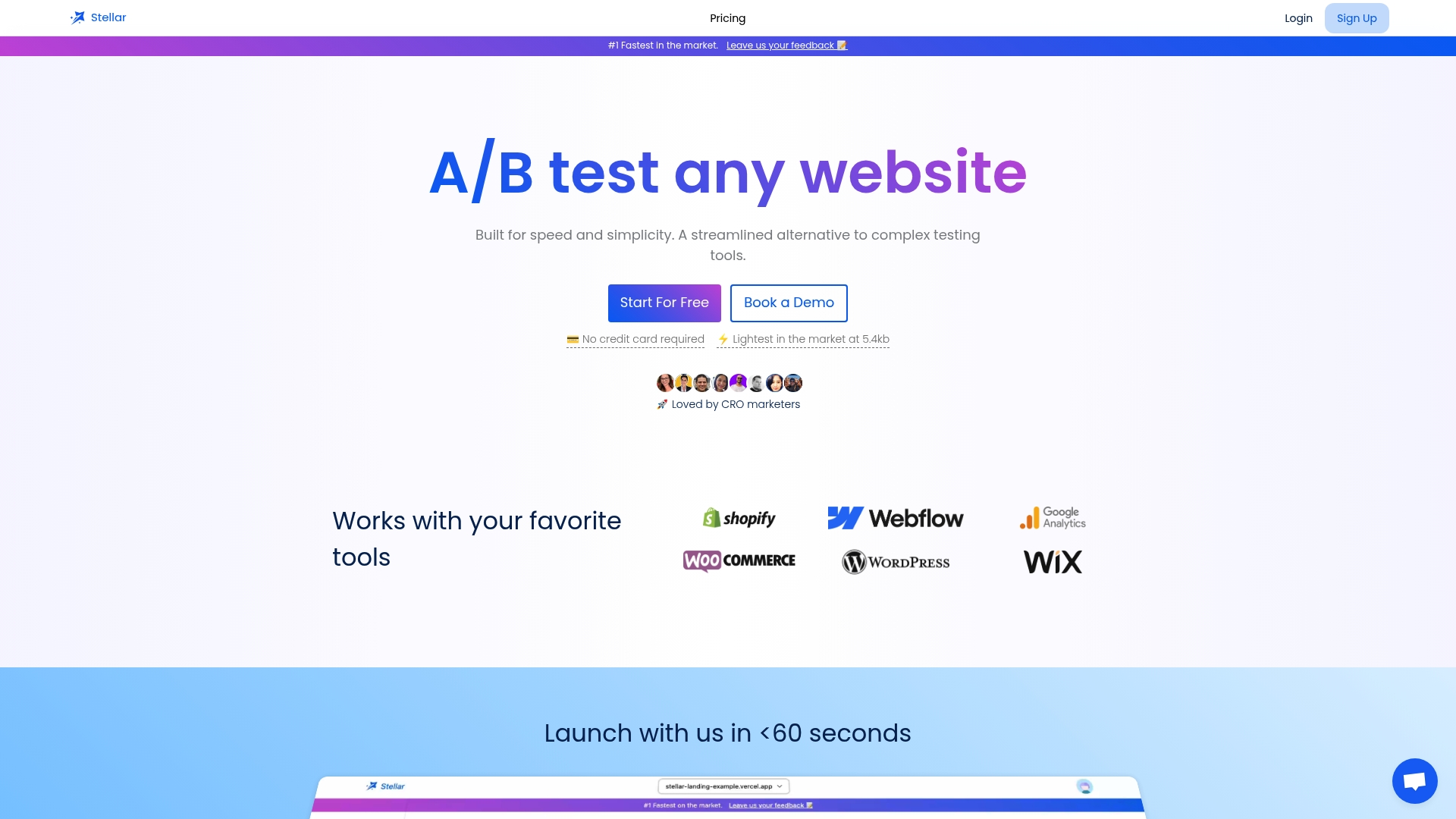
Discover how Stellar helps you avoid these pitfalls with its no-code visual editor and advanced goal tracking. Our fast 5.4KB script means you get results without site speed issues slowing you down. Ready to transform your A/B testing process and make confident, data-driven decisions? Start optimizing smarter today with Stellar. Learn more about setting up effective experiments in our guide to choosing test variants and explore how to stop A/B tests at the right time for reliable insights.
Frequently Asked Questions
What are the key goals I should define before starting an A/B test?
Defining clear goals is essential for a successful A/B test. Identify specific metrics that align with your business objectives, such as conversion rates or revenue per visitor, to guide your testing efforts effectively.
How do I determine if my A/B test is statistically significant?
To assess statistical significance, collect sufficient data points to ensure results are not random. Aim for a minimum confidence level of 95%, which typically requires running tests for 2 to 4 weeks, depending on your site's traffic.
What is the best way to segment my audience for A/B testing?
Effective audience segmentation involves breaking down your visitors into meaningful groups, such as by traffic source or user behavior. Focus on creating targeted experiments for each segment to gain deeper insights and optimize conversion rates.
How many variables should I test in a single A/B test?
It's best to test only one primary variable at a time. This approach minimizes confusion and ensures that you can clearly identify which change has impacted the results of your test.
What steps should I take for post-test analysis?
After completing your A/B test, thoroughly analyze the results to understand why one variant performed better than another. Examine factors such as statistical significance, audience segments, and any unexpected outcomes to apply valuable insights to future tests.
How can I maintain site speed while conducting A/B tests?
To keep your site running smoothly during A/B testing, choose lightweight testing scripts and minimize external loading. Regularly monitor page load times to ensure they remain optimal and do not negatively impact your conversion rates.
Recommended
- How to Choose Test Variants: A CRO Marketer’s Guide 2025
- A/B Testing Digital Marketing: Strategies and Best Practices 2025
- Test Duration Best Practices for Optimizing CRO Results
- A/B Testing Checklist 2025: Essentials for Marketers
- Understanding Effective Calls to Action for Greater Impact | Prodcast
Published: 11/21/2025