
Common Analytics Challenges Impacting A/B Testing
Launching a new experiment should offer clarity, yet digital marketers at small organizations often encounter hidden hurdles that disrupt even the simplest A/B test. These challenges stem from complex analytics issues such as low statistical power and randomization failures, complicating what seems straightforward. By understanding the intersection of statistical, technical, and practical problems, marketers can improve the reliability and impact of their A/B testing efforts, even without advanced data science skills. Analytics challenges in A/B testing stand at the center of achieving actionable, trustworthy insights.
Table of Contents
- Defining Analytics Challenges In A/B Testing
- Types Of Analytics Issues Marketers Face
- Key Factors Behind Data Quality Problems
- Impact Of Limited Traffic And Resources
- Legal And Privacy Obstacles For SmBs
- How SmBs Can Overcome Analytics Barriers
Key Takeaways
| Point | Details |
|---|---|
| Overcome Statistical Challenges | Utilize advanced statistical techniques and ensure robust experiment designs to address issues like low statistical power and small effect sizes. |
| Enhance Data Quality | Implement stringent quality control and validation protocols to mitigate data collection inconsistencies and ensure reliable insights. |
| Maximize Resource Efficiency | Develop targeted segmentation strategies and simplify experiments to achieve reliable results despite limited traffic and resources. |
| Navigate Legal Compliance | Create a comprehensive privacy compliance framework to address regulations effectively while maintaining user trust and operational integrity. |
Defining Analytics Challenges in A/B Testing
A/B testing represents a critical methodology for data-driven decision making, yet numerous complex analytics challenges frequently undermine its effectiveness. Online controlled experiments involve intricate statistical processes that demand rigorous design and meticulous interpretation to generate meaningful insights.
The core analytics challenges in A/B testing emerge from multiple intersecting domains. Statistical complexity represents the first significant hurdle, where researchers must navigate small effect sizes, limited statistical power, and potential validity threats. These challenges require sophisticated techniques to ensure experiment outcomes reflect genuine performance differences rather than random statistical noise. Statistical hypothesis testing methods play a crucial role in distinguishing meaningful variations from potential false positives.
Furthermore, A/B testing analytics challenges extend beyond pure statistical considerations. Stakeholder alignment, experiment design, sample size determination, and result interpretation collectively contribute to potential pitfalls. Marketing teams, product managers, and data scientists must collaborate closely to design experiments that generate actionable insights while maintaining methodological rigor.
Pro tip: Always validate your A/B test sample size and statistical significance thresholds before launching to minimize potential misinterpretation of results.
Here's a summary of common analytics challenges in A/B testing and strategies to address them:
| Challenge Domain | Example Issue | Strategic Solution |
|---|---|---|
| Statistical Analysis | Low statistical power, small effects | Use advanced statistical techniques |
| Data Collection | Incomplete or inconsistent data | Implement rigorous quality controls |
| Experiment Design | Poor segmentation, sample bias | Optimize sampling and segmentation |
| Result Interpretation | Misreading statistical significance | Collaborate with analytics experts |
Types of Analytics Issues Marketers Face
Marketing teams encounter a complex landscape of analytics challenges that can significantly impact the effectiveness of their A/B testing strategies. Infrastructure challenges in experimental design represent a critical area where marketers struggle to maintain reliable and scalable testing processes.
The primary types of analytics issues can be categorized into several key domains. Data collection quality emerges as a fundamental challenge, with marketers often facing inconsistent or incomplete data that undermines experimental integrity. Sample size limitations, statistical noise, and improper segmentation frequently compromise the reliability of test results. Practical analytics challenges demonstrate that even sophisticated marketing teams can encounter significant hurdles in generating meaningful insights.

Furthermore, technical and interpretative challenges compound the complexity of A/B testing analytics. Marketers must navigate issues like selection bias, inadequate control groups, premature result interpretation, and the inability to account for external variables that might influence test outcomes. The analytics tools for marketing play a crucial role in mitigating these challenges, providing sophisticated mechanisms for more accurate data analysis and interpretation.
Pro tip: Develop a standardized analytics validation protocol to systematically identify and mitigate potential data collection and interpretation errors before finalizing your A/B test results.
Key Factors Behind Data Quality Problems
Data quality challenges represent a critical obstacle in A/B testing, with multiple complex factors undermining experimental reliability. Randomization failures and data logging inconsistencies emerge as primary sources of potential analytical errors, creating significant risks for marketers seeking accurate insights.
The fundamental issues driving poor data quality can be categorized into technical, behavioral, and statistical domains. Technical challenges include imperfect tracking mechanisms, javascript implementation errors, and incomplete user session recording. Statistical measurement errors compound these problems, introducing sampling bias that can systematically skew experimental results. Behavioral variability further complicates data integrity, as user interactions become increasingly unpredictable across different digital platforms and devices.
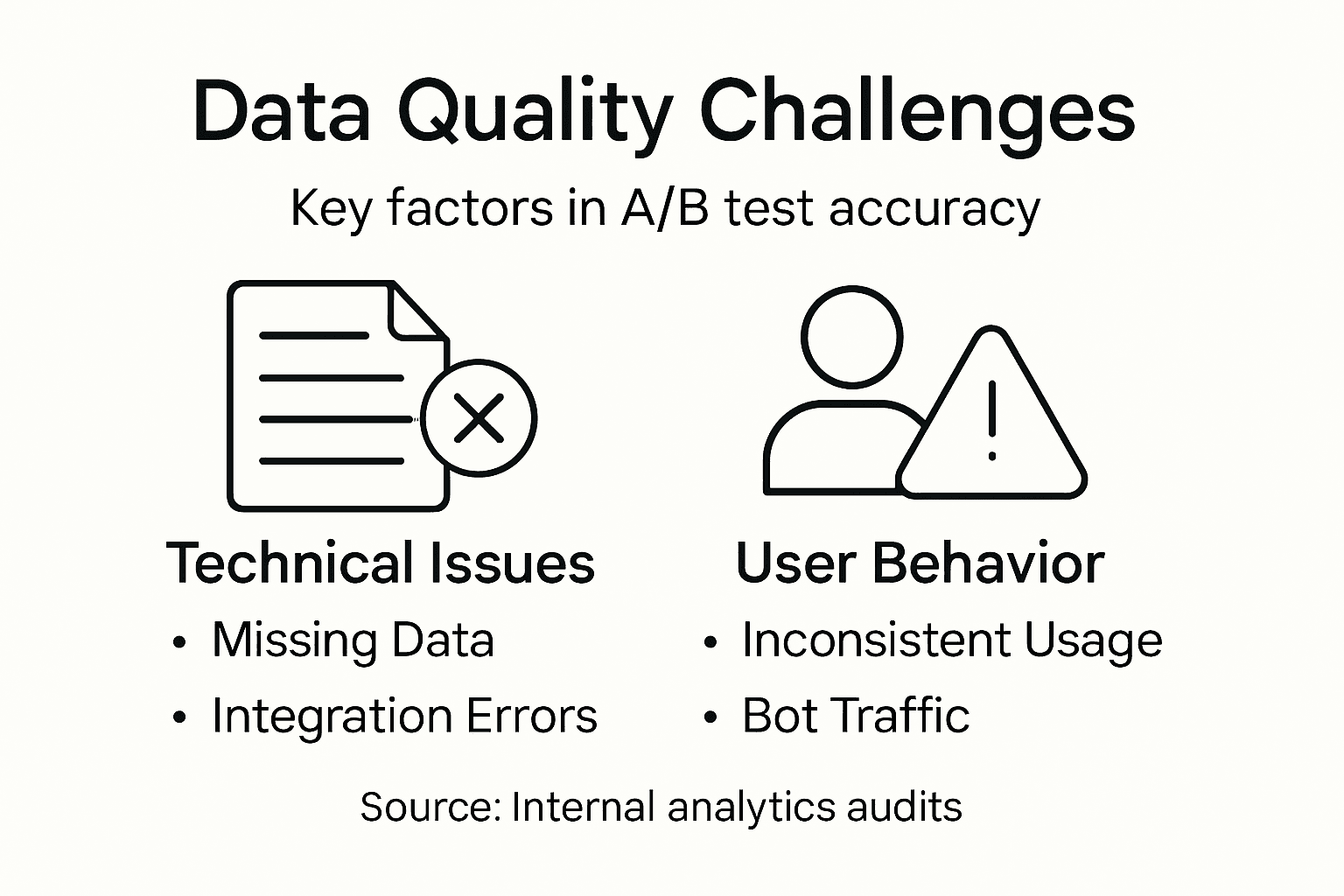
Additionally, contextual factors such as external environmental variables, device-specific behaviors, and temporal variations significantly impact data collection accuracy. Marketers must develop sophisticated strategies to identify and mitigate these potential sources of contamination. Implementing robust data validation protocols, using multiple tracking methods, and establishing stringent quality control checkpoints can help minimize the risk of misleading experimental outcomes.
Pro tip: Create a comprehensive data validation checklist that includes technical, statistical, and behavioral verification steps before launching any A/B test.
Here's a comparison of technical, behavioral, and contextual data quality factors affecting A/B testing:
| Factor Type | Common Problems | Potential Impact on Experiments |
|---|---|---|
| Technical | Faulty tracking, logging errors | Lost or misleading user interaction data |
| Behavioral | Unpredictable user actions, variability | Inaccuracy in audience insights and test results |
| Contextual | Seasonal effects, device variation | Reduced reliability in cross-platform analytics |
Impact of Limited Traffic and Resources
Limited traffic represents a critical constraint for marketing teams conducting A/B testing, fundamentally impacting experimental design and statistical reliability. Traffic volume challenges in experimentation significantly restrict an organization's ability to generate meaningful insights, creating substantial barriers for smaller businesses and digital platforms with reduced user engagement.

The primary consequences of limited traffic manifest across multiple analytical dimensions. Statistical power diminishes dramatically when sample sizes are constrained, leading to extended experiment durations and increased uncertainty in results. Scalability constraints in A/B testing highlight how resource limitations can prevent robust user segmentation and introduce potential experiment overlapping, which compromises the integrity of comparative analyses.
Small to medium-sized businesses face particularly acute challenges when navigating these resource constraints. Marketers must develop sophisticated strategies to maximize experimental efficiency, such as implementing more targeted segmentation, reducing experiment complexity, and utilizing statistical techniques that can extract meaningful insights from smaller sample sizes. Low-traffic A/B testing strategies become essential for organizations seeking to make data-driven decisions without extensive user bases.
Pro tip: Prioritize high-impact, low-complexity experiments and leverage statistical techniques like sequential testing to maximize insights from limited traffic volumes.
Legal and Privacy Obstacles for SMBs
Small and medium-sized businesses face increasingly complex legal challenges in data-driven marketing, particularly when implementing analytics and A/B testing strategies. Persistent privacy risks for small businesses create substantial barriers that demand sophisticated compliance approaches and deep understanding of regulatory landscapes.
The primary legal obstacles emerge from multifaceted privacy regulations such as GDPR, California Consumer Privacy Act, and emerging international data protection frameworks. These regulations impose stringent requirements for user consent, data collection transparency, and individual privacy rights. SMBs must navigate these complex legal terrains with limited legal resources, often struggling to develop robust compliance mechanisms that protect both user privacy and business interests. GDPR compliance in testing becomes particularly challenging, requiring meticulous documentation and explicit user consent protocols.
Moreover, the potential financial and reputational risks associated with data privacy violations create additional pressure for small businesses. Non-compliance can result in significant monetary penalties, legal actions, and substantial damage to brand reputation. Smaller organizations must invest disproportionate resources in understanding and implementing comprehensive privacy protection strategies, often competing with larger enterprises that have more extensive legal and technical capabilities.
Pro tip: Develop a comprehensive privacy compliance framework by consulting legal experts, implementing transparent user consent mechanisms, and regularly auditing your data collection and testing practices.
How SMBs Can Overcome Analytics Barriers
Small and medium-sized businesses must adopt strategic approaches to address analytics challenges, transforming limitations into opportunities for data-driven growth. Strategic technological interventions represent a critical pathway for overcoming fundamental barriers that traditionally impede effective A/B testing and analytics implementation.
Technological solutions form the cornerstone of analytics barrier mitigation. Cloud-based platforms and lightweight analytics tools can dramatically reduce infrastructure costs and complexity, enabling SMBs to access sophisticated testing capabilities without massive investments. Leveraging analytics tools for marketing success allows businesses to implement robust experimentation frameworks that were previously accessible only to large enterprises with extensive resources.
Educational and collaborative strategies complement technological solutions. SMBs should prioritize staff training in data methodologies, invest in upskilling team members, and consider strategic partnerships with external analytics experts. These approaches help bridge knowledge gaps, introduce advanced analytical techniques, and provide access to specialized expertise that can transform data collection, interpretation, and strategic decision-making processes.
Pro tip: Develop a scalable analytics learning program within your organization that combines online training, expert consultations, and hands-on experimentation to continuously improve your team's data capabilities.
Overcome Your A/B Testing Analytics Challenges with Stellar
Dealing with complex analytics issues like low statistical power, data quality problems, and limited traffic can leave marketers and product managers feeling stuck and unsure about their test results. If you want to avoid pitfalls like misinterpreting statistical significance or struggling with infrastructure limitations, then a powerful yet simple solution is essential. Stellar offers a lightweight, no-code platform that addresses these common pain points by providing fast load times, dynamic keyword insertion, and advanced goal tracking.
Start turning your A/B testing obstacles into growth opportunities today. Explore how our real-time analytics and user-friendly visual editor can simplify experiment design and improve decision-making. Visit Stellar's A/B Testing Tool to see how small and medium-sized businesses make smarter decisions with less complexity and better results. Don't let analytics challenges hold your business back. Take control now at https://gostellar.app.
Frequently Asked Questions
What are the common analytics challenges in A/B testing?
Common challenges include low statistical power, small effect sizes, incomplete or inconsistent data, poor experiment design, and misinterpretation of results.
How can marketers address data quality problems in A/B testing?
Marketers can implement rigorous quality control measures, establish comprehensive validation protocols, and utilize multiple tracking methods to mitigate data quality issues.
What should small businesses do to overcome limited traffic when running A/B tests?
Small businesses should prioritize high-impact experiments, reduce complexity, and leverage statistical techniques like sequential testing to extract meaningful insights from limited traffic.
How do privacy regulations impact A/B testing for small and medium-sized businesses?
Privacy regulations impose strict requirements on user consent and data transparency, making it essential for SMBs to develop robust compliance mechanisms to protect user privacy and avoid legal repercussions.
Recommended
- Overcoming A/B Testing Challenges: Strategies for 2025
- A B Testing Meaning: Uncover Data-Driven Insights for Better Conversions
- How to Interpret Analytics for Better A/B Test Results
- 7 Common A/B Testing Mistakes CRO Marketers Must Avoid
- Campaign Analytics Guide: Master Data-Driven Success in 2025 - Affinsy Blog | Affinsy
- AI Model A/B Testing Framework: Production Implementation Guide
Published: 1/17/2026