
Copywriting for landing pages: boost conversions in 2026
Most marketers think landing page copy is just about selling harder. That's backwards. Great landing page copywriting isn't about pushing products, it's about guiding visitors toward a single, clear action through strategic messaging. When done right, landing page copy drives conversion by removing friction, building trust, and speaking directly to visitor needs. In 2026, digital marketers who master these techniques see dramatically better campaign results. This article unpacks proven copywriting frameworks, optimization tactics, and real-world strategies to transform your landing pages into conversion machines.
Table of Contents
- What Makes Landing Page Copywriting Uniquely Powerful
- Proven Copywriting Frameworks: AIDA And PAS For Landing Pages
- Optimizing Landing Page Copy: Key Elements And Real-World Impacts
- Balancing Copy Length And Emotional Connection For Maximum Impact
- Optimize Your Landing Pages With Expert Support
- Frequently Asked Questions
Key takeaways
| Point | Details |
|---|---|
| Landing page copy focuses on one goal | Unlike homepages, landing pages eliminate distractions to drive a single conversion action |
| Frameworks remove guesswork | AIDA and PAS formulas provide proven structures for persuasive, psychologically driven copy |
| Specific elements drive results | Headlines, CTAs, and social proof can increase conversions by 10-30% when optimized |
| Copy length depends on context | Short copy works for simple offers while complex products need detailed narratives |
| Testing accelerates improvement | Continual A/B testing of copy elements compounds conversion gains over time |
What makes landing page copywriting uniquely powerful
Landing page copywriting is persuasive text designed for a single conversion action, whether that's a demo request, email signup, or purchase. Unlike homepages that offer multiple navigation paths, landing pages eliminate distractions to focus visitor attention on one specific goal. This singular focus makes landing page copy uniquely powerful for conversion optimization.
The real strength comes from message consistency. When your ad promise, email teaser, and landing page headline all align perfectly, visitors feel confident they're in the right place. This consistency builds immediate trust and reduces bounce rates. Every element on your landing page, from headline to CTA button text, should reinforce the same core message that brought visitors there.
Landing page copy plays a critical role in your marketing funnel. It bridges the gap between awareness (your ads) and action (conversion). Think of it as the moment of truth where interest transforms into commitment. Your copy must acknowledge where visitors are coming from, address their specific pain points, and make the next step feel obvious and low risk.
Consider these key differentiators:
- Focused messaging that speaks to one audience segment
- Elimination of navigation menus and competing CTAs
- Strategic placement of social proof at decision points
- Benefit driven language that answers "what's in it for me"
Pro Tip: Before writing a single word, review the exact ad copy or email that drives traffic to your landing page. Your headline should feel like a natural continuation of that message, not a jarring shift in tone or promise.
When you design effective landing pages, copy and design work together. White space around your headline makes it pop. Short paragraphs with clear benefit statements keep readers engaged. Every visual element should support your copy's persuasive flow, not compete with it. The goal is frictionless movement from curiosity to conversion, and strategic copywriting makes that journey feel effortless. Understanding how to improve landing page performance starts with recognizing that copy isn't decoration, it's the engine driving visitor behavior.

Proven copywriting frameworks: AIDA and PAS for landing pages
Copywriting formulas take the guesswork out of persuasion. Two frameworks dominate landing page strategy: AIDA and PAS. Both are proven to increase conversion rates by tapping into psychological triggers that move people toward action.
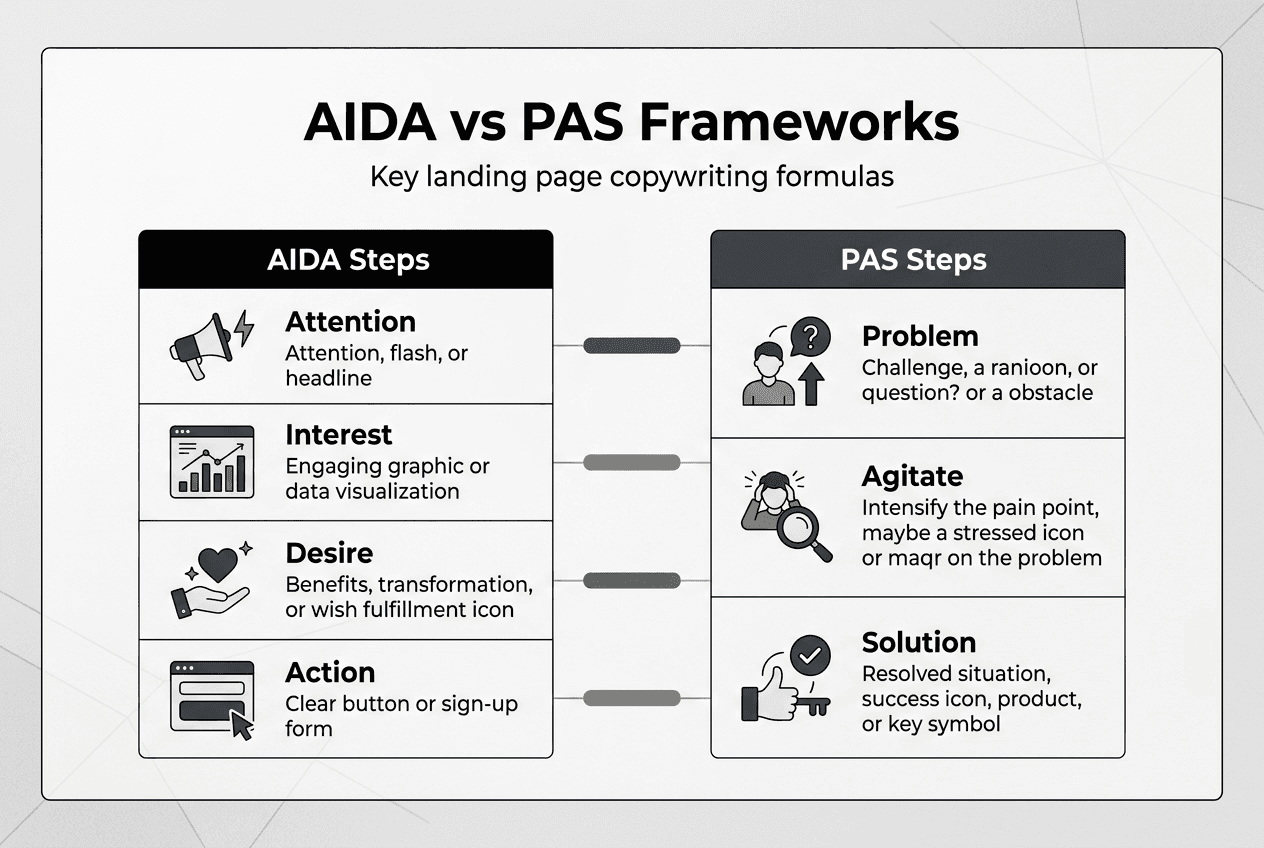
AIDA stands for Attention, Interest, Desire, Action. Start with a headline that grabs attention through specificity or surprise. Build interest with subheadings that preview key benefits. Create desire by showing transformation, not just features. Close with a clear action step. For example, a project management tool might use: "Stop Missing Deadlines" (attention), "See every task across teams in one view" (interest), "Join 50,000 teams shipping faster" (desire), "Start your free trial" (action).
PAS means Problem, Agitate, Solution. Open by naming the exact problem your audience faces. Agitate by exploring the consequences of inaction or the frustration of current solutions. Present your offer as the elegant solution. This works brilliantly for pain aware audiences. A backup software company might write: "Lost files cost businesses $12,000 per incident" (problem), "Manual backups fail 40% of the time, and you won't know until it's too late" (agitate), "Automated cloud backup runs every hour with zero setup" (solution).
| Framework | Best for | Structure | Strength |
|---|---|---|---|
| AIDA | Awareness stage traffic | Attention to Interest to Desire to Action | Builds excitement and momentum |
| PAS | Problem aware audiences | Problem to Agitation to Solution | Creates urgency through pain points |
| AIDA | Aspirational products | Positive emotional journey | Works for luxury and lifestyle offers |
| PAS | B2B and technical solutions | Logical problem solving path | Resonates with analytical buyers |
Choose your framework based on visitor awareness. If people don't know they have a problem, AIDA works better because it creates desire from scratch. If visitors are actively searching for solutions, PAS speaks directly to their existing pain and positions you as the answer.
Pro Tip: Match your formula to your traffic source. Paid search visitors (high intent) respond well to PAS because they're problem aware. Social media traffic (discovery mode) often converts better with AIDA's aspirational approach.
Both frameworks force you to think strategically about copy flow. You can't jump straight to features or pricing. You must earn attention, build a case, and make action feel inevitable. When you follow these structures, your landing page optimization efforts become systematic rather than random. You'll also avoid common landing page errors like burying the value proposition or creating confusing CTAs. These formulas have worked for decades because they mirror how humans actually make decisions.
Optimizing landing page copy: key elements and real-world impacts
Specific copy elements drive measurable conversion improvements. Your headline matters most. Rewriting above the fold content can boost conversions 10 to 30 percent because it's the first thing visitors evaluate. Make headlines specific, not clever. "Get 50% more leads in 30 days" beats "Transform your marketing" every time.
Your subheadline expands on the headline promise. Use it to add credibility or address the obvious objection. If your headline promises speed, your subheadline might add "No credit card required, setup in 5 minutes." Body copy should focus on benefits and outcomes, not features. Instead of "Cloud based dashboard," write "Access your data from anywhere, even on your phone."
CTAs deserve obsessive attention. Button copy should be action oriented and specific. "Start my free trial" outperforms "Submit" because it tells visitors exactly what happens next. Place your primary CTA above the fold and repeat it after each major benefit section. Social proof near CTAs reduces hesitation. Customer logos, testimonial snippets, or usage statistics ("Join 10,000 marketers") all work.
| Copy element | Baseline conversion | After optimization | Improvement |
|---|---|---|---|
| Headline specificity | 2.3% | 3.1% | +35% |
| Benefit focused body copy | 1.8% | 2.4% | +33% |
| Action oriented CTA | 2.1% | 2.9% | +38% |
| Social proof placement | 1.9% | 2.6% | +37% |
Real world results prove these tactics work. One advertiser tripled landing page conversions by rewriting copy to focus on customer outcomes rather than product features. They replaced technical jargon with plain language benefits and moved testimonials higher on the page. The result was a 3x increase in qualified leads with the same traffic volume.
Follow this optimization sequence:
- Test your headline first because it has the biggest impact on bounce rate
- Refine your primary CTA copy and placement next
- Optimize body copy to emphasize benefits over features
- Add or reposition social proof elements near decision points
- Remove any copy that doesn't directly support your conversion goal
- Test variations continuously to compound improvements over time
Pro Tip: Every word on your landing page should answer the question "So what?" from your visitor's perspective. If a sentence doesn't clearly communicate value or build trust, delete it. Clarity beats cleverness.
When you test headline variations, you'll discover that small wording changes create surprisingly large conversion swings. This is why testing landing pages matters for sustainable growth. Data beats opinions. What you think sounds good might underperform a straightforward benefit statement. Let your audience tell you what resonates through their actions, not your assumptions.
Balancing copy length and emotional connection for maximum impact
The short versus long copy debate misses the point. Copy length depends on context, specifically your product complexity, audience awareness, and where visitors are in the funnel. Simple, low cost offers convert with minimal copy. Complex B2B solutions need detailed explanations to overcome skepticism and justify higher prices.
Short copy works when your offer is self explanatory and low risk. A free ebook download needs just enough copy to communicate the value and build minimal credibility. Long copy works when you're asking for significant commitment, whether that's money, time, or business risk. Enterprise software buyers want proof, comparisons, and detailed feature explanations before they'll book a demo.
Audience awareness changes everything. If visitors already understand their problem and are comparing solutions, you can skip education and focus on differentiation. If they're problem unaware, you need more copy to build the case for why they should care. Match your copy length to how much convincing is required, not arbitrary word counts.
The real secret is emotional connection, not length. Speak your audience's language. Use the exact words they use to describe their problems. Address their specific fears and aspirations. Copy that resonates emotionally converts better than copy that just lists features, regardless of length.
Incorporate these emotional triggers:
- Fear of missing out on competitive advantage
- Desire for status or recognition among peers
- Frustration with current inefficient processes
- Hope for easier, faster results
- Trust built through transparency and social proof
"Features tell, benefits sell, but emotions close the deal. Your landing page copy must tap into what your audience truly cares about, whether that's saving time, reducing stress, or achieving professional success."
Test both approaches for your specific situation. Create a concise version and a detailed version, then let conversion data decide. You might discover that your audience wants more information than you assumed, or that you're overwhelming them with unnecessary detail. The answer isn't universal, it's specific to your offer and audience. Understanding whether short or long landing pages work better for your situation requires testing, and optimizing for mobile adds another layer since mobile users typically prefer scannable, concise copy. Balance thoroughness with readability, and always prioritize clarity over comprehensiveness.
Optimize your landing pages with expert support
You now have frameworks, tactics, and strategies to write high converting landing page copy. Implementing these improvements systematically requires the right tools. Stellar's A/B testing platform lets you test headline variations, CTA copy, and messaging frameworks without touching code. The visual editor makes it simple to iterate quickly.
Our lightweight script won't slow your pages down, and real time analytics show exactly which copy changes drive conversions. Whether you're testing AIDA versus PAS frameworks or optimizing individual elements, Stellar gives you the speed and insights to improve continuously. Start testing smarter at GoStellar and turn your landing pages into conversion engines.
Pro Tip: Set up tests for one element at a time so you know exactly what drives results. Test your headline first since it impacts every visitor, then move to CTAs and body copy systematically.
Frequently asked questions
What is landing page copywriting and why does it matter?
Landing page copywriting is persuasive text designed to guide visitors toward one specific conversion action. It matters because focused, strategic copy can increase conversion rates by 30 percent or more compared to generic messaging. Every word should remove friction and build confidence in taking the desired action.
How long should my landing page copy be?
Copy length depends on your offer complexity and audience awareness. Simple, low risk offers like ebook downloads convert with 200 to 300 words. Complex B2B products or high ticket items need 800 to 1500 words to address objections and build sufficient trust. Test both approaches with your specific audience to find what works.
Should I use AIDA or PAS for my landing page?
Use AIDA for awareness stage traffic that needs education and inspiration. Use PAS for problem aware audiences actively searching for solutions. Match your framework to traffic source: social media and display ads often work better with AIDA, while paid search converts well with PAS since visitors already recognize their problem.
What makes a landing page headline effective?
Effective headlines are specific, benefit focused, and align with the traffic source promise. Include numbers or timeframes when possible ("Get 50% more leads in 30 days"). Avoid clever wordplay that obscures your value proposition. Test headline variations since they have the biggest impact on initial engagement and bounce rates.
How often should I test landing page copy?
Test continuously, focusing on one element at a time for clear insights. Start with your headline since it affects all visitors, then test CTA copy, benefit statements, and social proof placement. Run each test until you reach statistical significance, typically 100 to 200 conversions per variation depending on your baseline conversion rate.
Recommended
Published: 3/12/2026