
Develop marketing hypotheses for A/B testing in 2026
Many marketers run A/B tests without clear direction, testing random changes and hoping for insights. This approach wastes time and budget. The difference between successful and failed experiments lies in developing strong, testable marketing hypotheses that predict exactly what will happen and why. This guide shows you how to create focused hypotheses that transform vague testing into actionable growth strategies for your business.
Table of Contents
- Introduction To Marketing Hypotheses In A/B Testing
- Key Components Of A Strong Marketing Hypothesis
- Using Data To Generate And Prioritize Hypotheses
- Common Misconceptions And Pitfalls In Developing Hypotheses
- Frameworks And Best Practices For Hypothesis Formulation
- Bridging Hypothesis Development To A/B Test Execution
- Conclusion: Transforming Marketing Decisions With Hypothesis-Driven Testing
- Explore Stellar For Seamless Hypothesis-Driven Marketing Tests
Key takeaways
| Point | Details |
|---|---|
| Marketing hypotheses guide focused testing | Strong hypotheses predict specific outcomes from specific changes, eliminating random experimentation. |
| Three components make hypotheses effective | Problem statement, proposed change, and measurable outcome create testable predictions. |
| Data prioritization increases success rates | Analytics and customer feedback help rank hypotheses by impact and effort for maximum ROI. |
| Single-variable testing prevents confusion | Testing one change at a time ensures clear attribution of results to specific modifications. |
| Frameworks accelerate hypothesis development | Structured approaches like MECLABS speed creation of testable, actionable predictions. |
Introduction to marketing hypotheses in A/B testing
A marketing hypothesis is a testable statement that predicts how a specific change will affect user behavior or business metrics. Unlike guesswork, hypotheses create a clear framework for experiments. They focus your testing efforts on measurable goals rather than hoping for accidental discoveries.
Small and medium-sized businesses face resource constraints. You cannot afford to test every idea that crosses your mind. Hypotheses solve this by connecting observed problems to proposed solutions with expected outcomes. This structure lets you learn systematically, whether tests succeed or fail.
Consider common business challenges that hypotheses address:
- Increasing conversion rates on landing pages
- Reducing cart abandonment during checkout
- Improving email open rates and click-through
- Boosting engagement on product pages
- Decreasing form completion time
Random testing generates data points without context. You might discover that a blue button outperforms a red button, but without understanding why, you cannot apply the learning elsewhere. Hypothesis-driven testing builds knowledge that compounds across experiments.
Understanding marketing psychology basics strengthens your ability to create hypotheses grounded in human behavior patterns rather than assumptions.
Key components of a strong marketing hypothesis
Every effective hypothesis contains three essential elements: a problem statement, a proposed change, and an anticipated measurable result. This structure creates clarity before you invest time building test variations.

The classic format follows this pattern: "If [change], then [result], because [reason]." The "because" component matters most. It forces you to articulate your reasoning, which reveals whether you are testing a genuine insight or just guessing. Effective hypotheses include measurable outcomes and clear rationale linking changes to expected behavior.
Examine these examples:
- Weak: "Changing the headline will increase conversions."
- Strong: "If we replace the feature-focused headline with a benefit-focused headline, then conversion rates will increase by 15% because visitors care more about outcomes than specifications."
The strong version specifies exactly what changes, by how much you expect results to improve, and why the change should work. This precision makes success or failure instructive.
Common mistakes include creating vague predictions like "improving the checkout process" without defining what improves or how you will measure improvement. Another error involves setting unrealistic expectations, such as predicting 200% conversion increases from minor copy changes. Your hypothesis should stretch your current performance while remaining achievable.
Review AB test hypothesis examples to see how successful marketers structure their predictions for various scenarios and industries.
Using data to generate and prioritize hypotheses
Your best hypotheses emerge from real user behavior, not brainstorming sessions. Quantitative data from web analytics reveals where users struggle. High exit rates on specific pages, low conversion rates on forms, and unusual drop-off patterns all signal opportunities.
Qualitative insights add context that numbers cannot provide. Customer surveys explain frustrations. Support tickets highlight confusion points. User interviews uncover motivations. Data such as analytics and surveys allows marketers to prioritize hypotheses with highest revenue potential and lowest effort.
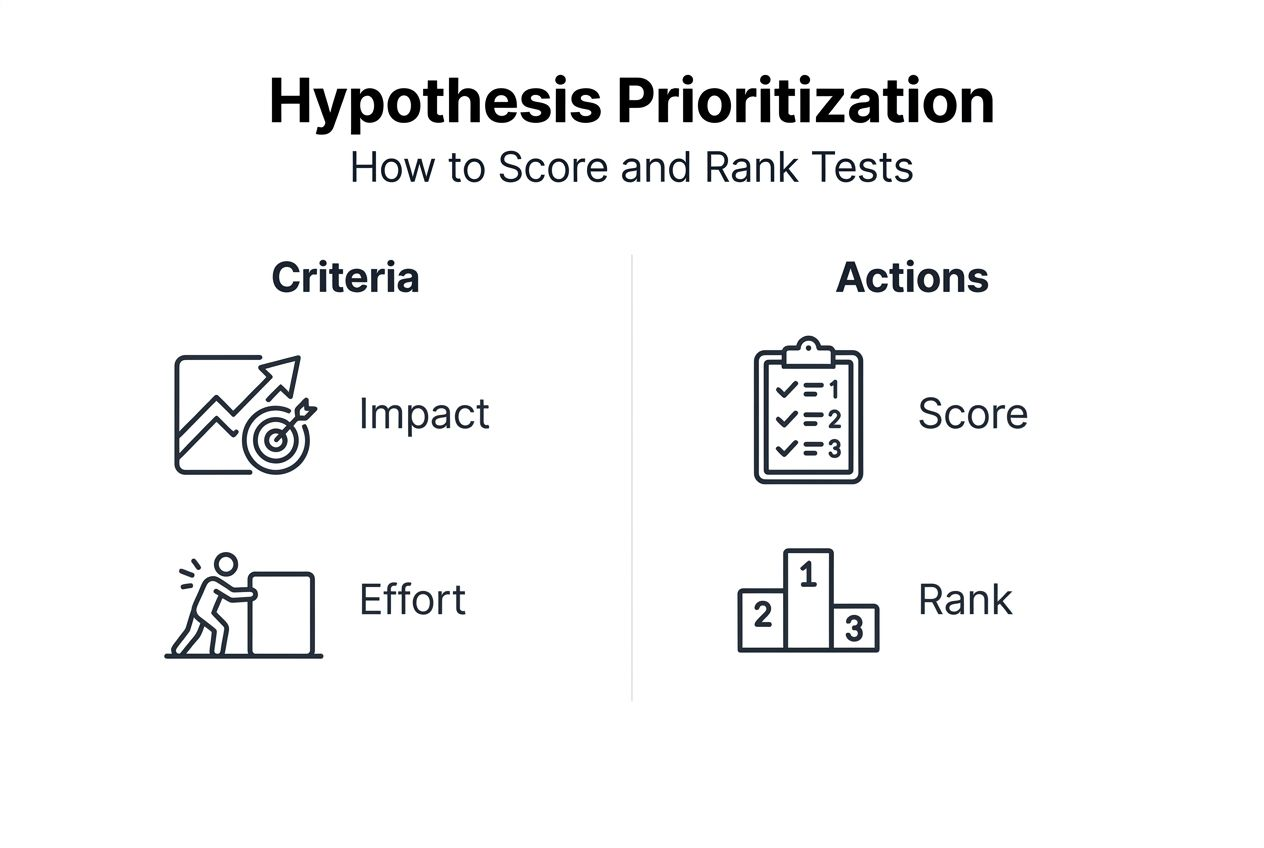
Prioritization frameworks prevent you from testing low-impact ideas. The impact-effort matrix evaluates each hypothesis on two dimensions: potential business value and implementation difficulty. Focus on high-impact, low-effort opportunities first.
| Hypothesis | Impact Score (1-10) | Effort Score (1-10) | Priority |
|---|---|---|---|
| Simplify checkout to 2 steps | 9 | 3 | High |
| Add trust badges near CTA | 7 | 2 | High |
| Redesign entire homepage | 8 | 9 | Low |
| Change button color | 3 | 1 | Low |
This table shows how scoring reveals which tests deserve immediate attention versus later consideration. The checkout simplification offers high impact with manageable effort, making it a priority. The homepage redesign might deliver results but requires substantial resources.
Pro Tip: Review your impact-effort matrix monthly as new data changes which hypotheses deserve testing first.
Understanding predictive analytics enhances how you forecast which hypotheses will deliver the strongest results. Learn how to prioritize marketing experiments systematically using frameworks that balance multiple factors beyond just impact and effort. After testing, analyzing test results properly ensures you extract maximum learning from every experiment.
Common misconceptions and pitfalls in developing hypotheses
Many marketers create hypotheses that doom their tests from the start. Vague hypotheses without measurable outcomes waste resources and produce unclear conclusions. Saying "make the page better" provides no direction for what to test or how to evaluate success.
Testing multiple variables simultaneously creates another critical error. If you change both headline and button color in one test, you cannot determine which modification drove results. This confounding effect means a winning test teaches you nothing applicable to future experiments.
Relying solely on intuition or assumptions leads to testing preferences rather than user needs. You might love minimalist design while your audience responds better to detailed information. Personal taste makes a poor foundation for hypotheses.
Consider these pitfalls:
- Skipping the "because" reasoning that explains why a change should work
- Setting no minimum success threshold before testing
- Ignoring statistical significance requirements
- Testing cosmetic changes instead of meaningful user experience improvements
- Failing to define clear success metrics upfront
Pro Tip: Always isolate one variable per hypothesis to maintain result clarity and ensure learnings transfer to future tests.
Some teams rush into testing without adequate traffic to reach statistical significance. A hypothesis might be brilliant, but if your sample size cannot detect meaningful differences, you waste time on inconclusive results. Calculate required traffic before launching tests.
Follow AB testing best practices to avoid these common traps and structure experiments that generate reliable, actionable insights.
Frameworks and best practices for hypothesis formulation
Structured frameworks remove guesswork from hypothesis creation. The "If [change], then [result], because [reason]" format provides a solid starting point for any test. This simple template ensures you address all essential components.
The MECLABS Four-Step Hypothesis Framework offers more depth. First, identify the problem through data. Second, propose a solution based on customer insights. Third, predict the measurable outcome. Fourth, explain the underlying principle that makes your prediction logical.
Structured hypothesis frameworks link customer insights to measurable tests, improving experiment design and success rates. These approaches work because they force systematic thinking rather than random idea generation.
| Framework | Strengths | Best For |
|---|---|---|
| If-Then-Because | Simple, fast to apply | Quick hypothesis generation |
| MECLABS Four-Step | Comprehensive, rigorous | Complex optimization projects |
| ICE Score | Balances multiple factors | Prioritizing hypothesis backlogs |
| PIE Framework | Emphasizes potential value | Revenue-focused decisions |
Setting clear success metrics matters as much as the hypothesis itself. Define your primary metric, such as conversion rate or revenue per visitor. Specify secondary metrics that capture unexpected effects, like increased bounce rate or decreased time on page. Establish the minimum detectable effect that justifies implementation effort.
Test timelines prevent premature conclusions. Calculate how long tests need to run based on traffic volume and expected effect size. Resist the temptation to stop tests early when you see positive trends. Statistical significance requires adequate sample sizes.
Key best practices include:
- Document assumptions underlying each hypothesis
- Link hypotheses to specific customer pain points
- Quantify expected improvements with realistic ranges
- Plan for both success and failure scenarios
- Review past test results before creating new hypotheses
Explore understanding tools for testing hypotheses to discover how modern platforms support systematic hypothesis development and tracking. Learn how to validate marketing ideas through structured testing approaches that build on these frameworks.
Bridging hypothesis development to A/B test execution
Developing a strong hypothesis means nothing without proper execution. Your carefully reasoned prediction needs translation into an actual test that measures what you intended. This bridge from theory to practice determines whether you gain actionable insights.
No-code visual editors eliminate technical barriers. You can implement test variations matching your hypothesis without developer resources. Change headlines, swap images, modify button text, or reorganize page elements through drag-and-drop interfaces. This speed matters because you can test more hypotheses in less time.
Real-time analytics provide immediate validation. You watch results accumulate as visitors interact with test variations. This visibility helps you spot implementation errors quickly rather than waiting weeks to discover a tracking problem invalidated your entire test.
Iterative testing cycles create compounding knowledge. Test your hypothesis, analyze results, refine your understanding, and develop an improved hypothesis for the next experiment. Each cycle builds on previous learnings, making subsequent hypotheses more accurate.
Follow these steps to translate hypotheses into executable tests:
- Break your hypothesis into specific elements that need modification
- Create test variations that isolate the single variable you are testing
- Configure tracking for your defined success metrics
- Set appropriate test duration based on traffic and effect size
- Document expected outcomes to compare against actual results
Alignment between hypothesis components and test execution ensures meaningful results. If your hypothesis predicts a 15% conversion increase from adding social proof, your test must measure conversion rate changes specifically attributed to that social proof element. Misalignment between prediction and measurement renders results useless.
Revisit understanding tools for testing hypotheses to see how integrated platforms connect hypothesis management directly to test execution and analysis workflows.
Conclusion: transforming marketing decisions with hypothesis-driven testing
Strong, data-driven hypotheses transform random testing into systematic growth engines. They focus your limited resources on changes most likely to improve business outcomes. Every test generates learnings, whether your prediction succeeds or fails, because you understand the reasoning behind each experiment.
Cost savings compound quickly. Avoiding ineffective tests based on guesswork frees budget and time for high-impact experiments. Marketers using structured frameworks report higher success rates and improved statistical significance across their testing programs.
For small and medium-sized businesses, hypothesis-driven testing offers a competitive advantage. You make faster decisions, learn more from each experiment, and build institutional knowledge that improves over time. The practices outlined in this guide provide a roadmap for implementing systematic experimentation in your marketing.
Stellar helps marketers execute hypothesis-driven tests efficiently through no-code tools and real-time analytics that align perfectly with structured testing approaches.
Explore Stellar for seamless hypothesis-driven marketing tests
You have developed strong hypotheses grounded in data and customer insights. Now you need a platform that executes tests quickly without technical complexity. Stellar's no-code visual editor lets you implement hypothesis tests in minutes, not weeks. You focus on strategy while the platform handles technical execution.
Real-time analytics measure your defined success metrics as tests run. You watch conversion rates, engagement metrics, and revenue impacts accumulate, making data-driven decisions faster. The lightweight 5.4KB script ensures testing never slows your site, maintaining user experience while you optimize.
Iterative hypothesis refinement happens naturally. Test results feed directly into your next hypothesis. This continuous learning cycle accelerates growth as each experiment builds on previous insights. Advanced goal tracking connects test outcomes to business objectives, proving ROI from your experimentation program.
Pro Tip: Stellar reduces the time from hypothesis to actionable insights, letting you test more ideas and learn faster than competitors stuck in slow development cycles.
Visit Stellar to see how streamlined hypothesis testing drives measurable growth for small and medium-sized businesses.
FAQ
What is a marketing hypothesis in the context of A/B testing?
A marketing hypothesis is a testable statement predicting how a specific change will affect user behavior or business metrics. It includes the problem you are solving, the change you propose, and the measurable outcome you expect. This structure guides focused experiments that generate actionable insights rather than random data points.
How do I prioritize which marketing hypotheses to test first?
Evaluate hypotheses using impact-effort frameworks that balance potential revenue gains against implementation difficulty. Focus on high-impact, low-effort opportunities first. Consider factors like traffic volume, current performance gaps, and strategic business priorities. Learn more about how to prioritize marketing experiments systematically.
Why should I test only one variable at a time in A/B tests?
Testing one variable ensures you can attribute results clearly to specific changes. When multiple variables change simultaneously, you cannot determine which modification drove outcomes. This confounding effect wastes resources and prevents learning transfer to future experiments. Follow AB testing best practices for clear, actionable results.
How does data improve the quality of marketing hypotheses?
Data reveals actual user behavior problems rather than assumed issues. Quantitative analytics show where visitors struggle, while qualitative feedback explains why. This combination creates hypotheses grounded in real customer needs, increasing test success rates. Strong data foundations make predictions more accurate and results more impactful. Discover how to analyze test results to extract maximum learning from your experiments.
Recommended
Published: 3/10/2026