
Ecommerce optimization guide: boost conversions with A/B testing
TL;DR:
- A/B testing provides data-driven insights to improve e-commerce conversion rates.
- Focus on simple, single-element tests to build a consistent optimization habit.
- Use affordable, no-code tools like GoStellar for quick, reliable testing and learning.
You've watched the analytics long enough. Visitors land on your store, browse a few pages, and leave without buying. You've tried tweaking the layout, updating product photos, maybe even rewriting your homepage copy. Nothing sticks. The frustrating truth is that most e-commerce store owners are guessing at what their customers want instead of testing it. A/B testing changes that equation completely. It gives you real data from real visitors so you can make changes that actually move the needle. This guide walks you through every step, from understanding the basics to running your first live test and learning from every result.
Table of Contents
- Understanding ecommerce optimization and A/B testing
- What you need to start: Tools, resources, and setup
- Step-by-step guide: Running your first A/B test
- Troubleshooting, common mistakes, and how to improve
- Our perspective: Why simple beats complex in ecommerce testing
- Get started with ecommerce optimization tools now
- Frequently asked questions
Key Takeaways
| Point | Details |
|---|---|
| Start small for impact | Begin with simple A/B tests on high-traffic pages to see quick conversion lifts. |
| Use the right tools | Reliable, affordable testing tools make optimization accessible to any store. |
| Learn and iterate | Analyze results, avoid common mistakes, and keep optimizing for compounding gains. |
| Simplicity wins | Straightforward, focused changes often deliver the best long-term growth. |
Understanding ecommerce optimization and A/B testing
Ecommerce optimization is the ongoing process of improving your online store so more visitors take the actions you want, whether that's adding a product to the cart, completing a purchase, or signing up for your email list. It's not a one-time project. It's a cycle of testing, learning, and refining that compounds over time.
A/B testing (also called split testing) is one of the most powerful tools in that cycle. You create two versions of a page element, show each version to a different group of visitors at the same time, and measure which one performs better. The element could be anything: a button color, a headline, a product image, a price display, or even the order of your navigation links.
Here's a quick example. Imagine your "Add to Cart" button is gray. You suspect that a bright orange button might get more clicks. You set up an A/B test where 50% of visitors see the gray button (the control) and 50% see the orange button (the variant). After enough visitors have seen both versions, you check which button drove more purchases. That's it. That's A/B testing.
Why does this matter for small businesses? Because A/B testing drives online sales growth by refining the customer experience one step at a time. You don't need a massive budget or a data science team. You need a clear question, a testable change, and enough traffic to get meaningful results.
Some common myths worth clearing up:
- Myth: A/B testing is only for big companies. False. Any store with consistent traffic can run meaningful tests.
- Myth: You need a developer. Modern tools make no-code testing completely realistic.
- Myth: One test is enough. Optimization is iterative. Each test teaches you something new.
- Myth: Small changes don't matter. A single headline tweak can lift conversions by double digits.
"The goal of optimization isn't perfection on day one. It's progress, one test at a time."
Understanding your sales funnel optimization is equally important here. Every stage of the funnel, from landing page to checkout, is a candidate for testing. Pair that with solid conversion rate tactics and you have a repeatable system for growth. If you want to avoid slowing your site down while you test, faster conversion techniques can help you keep performance sharp.
What you need to start: Tools, resources, and setup
Getting started with A/B testing doesn't require a big investment. What it does require is the right setup so your data is clean and your results are trustworthy.
Here's a comparison of common A/B testing tools and what they offer:
| Tool | Free plan | No-code editor | Real-time analytics | Best for |
|---|---|---|---|---|
| Stellar | Yes (up to 25K users) | Yes | Yes | Small to mid-size stores |
| Google Optimize | Limited | Partial | No | Beginners with low traffic |
| VWO | Trial only | Yes | Yes | Mid-size businesses |
| Optimizely | No | Yes | Yes | Enterprise teams |
Simple tools make A/B testing accessible to businesses of every size. You don't need the most expensive platform to get started. You need one that fits your traffic volume and doesn't require a developer to operate.
Before you launch your first test, run through this checklist:
- Analytics installed: Make sure Google Analytics or a similar tool is tracking all pages.
- Goal tracking active: Know exactly what conversion event you're measuring (purchase, click, form fill).
- Baseline data collected: Have at least 2-4 weeks of traffic data so you understand your current conversion rate.
- Site backup created: Any change to your site should have a rollback plan.
- Mobile experience reviewed: Most shoppers are on mobile. Your test must work on every screen size.
For a deeper look at what to evaluate before testing, the site testing basics guide covers the full pre-launch checklist. You can also explore top optimization tools to find the right fit for your store's needs and budget.
As for time investment, expect to spend about 2-3 hours setting up your first test. After that, most of the work is waiting for results and reviewing the data.
Pro Tip: Don't start with your most complex page. Pick one high-traffic, high-intent page like a product detail page or your checkout button, and test one single element. Easy wins build momentum and teach you how the process works before you scale up.
Step-by-step guide: Running your first A/B test
A structured approach to A/B testing consistently delivers measurable results. Here's how to run yours from start to finish.
Step 1: Write your hypothesis. A good hypothesis follows this format: "If I change [element], then [metric] will improve because [reason]." For example: "If I change the checkout button text from 'Submit' to 'Complete My Order,' then the checkout completion rate will increase because the new text is more action-oriented and reassuring."

Step 2: Choose your test element. Start with high-impact, easy-to-change elements. Call-to-action buttons, headlines, hero images, and pricing displays are all strong starting points.
Step 3: Build your variants. Create version A (your current page, unchanged) and version B (your modified version). Change only one element. Changing multiple things at once makes it impossible to know what caused any difference in results.
Step 4: Set up tracking. Define your primary goal (e.g., purchases) and any secondary goals (e.g., add-to-cart clicks). Your testing tool should record both.
Step 5: Launch and wait. Let the test run without interference. Don't make other changes to the page during the test.
Step 6: Analyze results. Look for statistical significance, meaning you're confident the result isn't just random chance. Most tools flag this for you automatically.
Here's a quick comparison of manual versus automated testing approaches:
| Approach | Speed | Accuracy | Effort | Best for |
|---|---|---|---|---|
| Manual testing | Slow | Lower | High | Very small budgets |
| Automated tools | Fast | Higher | Low | Most businesses |
One important stat: tests that run for fewer than two weeks often produce unreliable data, especially for stores with lower daily traffic. Patience here pays off. For more ideas on what to test, explore these testing strategies and proven increase conversion strategies that other e-commerce brands have used successfully.
Troubleshooting, common mistakes, and how to improve
Even well-planned tests can produce confusing results. Knowing what to watch for saves you time and protects your data quality.
The most common A/B testing mistakes include:
- Testing too many elements at once. This is the single biggest error. Stick to one change per test.
- Ending tests too early. A result that looks promising on day three might reverse by day ten.
- Ignoring mobile vs. desktop splits. Your variant might win on desktop and lose on mobile. Always segment your results.
- Using low-traffic pages. A page with 50 visitors a week will take months to produce reliable data.
- Not defining success upfront. If you don't know what you're measuring before the test starts, the results won't mean much.
Awareness of common A/B testing errors directly increases your long-term ROI by keeping your data clean and your decisions sound.
"Inconclusive results aren't failures. They're information. They tell you the change didn't matter, which is just as valuable as knowing what does."
If your test produces inconclusive results, check these things first: Was the test running long enough? Did any external factors (a sale, a traffic spike, a seasonal event) skew the data? Was the change significant enough for visitors to actually notice?
When you're ready to move on from a test, document everything. What you tested, what you expected, what happened, and what you'll try next. This log becomes your most valuable asset over time.
Pro Tip: After a winning test, don't stop. Use the insight to form your next hypothesis. If a shorter headline won, test an even shorter one. Iterating on wins accelerates your results faster than starting from scratch each time. Explore avoiding conversion pitfalls and balancing speed and CRO to keep your momentum going without sacrificing site performance.
Our perspective: Why simple beats complex in ecommerce testing
Here's something the optimization industry doesn't say loudly enough: complexity is usually the enemy of progress, not the path to it.
We've seen small e-commerce brands run elaborate multivariate tests across five page elements simultaneously, spend weeks analyzing the results, and walk away with no clear winner and no actionable insight. Meanwhile, a store that tested one thing, a single headline change on a product page, saw a 14% lift in add-to-cart clicks within three weeks. Simple, focused, fast.
The instinct to go big makes sense. You want results quickly, so you test everything at once. But that approach actually slows you down because muddled data means muddled decisions. Small, consistent tests compound. Each one teaches you something concrete. Each win, even a modest one, gives you a foundation for the next test.
For most small businesses, the goal isn't to find the perfect page. It's to build a testing habit that keeps improving the store month over month. Conversion optimization insights consistently show that stores with a regular testing cadence outperform those that rely on occasional big redesigns. Simplicity isn't a limitation. It's a strategy.
Get started with ecommerce optimization tools now
If you're ready to put these tactics into action, the right platform makes all the difference between a test that teaches you something and one that wastes your time.
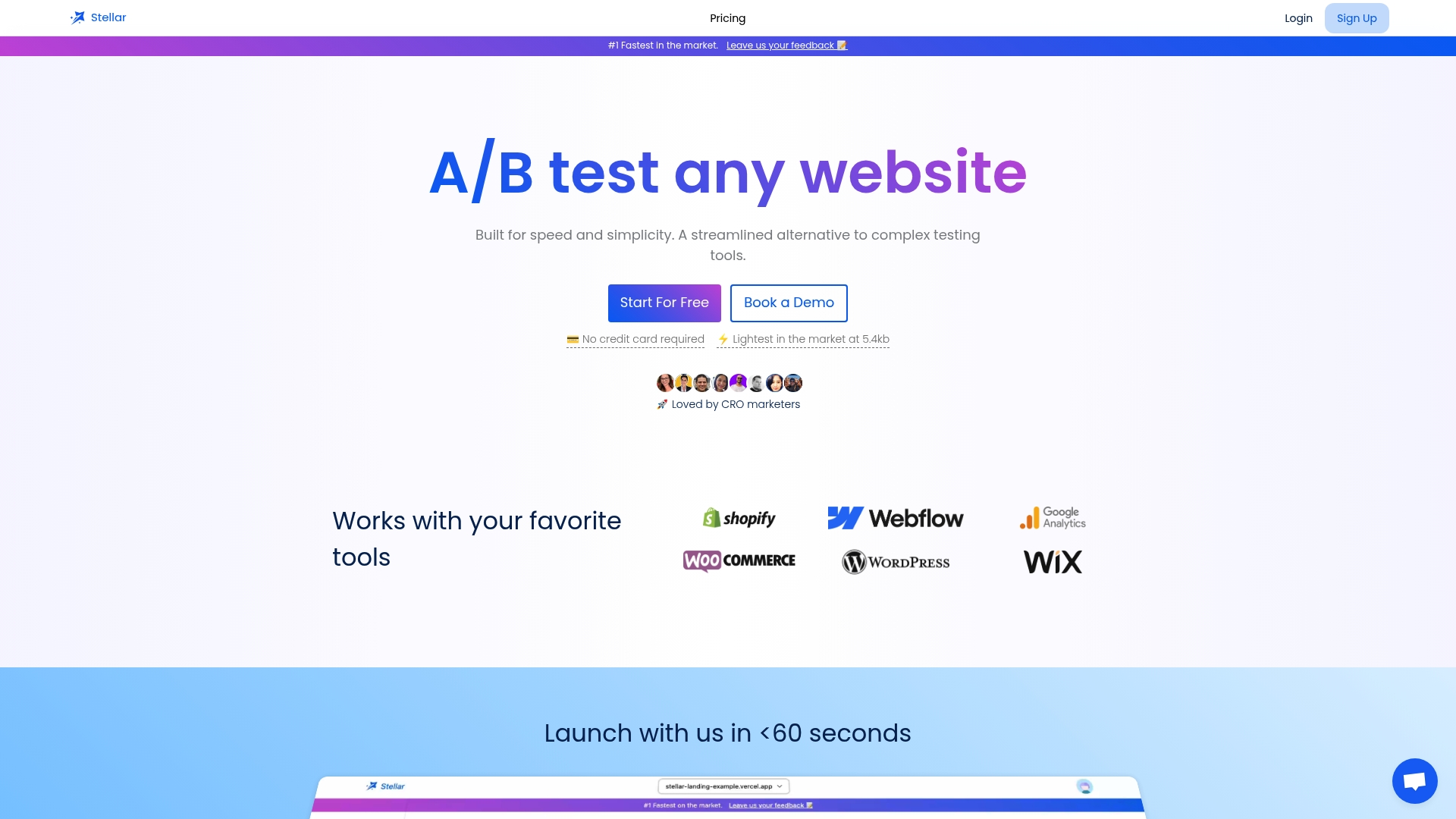
GoStellar is built specifically for marketers and small business owners who want fast, reliable A/B testing without the technical headache. With a no-code visual editor, real-time analytics, and a lightweight 5.4KB script that won't slow your store down, you can set up your first test in minutes. There's a free plan for stores with under 25,000 monthly tracked users, so there's no reason to wait. Start testing, start learning, and start converting more of the visitors you're already getting.
Frequently asked questions
What is ecommerce optimization?
Ecommerce optimization is the process of making website changes that improve customer experience and boost sales conversions by improving site usability and reducing friction in the buying journey.
How long should I run an A/B test for reliable results?
Most A/B tests should run at least 2-3 weeks, or until you reach statistical significance. Proper test duration is critical to accurate measurement, especially for stores with moderate traffic.
What are the easiest elements to test first?
Start with headlines, call-to-action buttons, images, and pricing displays. Testing critical page elements like these can rapidly improve conversions with minimal setup time.
Do I need expensive tools for A/B testing?
No. There are free and affordable options that work well for small businesses. Simple tools make A/B testing accessible to any business size without requiring a large budget or technical expertise.
Recommended
Published: 4/4/2026