
Ecommerce testing: master A/B tests for higher conversions
TL;DR:
- Effective ecommerce testing requires careful planning, segmentation, and control to ensure accurate results.
- Common challenges include traffic dilution, test collision, seasonality, and misinterpretation of segmented data.
- Prioritize high-traffic pages and analyze results by audience segments to maximize conversion and revenue growth.
Most marketers assume A/B testing is straightforward: change one thing, measure the result, and move on. But ecommerce testing is far more nuanced than that. A single overlooked variable, a poorly segmented audience, or a test run during a seasonal spike can completely distort your results and lead you to optimize in the wrong direction. The stakes are real. This guide cuts through the oversimplification and gives you a precise, practical framework for running ecommerce A/B tests that actually improve conversion rates and compound revenue over time.
Table of Contents
- What is ecommerce testing and why does it matter?
- The core steps for effective ecommerce A/B testing
- Common challenges and advanced nuances in ecommerce testing
- Applying ecommerce testing insights for growth
- Our perspective: What most ecommerce testing guides miss
- Ready to elevate your ecommerce testing results?
- Frequently asked questions
Key Takeaways
| Point | Details |
|---|---|
| Data-driven decision making | Ecommerce testing provides clear insights that drive conversion growth when done correctly. |
| Segmentation matters | Analyzing results by device and user group prevents missed opportunities and misleading conclusions. |
| Beware testing pitfalls | Overlapping tests and timing with promotions can easily skew results if not managed carefully. |
| Iterate for growth | Continuous, prioritized testing delivers compounding improvements in revenue and user experience. |
What is ecommerce testing and why does it matter?
Ecommerce testing is the practice of running controlled experiments on your online store to determine which version of a page, element, or flow drives better outcomes. It sounds simple, but the method you choose matters enormously.
A/B testing compares two versions of a single element, like a call-to-action button, to see which performs better. Split testing pits two entirely different page designs against each other using separate URLs. Multivariate testing goes further, testing multiple changes simultaneously to find the best-performing combination. Each method has a different use case, and choosing the wrong one for your situation wastes traffic and time.
Why does this matter for your bottom line? Because A/B testing drives significant revenue growth for online retailers, and even a 1% lift in conversion rate can translate to thousands of dollars in additional monthly revenue depending on your traffic volume. These gains compound. A 2% improvement this quarter plus a 1.5% improvement next quarter adds up to a meaningfully different business trajectory.
Here are the most common ecommerce elements worth testing:
- Call-to-action (CTA) button copy, color, and placement
- Product images and video thumbnails
- Pricing display and discount framing
- Checkout flow steps and form fields
- Trust signals like reviews, badges, and guarantees
- Page headlines and value propositions
- Navigation structure and category filters
To put the impact in perspective, here is a quick look at how different test types compare:
| Test type | Primary goal | Avg. conversion lift | Best for |
|---|---|---|---|
| A/B test | Single element optimization | 5 to 15% | High-traffic pages |
| Split test | Full page redesign | 10 to 25% | Landing pages |
| Multivariate | Multi-element combos | 8 to 20% | Complex page layouts |
The conversion boosting strategies that deliver lasting results always start with understanding which test type fits your current question. Jumping straight into multivariate testing when you lack the traffic to support it is one of the most common and costly mistakes we see.
The core steps for effective ecommerce A/B testing
Understanding which tests to run is one thing, but executing them properly is what really drives conversion gains. A structured workflow keeps your results clean and your decisions defensible.
Here is a proven step-by-step process:
- Form a hypothesis. Start with a specific, measurable prediction. "Changing the CTA from 'Buy Now' to 'Get Yours Today' will increase add-to-cart clicks by 10% for first-time visitors."
- Define your audience segment. Decide who sees this test. New vs. returning visitors, mobile vs. desktop, or a specific traffic source.
- Select one variable. Isolate the change you are testing. Multiple changes in a single A/B test make it impossible to know what caused the result.
- Allocate traffic. Split traffic evenly between variants unless you have a specific reason to weight it differently. Avoid running tests on less than 20% of your total page traffic.
- Set a measurement window. Run tests for at least two full business cycles (typically two weeks minimum) to account for day-of-week behavior differences.
- Analyze with statistical significance. Aim for at least 95% confidence before calling a winner. Anything below that is a guess, not a decision.
"Test execution must control variables carefully to avoid misleading results. Variable contamination is one of the most underappreciated risks in ecommerce testing."
The A/B testing strategies that consistently outperform are built on disciplined hypothesis formation and rigorous variable isolation. Skipping either step is where most teams go wrong.
Following A/B testing best practices from the start saves you from the frustrating experience of running a four-week test only to realize the data is unusable.
Pro Tip: Start with your highest-traffic, highest-value pages first. Product detail pages and checkout flows offer the fastest path to statistically significant results because they see the most volume.
Common challenges and advanced nuances in ecommerce testing
While the process seems straightforward, there are key challenges and nuances unique to ecommerce environments that can silently corrupt your data.
Here are the four most critical issues to watch for:
- Traffic dilution. If you spread a test across too many page variants or audience segments, no single variant gets enough traffic to reach significance. Your test runs indefinitely without a clear winner.
- Interaction effects. Running two tests simultaneously on overlapping audiences means the results of each test can influence the other. This is called test collision, and it produces unreliable data.
- Segment blindness. Aggregated results often hide important differences. A variant that wins overall might actually lose badly among mobile users, which could represent 60% of your future traffic.
- Seasonality skew. Running a test during a flash sale, holiday, or major campaign launch introduces external variables that inflate or deflate results in ways that don't reflect normal behavior.
The edge cases of traffic dilution, interaction effects, and seasonality skew are responsible for more failed tests than most teams realize.

Here is a quick comparison of two common testing approaches:
| Approach | Pros | Cons | When to use |
|---|---|---|---|
| Isolation testing | Clean data, easy to interpret | Slower, needs more traffic | Single element changes |
| Randomized concurrent | Faster results | Risk of interaction effects | Only with test management tools |
Most failed tests trace back to overlooked audience segments or poor timing. Before you call a test inconclusive, segment the results by device, user type, and traffic source. You will often find a clear winner hiding inside the aggregate data.
Following key A/B testing best practices around test isolation is non-negotiable when you are managing multiple experiments. Staying current on top A/B testing trends also helps you anticipate new challenges as ecommerce behavior evolves.
Pro Tip: Always break down your results by mobile vs. desktop and new vs. returning users before making a final call. These segments often behave in opposite ways, and a blended result can lead you to the wrong conclusion.
Applying ecommerce testing insights for growth
With challenges and solutions clear, it is time to put insights into action for real business results. Knowing how to test is only half the equation. Knowing what to test and in what order is what separates high-growth teams from those spinning their wheels.
Start by identifying your biggest conversion bottlenecks. Use your analytics to find the pages with the highest drop-off rates. Those are your highest-leverage testing opportunities. Common priorities include:
- Homepage hero section. First impressions drive bounce rates. Test headlines, imagery, and primary CTA placement.
- Product detail pages. Test image quantity, social proof placement, and urgency signals like low-stock indicators.
- Cart page. Test upsell placement, trust badge positioning, and CTA copy.
- Checkout flow. Even a single-field reduction can lift completion rates significantly. Test guest checkout options and progress indicators.
- Mobile experience. With mobile traffic often exceeding 50% for ecommerce stores, mobile-specific tests frequently deliver outsized returns.
Strategic test selection can amplify ROI and speed learning across your entire testing program. Prioritizing by potential revenue impact rather than ease of implementation keeps your roadmap focused on what matters.
Once a test concludes, do not just implement the winner and move on. Ask why it won. A CTA that outperformed because of its color tells you something different than one that won because of its copy. That interpretation shapes your next hypothesis and makes each testing cycle smarter than the last.
For advanced ecommerce optimization, build a living test backlog organized by page, hypothesis, and expected impact. Review it monthly and reprioritize based on what you have learned.
Pro Tip: Map your test schedule to your promotional calendar. Avoid launching new tests the week before a major sale. The traffic and behavior shifts during promotions will contaminate your baseline and make results impossible to apply to normal conditions.
Our perspective: What most ecommerce testing guides miss
We have reviewed enough ecommerce testing programs to notice a consistent blind spot in most published advice: guides treat testing as a static, controlled science when real ecommerce environments are anything but.
User behavior shifts mid-test all the time. A competitor runs a flash sale. Your ad spend spikes on day three. A product goes viral on social media. Standard guides rarely tell you how to handle these disruptions, and the default advice to "just keep running the test" can lock in bad data.
The other thing most guides underplay is that one winning test does not mean you have optimized anything. It means you found one better option under one set of conditions. Comprehensive ecommerce optimization is a continuous process, not a destination. The teams that win long-term treat every result, including inconclusive ones, as useful signal.
Segment-specific decision-making is also chronically underemphasized. Your returning customers and your first-time visitors are essentially different audiences with different motivations. Treating them as one group in your testing program is leaving growth on the table.
Ready to elevate your ecommerce testing results?
Putting these strategies into practice requires the right toolset, and that is exactly where Stellar comes in. Built specifically for marketers at small to medium-sized businesses, Stellar's ecommerce testing solutions give you a no-code visual editor, real-time analytics, and advanced goal tracking without the complexity of enterprise tools.
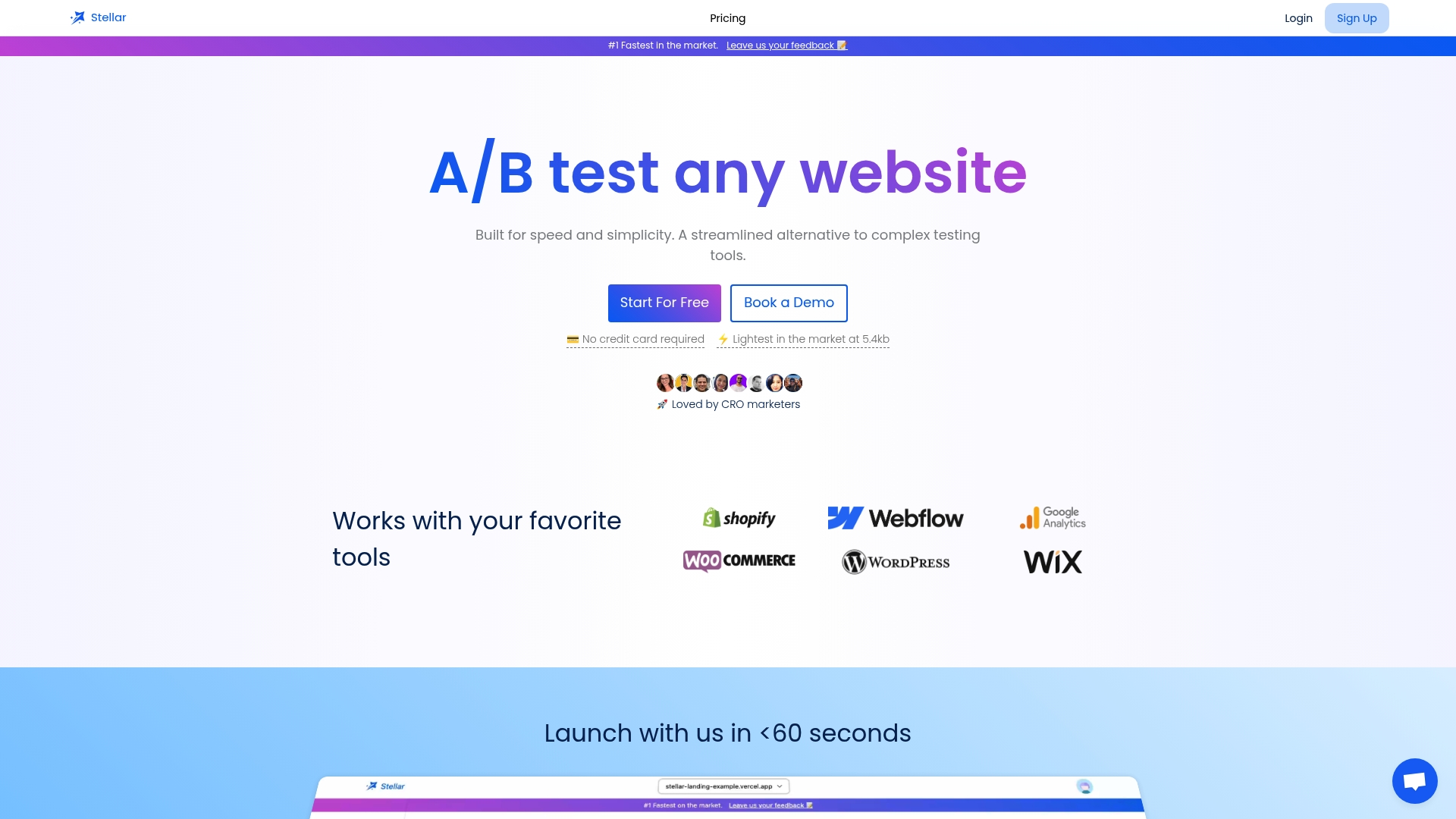
Stellar's lightweight 5.4KB script means your tests never slow down your store, protecting both your user experience and your SEO. Whether you are running your first A/B test or managing a full testing roadmap, Stellar makes it fast and straightforward. Explore how driving revenue with effective tests can become a repeatable system for your business.
Frequently asked questions
What is the difference between A/B, split, and multivariate testing in ecommerce?
A/B tests compare two variants of a single element, split tests compare entirely different page URLs, while multivariate tests assess multiple simultaneous changes to find the best-performing combination.
How much website traffic do I need for reliable A/B test results?
You typically need at least a few thousand unique visitors per variation to reach statistical significance, though the exact number depends on your baseline conversion rate and the size of the improvement you are trying to detect.
How do I avoid bias and contamination in ecommerce tests?
Interaction effects and seasonality are best avoided by segmenting your audience carefully, isolating tests from major campaigns, and limiting the number of concurrent experiments on overlapping audiences.
What pages should I test first on my ecommerce site?
Start with high-traffic, high-value pages such as your homepage, product detail pages, cart, and checkout, since these offer the fastest path to statistically significant results.
How often should I run new tests?
Aim for continuous testing by launching new experiments as soon as previous ones conclude, so your learning compounds and your conversion rate keeps improving over time.
Recommended
Published: 4/10/2026