
Ethical Marketing Experimentation: Building Trust and Performance
Finding A/B testing solutions that respect user privacy while delivering meaningful business insights can feel like walking a tightrope for growth-focused teams. As companies expand beyond local markets and integrate global ecommerce strategies, the demand for ethical marketing experimentation has never been higher. This guide explores practical methods for testing and optimizing digital experiences, offering actionable insights that help marketers prioritize transparency, fairness, and consent without sacrificing conversion or speed.
Table of Contents
- Defining Ethical Marketing Experimentation
- Types and Methods of A/B Testing
- Core Principles: Consent, Transparency, and Fairness
- Legal Compliance in Global Experimentation
- Risks, Pitfalls, and How to Avoid Them
- Best Practices for Sustainable Growth
Key Takeaways
| Point | Details |
|---|---|
| Ethical Marketing | Ethical marketing experimentation prioritizes participant rights, informed consent, and transparency to build consumer trust. |
| A/B Testing Methods | Different A/B testing methods provide unique advantages and should be selected based on specific business goals and desired outcomes. |
| Legal Compliance | Understanding diverse legal frameworks is essential for protecting user rights and ensuring ethical marketing practices across different regions. |
| Sustainable Growth | Companies should integrate ethical values into their overall strategy to achieve sustainable growth and demonstrate genuine commitment to societal welfare. |
Defining Ethical Marketing Experimentation
Ethical marketing experimentation represents a strategic approach to research and testing that prioritizes human dignity, transparency, and respect for participant rights. At its core, this methodology goes beyond traditional data collection to ensure that marketing practices align with societal expectations and fundamental ethical standards.
Marketing research must balance the pursuit of business insights with responsible research practices. This means developing experimental frameworks that protect participants' privacy, obtain informed consent, and maintain clear boundaries between data collection and potential manipulation. Ethical marketing experimentation involves several critical considerations:
- Prioritizing participant informed consent
- Protecting individual privacy and data rights
- Maintaining transparency about research objectives
- Minimizing potential psychological or emotional risks
- Ensuring fair compensation for participant time
The global business landscape increasingly demands higher ethical standards, driven by growing awareness of marketing's social impact. Cross-cultural marketing ethics have become particularly important as businesses operate across diverse cultural contexts, requiring nuanced understanding of ethical boundaries and social expectations.
Responsible experimentation means recognizing that data points represent real human experiences. Marketers must approach research with empathy, understanding that each participant is more than just a potential conversion metric.
Pro tip: Always design marketing experiments with the same respect and consideration you would want if you were the participant.
Types and Methods of A/B Testing
A/B testing represents a powerful experimental approach that allows marketers and product developers to systematically evaluate different versions of digital content, interfaces, and marketing strategies. Randomized controlled experiments enable businesses to make data-driven decisions by comparing two variants and measuring their relative performance against predefined metrics.
Modern A/B testing encompasses several sophisticated methodological approaches:
- Classic Single-Variable Testing: Comparing two versions with a single changed element
- Multivariate Testing: Evaluating multiple variables simultaneously
- Sequential Analysis Testing: Allowing real-time monitoring and adaptive decision-making
- Split URL Testing: Comparing entirely different webpage designs
- Redirect Testing: Routing traffic to different versions of a webpage
Understanding the nuanced statistical methods for A/B testing is crucial for generating meaningful insights. Marketers must carefully select appropriate statistical metrics such as counts, means, conversion rates, and probabilistic comparisons to ensure robust experimental design.
Statistical Rigor distinguishes professional A/B testing from amateur guesswork. Successful experiments require precise measurement, controlled variables, and statistically significant sample sizes that reveal genuine performance differences rather than random fluctuations.

Here's a comparison of A/B testing methods and their typical business outcomes:
| Testing Method | Main Advantage | Typical Business Application |
|---|---|---|
| Classic Single-Variable | Simplifies performance analysis | Optimizing button colors or headlines |
| Multivariate | Identifies best element combinations | Improving page layouts or ad mix |
| Sequential Analysis | Allows fast decision-making | Testing price sensitivity or campaign tweaks |
| Split URL | Measures full design impact | Revamping landing pages or product sites |
| Redirect | Tests overall user experience | Launching temporary promotions or events |
Pro tip: Always establish clear hypotheses and success metrics before launching any A/B test to maintain experimental integrity and avoid confirmation bias.
Core Principles: Consent, Transparency, and Fairness
Ethical marketing experimentation hinges on three fundamental principles that protect consumer rights and build long-term trust. Transparent consent processes are the foundation of responsible data collection and usage, ensuring that individuals understand and willingly participate in marketing research.
The core principles of ethical marketing experimentation include:
- Informed Consent: Ensuring participants fully understand the purpose and scope of data collection
- Data Transparency: Clearly communicating how data will be used and processed
- Individual Autonomy: Respecting participants' right to withdraw or modify their participation
- Fair Treatment: Preventing discrimination or manipulative practices
- Privacy Protection: Safeguarding personal information from unauthorized use
Global policy frameworks increasingly emphasize the importance of fairness-aware marketing approaches. This means developing marketing strategies that go beyond legal compliance to genuinely respect consumer rights and societal values. Ethical marketing requires a holistic approach that considers the broader impact of data collection and usage.
Consumer Trust is the most valuable currency in modern marketing. By prioritizing consent, transparency, and fairness, businesses can create meaningful connections that transcend transactional interactions and build lasting relationships with their audience.
Pro tip: Always design your marketing experiments with the same level of respect and consideration you would expect if you were the participant.
Legal Compliance in Global Experimentation
Navigating the complex landscape of global marketing experimentation requires a comprehensive understanding of diverse legal frameworks and regulatory requirements. Controlled online experiments demand rigorous adherence to ethical standards that protect user rights and ensure responsible research practices.
Key legal considerations for global marketing experimentation include:
- International Data Privacy Regulations: Understanding GDPR, CCPA, and regional data protection laws
- Consent Management: Developing transparent and comprehensive consent mechanisms
- Cross-Border Compliance: Adapting strategies to meet varied international legal standards
- User Rights Protection: Ensuring participant autonomy and information control
- Intellectual Property Considerations: Respecting creative and legal boundaries in research
Marketers must develop comprehensive compliance strategies that go beyond simple legal checklist completion. This means creating robust governance frameworks that anticipate potential regulatory challenges and proactively address ethical concerns across different jurisdictions.
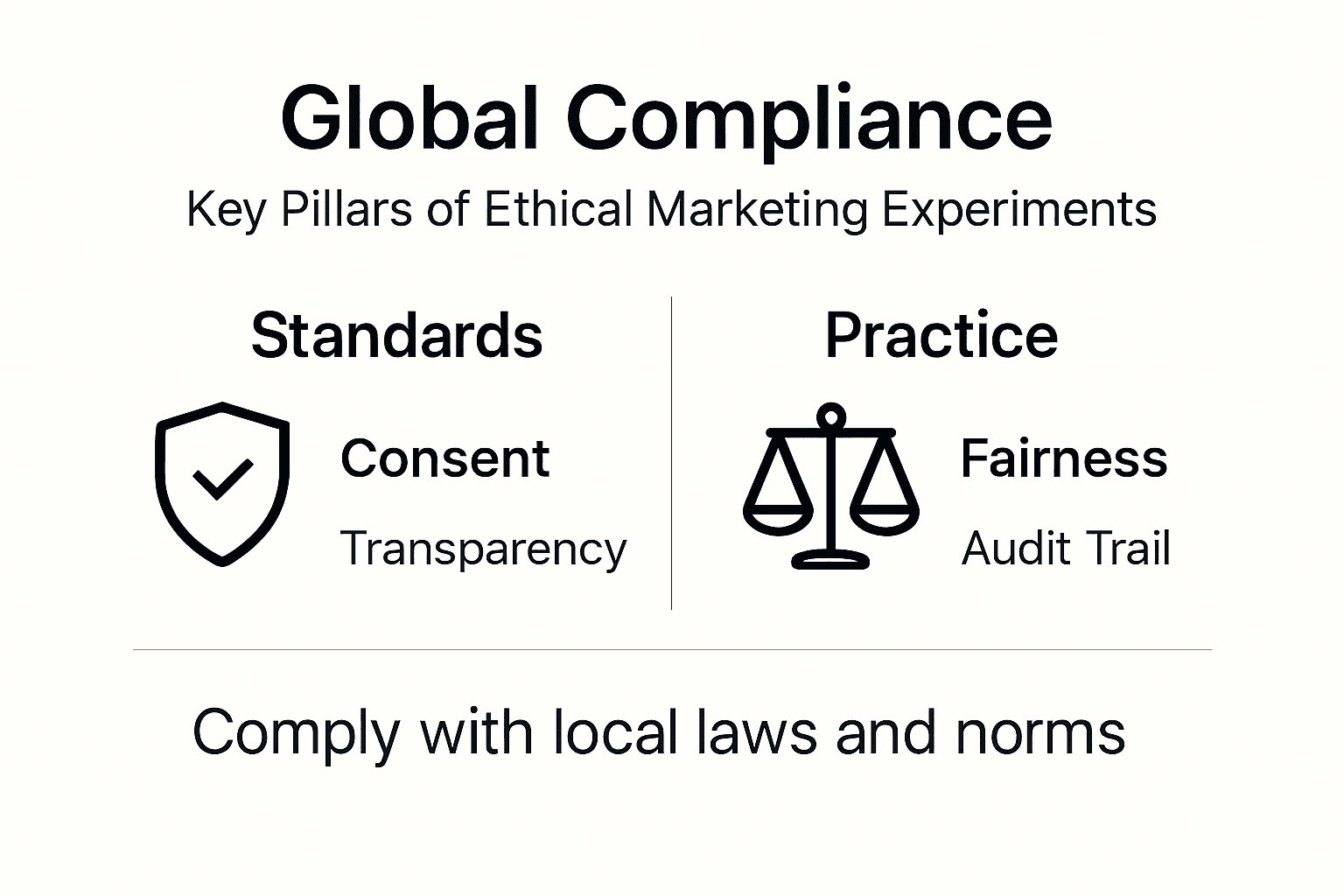
Regulatory Intelligence has become a critical competency for modern marketers. Successful global experimentation requires continuous learning and adaptation to evolving legal landscapes that vary significantly across different regions and industries.
The following table summarizes key global marketing compliance challenges and their solutions:
| Challenge | Example Context | Solution Strategy |
|---|---|---|
| Data privacy regulations | GDPR in EU, CCPA in California | Localized privacy policy and consent forms |
| Cross-border data transfer | Campaigns targeting multiple countries | Regional compliance audits and encryption |
| Consent management | Digital sales in Asia | Multi-language opt-in mechanisms |
| User rights protection | Social media ads | Personalized account access and deletion tools |
| Intellectual property | Content in global ads | Clear licensing agreements and trademark checks |
Pro tip: Develop a comprehensive compliance checklist specific to each geographic market where you plan to conduct marketing experiments.
Risks, Pitfalls, and How to Avoid Them
Ethical marketing experimentation requires vigilant awareness of potential risks that can undermine research integrity and damage organizational reputation. Unethical marketing practices pose significant threats to brand credibility and consumer trust, making proactive risk management essential.
Key risks and potential pitfalls in marketing experimentation include:
- Data Privacy Violations: Unauthorized collection or misuse of participant information
- Deceptive Research Practices: Misleading participants about experiment objectives
- Consent Manipulation: Pressuring or tricking participants into engagement
- Vulnerable Population Targeting: Exploiting individuals with limited decision-making capacity
- Statistical Misrepresentation: Presenting biased or manipulated experimental results
Researchers must develop robust strategies to mitigate ethical research risks. This involves creating comprehensive frameworks that prioritize participant rights, maintain transparency, and ensure informed consent throughout the experimental process. Successful risk management requires a holistic approach that goes beyond mere compliance to genuinely respect participant autonomy.
Experimental Integrity demands constant vigilance and a commitment to ethical principles. Marketers must view participants as partners in research, not mere data points to be exploited.
Pro tip: Implement a pre-experiment ethics review process that critically examines potential risks and participant protections before launching any marketing research initiative.
Best Practices for Sustainable Growth
Sustainable marketing transcends traditional performance metrics by integrating ethical values and strategic innovation into core business practices. Organizational capabilities that support sustainability are critical for businesses seeking long-term success in an increasingly conscious marketplace.
Key best practices for achieving sustainable growth include:
- Stakeholder-Centric Approach: Prioritizing the interests of all involved parties
- Transparent Communication: Maintaining open and honest dialogue with consumers
- Environmental Responsibility: Minimizing ecological impact of marketing activities
- Continuous Learning: Adapting strategies based on ethical feedback and insights
- Value-Driven Innovation: Developing solutions that create social and environmental benefit
Companies must build trust through ethical marketing by demonstrating genuine commitment to societal welfare. This means moving beyond superficial corporate social responsibility initiatives to create meaningful, systemic change that aligns business objectives with broader human and environmental needs.
Strategic Alignment represents the cornerstone of sustainable marketing. Successful organizations recognize that long-term growth requires a holistic approach that balances economic performance with social and environmental considerations.
Pro tip: Develop a comprehensive sustainability scorecard that tracks not just financial metrics, but also social impact and environmental contributions.
Elevate Your Ethical Marketing Experiments with Stellar
The challenge of conducting marketing experimentation ethically while maintaining transparency, consent, and fairness demands tools that simplify complex processes without sacrificing integrity. This article highlights how prioritizing participant rights and data privacy is crucial to building consumer trust and achieving sustainable growth. Marketers and growth hackers need reliable solutions that support robust A/B testing methodologies with clear metrics and real-time insights that uphold these ethical standards.
Stellar offers a powerful yet easy-to-use SaaS platform tailored for marketers who want to perform responsible A/B testing without the drawbacks of heavy, complicated software. Its lightweight script ensures minimal impact on user experience while providing a dynamic no-code visual editor that helps craft experiments with precision. From advanced goal tracking to dynamic keyword insertion for personalization, Stellar empowers you to execute experiments aligned with transparency and fairness principles outlined in the article.
Make every marketing experiment a step toward both performance and trust. Discover how Stellar can help you uphold ethical marketing practices and accelerate data-driven growth at https://gostellar.app. Explore features like the No-Code Visual Editor and Advanced Goal Tracking to seamlessly integrate ethical testing into your marketing strategy.
Ready to build trust and optimize performance without compromise

Get started today with Stellar and turn your ethical marketing experimentation into your strongest asset. Visit Stellar now and take control of your testing with confidence.
Frequently Asked Questions
What is ethical marketing experimentation?
Ethical marketing experimentation is a research approach that prioritizes human dignity, transparency, and respect for participant rights, ensuring alignment with societal expectations and ethical standards in marketing practices.
Why is informed consent important in marketing experiments?
Informed consent is crucial as it ensures that participants fully understand the purpose and scope of data collection, allowing them to willingly engage in the research without feeling coerced or misled.
What are some common methods used in A/B testing?
Common A/B testing methods include Classic Single-Variable Testing, Multivariate Testing, Sequential Analysis Testing, Split URL Testing, and Redirect Testing, each designed to measure different aspects of user engagement and performance.
How can businesses ensure compliance with ethical standards in global marketing experiments?
Businesses can ensure compliance by understanding international data privacy regulations, developing transparent consent mechanisms, adapting strategies to meet diverse legal standards, and establishing robust governance frameworks that address ethical concerns.
Recommended
Published: 2/10/2026