
GDPR Compliance for Marketers: Ensuring Trust and Growth
Every marketing team faces the challenge of balancing data-driven campaigns with strict privacy rules, especially when running A/B tests targeting European audiences. GDPR now demands that companies everywhere embrace transparency and clear user consent, turning traditional data strategies on their head. This guide breaks down exactly how digital marketers can align with GDPR principles, safeguard customer trust, and adapt their A/B testing methods without compromising compliance.
Table of Contents
- Gdpr Compliance For Marketers Explained
- Key Principles Shaping Modern Data Practices
- Lawful Consent And Data Processing Mechanisms
- Managing User Rights And Vendor Responsibilities
- Minimizing Risk: Common Errors And SaaS Implications
Key Takeaways
| Point | Details |
|---|---|
| GDPR Compliance is Global | GDPR affects any organization handling data of EU citizens, necessitating a shift in global marketing practices towards transparency and consent. |
| Core Principles of Data Practices | Key principles include lawfulness, fairness, transparency, purpose limitation, and data minimization, guiding ethical data management. |
| Lawful Consent Requirements | Consent must be freely given, specific, informed, and unambiguous, with clear records maintained for compliance. |
| User Rights and Vendor Responsibilities | Organizations must respect user data rights such as access and erasure while ensuring strict vendor compliance through data processing agreements. |
GDPR Compliance for Marketers Explained
The General Data Protection Regulation (GDPR) represents a transformative legal framework that fundamentally reshapes how marketers approach data collection, processing, and customer engagement. At its core, GDPR establishes stringent guidelines for protecting individual privacy rights across the European Union and beyond, compelling marketing professionals to reimagine their data strategies with transparency and consent at the forefront.
Understanding GDPR requires recognizing its global implications. The regulation applies not just to European companies, but to any organization processing data of European citizens, which means marketers worldwide must adapt their practices. Key compliance principles for marketers include obtaining explicit consent, providing clear data usage information, and implementing robust data protection mechanisms. These requirements shift marketing from a data-acquisition mindset to a trust-building approach that prioritizes individual privacy.
The practical impact of GDPR on marketing activities is profound. Companies must now audit their existing data practices, redesign consent mechanisms, and establish clear protocols for data management. This means implementing systems that allow individuals to understand exactly what data is being collected, how it will be used, and providing easy mechanisms to withdraw consent. Marketers must also ensure data minimization principles are followed, collecting only information directly relevant to specified purposes and maintaining accurate, up-to-date records.
Pro tip: Create a comprehensive internal GDPR compliance checklist that includes regular data audits, consent tracking, and clear documentation of your data processing activities to maintain ongoing regulatory alignment.
Key Principles Shaping Modern Data Practices
GDPR establishes a comprehensive framework of core principles that fundamentally transform how organizations handle personal data. These principles are not merely legal requirements but represent a profound shift towards ethical and responsible data management. Marketing data governance principles create a structured approach that prioritizes individual privacy and organizational accountability.

The foundational principles of data practices under GDPR include lawfulness, fairness, transparency, purpose limitation, and data minimization. Lawfulness means processing personal data only through legitimate legal grounds, such as explicit user consent or contractual necessity. Fairness ensures that data collection and processing do not adversely impact individuals, while transparency demands clear communication about how data will be used. Purpose limitation restricts data usage to specific, clearly defined objectives, preventing unnecessary or unrelated data exploitation.
Data minimization represents a critical principle that challenges traditional marketing data collection strategies. Organizations must collect only the precise data necessary for their specified purpose, eliminating the previous practice of accumulating extensive user information. This approach requires marketers to be surgical in their data collection, focusing on quality over quantity. Accuracy, storage limitation, and robust security mechanisms further reinforce these principles, compelling businesses to maintain updated, relevant data and implement stringent protection protocols.
Pro tip: Develop a comprehensive data inventory mapping exactly what personal information you collect, why you collect it, and how long you retain it to ensure ongoing GDPR compliance.
Here's a summary of GDPR's foundational principles and their business impact for marketers:
| Principle | Definition | Business Impact |
|---|---|---|
| Lawfulness | Data processed on legal grounds | Ensures compliant marketing efforts |
| Fairness | Data usage must not harm individuals | Builds customer trust |
| Transparency | Clear communication about data use | Reduces customer confusion |
| Purpose Limitation | Data used for specific, stated objectives | Prevents misuse of customer data |
| Data Minimization | Only necessary data is collected | Cuts storage costs, lowers risk |
| Accuracy | Data kept up-to-date and correct | Improves marketing effectiveness |
| Storage Limitation | Data stored for defined time periods | Mitigates regulatory risk |
| Security | Robust protection against breaches | Shields brand from reputational harm |
Lawful Consent and Data Processing Mechanisms
GDPR fundamentally transforms how marketers approach data collection by establishing rigorous standards for lawful consent and data processing. Consent requirements for marketing go far beyond traditional data collection practices, demanding a comprehensive and transparent approach to user permissions.
Under GDPR, lawful consent must meet four critical criteria: it must be freely given, specific, informed, and unambiguous. This means marketers cannot use pre-checked boxes, complex legal language, or bundled consent mechanisms. Each consent request must clearly explain what data is being collected, why it is being collected, and provide an easy mechanism for users to withdraw their permission. Organizations must maintain detailed records of when and how consent was obtained, ensuring they can demonstrate compliance if challenged.
Two primary legal bases exist for data processing: explicit consent and legitimate interest. Consent requires direct, clear permission from the individual, while legitimate interest allows processing when there is a reasonable expectation that serves both the organization and the individual's interests. However, legitimate interest is not a blanket permission. Marketers must conduct a thorough Legitimate Interest Assessment, carefully weighing their processing purposes against individual rights and freedoms. This nuanced approach prevents arbitrary data usage and protects individual privacy while allowing necessary business operations.
Pro tip: Create a standardized consent template that clearly explains data usage, includes granular opt-in options, and provides a simple one-click withdrawal mechanism for each type of data processing.
Here is a quick comparison of GDPR consent and legitimate interest methods for marketers:
| Basis for Processing | Consent | Legitimate Interest |
|---|---|---|
| User Permission | Explicit, documented opt-in | Implied by business relevance |
| Flexibility | User-controlled, can withdraw any time | Evaluated on balancing interests |
| Common Use | Email marketing, direct communications | Analytical, infrastructure processing |
| Compliance Evidence | Requires precise records of consent | Needs Legitimate Interest Assessment |
Managing User Rights and Vendor Responsibilities
GDPR introduces a comprehensive framework that empowers individuals with robust data protection rights while simultaneously establishing stringent responsibilities for organizations handling personal information. User data protection rights represent a fundamental shift from traditional data management approaches, prioritizing individual control and transparency.
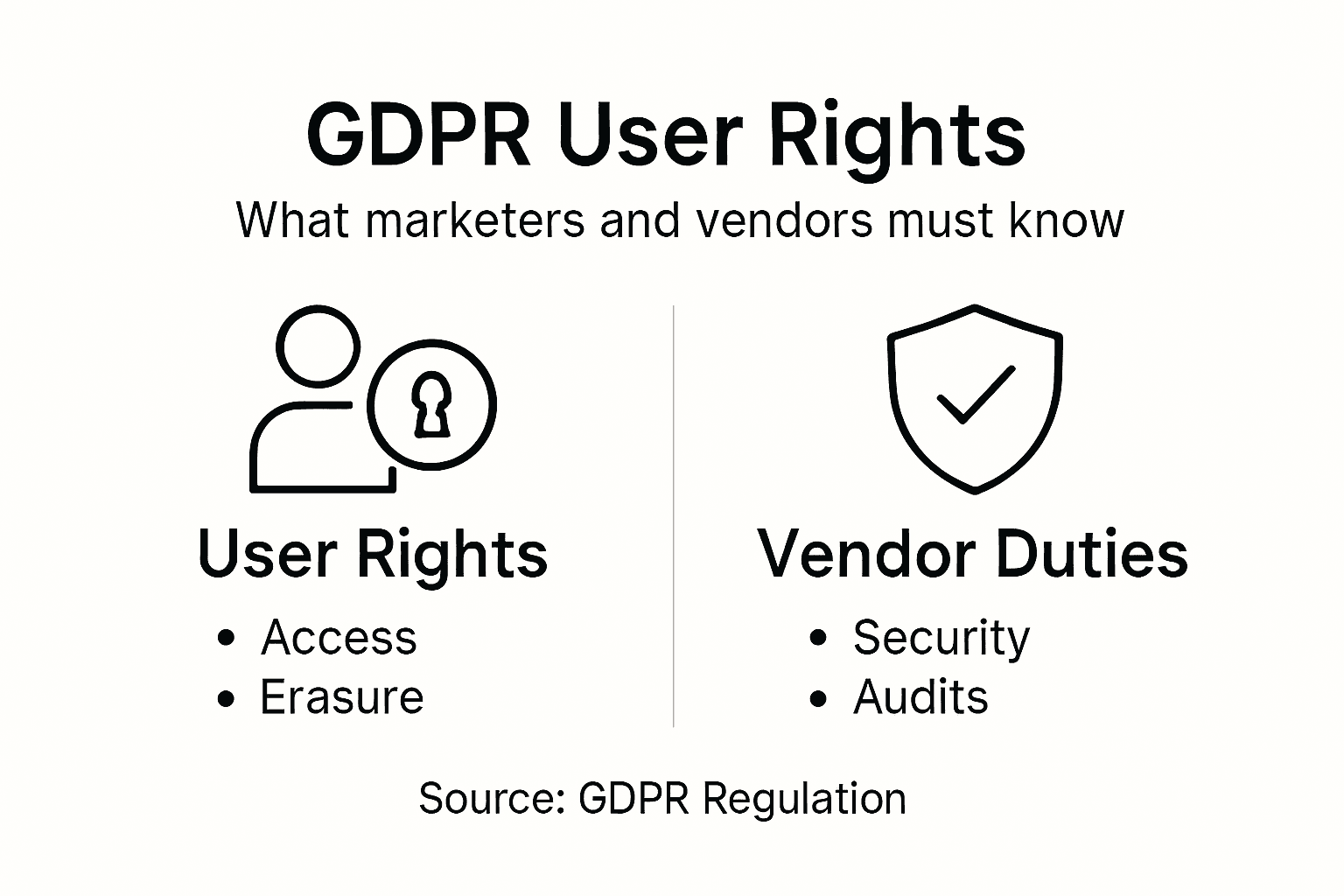
The regulation defines several critical user rights that marketers and vendors must systematically respect. These include the right to access, enabling individuals to request comprehensive information about their stored personal data, the right to rectification allowing correction of inaccurate information, and the right to erasure (also known as the "right to be forgotten"). Each right requires organizations to establish clear, accessible mechanisms for users to exercise their permissions. Responding to these requests is not optional but a legal obligation that demands prompt, comprehensive action within specified timeframes.
Vendor responsibilities under GDPR extend far beyond simple data collection compliance. Organizations must implement robust data processing agreements that clearly outline how third-party vendors handle, protect, and process personal information. This includes conducting thorough vendor assessments, ensuring contractual guarantees of GDPR compliance, and maintaining detailed documentation of all data processing activities. Vendors are legally accountable for breaches, with potential significant financial penalties for non-compliance, making rigorous vendor management a critical component of overall data protection strategy.
Pro tip: Develop a comprehensive vendor assessment checklist that includes detailed GDPR compliance verification, data processing agreement templates, and regular audit protocols to mitigate potential regulatory risks.
Minimizing Risk: Common Errors and SaaS Implications
Navigating GDPR compliance in SaaS marketing requires a proactive approach to identifying and mitigating potential risks. Privacy-centric marketing practices demand sophisticated strategies that go beyond basic legal checkbox compliance, focusing on systematic risk management and technological safeguards.
Marketing teams frequently encounter several critical compliance pitfalls in their SaaS ecosystems. Common errors include inadequate consent documentation, inconsistent data processing records, and failure to implement robust vendor risk assessment protocols. Organizations often struggle with complex consent mechanisms, particularly when using multiple SaaS platforms that may handle user data differently. This fragmentation creates potential compliance vulnerabilities, where each tool becomes a potential point of regulatory risk. Critical areas of concern involve improper data collection practices, lack of transparent user communication, and insufficient mechanisms for data subject rights enforcement.
Effective GDPR risk mitigation in SaaS marketing requires a comprehensive, multi-layered approach. This means developing stringent vendor assessment frameworks, implementing privacy-by-design principles, and creating detailed data processing documentation. Marketing teams must conduct regular compliance audits, maintain clear data mapping processes, and establish transparent communication channels that enable users to understand and control their personal information. Technical safeguards such as encryption, access controls, and automated consent management systems become essential tools in creating a robust compliance infrastructure.
Pro tip: Develop a comprehensive SaaS vendor compliance scorecard that evaluates potential tools across multiple GDPR risk dimensions, including data handling practices, consent mechanisms, and user rights management.
Simplify GDPR Compliance While Driving Data-Driven Growth
Marketers face the tough challenge of balancing strict GDPR requirements like lawful consent, data minimization, and transparent user rights management with the need for agile, effective experimentation. The risks of non-compliance are high and can impact trust-building efforts and long-term growth. That is why using a streamlined, privacy-conscious platform is critical for modern marketers who want to optimize performance without adding complexity.

Discover how Stellar's A/B Testing Tool helps you comply with GDPR principles such as transparency and purpose limitation by offering a lightweight, no-code visual editor that keeps user data minimal and secure. With advanced goal tracking and real-time analytics, you gain actionable insights while respecting user privacy. Ready to reduce compliance risks and accelerate marketing success? Visit https://gostellar.app now and start your free plan for small business-friendly experimentation today.
Frequently Asked Questions
What is GDPR and why is it important for marketers?
GDPR stands for General Data Protection Regulation. It establishes strict guidelines for data collection and processing, emphasizing individual privacy rights. It's crucial for marketers as it requires transparency and consent in handling personal data, fostering trust with customers.
What are the key principles of GDPR that marketers should follow?
Marketers should adhere to principles such as lawfulness, fairness, transparency, purpose limitation, data minimization, accuracy, storage limitation, and security. These principles guide ethical data management and compliance.
How can marketers ensure they obtain lawful consent under GDPR?
Marketers must ensure that consent is freely given, specific, informed, and unambiguous. This involves clear communication about data collection purposes and allowing users to easily withdraw consent.
What are the rights of users under GDPR that marketers need to respect?
Users have rights including the right to access their data, the right to rectification, and the right to erasure (or the right to be forgotten). Marketers must establish mechanisms for users to exercise these rights promptly and effectively.
Recommended
Published: 1/28/2026