
Goal Tracking in CRO: Driving Better A/B Test Outcomes
Struggling to turn website visitors into loyal customers can feel like chasing a moving target for marketers in small and medium-sized businesses. Conversion Rate Optimization hinges on understanding real user actions, and goal tracking is the key mechanism that brings clarity to this process. With well-structured goal tracking, American and Canadian digital marketers can pinpoint conversion pathways, track progress, and make informed improvements without technical barriers. This guide reveals practical strategies and insights to streamline your CRO efforts using no-code A/B testing and data-driven goal setup.
Table of Contents
- Defining Goal Tracking In CRO
- Types Of Goals For SaaS Marketers
- How Goal Tracking Works In A/B Testing Tools
- Key Steps To Effective Goal Setup
- Common Mistakes And How To Avoid Them
Key Takeaways
| Point | Details |
|---|---|
| Importance of Goal Tracking | Goal tracking is essential for understanding conversion pathways and improving digital performance. It encompasses both macro and micro-conversions to enhance user engagement. |
| SMART Goals Framework | Establishing goals using the SMART criteria (Specific, Measurable, Achievable, Relevant, Time-bound) ensures clear objectives that drive meaningful results. |
| A/B Testing Insights | A/B testing tools facilitate structured experiments and require proper goal tracking to derive actionable insights from user behavior data. |
| Common CRO Mistakes | Avoiding pitfalls such as undefined goals and insufficient sample sizes is critical for achieving reliable outcomes in Conversion Rate Optimization efforts. |
Defining Goal Tracking in CRO
Conversion Rate Optimization (CRO) revolves around systematically improving how effectively websites transform visitors into customers. Goal tracking represents the core measurement mechanism that enables marketers to understand and enhance these conversion pathways. By documenting organizational objectives, businesses can create precise roadmaps for digital performance improvement.
At its fundamental level, goal tracking in CRO involves several critical components:
- Identifying specific conversion actions
- Establishing quantifiable metrics
- Monitoring performance against predefined benchmarks
- Implementing continuous optimization strategies
Successful goal tracking requires understanding both the technical and strategic dimensions of conversion. Marketers must recognize that goals extend beyond simple transaction completions - they encompass micro-conversions like email sign-ups, content downloads, and engagement interactions that signal potential customer interest.
The measurement process demands rigorous data collection and analysis. Conversion metrics should reflect genuine business objectives, which means moving beyond surface-level statistics to capture meaningful user behavior patterns. Sophisticated goal tracking transforms raw data into actionable insights, enabling marketers to make informed decisions about user experience improvements.
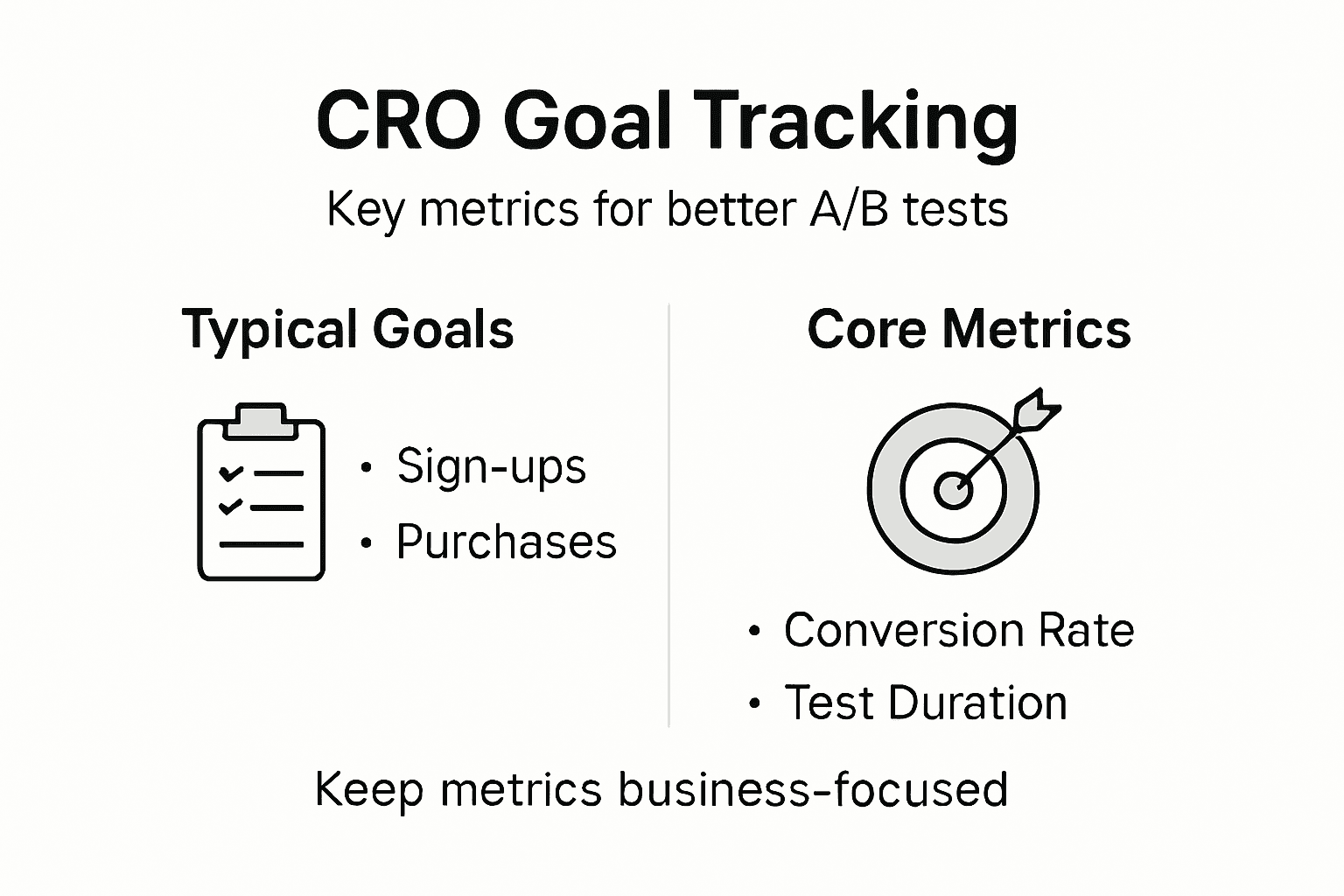
The table below outlines the key differences between a basic and advanced goal tracking setup in CRO:
| Setup Type | Data Depth | Insights Provided | Common Use Case |
|---|---|---|---|
| Basic | Limited | Surface-level metrics | Initial site performance checks |
| Advanced | Granular | Behavior & journey analysis | Strategic optimization decisions |
Goal tracking is not just about measuring outcomes, but about understanding the journey that leads to those outcomes.
Pro tip: Start by mapping out all potential conversion points in your user journey before implementing complex tracking mechanisms.
Types of Goals for SaaS Marketers
SaaS marketing goals represent strategic targets that drive business growth and customer acquisition. These goals go far beyond simple vanity metrics, encompassing a comprehensive approach to digital marketing performance. Understanding the nuanced types of goals helps marketers create more targeted and effective strategies.
Marketing goals for SaaS businesses typically fall into several key categories:
- Brand Awareness: Increasing visibility and recognition in the market
- Lead Generation: Capturing potential customer contact information
- Customer Acquisition: Converting interested prospects into paying customers
- Customer Retention: Reducing churn and maintaining existing subscriber base
- Thought Leadership: Establishing industry credibility and expertise
Each goal type requires specific key performance indicators (KPIs) and measurement strategies. Brand awareness might track metrics like website traffic and social media engagement, while lead generation focuses on conversion rates and quality of leads captured. Customer retention goals typically examine churn rates, subscription renewals, and customer satisfaction scores.

Successful SaaS marketers understand that these goals are interconnected. A robust marketing strategy doesn't just focus on one objective but creates a holistic approach that balances multiple goals simultaneously. This means developing nuanced tracking mechanisms that provide comprehensive insights into overall business performance.
Here's a summary comparing different SaaS marketing goal types and their typical business impact:
| Goal Type | Typical KPIs | Business Impact | Optimization Focus |
|---|---|---|---|
| Brand Awareness | Impressions, traffic | Expands market reach | Content & social presence |
| Lead Generation | Form submissions, sign-ups | Builds sales pipeline | Landing page design |
| Customer Acquisition | Conversion rate, sales | Drives revenue growth | Pricing & onboarding |
| Customer Retention | Churn rate, renewals | Increases lifetime value | Support & engagement |
| Thought Leadership | Shares, media mentions | Boosts credibility and authority | Blogging & webinars |
Effective goal tracking transforms marketing from a cost center to a strategic revenue driver.
Pro tip: Develop a balanced scorecard that tracks multiple goal types to ensure a comprehensive view of marketing performance.
How Goal Tracking Works in A/B Testing Tools
A/B testing tools transform complex conversion optimization processes into streamlined, data-driven experiments. These sophisticated platforms enable marketers to analyze test results with precision and strategic insight. Goal tracking represents the critical mechanism that transforms raw website interactions into meaningful performance metrics.
The core components of goal tracking in A/B testing tools typically include:
- Conversion Event Detection: Identifying specific user actions
- Performance Measurement: Quantifying the impact of variations
- Statistical Significance Calculation: Determining reliable outcomes
- Visualization and Reporting: Presenting data in actionable formats
- Segment Analysis: Breaking down performance across different user groups
Successful goal tracking requires understanding multiple layers of user interaction. Most A/B testing tools capture granular data points such as button clicks, form submissions, page views, and time spent on specific sections. These tools use advanced tracking scripts that monitor user behavior without compromising website performance, allowing marketers to gain deep insights into conversion dynamics.
The tracking process involves sophisticated algorithms that compare control and variant versions, calculating precise conversion rates and statistical significance. Advanced platforms provide real-time dashboards that display comprehensive metrics, enabling marketers to make quick, data-driven decisions about website optimization strategies.
Goal tracking transforms website data from passive information into strategic business intelligence.
Pro tip: Configure multiple goal types in your A/B testing tool to capture a holistic view of user interactions and conversion potential.
Key Steps to Effective Goal Setup
Designing meaningful conversion goals requires a strategic approach that goes beyond simple metrics. Marketers must develop systematic goal-setting strategies that align with broader business objectives and provide actionable insights into user behavior.
The most effective goal setup process involves several critical components:
- Define Clear Objectives: Establish precise, measurable targets
- Align with Business Priorities: Connect goals to overall organizational strategy
- Select Relevant Metrics: Choose indicators that truly reflect performance
- Establish Baseline Measurements: Understand current performance levels
- Create Realistic Benchmarks: Set achievable yet challenging targets
Successful goal setup follows the SMART criteria, which ensures that each objective is Specific, Measurable, Achievable, Relevant, and Time-bound. This framework transforms abstract intentions into concrete, trackable outcomes. For instance, instead of setting a vague goal like "increase conversions," a SMART goal might specify "increase landing page conversion rates by 15% within the next quarter by optimizing call-to-action placement and design".
The implementation process requires continuous refinement and careful analysis. Marketers must remain flexible, regularly reviewing goal performance and adjusting strategies based on emerging data and changing business landscapes. This approach transforms goal tracking from a static exercise into a dynamic, responsive optimization process.
Effective goal setup is not about perfection, but about creating a systematic approach to continuous improvement.
Pro tip: Conduct monthly reviews of your goal tracking metrics to ensure ongoing alignment with business objectives and user behavior patterns.
Common Mistakes and How to Avoid Them
Conversion Rate Optimization (CRO) success hinges on identifying and mitigating potential pitfalls that can derail testing efforts. Marketers must recognize common CRO mistakes to ensure more reliable and actionable experimental outcomes.
The most critical mistakes in A/B testing and goal tracking include:
- Undefined Goals: Lacking clear, measurable objectives
- Insufficient Sample Size: Running tests with inadequate traffic
- Premature Test Termination: Stopping experiments too early
- Ignoring Statistical Significance: Making decisions without robust data
- Overlooking User Segmentation: Treating all users as a homogeneous group
- Testing Multiple Variables Simultaneously: Reducing experiment clarity
Each mistake represents a potential roadblock in understanding true user behavior. Statistical significance is particularly crucial - many marketers make decisions based on insufficient data, which can lead to misguided optimization strategies. Proper testing requires patience, with experiments typically needing to run long enough to gather meaningful insights across different user segments and behavioral patterns.
Successful CRO demands a methodical approach that prioritizes data integrity and comprehensive analysis. This means designing experiments with precision, maintaining rigorous testing protocols, and remaining open to insights that might challenge existing assumptions about user behavior and conversion potential.
Data-driven decisions require more than numbers - they demand nuanced understanding and careful interpretation.
Pro tip: Implement a structured review process that critically examines test results before making any significant website modifications.
Elevate Your CRO Strategy with Stellar's Goal Tracking and A/B Testing
Achieving precise goal tracking is essential for reliable A/B test outcomes and effective conversion rate optimization. If you are facing challenges like undefined goals, insufficient data, or difficulty analyzing user behavior across multiple segments, Stellar offers a solution designed specifically for marketers and growth hackers who want to simplify this complex process. With advanced goal tracking capabilities embedded in a no-code visual editor, you can effortlessly monitor key conversion events from micro-interactions to full sales, turning raw data into actionable insights.
Don’t let unclear objectives or premature test decisions hold back your marketing growth. Try Stellar’s fast and lightweight platform with real-time analytics to gain the clarity you need now. Take the next step toward smarter experimentation and improved conversions by exploring how our tool can streamline your A/B testing journey at Stellar’s landing page. Discover how easy it can be to set measurable, strategic goals and optimize your website’s performance with the Advanced Goal Tracking features designed for small to medium-sized businesses.
Frequently Asked Questions
What is goal tracking in Conversion Rate Optimization (CRO)?
Goal tracking in CRO refers to the process of measuring and analyzing specific conversion actions on a website to enhance performance and convert visitors into customers. It involves identifying metrics, monitoring performance, and implementing optimization strategies.
How can goal tracking improve A/B testing outcomes?
Effective goal tracking allows marketers to understand user behavior and preferences, ensuring that A/B tests are run with clear objectives and measurable results. By analyzing conversion metrics, marketers can make informed decisions to optimize website elements for better performance.
What are common mistakes to avoid in goal tracking for CRO?
Common mistakes in goal tracking include having undefined goals, using insufficient sample sizes, stopping tests prematurely, ignoring statistical significance, and testing multiple variables simultaneously. Each of these can skew results and lead to ineffective optimization strategies.
What types of goals should SaaS marketers focus on?
SaaS marketers should focus on goals such as brand awareness, lead generation, customer acquisition, customer retention, and thought leadership. Each of these goals requires specific key performance indicators (KPIs) to measure success effectively.
Recommended
Published: 2/4/2026