
How MTU testing centers boost A/B testing for SMBs
TL;DR:
- MTU stands for Monthly Tested Users, the unique visitors included in A/B tests each month.
- Exceeding MTU caps can pause experiments, inflate costs, or force unexpected upgrades.
- Strategic MTU management fosters focus, faster insights, and better results for SMBs.
Most marketers assume their A/B testing platform will scale with their ambitions, until they hit an invisible wall. That wall has a name: the MTU cap. Monthly Tested Users limits are the single most misunderstood constraint in A/B testing, and crossing that threshold without a plan can pause your experiments mid-campaign, inflate your costs overnight, or force you into a pricing tier you never budgeted for. This guide breaks down exactly what MTU testing centers are, how these limits shape your testing strategy, and how to pick the platform that fits your traffic and growth goals without surprises.
Table of Contents
- What is an MTU testing center and why does it matter?
- How MTU limits affect your A/B testing strategy
- Choosing the right MTU testing center for your needs
- Maximizing results: Best practices for SMBs using MTU testing centers
- The hidden superpower of MTU testing centers for agile teams
- Next steps: Supercharge your A/B testing with the right tools
- Frequently asked questions
Key Takeaways
| Point | Details |
|---|---|
| MTU defines test scope | Monthly Tested Users caps determine how many people can be included in your experiments each month. |
| SMBs can start free | Platforms like VWO offer free plans with high MTU limits, which are great for small businesses just getting started. |
| Strategic MTU management | Prioritize and segment tests to maximize learning without exceeding platform limits or incurring extra costs. |
| Choosing the right platform | Match your typical monthly test traffic to a vendor’s MTU tier for the most efficient spend and best results. |
What is an MTU testing center and why does it matter?
Let's clear up the confusion first. MTU stands for Monthly Tested Users, the count of unique visitors who are actually included in your A/B experiments during a given month. This is not the same as your total website traffic. If 100,000 people visit your site but only 30,000 land on pages where you're running experiments, your MTU count is 30,000.
This distinction matters enormously. Many platforms charge based on MTU rather than raw pageviews or sessions. That's actually a more marketer-friendly model because you only "use up" your limit when visitors are actively enrolled in a test. Understanding A/B testing basics helps frame why this metric became the standard: it ties your costs directly to your experimentation activity, not your overall traffic volume.
MTU vs. MUV: what's the difference?
MUV stands for Monthly Unique Visitors, which counts everyone who shows up regardless of whether they see a test. MTU is a subset of MUV. Some platforms bill on MUV (which can feel punishing for high-traffic, low-experiment periods), while MTU-based platforms reward teams that run focused, deliberate experiments. For SMBs with limited budgets, MTU-based pricing is often the smarter economic model.
An MTU testing center refers to any A/B testing platform that structures its pricing and capacity around the MTU metric, giving you a defined cap per pricing tier. Here's what you need to know about these caps:
- They reset monthly, so overage in one month doesn't carry into the next
- Exceeding your cap usually means experiments pause automatically or you're prompted to upgrade
- Different platforms handle overages differently: some charge per additional MTU block, others simply stop your tests
- Free tiers typically offer the most limited MTU allocations but can still be powerful for early-stage testing
"The VWO Starter plan offers A/B testing for free up to 50,000 MTU per month, making it a practical entry point for small businesses ready to run their first experiments."
The most common pitfall teams fall into is simply ignoring the MTU counter until it's too late. You launch a high-traffic campaign, your experiment enrollment spikes, and suddenly your test pauses right when you're collecting the most valuable data. That's not a platform failure — it's a planning failure. Knowing your MTU ceiling before you launch is as essential as knowing your campaign budget.
How MTU limits affect your A/B testing strategy
Now that you know what MTU is, let's explore how these limits shape your real-world A/B testing decisions and outcomes.
Here are three realistic scenarios for how MTU caps play out in practice:
- Below the cap: Your site gets 15,000 monthly visitors and you're on a free plan capped at 25,000 MTU. You can run multiple experiments simultaneously, test several page variants, and still have headroom. This is the sweet spot: maximum experimentation freedom at zero cost.
- At the cap: Your traffic grows to 22,000 monthly visitors and you've been running three concurrent tests. You're approaching your limit. You need to prioritize which experiments are still active versus paused. Without monitoring, you won't know until a test silently stops.
- Above the cap: Your seasonal campaign drives a traffic spike. You hit the MTU ceiling on day 18 of your 30-day test. Remaining data is incomplete, statistical significance may never be reached, and you've wasted two weeks of setup time. This scenario is avoidable with proactive MTU tracking.
To put these scenarios in concrete terms, here's how MTU caps typically impact your testing capacity:
| MTU cap | Concurrent tests (typical) | Test duration needed | Result reliability |
|---|---|---|---|
| Up to 25,000 | 1 to 2 | 4 to 6 weeks | Moderate (for low-traffic sites) |
| Up to 50,000 | 2 to 3 | 2 to 4 weeks | Good |
| Up to 100,000 | 3 to 5 | 1 to 3 weeks | Strong |
| 100,000+ | 5 or more | Under 2 weeks | Very strong |
Notice the compounding effect. More MTU doesn't just mean bigger tests. It means faster results, which means faster iteration, which means more learning cycles per quarter. That's a genuine competitive advantage for any growth-focused team.

The VWO Starter plan's 50,000 MTU free tier sits in a particularly useful middle range. It's enough to run meaningful multivariate tests on moderate-traffic sites without opening your wallet.
Pro Tip: Set a monthly calendar reminder on day 20 of each month to review your MTU consumption. If you're above 75% of your cap with 10 days left, either pause lower-priority tests or prepare to upgrade. Never let a critical test get cut off at the worst possible moment.
Following A/B testing best practices around test prioritization becomes even more important when MTU is a constraint. You can't afford to run low-value tests that eat into your monthly allocation. Every enrolled user should be contributing to a decision you actually need to make.
Choosing the right MTU testing center for your needs
Understanding your MTU needs, the next step is matching them to the testing center best equipped to serve your team and traffic.
The first question to answer is: where does your business sit right now?
Most SMBs fall into one of three categories. Early-stage teams under 10,000 monthly visitors should prioritize free tiers with enough flexibility to learn the craft. Growing teams between 10,000 and 75,000 visitors need solid reporting and multi-test capability without enterprise pricing. Scaling teams above 75,000 monthly visitors should look at paid tiers that offer behavioral segmentation, advanced goal tracking, and priority support.
Here's a comparison of how popular platforms stack up on MTU-related criteria:
| Platform | Free MTU limit | Paid MTU starts at | Visual editor | Real-time analytics | Ease of use |
|---|---|---|---|---|---|
| Stellar | 25,000 MTU | Custom tiers | Yes (no-code) | Yes | Very high |
| VWO | 50,000 MTU free | 50,000+ paid | Yes | Yes | High |
| Google Optimize | Discontinued | N/A | Limited | No | Medium |
| Optimizely | No free tier | Enterprise pricing | Yes | Yes | Medium |
When you're evaluating A/B testing platform options, don't let MTU caps be the only factor. Here are the other criteria that separate a frustrating tool from one your team actually adopts:
- Integration depth: Does it connect to your CRM, analytics stack, or ad platforms?
- Visual editor quality: Can a non-technical marketer build and launch a test without touching code?
- Goal tracking flexibility: Can you define custom conversion events beyond just clicks and pageviews?
- Support responsiveness: When you're troubleshooting a live test, how fast can you get help?
- Script performance: A bloated testing script slows your site and distorts results. Look for lightweight scripts under 10KB.
- Reporting clarity: Can you read the results and make a decision without an analyst on call?
For a deep look at how VWO specifically handles SMB use cases, the VWO guide for SMBs is worth reviewing before you commit to a plan. Different team sizes and testing maturities will get very different value from the same platform.
Maximizing results: Best practices for SMBs using MTU testing centers
Once you've locked in your MTU testing platform, these strategies will help you extract the most value while avoiding common pitfalls faced by busy SMB teams.
Prioritize high-value traffic segments first. Not all visitors are equal. If your checkout page converts at 3x the rate of your homepage, run your experiments there first. Each MTU enrolled on a high-intent page generates more actionable learning than the same MTU on a low-stakes informational page. Identify your highest-converting traffic sources and focus early experiments on those user segments.
Batch your tests by theme or page type. Running one test on your pricing page, one on your hero headline, and one on your email signup form simultaneously is fine if your MTU allows it. But if you're close to your cap, batch experiments by priority. Finish the pricing page test, implement the winner, then move to the next. Sequential testing can be slower, but it avoids splitting your MTU across too many inconclusive tests at once.
"Teams that stay within their MTU allocation by testing strategically, rather than launching every idea at once, consistently reach statistical significance faster and with cleaner data."
Use no-code visual editors to eliminate the IT bottleneck. One of the biggest friction points for SMB testing is waiting for developer time. If every test variant requires a code change, you'll run maybe four to six tests per year. With a no-code visual editor, a marketer can build, preview, and launch a variant in under an hour. That's the difference between 6 tests per year and 40.
Leverage dynamic content tools to maximize each test. Dynamic keyword insertion, for example, lets you personalize landing pages based on the traffic source without creating dozens of separate variants. One experiment, multiple audience segments, smarter data. Tools that combine testing with personalization let you stretch your MTU further by making each enrolled user more informative.
Here's a focused checklist for running MTU-efficient experiments:
- Define a clear primary metric before launching any test (click rate, form fills, purchases)
- Set a minimum sample size target before calling a winner (don't stop early based on gut feel)
- Run tests for at least one full business cycle, typically seven days minimum, to account for weekly traffic patterns
- Archive completed tests and their results so you build institutional knowledge over time
- Review VWO testing strategies and adapt frameworks that fit your traffic volume
Pro Tip: Use your platform's traffic allocation settings to limit test exposure to 50% of eligible visitors during the first 48 hours. This protects against bugs in your variant and lets you validate the test is running correctly before committing your full MTU budget to it.
The hidden superpower of MTU testing centers for agile teams
Here's the contrarian take most platform comparison articles won't tell you: chasing unlimited plans is often a trap for SMBs.
The assumption is that more capacity equals better testing. But the teams we see running the most impactful experiments are almost never the ones with the biggest plans. They're the ones that treat their MTU budget like a sprint allocation in agile development. Fixed capacity creates focus. Focus creates better experiments.
When you have 25,000 or 50,000 MTU per month, you're forced to answer a critical question before every test: "Is this experiment worth the allocation?" That question alone eliminates a huge category of low-value, "nice to know" tests that pollute your data and slow down your learning cycles.
Consider what happens on teams with unlimited testing budgets. They run everything. They test button colors when they should be testing pricing structures. They run five simultaneous experiments on the same page, creating interaction effects that make results uninterpretable. More is not always better in experimentation.
"Limited capacity breeds creativity. The best A/B testing programs are defined by ruthless prioritization, not raw volume."
Teams that treat MTU as a strategic resource rather than a constraint to overcome consistently outperform those focused on headline features or raw scale. They develop better hypothesis frameworks, document results more carefully, and build institutional memory that compounds over time. That's the real ROI of thoughtful MTU management.
If you're curious how this plays out in practice across different business types, the SMB beta testing guide covers several real scenarios where constrained testing budgets drove sharper, more decisive experiments than open-ended programs.
The modern A/B platform landscape was built for iteration, not endless scale. The tools, the pricing models, the no-code editors — they're all optimized for teams moving fast with limited resources. SMBs that internalize that design philosophy and work with their MTU limits rather than around them are consistently the fastest learners.
Next steps: Supercharge your A/B testing with the right tools
Ready to put MTU best practices to work? Choosing a platform that fits your traffic, your team's skill level, and your budget shouldn't be a months-long evaluation process.
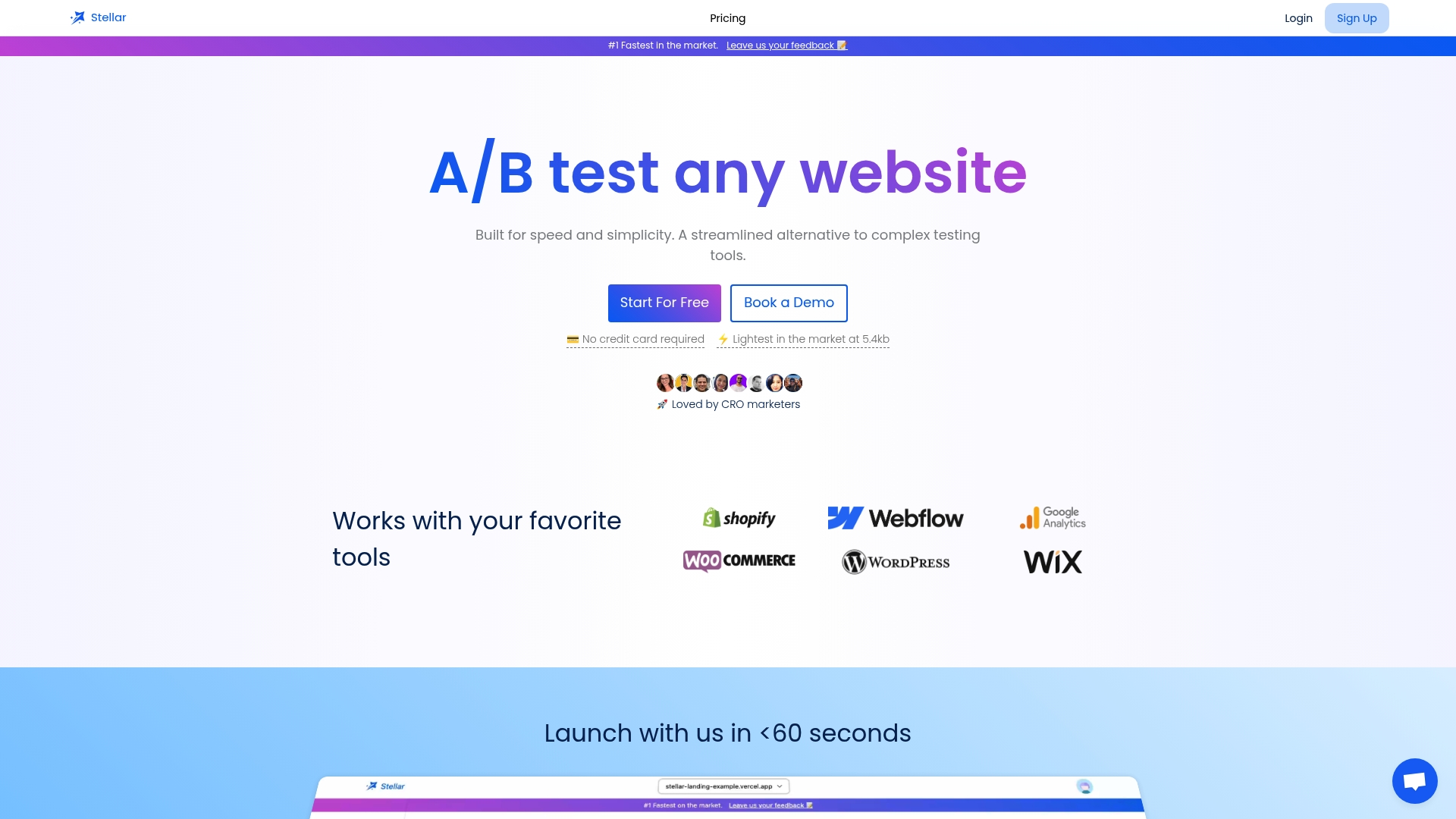
Stellar was built specifically for marketers and product managers at SMBs who need to move fast without a developer on speed dial. With a lightweight 5.4KB script, a no-code visual editor, real-time analytics, and a free plan for sites under 25,000 monthly tracked users, Stellar removes every friction point between your hypothesis and your first result. You can launch your first A/B test today, track conversions against goals you define, and get clear data without wrestling with enterprise-level complexity. If your team is ready to run smarter experiments that actually move the needle, explore what Stellar can do for your testing program at gostellar.app.
Frequently asked questions
What does MTU stand for in A/B testing platforms?
MTU stands for Monthly Tested Users, meaning the unique visitors included in A/B tests within a given month, not your total site traffic.
How do I know if my site will exceed a platform's MTU cap?
Compare your average monthly unique visitors on tested pages against your platform's MTU limit, and set up alerts or manual check-ins at the 75% usage mark each month.
Are there free A/B testing platforms with generous MTU limits?
Yes, platforms like VWO offer free A/B testing up to 50,000 MTU per month on their Starter plan, which covers most small business traffic volumes without any cost.
What happens if I go over my MTU limit?
Most platforms will automatically pause your active experiments or prompt you to upgrade your plan before testing can resume, which can interrupt time-sensitive campaigns.
How does MTU impact test accuracy for SMBs?
Staying within your MTU cap may require prioritizing your highest-impact experiments, but disciplined test selection actually improves accuracy by reducing interaction effects and keeping your sample sizes clean and meaningful.
Recommended
Published: 4/29/2026