
How to Prioritize Marketing Experiments for Higher ROI
Chasing higher conversion rates can quickly feel overwhelming when every experiment competes for your time and resources. For marketing managers at SaaS companies, getting real results means moving past trial and error toward a focused approach. By grounding your process in clear business goals and smart experiment prioritization, you ensure every A/B test drives measurable growth instead of guesswork.
Table of Contents
- Step 1: Define Your Primary Business Goals
- Step 2: Gather Relevant Data And Customer Insights
- Step 3: Score Experiment Ideas Using Impact And Effort
- Step 4: Select High-Priority Experiments To Execute
- Step 5: Validate Results And Adjust Prioritization Framework
Quick Summary
| Key Insight | Explanation |
|---|---|
| 1. Define SMART Business Goals | Establish clear, Specific, Measurable, Achievable, Relevant, and Time-bound objectives to guide marketing efforts effectively. |
| 2. Utilize Diverse Data Collection | Employ quantitative and qualitative methods to gain comprehensive customer insights for designing impactful marketing strategies. |
| 3. Prioritize Experiments Strategically | Score marketing experiments based on potential impact and effort to focus on the most valuable opportunities. |
| 4. Select High-Priority Experiments | Use frameworks like ICE or scoring systems to choose experiments with the highest potential benefits and feasibility. |
| 5. Validate Results for Continuous Improvement | Analyze experiment outcomes critically to extract meaningful insights that inform future marketing strategies and decisions. |
Step 1: Define your primary business goals
Defining clear business goals is the foundational step that will drive your entire marketing experimentation strategy. By establishing precise, measurable objectives, you create a strategic roadmap that aligns your marketing efforts with actual business outcomes.
To begin defining your primary business goals, start by conducting a comprehensive assessment of your current business performance and future aspirations. Marketing goals are specific outcomes that connect your day-to-day activities to larger strategic objectives. These goals should be both ambitious and realistic.
Here are key considerations when defining your business goals:
- Revenue growth: Determine specific financial targets for the next quarter or year
- Market expansion: Identify new customer segments or geographic markets
- Brand awareness: Quantify targets for increased visibility and recognition
- Customer acquisition: Set specific targets for new customer numbers
- Customer retention: Establish metrics for improving customer loyalty
The most effective business goals are SMART: Specific, Measurable, Achievable, Relevant, and Time-bound.
To make your goals actionable, transform broad ambitions into concrete, trackable metrics. For instance, instead of saying "increase sales," specify "grow quarterly revenue by 15% through targeted marketing experiments." This approach ensures your goals are clear, quantifiable, and directly tied to your marketing strategies.
Pro tip: Schedule quarterly goal review sessions to reassess and recalibrate your objectives based on experimental results and changing market conditions.
Here's a summary comparing common goal-setting frameworks useful in marketing experimentation:
| Framework | Core Focus | Strengths | Typical Use Case |
|---|---|---|---|
| SMART | Specific, Measurable, Achievable, Relevant, Time-bound | Clarity and accountability | Defining actionable marketing targets |
| OKR | Objectives and Key Results | Alignment, transparency | Coordinating team-wide priorities |
| KPI-Driven | Key Performance Indicators | Quantitative tracking | Monitoring ongoing campaign impact |
| BHAG | Big Hairy Audacious Goal | Vision, motivation | Inspiring long-term innovation |
Step 2: Gather relevant data and customer insights
Gathering comprehensive customer insights is crucial for designing effective marketing experiments that drive meaningful business results. This step involves systematically collecting and analyzing data to understand your target audience's behaviors, preferences, and potential pain points.

Customer insights help firms tailor marketing strategies by generating and interpreting critical information about customer needs. To begin, you'll want to employ multiple data collection techniques that provide a holistic view of your audience.
Key data collection methods include:
- Web analytics: Track user behavior on your website
- Surveys: Collect direct feedback from customers
- Social media monitoring: Understand audience sentiment and trends
- Customer interviews: Gain deep qualitative insights
- Purchase history analysis: Identify buying patterns and preferences
Effective data collection requires a mix of quantitative and qualitative research techniques to uncover comprehensive customer understanding.
To ensure robust insights, focus on gathering first-party data directly from your target audience. This means going beyond surface-level metrics and diving deep into understanding the motivations and challenges your customers face. Combine digital interaction data, purchase histories, and direct feedback to create a nuanced picture of your customer base.
Pro tip: Create a centralized data repository that integrates insights from multiple sources, allowing for easier cross-referencing and more comprehensive analysis.
This table highlights the distinct value of quantitative and qualitative data for customer insight:
| Data Type | Example Insights | Strengths | Key Limitation |
|---|---|---|---|
| Quantitative | Click rates, sales volume | Scalable, objective | Lacks behavioral context |
| Qualitative | Customer feedback, interviews | Deep understanding, detail | Smaller sample sizes |
Step 3: Score experiment ideas using impact and effort
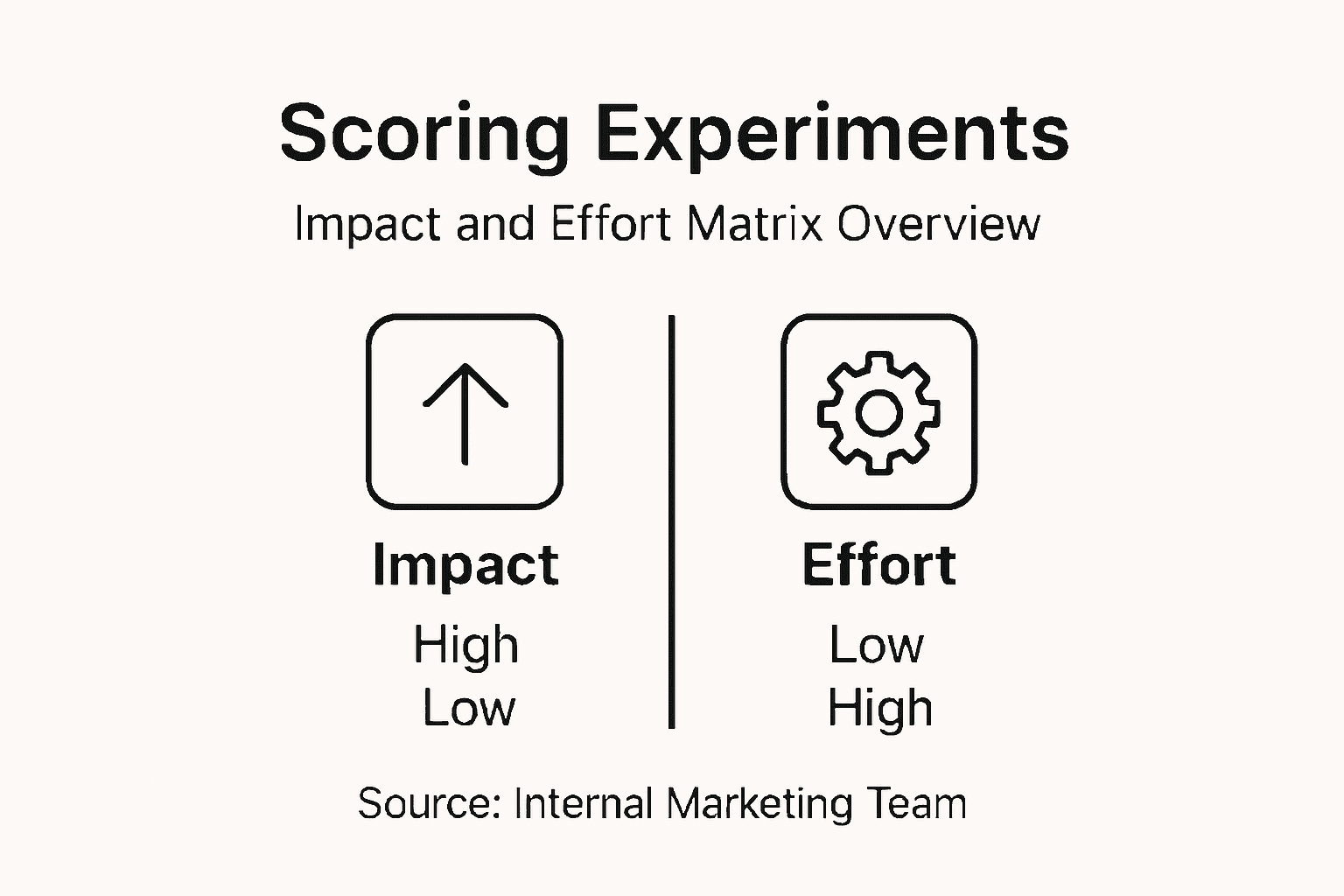
Prioritizing marketing experiments requires a strategic approach that balances potential impact with the resources required for implementation. Impact and Effort Matrix helps teams prioritize ideas effectively by systematically evaluating each potential experiment.

To score your experiment ideas, you'll need to create a structured assessment framework that objectively measures two critical dimensions: potential business impact and the effort required to execute the experiment. This approach ensures you focus on experiments that deliver maximum value with minimal resource investment.
Key scoring criteria for evaluating experiments:
- Business impact: Potential revenue increase, customer acquisition, or strategic advancement
- Implementation effort: Time, resources, and complexity required
- Technical feasibility: Ease of execution and technical constraints
- Data availability: Quality and accessibility of required data
- Alignment with business goals: Direct connection to strategic objectives
The most effective experiments balance high potential impact with manageable implementation complexity.
Create a simple scoring system where you rate each experiment idea on a scale of 1-10 for both impact and effort. Experiments with high impact (8-10) and low effort (1-3) become your quick wins and should be prioritized. Those with high impact but high effort require careful strategic consideration.
Pro tip: Develop a standardized scoring spreadsheet that allows team members to consistently and objectively evaluate experiment ideas across multiple dimensions.
Step 4: Select high-priority experiments to execute
Selecting the right marketing experiments is critical to driving meaningful business growth. Marketing science research supports strategic experiment selection by focusing on initiatives that deliver maximum impact and actionable insights.
To identify your most promising experiments, you'll want to synthesize the scoring work from the previous step and apply additional strategic filters. This means looking beyond raw numbers and considering the broader context of each potential experiment.
Key criteria for final experiment selection:
- Strategic alignment: Direct connection to core business objectives
- Potential for transformative insights: Experiments that could fundamentally improve understanding
- Resource efficiency: Minimal investment with maximum potential return
- Technical feasibility: Realistic implementation within current capabilities
- Immediate actionability: Clear pathway from experiment results to business improvements
The most effective experiments are those that balance innovative thinking with practical execution potential.
Consider using the ICE (Impact, Confidence, Ease) framework to make final selections. Rate each experiment across these three dimensions and prioritize those with the highest combined scores. This approach ensures you're not just choosing experiments that look good on paper but ones that can genuinely move the needle for your business.
Pro tip: Create a collaborative selection process that involves multiple stakeholders to reduce individual bias and leverage diverse perspectives.
Step 5: Validate results and adjust prioritization framework
Continuous experimentation allows businesses to scale effectively by systematically analyzing and learning from marketing experiment outcomes. Validating results is not just about confirming success or failure but understanding the deeper insights that can reshape your future marketing strategies.
To effectively validate your marketing experiment results, you'll need a comprehensive and rigorous approach that goes beyond surface-level metrics. This means critically examining both the quantitative data and the qualitative context of your experiments.
Key validation and framework adjustment strategies:
- Statistical significance: Ensure results are not due to random chance
- Control group comparison: Measure actual impact against baseline performance
- Contextual analysis: Understand broader factors influencing experiment outcomes
- Replicability assessment: Verify if results can be consistently reproduced
- Cross-functional review: Gather insights from different team perspectives
Robust validation requires looking beyond the numbers to understand the complete story behind your experimental results.
Develop a dynamic prioritization framework that can evolve based on validated insights. This means creating a feedback loop where each experiment's results directly inform your future experimental design, resource allocation, and strategic priorities.
Pro tip: Create a standardized experiment results dashboard that automatically tracks key performance indicators and highlights statistically significant findings.
Unlock Higher ROI by Prioritizing Your Marketing Experiments with Stellar
If you found the process of scoring and selecting marketing experiments challenging in the article, you know how critical it is to balance impact and effort while aligning experiments with business goals. Key pain points like measuring potential business impact, ensuring technical feasibility, and tracking real-time results can slow down your decision-making and dilute your ROI. That is where Stellar’s lightweight and fast A/B testing platform becomes your game changer. Stellar’s user-friendly Visual Editor lets you quickly design and launch experiments without technical hurdles, so you can focus on what truly matters: high-impact experiments backed by data and aligned with your priorities.
Start transforming your marketing experimentation today with Stellar’s advanced goal tracking and real-time analytics. Don’t wait to validate results and adjust your strategy. Take control of your experiment pipeline with a tool built for speed, simplicity, and powerful insights. Experience how easy it is for marketers and growth hackers to prioritize and execute winning tests by visiting Stellar’s homepage now. Your next breakthrough experiment is just a click away.
Frequently Asked Questions
How do I define my primary business goals for marketing experiments?
Defining primary business goals involves assessing your current performance and establishing measurable objectives. Start by determining targets like revenue growth or customer retention, and ensure that these goals are Specific, Measurable, Achievable, Relevant, and Time-bound (SMART).
What data should I gather to prioritize my marketing experiments?
Gather a mix of quantitative and qualitative data to understand your target audience better. Utilize web analytics, surveys, and customer interviews to collect insights about behavior and preferences, which will inform your marketing strategies.
How can I score my experiment ideas to prioritize them effectively?
Use an Impact and Effort Matrix to score your experiment ideas based on potential business impact and implementation effort. Rate each idea on a scale of 1-10 for both criteria, focusing on quick wins that have high impact and low effort to execute first.
What criteria should I consider when selecting high-priority experiments?
When selecting high-priority experiments, consider strategic alignment, potential for transformative insights, and resource efficiency. Prioritize experiments that directly relate to your core business objectives and have a clear pathway to actionable outcomes.
How do I validate the results of my marketing experiments?
To validate results, ensure that you check for statistical significance and compare outcomes against a control group. Conduct a thorough examination of both quantitative data and any qualitative context to derive meaningful insights that can influence future marketing strategies.
What steps can I take to adjust my prioritization framework after validating results?
After validating results, develop a dynamic prioritization framework that incorporates insights from previous experiments. Create a feedback loop that allows you to reassess and adjust future resource allocation and strategic priorities based on validated findings.
Recommended
Published: 2/2/2026