
Machine learning for e-commerce: Boost your conversions
TL;DR:
- Machine learning boosts e-commerce sales, with Amazon attributing 35% of revenue to it.
- Hybrid recommendation systems effectively handle cold starts and provide accurate, explainable suggestions.
- Prioritize funnel optimization and site speed before implementing advanced ML personalization.
Machine learning isn't a luxury reserved for companies with hundreds of engineers and eight-figure tech budgets. Amazon generates 35% of its revenue from recommendation systems powered by machine learning, and that single fact reshapes the conversation for every SMB selling online. The gap between enterprise and small business isn't about access to the technology anymore. It's about knowing which techniques fit your scale, your data, and your current conversion goals. This article breaks down what actually works, what the benchmarks say, and how you can apply machine learning thinking to your store starting now.
Table of Contents
- The essentials of machine learning for e-commerce
- Comparing machine learning recommendation techniques
- Success stories: Machine learning lifting e-commerce conversions
- Common pitfalls and how SMBs can maximize ML impact
- Our take: Machine learning is powerful—but don't skip the basics
- Get started: Empower your e-commerce with machine learning
- Frequently asked questions
Key Takeaways
| Point | Details |
|---|---|
| Hybrid systems work best | Combining collaborative and content-based filtering yields greater accuracy while addressing cold start challenges for SMBs. |
| Machine learning boosts conversions | AI-driven personalization and recommendations can improve conversion rates by 20–40 percent for online stores. |
| Pitfalls can limit success | Cold start, popularity bias, and other issues must be actively managed to maximize the impact of machine learning. |
| Case studies prove ROI | Benchmarks from Amazon and Shopify show substantial revenue and conversion gains linked to machine learning. |
| Basics still matter | Don't skip checkout and funnel optimization—these essential steps underpin machine learning effectiveness. |
The essentials of machine learning for e-commerce
Machine learning in e-commerce is fundamentally about predicting what a shopper wants before they know they want it. At its core, you have three major approaches, each with distinct strengths and weaknesses that matter a lot when you're running a lean operation without a dedicated data science team.
Collaborative filtering is the most widely deployed technique. It works by looking at what groups of similar users bought, browsed, or rated, and then making predictions for an individual based on those shared patterns. Think of it as crowd wisdom applied to product discovery. If 500 shoppers who bought running shoes also bought moisture-wicking socks, the system learns to recommend those socks to the next runner. The upside is powerful serendipitous discovery. The downside is the cold start problem: when a new user or a new product enters the system with no history, the algorithm has nothing to work with.
Content-based filtering takes a different angle. Instead of relying on community behavior, it matches products to a specific user based on the attributes of items they've already engaged with. If someone consistently browses leather wallets in dark brown tones, a content-based system surfaces more dark brown leather accessories. This approach handles new items well and gives you explainability, meaning you can tell the user exactly why a product is being recommended. The risk is a filter bubble: the system keeps showing variations of the same thing and limits discovery.
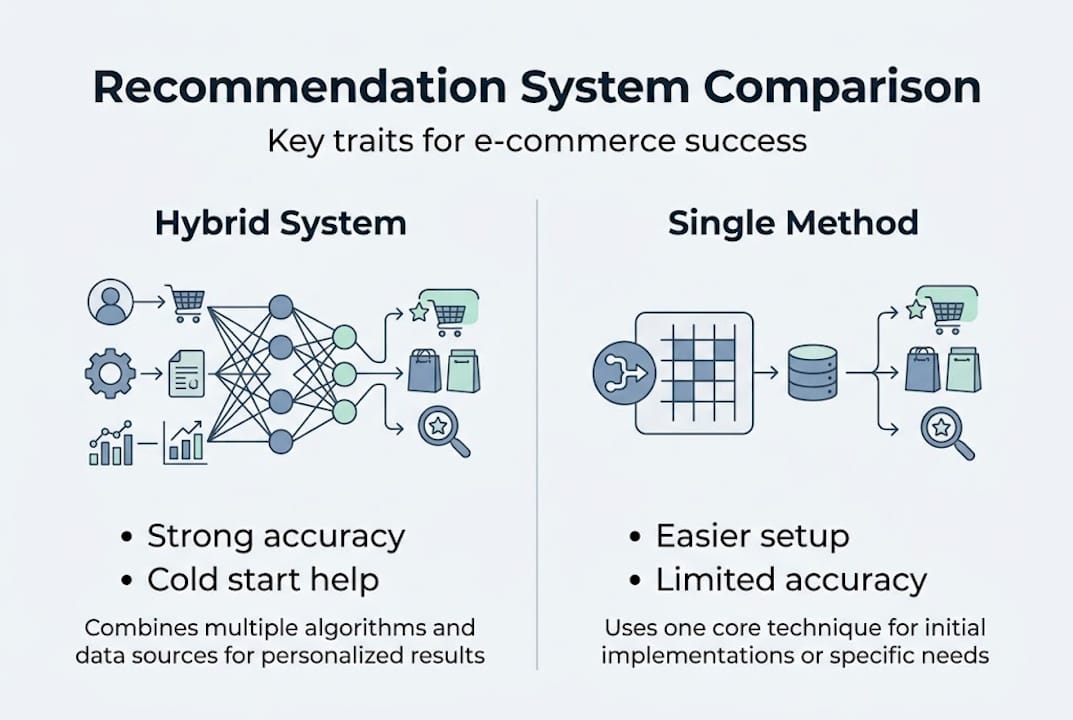
Hybrid systems combine both approaches, and this is where the real magic happens for SMBs. By blending collaborative signals with content attributes, hybrids can handle cold starts while still offering the variety of collaborative discovery. As research confirms, collaborative filtering excels at discovery but struggles with new users and products, while content-based methods provide explainability but risk filter bubbles. Hybrids address both limitations.
Here's a quick breakdown of what each approach delivers:
- Collaborative filtering: Best for product discovery, requires a sizable behavioral dataset, struggles with cold starts
- Content-based filtering: Works with new products immediately, highly explainable, risks narrow recommendations
- Hybrid systems: Balances accuracy and explainability, handles cold starts better, ideal for most SMB use cases
- Deep neural networks (DNNs): Best for sequential behavior and large catalogs, more complex to implement but increasingly accessible through third-party tools
For SMBs looking to increase conversion rate strategies through personalization, starting with a hybrid approach gives you the best balance of performance and manageability without requiring a PhD to operate.

Comparing machine learning recommendation techniques
Building on those core concepts, let's see how each machine learning method stacks up for real-world results. Choosing the right technique isn't just a technical decision; it's a business decision with direct revenue implications.
| Technique | Cold start handling | Explainability | Conversion impact | Complexity for SMBs |
|---|---|---|---|---|
| Collaborative filtering | Poor | Low | High (with data) | Medium |
| Content-based filtering | Good | High | Moderate | Low |
| Hybrid systems | Good | Medium | High | Medium |
| Deep neural networks | Excellent | Low | Very high | High |
The numbers behind the table matter. Hybrid recommendation systems combining collaborative and content-based filtering improve accuracy and address limitations like cold starts, while deep neural networks handle sequential behavior, meaning they can predict what someone will want next based on the full arc of their browsing session, not just a single click.
The evidence from production systems makes the DNN case even stronger. In a controlled OTTO A/B test, a simple DNN Two-Tower model outperformed the traditional tree-based LambdaMART model with a 1.86% lift in clicks and a 0.56% increase in revenue. Those numbers sound modest until you apply them to a business processing thousands of transactions per month. A 0.56% revenue lift on $500,000 in monthly revenue is $2,800 per month, or more than $33,000 per year, from a single algorithmic change.
That's why A/B testing for revenue growth is so closely tied to ML adoption. You can't know which model is right for your store without testing it against your actual audience. The OTTO result is instructive: the simpler DNN beat the more complex tree-based model, which is a reminder that sophistication doesn't always mean better performance in your specific context.
For SMBs evaluating conversion rate tactics, the practical priority order looks like this: start with a hybrid system to get real-world performance data, then consider DNN approaches as your catalog and user base grow and as turnkey ML platforms make those architectures more accessible.
Pro Tip: If you're new to ML-driven recommendations, look for e-commerce platforms or plugins that offer built-in hybrid recommendation engines. You get the performance benefits without building from scratch, and you can still run A/B tests to validate the lift before fully committing.
Success stories: Machine learning lifting e-commerce conversions
With the understanding of ML frameworks, let's explore how they drive conversion gains in practice. The benchmarks here are real, they come from production systems, not controlled lab settings.
"Shopify's generative recommender, built on HSTU architecture with time encoding and improved negative sampling, achieved a 0.94% increase in orders and a 0.71% lift in conversion rate across live traffic."
That result, documented by Shopify's engineering team, came from a system specifically designed to handle the messy, sparse data that real e-commerce stores generate. HSTU, or Hierarchical Sequential Transduction Units, is an architecture built to capture the order and timing of user actions, not just what someone clicked but when and in what sequence.
Here's a snapshot of how ML impacts key conversion metrics across different use cases:
| ML application | Conversion impact | Revenue impact | Notable example |
|---|---|---|---|
| Personalized recommendations | +20% to +40% | +35% (Amazon) | Amazon product pages |
| Visual search | +23% conversion rate | Significant | Fashion and furniture retailers |
| Chatbots with ML | +20% conversion lift | Moderate | Direct-to-consumer brands |
| Hybrid recommenders | +0.71% CR lift | +0.94% orders | Shopify production system |
| DNN Two-Tower model | +1.86% clicks | +0.56% revenue | OTTO marketplace |
The AI personalization benchmarks tell a consistent story: personalization lifts conversions by 20 to 40%, visual search drives a 23% higher conversion rate, and chatbots with ML capability deliver a 20% improvement in conversion.
Beyond the headline numbers, a few specific applications are worth calling out for conversion optimization strategies:
- Visual search lets shoppers upload a photo and find similar products. For apparel and home goods, this removes the friction of trying to describe what you want in words. The result is a 23% conversion rate improvement because users land on exactly what they had in mind.
- ML-powered chatbots don't just answer questions. They guide users through product selection based on stated preferences and past behavior, keeping more sessions active and steering users toward purchase decisions.
- Behavioral segmentation uses ML to cluster users by real behavior patterns, not just demographics, enabling far more targeted email campaigns and on-site messaging that convert at rates traditional segmentation can't match.
The lesson from these case studies isn't that you need to replicate Shopify's engineering team. It's that incremental ML gains, even fractions of a percent in conversion rate, compound into significant revenue when applied consistently across your full traffic volume.
Common pitfalls and how SMBs can maximize ML impact
While ML brings major gains, it's not without challenges. Knowing the failure modes before you invest saves you time, money, and the frustration of a recommendation engine that actively hurts your conversion rate.
The most important pitfalls to understand, and actively mitigate, are:
-
Cold start problems: New users and new products have no behavioral history. Without that data, algorithms default to recommending popular items, which creates a feedback loop that ignores your long-tail catalog and frustrates users who don't want what everyone else is buying. Cold start affects new users and items by forcing defaults to popularity, introducing systematic bias from day one.
-
Popularity bias: When the algorithm over-indexes on top-selling items, your recommendation engine essentially becomes a "bestsellers" list. This undermines the whole point of personalization and buries niche products that might be a perfect match for a specific user.
-
Position bias: Items shown at the top of recommendation carousels get clicked more simply because of their position, not their relevance. If your ML model trains on click data without accounting for position, it learns to recommend things based on placement, not quality of fit.
-
Data sparsity: Most SMB stores don't have the interaction volume of Amazon. When your dataset is thin, collaborative filtering in particular struggles to find meaningful patterns, producing recommendations that feel random or generic.
-
Data leakage: This is a sneaky one. If your training data includes signals that wouldn't be available at the time of actual prediction (like post-purchase behavior used to predict purchases), your offline metrics look great but your live performance disappoints.
The fixes aren't always complex. For cold starts, hybrid approaches and content attribute data fill the gap. For popularity bias, you can apply diversity constraints to recommendation outputs. For position bias, use randomized display experiments to collect unbiased click data.
The data is clear on what boosts live performance: real-time personalization outperforms batch processing by roughly 20% in conversion rate, and multi-channel personalization drives 6.5 times more purchases than single-channel approaches. Both of these findings point to the same principle: the closer your ML system is to the shopper's actual current behavior, the better it performs.
For practical next steps, start by auditing your website testing for conversions before adding ML complexity. Make sure your tracking is clean, your data pipelines are reliable, and your baseline metrics are accurate. A flawed data foundation produces flawed ML outcomes, no matter how sophisticated the model.
Pro Tip: Before scaling any ML personalization feature, run a clean A/B test with a control group receiving no personalization. This gives you a truthful baseline so you actually know whether the ML is helping or just changing behavior without lifting revenue.
Our take: Machine learning is powerful—but don't skip the basics
Here's the uncomfortable truth that most ML vendors won't tell you: a 5% conversion rate lift achieved through 36 disciplined A/B tests, heatmap analysis, and funnel optimization is worth more than an AI recommendation layer slapped on top of a broken checkout flow.
We've seen SMBs get seduced by the promise of ML personalization while their cart abandonment rate sits at 80% because the checkout has three redundant form fields and a surprise shipping fee at the last step. Machine learning cannot fix a user experience that fails at the fundamentals. It can only amplify what's already working.
The most effective approach we recommend is a sequenced one. Fix your checkout and funnel first, measure baseline conversion rates with rigorous testing, then introduce ML as an accelerant. When your foundation is solid, even a 0.7% ML-driven conversion lift hits meaningful revenue targets.
The conversion techniques that preserve site speed matter here too. Heavy ML scripts that slow your page load by even 200 milliseconds can erase every personalization gain you achieve. Treat ML as one layer in a stack of proven conversion practices, not a replacement for them.
Get started: Empower your e-commerce with machine learning
If you're ready to see machine learning transform your e-commerce outcomes, here's where to begin. The most important first step isn't picking an ML platform. It's setting up the testing infrastructure that tells you whether any change, ML-powered or not, is actually moving your numbers in the right direction.
Stellar gives SMBs a lightweight, no-code A/B testing platform built specifically for teams who need to move fast without sacrificing data quality. With a 5.4KB script that won't drag down your page speed and real-time analytics that surface results as they happen, you can validate every ML personalization decision with hard evidence. Explore Stellar's machine learning solutions and pair your personalization strategy with proven conversion rate strategies to build a testing program that turns ML experiments into measurable revenue.
Frequently asked questions
How do machine learning recommendations impact e-commerce sales?
ML-driven recommendations significantly increase conversion rates and revenue, with Amazon attributing 35% of revenue directly to these systems, making them one of the highest-ROI investments in e-commerce personalization.
What is the cold start problem in e-commerce machine learning?
The cold start problem occurs when new users or products lack behavioral data, forcing the algorithm to default to popular items and producing generic rather than personalized recommendations.
Are hybrid recommendation systems better for SMBs?
Yes, hybrid recommendation systems combining collaborative and content-based filtering balance accuracy, cold start handling, and explainability, making them the most practical and effective choice for most SMB e-commerce deployments.
Should SMBs prioritize machine learning over checkout optimization?
No. Research shows that funnel basics before advanced ML consistently deliver stronger overall conversion lifts, so optimizing your checkout experience first creates the foundation that makes ML investments pay off.
How much conversion lift can machine learning personalization achieve?
AI personalization benchmarks show 20 to 40% conversion improvements from personalized recommendations, with specialized applications like visual search delivering up to 23% higher conversion rates in production environments.
Recommended
Published: 4/26/2026