
Marketing Analytics for Beginners: Smarter Campaigns Fast
Juggling dozens of campaigns often leaves marketers asking which strategies truly move the needle. With so many choices and only limited resources, finding data-driven answers becomes essential for growth. Marketing analytics turns complex metrics into practical insights that let businesses refine their efforts, increase ROI, and confidently run A/B tests. This guide will clarify how user-friendly analytics tools empower smarter marketing by making your decisions easier and more effective.
Table of Contents
- What Marketing Analytics Really Means
- Types of Marketing Analytics and Common KPIs
- How Marketing Analytics Tools Work
- Integrating A/B Testing With Analytics
- Avoiding Common Analytics Mistakes
Key Takeaways
| Point | Details |
|---|---|
| Understanding Marketing Analytics | Marketing analytics involves transforming raw data into strategic insights through descriptive, predictive, and prescriptive methods. This approach helps decode customer behavior and optimize marketing strategies. |
| Key Performance Indicators (KPIs) | Essential KPIs like conversion rates and click-through rates are critical for measuring campaign effectiveness and tailoring marketing efforts to customer preferences. |
| Real-Time Analytics Tools | Marketing analytics tools provide real-time monitoring, allowing businesses to make immediate adjustments to campaigns based on data insights, maximizing their effectiveness. |
| A/B Testing Integration | Incorporating A/B testing with analytics minimizes guesswork in decision-making, enabling marketers to validate strategies based on data-driven insights. |
What Marketing Analytics Really Means
Marketing analytics transforms raw data into strategic insights that drive business growth. At its core, marketing analytics involves collecting and analyzing specific marketing data to measure campaign effectiveness and optimize performance.
This discipline goes far beyond simple number-counting. Marketing analytics encompasses three critical analytical approaches:
- Descriptive Analytics: Understanding what has already happened
- Predictive Analytics: Forecasting potential future marketing outcomes
- Prescriptive Analytics: Recommending specific actions based on data insights
The fundamental goal of marketing analytics is decoding customer behavior. By examining metrics like page views, conversion rates, social media engagement, and email open rates, marketers can develop precise strategies that resonate with their target audience. Advanced analytics offers companies sustainable competitive advantages by transforming data into actionable intelligence.
Companies leveraging marketing analytics can:
- Optimize marketing campaign performance
- Predict customer preferences
- Personalize customer experiences
- Allocate budgets more effectively
- Reduce wasted marketing spend
Pro tip: Start small by tracking 3-5 core metrics relevant to your business goals, then gradually expand your analytics approach.
Types of Marketing Analytics and Common KPIs
Marketing analytics offers several sophisticated approaches to understanding business performance. Digital marketing analytics examines data from multiple channels to help businesses make more informed strategic decisions, breaking down complex information into actionable insights.
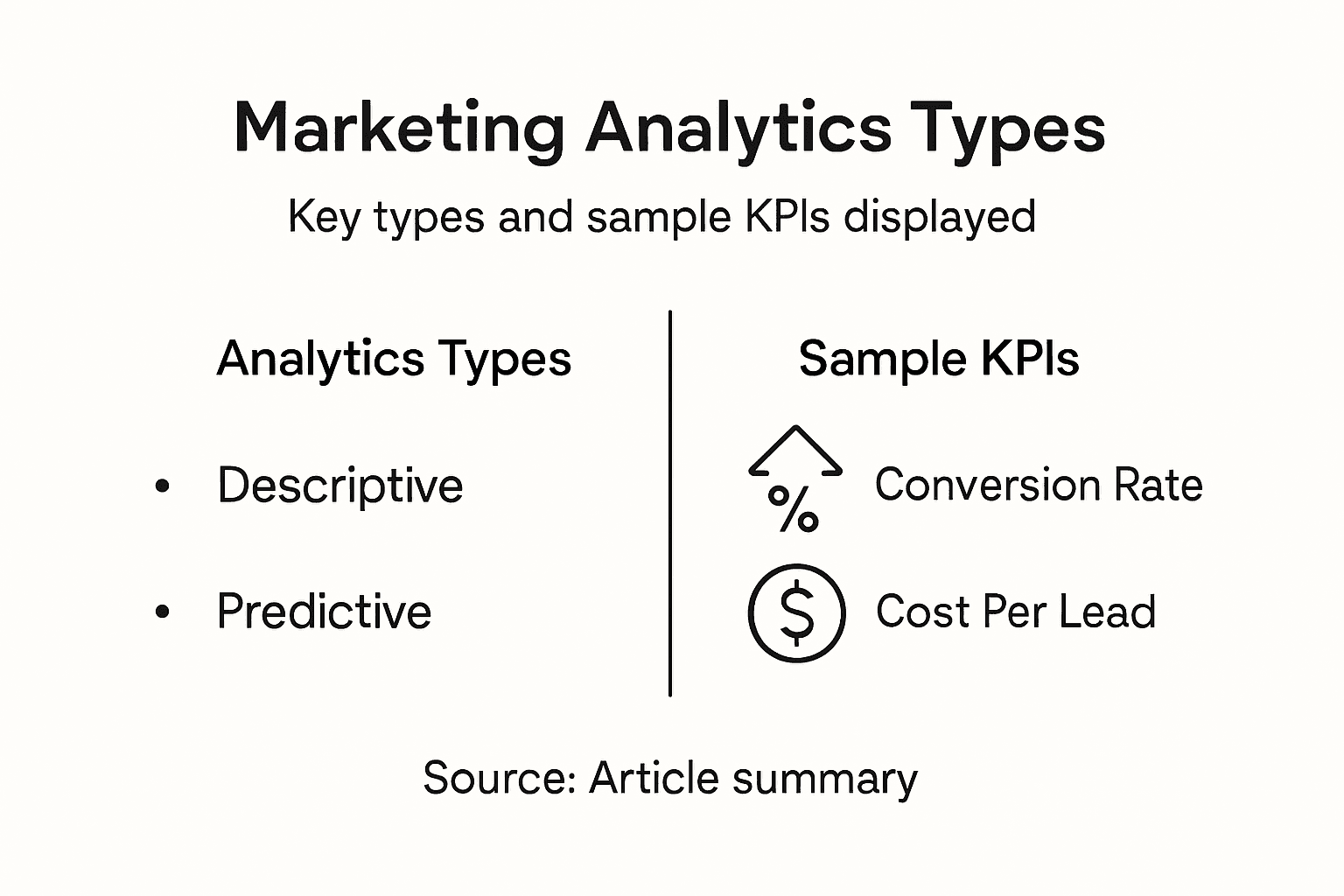
The primary types of marketing analytics include:
- Descriptive Analytics: Analyzing historical performance data
- Predictive Analytics: Forecasting future trends and customer behaviors
- Prescriptive Analytics: Recommending specific marketing actions
Key Performance Indicators (KPIs) serve as critical measurement tools across these analytical approaches. Marketing analytics tracks essential metrics that reveal campaign effectiveness and customer engagement:
-
Website Performance KPIs:
- Page views
- Bounce rate
- Conversion rate
-
Digital Marketing KPIs:
- Click-through rates (CTR)
- Cost per acquisition (CPA)
- Return on ad spend (ROAS)
-
Customer Engagement KPIs:
- Social media interaction
- Email open rates
- Lead generation metrics
Understanding these metrics allows marketers to develop targeted strategies, optimize budget allocation, and create more personalized customer experiences. The goal is transforming raw data into strategic intelligence that drives measurable business growth.

Here's a comparison of the three main analytics types and their business implications:
| Analytics Type | Main Purpose | Typical Use Case | Business Value |
|---|---|---|---|
| Descriptive | Summarize past performance | Monthly campaign reports | Understand trends and patterns |
| Predictive | Forecast future outcomes | Customer retention models | Inform future marketing strategy |
| Prescriptive | Recommend best actions | Budget allocation tools | Maximize ROI through action |
Pro tip: Focus on 3-5 core KPIs that directly align with your specific business objectives, rather than tracking every possible metric.
How Marketing Analytics Tools Work
Marketing analytics tools collect and process data from multiple digital channels, transforming raw information into strategic insights. These sophisticated platforms aggregate data from websites, social media, email campaigns, and advertising platforms to help businesses understand their marketing performance.
The core functionality of marketing analytics tools involves several key processes:
- Data Collection: Gathering information from various marketing channels
- Data Processing: Cleaning and organizing raw data
- Data Analysis: Interpreting metrics and generating insights
- Visualization: Creating understandable reports and dashboards
Real-time monitoring represents a critical feature of modern marketing analytics platforms. Digital marketing analytics tools track web traffic and user interactions with incredible precision, offering businesses immediate insights into campaign performance.
These tools typically provide advanced capabilities such as:
- Automatic performance tracking
- Detailed audience segmentation
- Predictive behavior modeling
- Comprehensive campaign reporting
- ROI calculation mechanisms
By integrating multiple data sources, marketing analytics tools enable businesses to make data-driven decisions, optimize marketing strategies, and improve overall campaign effectiveness.
Below is a summary of how key analytics tool features impact marketing effectiveness:
| Tool Feature | Business Problem Solved | Impact on Marketing Effectiveness |
|---|---|---|
| Real-time monitoring | Delayed response to issues | Enables instant campaign adjustments |
| Audience segmentation | Generic messaging | Increases personalization efforts |
| Predictive behavior | Missed sales opportunities | Targets high-value prospects faster |
| ROI calculation | Unclear campaign profitability | Justifies budget and resource spend |
| Comprehensive reporting | Fragmented performance data | Informs holistic strategy decisions |
Pro tip: Select an analytics tool that offers seamless integration with your existing marketing platforms to ensure comprehensive and accurate data tracking.
Integrating A/B Testing With Analytics
A/B testing represents a powerful method for data-driven marketing decisions, enabling businesses to compare different variations of marketing elements and determine the most effective approach. By systematically testing and analyzing alternative strategies, marketers can optimize their campaigns with unprecedented precision.
The integration process involves several critical steps:
- Experiment Design: Creating controlled test scenarios
- Metric Selection: Identifying key performance indicators
- Traffic Allocation: Distributing visitors across test variations
- Statistical Analysis: Measuring significant differences
- Result Interpretation: Drawing actionable insights
Real-time analytics play a crucial role in this process. Integrated tools enable comprehensive experiment tracking by providing detailed reports on unique visitors, conversion rates, and statistical significance. These platforms help marketers validate improvements through rigorous data analysis.
Key benefits of integrating A/B testing with analytics include:
- Objective performance measurement
- Reduced marketing guesswork
- Data-driven decision making
- Continuous campaign optimization
- Enhanced understanding of audience preferences
By leveraging sophisticated analytics platforms, businesses can transform their marketing strategies from intuition-based to evidence-based approaches, ensuring more consistent and predictable results.
Pro tip: Always establish a clear hypothesis before running A/B tests, and ensure you have sufficient sample size to draw statistically valid conclusions.
Avoiding Common Analytics Mistakes
Analytics mistakes can significantly undermine marketing decision-making, potentially leading businesses down costly and ineffective paths. Understanding and recognizing these common pitfalls is crucial for maintaining the integrity and effectiveness of your marketing analytics strategy.
The most prevalent analytics errors include:
- Correlation vs. Causation: Mistaking statistical correlation for direct causation
- Data Quality Issues: Failing to validate and clean data before analysis
- Confirmation Bias: Selecting data that only confirms preexisting beliefs
- Inappropriate Statistical Methods: Using incorrect analytical techniques
- Overlooking Context: Analyzing metrics in isolation without broader understanding
Ineffective experimental design can lead to unreliable results, compromising the entire analytical process. Marketers must approach data with a critical eye, understanding the nuanced differences between descriptive and inferential statistics.
To mitigate these risks, marketing professionals should:
- Establish rigorous data validation protocols
- Use multiple statistical methods for verification
- Maintain transparency in analytical processes
- Seek peer review and external validation
- Continuously update analytical skills and knowledge
By adopting a methodical and skeptical approach to data analysis, businesses can transform potential analytical weaknesses into opportunities for more robust insights and strategic decision-making.
Pro tip: Always cross-reference your analytical findings with multiple data sources and seek alternative interpretations to challenge your initial conclusions.
Empower Your Marketing Analytics With Fast, Easy A/B Testing
This article highlights the importance of data-driven decisions and precise campaign optimization through marketing analytics and A/B testing. If you are a marketer or growth hacker struggling to streamline your analytics or to swiftly test new strategies without technical complexity, the challenges of real-time monitoring and actionable insights can slow your progress. Key concepts like predictive analytics, real-time data tracking, and goal-oriented experiments demand tools that are both powerful and easy to use.
Stellar offers a perfect match to these needs with its A/B Testing Tool, boasting a lightning-fast 5.4KB script that minimizes impact on website performance. Their no-code visual editor allows seamless experiment setup while advanced goal tracking and real-time analytics ensure you never miss critical insights. This solution is specifically designed for small to medium-sized businesses who want smarter campaigns fast without sacrificing user experience.

Ready to transform your marketing analytics into clear, actionable strategies with user-friendly technology? Discover how Stellar combines speed, precision, and simplicity to accelerate your growth testing. Start your data-driven journey now and experience the fastest path to smarter campaigns by visiting https://gostellar.app today.
Frequently Asked Questions
What is marketing analytics?
Marketing analytics is the process of collecting and analyzing marketing data to measure the effectiveness of campaigns and optimize overall performance. It involves using various analytical approaches to gain insights into customer behavior and campaign success.
What are the different types of marketing analytics?
The primary types of marketing analytics include descriptive analytics (understanding past performance), predictive analytics (forecasting future outcomes), and prescriptive analytics (recommending specific actions based on data insights).
Why should I use marketing analytics for my campaigns?
Using marketing analytics allows businesses to optimize campaign performance, predict customer preferences, and personalize customer experiences. It enhances budget allocation and reduces wasted marketing spend by making data-driven decisions.
What are some common Key Performance Indicators (KPIs) in marketing analytics?
Common KPIs in marketing analytics include website performance metrics like page views and conversion rates, digital marketing metrics such as click-through rates and return on ad spend, and customer engagement metrics like social media interaction and email open rates.
Recommended
Published: 2/12/2026