
Marketing Psychology Basics: Driving Better A/B Tests
What makes some campaigns resonate and drive action while others fall flat? Understanding the core concepts of marketing psychology can transform how growth marketers approach A/B testing and user engagement. By examining how emotions, cognitive biases, and social influence shape consumer behavior, growth marketers at small and medium-sized e-commerce businesses can craft strategies that connect more deeply with audiences and drive measurable results.
Table of Contents
- Core Concepts Of Marketing Psychology
- Key Cognitive Biases Affecting Decisions
- Applying Psychological Triggers To Campaigns
- Personalization And Messaging For Engagement
- Avoiding Common Pitfalls In Experimentation
Key Takeaways
| Point | Details |
|---|---|
| Understanding Consumer Psychology | Marketers should leverage emotional triggers, social influences, and cognitive biases to enhance marketing strategies. |
| Utilizing Personalization | Personalized marketing significantly increases engagement by catering to individual preferences and emotional needs. |
| Avoiding Experimentation Pitfalls | Rigorous methodology helps avoid common pitfalls in A/B testing, ensuring valid insights and effective decision-making. |
| Emotional Engagement in Campaigns | Campaigns that tap into emotional responses can greatly enhance brand recall and purchase intent, leading to higher conversions. |
Core Concepts of Marketing Psychology
Marketing psychology represents a sophisticated approach to understanding how consumers make decisions, revealing the complex psychological mechanisms driving purchasing behavior. At its core, this discipline explores the intricate relationship between human cognition, emotion, and consumer choice. By uncovering psychological foundations of consumer responses, marketers can develop more nuanced and effective strategies.
Consumer behavior is fundamentally driven by several key psychological principles:
- Emotional Triggers: Purchasing decisions are rarely purely rational
- Social Influence: Consumer choices are heavily impacted by peer perceptions
- Cognitive Biases: Unconscious mental shortcuts dramatically affect decision-making
- Motivational Factors: Deep-seated needs and desires shape consumer preferences
The interaction between psychological mechanisms creates a complex landscape of consumer motivation. Emotional drivers often supersede logical reasoning, with consumers frequently making purchases based on feelings rather than objective analysis. Social proof and belonging needs play critical roles in this process, influencing everything from brand selection to product perception.
Psychological research reveals that up to 95% of purchasing decisions are made subconsciously, highlighting the profound impact of marketing psychology.
Understanding these core concepts allows marketers to craft more resonant messaging, design more compelling experiences, and ultimately drive higher conversion rates. By mapping consumer psychology, businesses can anticipate needs, address underlying motivations, and create more authentic connections with their target audiences.

Here's a summary of how core psychological concepts influence consumer behavior:
| Psychological Concept | Impact on Decision-Making | Example in Marketing |
|---|---|---|
| Emotional Triggers | Overrides rational analysis | Storytelling ads |
| Social Influence | Shapes brand and product perceptions | Influencer endorsements |
| Cognitive Biases | Leads to unconscious choices | Price anchoring |
| Motivational Factors | Drives product preference | Loyalty programs |
Pro tip: Develop customer personas that go beyond demographics and explore deep psychological motivations to create more targeted marketing strategies.
Key Cognitive Biases Affecting Decisions
Cognitive biases represent powerful psychological mechanisms that fundamentally shape consumer decision-making processes. These mental shortcuts can dramatically influence how individuals perceive information, evaluate options, and ultimately make purchasing choices. Exploring cognitive marketing reveals complex psychological patterns that marketers must understand to design more effective strategies.
Several critical cognitive biases significantly impact consumer behavior:
- Loss Aversion: Consumers more strongly prefer avoiding losses than acquiring equivalent gains
- Confirmation Bias: People tend to seek information that validates existing beliefs
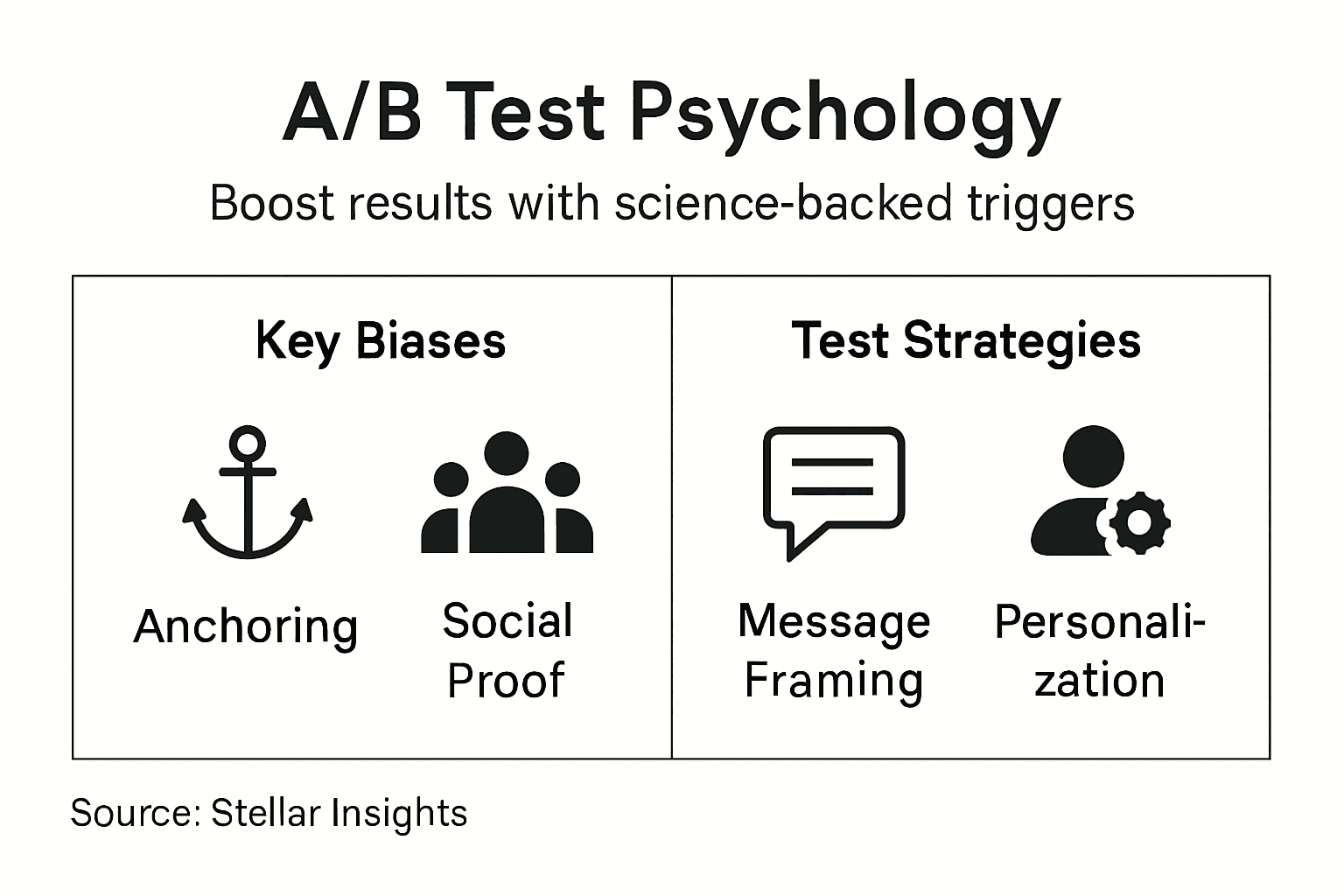
- Anchoring Effect: Initial information disproportionately influences subsequent decisions
- Availability Heuristic: Individuals judge probability based on how easily examples come to mind
- Negativity Bias: Negative experiences carry more psychological weight than positive ones
Understanding these biases provides marketers with profound insights into consumer psychology. Psychological decision-making is rarely a purely rational process, with unconscious mental mechanisms frequently overriding logical reasoning. For instance, the anchoring effect can make consumers perceive a discounted price as more attractive simply by presenting an initial higher reference point.
Cognitive biases can distort consumer judgments, making approximately 95% of purchasing decisions fundamentally unconscious and emotionally driven.
By recognizing these psychological patterns, marketers can design more sophisticated A/B testing strategies that account for inherent cognitive limitations. This approach allows for more nuanced messaging, targeted communication, and ultimately more effective conversion optimization techniques.
Pro tip: Design A/B test variations that deliberately account for different cognitive biases to uncover more meaningful insights about consumer decision-making processes.
Applying Psychological Triggers to Campaigns
Psychological triggers in advertising represent sophisticated strategies that tap into human emotions and cognitive processes to drive consumer behavior. These powerful mechanisms go beyond traditional marketing approaches by creating deep, subconscious connections with potential customers.
Key psychological triggers that marketers can leverage include:
- Reciprocity: Creating a sense of obligation through initial value
- Social Proof: Demonstrating widespread acceptance and popularity
- Scarcity: Highlighting limited availability to increase perceived value
- Commitment: Encouraging small initial actions that lead to larger decisions
- Authority: Establishing credibility through expert endorsements
Emotional engagement remains critical in campaign design. Neuroscientific research suggests that campaigns triggering authentic emotional responses can dramatically increase brand recall and purchase intent. For instance, storytelling techniques that create narrative resonance can transform simple marketing messages into memorable experiences that consumers connect with on a deeper level.
Emotional triggers can increase marketing effectiveness by up to 70%, making psychological connection more important than rational persuasion.
Successful marketers understand that psychological triggers are not manipulation tactics, but sophisticated communication strategies that respect consumer psychology. By carefully designing campaigns that align with underlying emotional and cognitive patterns, brands can create more genuine, impactful connections with their target audiences.
Pro tip: Map your target audience's core emotional drivers before designing campaign triggers to ensure maximum psychological relevance and engagement.
Personalization and Messaging for Engagement
Personalized marketing strategies represent a sophisticated approach to connecting with consumers on a deeper, more meaningful level. By leveraging advanced data insights and behavioral tracking, marketers can create messaging that feels uniquely tailored to individual preferences and needs.
Effective personalization strategies encompass multiple dimensions:
- Behavioral Tracking: Analyzing user interactions and past engagement
- Dynamic Content: Adapting messaging in real-time based on user characteristics
- Contextual Relevance: Matching communication to specific user moments
- Predictive Recommendations: Anticipating user needs before they arise
- Emotional Intelligence: Crafting messages that resonate on a psychological level
Consumer engagement goes far beyond simple demographic targeting. Modern personalization requires a nuanced understanding of individual motivations, preferences, and emotional triggers. Successful marketers recognize that each interaction is an opportunity to build a more intimate, trust-based relationship with potential customers.
Personalized marketing communications can increase engagement rates by up to 300%, transforming generic messaging into powerful, resonant experiences.
The most effective personalization strategies balance technological capabilities with genuine human connection. By combining data-driven insights with empathetic communication, brands can create marketing experiences that feel both intelligent and authentically personal.
Pro tip: Develop a comprehensive customer data framework that respects privacy while enabling deep, meaningful personalization strategies.
Avoiding Common Pitfalls in Experimentation
Experimental research in marketing demands rigorous methodology to ensure valid and meaningful insights. Marketers frequently encounter subtle yet significant challenges that can compromise the integrity and reliability of their A/B testing processes.
Common experimental pitfalls include:
- Sampling Bias: Using non-representative or convenience samples
- Hypothesis Weakness: Poorly defined or overly broad research questions
- Statistical Significance Misinterpretation: Drawing conclusions from insufficient data
- Confounding Variable Neglect: Failing to control external factors
- Premature Scaling: Implementing results before thorough validation
Experimental design requires meticulous attention to methodological details. Small oversights can lead to dramatically skewed results, potentially causing marketers to make misguided strategic decisions. Understanding these potential pitfalls is crucial for developing robust, reliable testing frameworks that generate actionable insights.
Approximately 70% of experimental studies contain methodological errors that can significantly undermine their validity and generalizability.
Successful experimentation demands a disciplined approach that balances statistical rigor with practical marketing objectives. Marketers must cultivate a critical mindset, continuously questioning their assumptions and refining their experimental techniques.
This table compares common pitfalls in marketing experimentation and their consequences:
| Experimental Pitfall | Typical Impact on Results | How to Mitigate |
|---|---|---|
| Sampling Bias | Unrepresentative findings | Use random samples |
| Hypothesis Weakness | Vague data interpretation | Clearly define objectives |
| Confounding Variable Neglect | Misleading conclusions | Control relevant variables |
| Premature Scaling | Ineffective strategy rollout | Validate with multiple tests |
Pro tip: Develop a standardized experimental checklist that includes mandatory validation steps to minimize methodological errors and enhance result reliability.
Harness Marketing Psychology to Elevate Your A/B Testing Results
Understanding how psychological triggers and cognitive biases influence consumer decisions is crucial for crafting winning marketing strategies. The article highlights common challenges like overcoming unconscious decision-making patterns and designing tests that truly resonate with your audience’s deep motivations. If you want to move beyond guesswork and create experiments that tap into emotional drivers such as loss aversion, social proof, and commitment, then adopting the right tools makes all the difference.
Our platform at Stellar is built specifically to streamline complex A/B testing without technical barriers. With features like a no-code visual editor and advanced goal tracking, you can quickly design experiments that account for psychological insights and measure your impact in real time. Plus, our lightweight script ensures your website speed remains fast, keeping user experience smooth while maximizing your conversion potential.

Ready to optimize your marketing campaigns by scientifically applying marketing psychology? Start your journey with Stellar today to turn psychological principles into profitable tests that deliver meaningful results. Visit https://gostellar.app now and see how faster, smarter A/B testing can transform your growth efforts.
Frequently Asked Questions
What is marketing psychology?
Marketing psychology is the study of how psychological principles affect consumer behavior and decision-making. It explores the emotional, cognitive, and social influences that drive purchasing choices.
How do cognitive biases impact consumer decisions in marketing?
Cognitive biases act as mental shortcuts that can distort consumer judgments. They lead to decisions based on emotions rather than rational analysis, greatly affecting how products are perceived and chosen.
What are some effective psychological triggers in advertising?
Effective psychological triggers in advertising include reciprocity, social proof, scarcity, commitment, and authority. These triggers can create emotional connections that drive consumer engagement and purchases.
How can A/B testing be improved using marketing psychology?
A/B testing can be improved by using insights from marketing psychology to design tests that account for cognitive biases and emotional triggers, leading to more accurate results and better-informed marketing strategies.
Recommended
Published: 2/19/2026