
Master seasonality in marketing tests for 2026 success
Many marketers run A/B tests assuming consumer behavior stays constant year-round, only to discover their winning variant from December fails miserably in March. Seasonality can create artificial lifts or drops in marketing KPIs affecting test reliability, turning what seemed like a breakthrough into a costly mistake. Understanding how seasonal patterns influence your tests isn't optional anymore. This guide walks you through recognizing seasonal effects, designing tests that account for them, and interpreting results correctly so your campaigns succeed regardless of the calendar.
Table of Contents
- Understanding Seasonality In Marketing Tests
- Designing Effective Marketing Tests Around Seasonality
- Analyzing And Interpreting Test Results With Seasonal Context
- Applying Seasonality Insights To Improve Marketing Campaigns
- Boost Your Seasonal Marketing Tests With Gostellar
- Frequently Asked Questions
Key takeaways
| Point | Details |
|---|---|
| Seasonality distorts baselines | Periodic consumer behavior shifts can make test results misleading if you treat all periods equally. |
| Test timing matters | Strategic scheduling around peak and off-peak seasons improves statistical validity and decision quality. |
| Duration adjustments reduce bias | Longer test windows during volatile periods capture stable patterns and minimize false conclusions. |
| Historical data forecasts effects | Analyzing past seasonal trends helps you anticipate and plan for upcoming fluctuations. |
| Context-aware analysis wins | Interpreting results with seasonal awareness prevents budget waste and drives smarter campaign optimization. |
Understanding seasonality in marketing tests
Seasonality refers to predictable, recurring fluctuations in consumer behavior tied to specific times of year. These patterns affect everything from purchase intent to engagement rates, creating natural peaks and valleys in your marketing performance. When you run tests without recognizing these cycles, you risk attributing seasonal changes to your test variants, leading to fundamentally flawed conclusions.
Common seasonal events that impact tests include:
- Holiday shopping periods when conversion rates spike naturally
- Back-to-school seasons driving category-specific demand
- Weather changes affecting product interest and browsing behavior
- Tax seasons influencing financial service engagement
- Industry-specific cycles like conference seasons or fiscal year ends
The biggest misconception? Treating January data the same as July data. A variant that performs well during Black Friday might completely underperform in February, not because the variant failed, but because baseline consumer behavior shifted dramatically. This confusion causes marketers to launch campaigns based on seasonal anomalies rather than genuine improvements.
Ignoring seasonality wastes budget in two ways. First, you might scale a "winning" variant that only succeeded because you tested during an unusually strong period. Second, you could abandon actually effective strategies because you tested them during a seasonal slump. Both scenarios drain resources and damage campaign performance.
"The difference between a successful test and a misleading one often comes down to whether you accounted for the calendar."
Recognizing these patterns transforms how you approach testing. Instead of wondering why your summer winner flopped in winter, you'll design tests that isolate true performance from seasonal noise. Check out these seasonal A/B testing tips for additional context on managing these challenges. Understanding the broader landscape of A/B testing challenges in 2026 helps you avoid common pitfalls beyond just seasonality.
Designing effective marketing tests around seasonality
Smart test design begins with acknowledging that not all weeks are created equal. Follow these steps to build seasonality awareness into your testing framework:
-
Identify your seasonal patterns using historical data. Pull performance metrics from the past two to three years and map them against the calendar. Look for recurring spikes, dips, and plateaus. Your analytics platform should reveal clear patterns like increased traffic every November or conversion drops every August. Document these trends with specific percentage changes so you know what "normal" looks like for each period.
-
Choose test timing strategically based on your goals. If you want to understand baseline performance, test during stable, non-peak periods when seasonal effects are minimal. If you're optimizing specifically for high-traffic seasons, run tests during those windows but extend the duration to capture enough data. Avoid starting tests right before major seasonal shifts unless you're specifically measuring that transition.
-
Adjust test duration to match seasonal volatility. Adjusting test duration during seasonal peaks helps maintain reliable significance levels. A test that needs two weeks in March might require four weeks in December to reach the same statistical confidence because daily variance increases during busy periods. Calculate your required sample size, then factor in expected traffic fluctuations to determine realistic timelines.
-
Segment audiences to separate seasonal and non-seasonal behaviors. Create audience segments based on purchase history, geographic location, or engagement patterns. Analyze how each segment responds during different seasons. New customers might show different seasonal sensitivity than repeat buyers. This segmentation reveals whether seasonal effects impact your entire audience uniformly or vary by group.
-
Use holdout or control groups to isolate seasonal impact. Run a portion of your traffic through an unchanged experience while testing variants. This control group shows you what would have happened without any changes, making it easier to distinguish genuine variant improvements from seasonal lifts. Compare control group performance across seasons to quantify seasonal effects independently.
Pro Tip: Create a seasonal testing calendar at the start of each year. Mark known high-traffic periods, industry events, and historical performance shifts. Schedule tests around these markers so you're never caught off guard by predictable fluctuations.
Here's how test parameters shift with seasonality:
| Factor | Stable Period | Seasonal Peak | Seasonal Trough | | --- | --- | --- | | Recommended Duration | 2-3 weeks | 4-6 weeks | 3-4 weeks | | Minimum Sample Size | Standard calculation | 1.5x standard | 1.25x standard | | Confidence Threshold | 95% | 95-99% | 95% | | Segment Analysis | Optional | Required | Recommended |
Applying these best practices for test duration ensures your seasonal tests produce actionable insights. Consider how often to test marketing strategies when planning your annual testing roadmap around seasonal cycles.
Analyzing and interpreting test results with seasonal context
Collecting data is only half the battle. Interpreting results correctly requires understanding how seasonality influences your metrics and statistical measures. Seasonality influences statistical significance thresholds and can cause false positives if not accounted for.

Recognize warning signs that seasonal effects may be skewing your results. If your test shows dramatically different performance week over week, seasonality might be introducing noise. If results contradict previous tests run during different periods, seasonal context likely explains the discrepancy. When confidence intervals are unusually wide, increased seasonal variance could be the culprit.
Adjust your analysis approach by incorporating season-aware metrics. Instead of comparing raw conversion rates, look at percentage change from seasonal baseline. If November typically sees 30% higher conversions than October, your test variant should beat that expected lift to demonstrate real improvement. Calculate what performance would look like without seasonal effects, then measure your variants against that adjusted baseline.
Here's how interpretation differs with and without seasonal awareness:
| Approach | Seasonality-Agnostic | Seasonality-Aware |
|---|---|---|
| Baseline Comparison | Overall average | Season-specific average |
| Success Metric | Absolute lift | Lift above seasonal expectation |
| Confidence Assessment | Standard threshold | Adjusted for seasonal variance |
| Result Validation | Single-period data | Multi-season confirmation |
Common biases caused by ignoring seasonality include:
- False positives from seasonal uplifts. Your variant looks like a winner because you tested during a naturally strong period. The improvement disappears when seasonality normalizes.
- False negatives from seasonal downturns. An actually effective variant appears to underperform because you tested during a seasonal slump.
- Misattribution of seasonal changes. You credit your new landing page for increased conversions when holiday shopping behavior drove the real change.
- Inconsistent replication. Tests that "worked" previously fail to replicate because seasonal conditions changed between test periods.
Marketers often misinterpret seasonal fluctuations as test effects without proper controls, leading to strategic decisions based on incomplete analysis. Proper analyzing test results for marketing requires seasonal context at every step.
Pro Tip: Cross-validate significant findings by running the same test during a different seasonal period. If your December winner also wins in March, you've found a genuine improvement rather than a seasonal artifact. This validation step prevents costly scaling mistakes.
Be especially cautious with tests spanning seasonal transitions. A test that starts in October and ends in November crosses a major seasonal boundary for many businesses. Split your analysis into pre-transition and post-transition periods to see if results hold consistent or shift with the season. Recognizing these common A/B testing pitfalls helps you avoid the most expensive mistakes.
Applying seasonality insights to improve marketing campaigns
Understanding seasonality transforms from academic exercise to competitive advantage when you apply these insights to real campaign decisions. Your test data now informs when to launch, what to spend, and how to message.
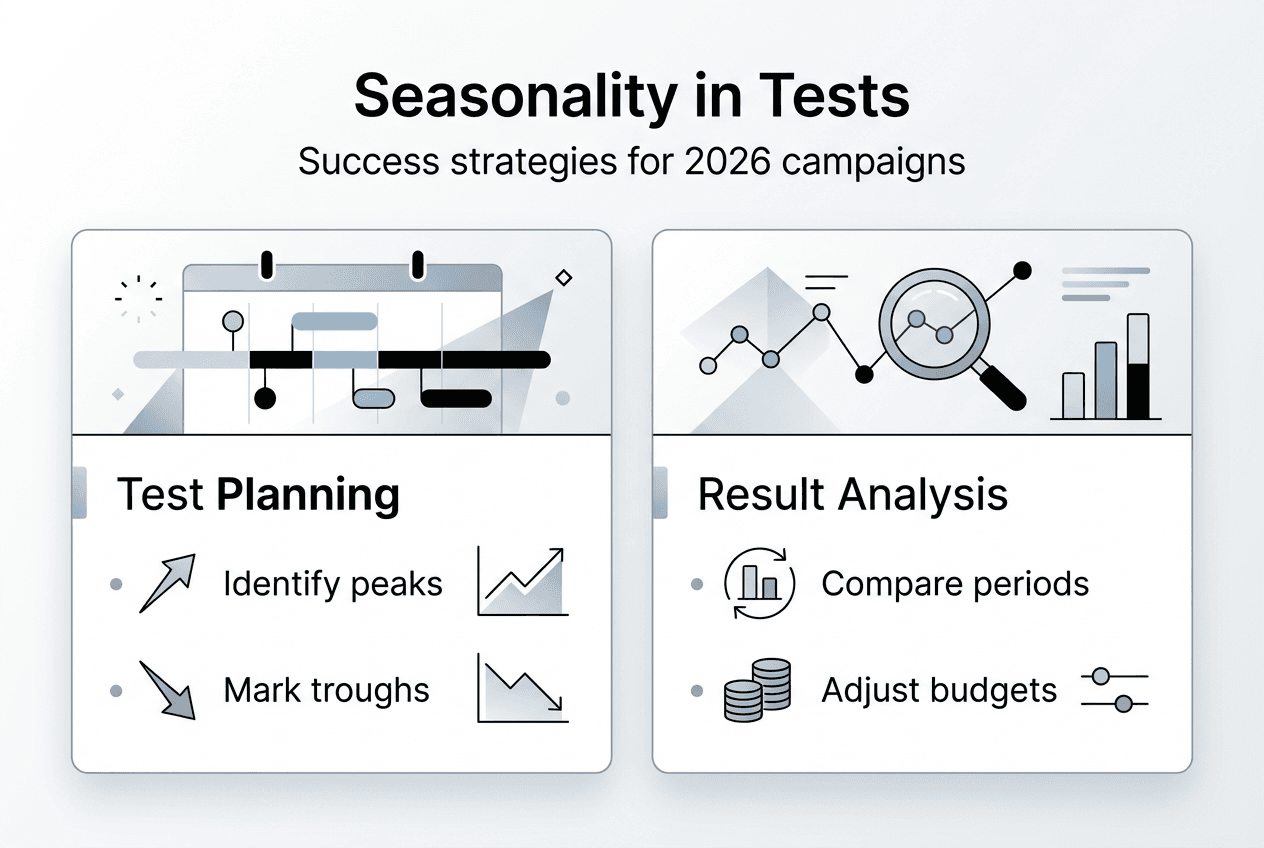
Use seasonal test insights to optimize campaign timing. If your tests show a variant performs 40% better during Q4 than Q2, schedule major campaigns and budget allocation accordingly. Launch new initiatives during periods when your audience is most receptive. Hold back experimental campaigns for stable periods when you can measure true effectiveness without seasonal interference.
Allocate budgets more strategically by understanding seasonal ROI patterns. Incorporating seasonality into campaign planning leads to higher ROI and better budget utilization. Instead of spreading budget evenly across months, concentrate spending during high-performing seasons identified through testing. Reserve smaller budgets for off-peak testing and optimization. This data-driven allocation prevents wasting resources during naturally weak periods.
Adjust creatives and offers to match seasonal behavior patterns. Your tests might reveal that discount-focused messaging works better in January when budgets are tight, while premium positioning succeeds in November during gift-buying season. Swap creative elements based on these proven seasonal preferences rather than guessing or using the same approach year-round.
Top seasonality-driven campaign tactics include:
- Seasonal variant libraries. Maintain separate sets of tested winners for different seasons, swapping them in as the calendar shifts.
- Dynamic budget pacing. Automatically increase or decrease daily spend based on historical seasonal performance curves.
- Predictive launch calendars. Schedule campaigns to go live exactly when seasonal conditions favor your tested approach.
- Seasonal audience segmentation. Target different customer segments during different seasons based on which groups show strongest seasonal response patterns.
- Offer rotation schedules. Cycle through different promotional strategies aligned with seasonal buying motivations your tests identified.
Case studies show improved engagement and conversions when seasonal factors guide marketing adjustments. Companies applying these principles see 20-35% improvement in campaign efficiency compared to season-blind approaches. Understanding sales triggers for optimal outreach complements your seasonal strategy by identifying the right moments within seasonal windows.
Pro Tip: Build a seasonal playbook documenting which variants, offers, and strategies work best during each period. Update it after every major test. This living document becomes your competitive advantage, capturing institutional knowledge that prevents repeating past mistakes and accelerates future optimization.
Continuously monitor seasonality impact even after implementing changes. Consumer behavior evolves, new competitors shift market dynamics, and external factors like economic conditions alter seasonal patterns. Review your seasonal assumptions quarterly and run validation tests annually to confirm your patterns still hold. What worked in 2024 might need adjustment by 2026 as markets mature and audiences change. Explore more seasonal A/B testing strategies to keep your approach current and effective.
Boost your seasonal marketing tests with GoStellar
Managing seasonality-aware testing manually creates complexity that slows down optimization and increases error risk. GoStellar's platform simplifies the entire process, from planning tests around seasonal patterns to interpreting results with proper context.
Our advanced analytics automatically flag seasonal variance in your data, helping you spot when results might be influenced by calendar effects rather than true variant performance. The visual editor lets you quickly swap seasonal variants without developer resources, so you can adapt campaigns as seasons change. Real-time tracking shows how performance shifts day by day, making seasonal patterns visible immediately.
Save time and budget by testing smarter during both peak and off-peak periods. GoStellar's lightweight 5.4KB script ensures your tests run fast even during high-traffic seasonal spikes, while goal tracking capabilities let you measure season-specific objectives. Try GoStellar today and transform seasonal challenges into competitive advantages.
Frequently asked questions
What is seasonality in marketing tests?
Seasonality represents cyclical patterns in consumer behavior that repeat annually, affecting how audiences engage with marketing campaigns. These patterns create natural performance fluctuations that can make test results misleading if you don't account for them. Tests ignoring seasonality may attribute seasonal changes to variant performance, leading to incorrect strategic decisions. Plan tests considering both peak and off-peak seasons to isolate genuine improvements from calendar-driven effects.
How should I adjust test duration during seasonal peaks?
Extending test durations during seasonal peaks helps ensure statistical significance and reduces volatility. Increased traffic variance during busy periods requires larger sample sizes to reach reliable conclusions. A test needing two weeks during stable periods might need four to six weeks during holiday seasons. Avoid cutting tests short during peaks, as premature conclusions based on incomplete data often prove incorrect when seasonality normalizes.
Can seasonality cause false positives in A/B test results?
Yes, seasonal fluctuations frequently mimic changes caused by test variants, creating misleading winners. Ignoring seasonality can inflate false positives by mistaking seasonal changes for test effects. A variant tested only during November might show strong performance due to holiday shopping behavior rather than actual effectiveness. Proper seasonality-aware methods like control groups, extended durations, and multi-season validation significantly reduce false positive risks and improve decision quality.
What tools can help manage seasonality in marketing tests?
Platforms like GoStellar enable comprehensive test planning and analysis that accounts for seasonal patterns automatically. These tools simplify managing test timing, data segmentation, and result interpretation by flagging seasonal variance and adjusting metrics accordingly. Advanced analytics identify when results might be seasonally influenced, while visual editors let you quickly adapt campaigns as seasons change. Dedicated A/B testing platforms remove manual complexity from seasonality management, letting you focus on strategy rather than statistical adjustments.
Recommended
- Seasonal A/B Testing Tips: Maximize Results Year-Round
- Marketing Automation Trends 2025: 40% Faster A/B Testing
- 7 Essential Common Marketing KPIs in 2025 for Marketers
- 7 Essential Marketing Trends for 2025 CRO Teams Must Know
- CODEIT: DRIVING SUSTAINABLE GROWTH THROUGH SALES LEAD GENERATION ADJUSTMENTS - Sales Label IT Consulting
- Amazon Seller Tips 2025: Essential Strategies for Success
Published: 3/15/2026