
No-code marketing solutions: simplify A/B testing
Many marketers believe effective A/B testing demands coding expertise and developer resources, creating a barrier that slows campaign optimization. This misconception keeps teams dependent on technical staff for every experiment, delaying insights and limiting testing frequency. No-code marketing solutions eliminate these obstacles entirely, empowering marketers to design, launch, and analyze tests independently. This guide explores what no-code tools are, how they transform A/B testing workflows, and practical strategies to leverage them for measurable growth without writing a single line of code.
Table of Contents
- What Are No-Code Marketing Solutions And Why They Matter
- Understanding A/B Testing Fundamentals For Effective Use
- Comparing Popular No-Code A/B Testing Tools And Features
- Best Practices For Running Successful No-Code A/B Tests
- Discover No-Code Marketing Tools At Go Stellar
- Frequently Asked Questions
Key takeaways
| Point | Details |
|---|---|
| No-code tools remove barriers | Marketers can run A/B tests independently without developer support or coding knowledge |
| Statistical rigor still matters | Understanding sample size, test duration, and significance ensures reliable results |
| Mature testing drives ROI | Companies with established testing cultures see 30% higher returns on digital spend |
| Multi-channel testing capability | No-code platforms support experiments across websites, emails, ads, and mobile apps |
| Speed creates competitive advantage | Visual editors and AI features accelerate test creation from weeks to hours |
What are no-code marketing solutions and why they matter
No-code marketing solutions are platforms that enable marketers to create, launch, and manage digital campaigns and experiments without writing code or relying on developers. These tools replace technical complexity with visual interfaces, drag-and-drop editors, and pre-built templates that make sophisticated marketing tactics accessible to non-technical users. For A/B testing specifically, no-code platforms eliminate developer dependency by providing intuitive editors where marketers can modify page elements, create variations, and set success metrics independently.
The shift to no-code represents a fundamental change in how marketing teams operate. Traditional A/B testing workflows required submitting tickets to development teams, waiting for implementation, and coordinating deployment schedules. This process could take weeks for a single test. Modern no-code tools use visual editors and AI-powered features that let marketers point, click, and publish tests in hours, not weeks.
Key benefits that make no-code solutions essential for modern marketers include:
- Speed: Launch tests the same day you conceive them, accelerating learning cycles dramatically
- Autonomy: Control your optimization roadmap without competing for developer time
- Cost efficiency: Reduce technical resource requirements while increasing testing volume
- Experimentation culture: Lower barriers encourage more frequent testing and data-driven decisions
Small to medium-sized businesses benefit most from this approach. These organizations typically lack dedicated development resources for marketing experiments, making A/B testing without dev support previously impractical. No-code platforms level the playing field, giving lean teams the same optimization capabilities as enterprise organizations with large technical staffs.
The contrast with traditional workflows is striking. Where conventional testing required writing JavaScript, deploying code changes, and managing version control, no-code platforms abstract these complexities behind user-friendly interfaces. Marketers select elements visually, make changes in real-time preview modes, and deploy tests with single-click publishing. This democratization of testing capability transforms optimization from a technical bottleneck into a core marketing competency, delivering the benefits of no-code testing to teams of all sizes.
Understanding A/B testing fundamentals for effective use
Even with no-code tools simplifying implementation, understanding A/B testing fundamentals remains critical for generating meaningful insights. A/B testing compares two versions to determine which performs better against specific metrics. Version A serves as the control, representing your current approach, while version B introduces a single variable change. The methodology isolates that one change, ensuring any performance difference can be attributed to the modification rather than external factors.

Three statistical concepts determine whether your test results are trustworthy. First, sample size affects reliability. Testing with 50 visitors per variation produces unreliable results, while 1,000 visitors per variation increases confidence substantially. Second, test duration must account for weekly patterns. Running tests for at least one full business cycle, typically seven to fourteen days, captures weekday and weekend behavior differences. Third, statistical significance indicates result reliability, with 95% confidence meaning only a 5% chance results occurred randomly.
Common A/B testing scenarios span multiple marketing channels:
- Landing page headlines and value propositions
- Call-to-action button colors, sizes, and placement
- Email subject lines and preview text
- Pricing page layouts and plan presentations
- Ad creative variations and messaging angles
- Form field quantities and required information
Pro Tip: Start with high-traffic pages where smaller improvements generate significant impact. A 2% conversion lift on a page receiving 10,000 monthly visitors delivers 200 additional conversions, while the same improvement on a 500-visitor page yields only 10.
Setting meaningful hypotheses prevents random testing and focuses efforts on genuine optimization opportunities. Effective hypotheses follow this structure: "Changing [specific element] to [specific variation] will increase [specific metric] because [logical reasoning]." For example, "Changing the signup button from blue to orange will increase clicks by 15% because orange creates stronger visual contrast against our white background." This framework ensures you design experiments for A/B testing with clear success criteria and learning objectives.
Avoiding bias requires discipline in test design and interpretation. Never stop tests early because one variation appears to be winning. Short-term fluctuations often reverse with more data. Similarly, avoid testing multiple changes simultaneously in a single variation, as you cannot determine which element drove results. Test one variable at a time, document your methodology, and let tests run to statistical significance before drawing conclusions.
Comparing popular no-code A/B testing tools and features
Selecting the right no-code platform requires evaluating features, ease of use, integrations, and pricing against your specific testing needs. Leading platforms differentiate themselves through unique combinations of capabilities that serve different team sizes, technical comfort levels, and optimization priorities.
| Platform | Key Strengths | Ideal For | Starting Price | | --- | --- | --- | | Stellar | Lightweight 5.4KB script, visual editor, dynamic keyword insertion | SMBs prioritizing speed and performance | Free under 25K users | | Optimizely | Enterprise features, advanced targeting, extensive integrations | Large organizations with complex testing needs | Custom pricing | | VWO | Comprehensive optimization suite, heatmaps, session recordings | Teams wanting all-in-one conversion platform | $199/month | | Google Optimize | Free tier, seamless Analytics integration, familiar interface | Budget-conscious teams using Google ecosystem | Free (sunset 2023) |
Visual editing capabilities vary significantly across platforms. The most intuitive tools let you click any page element and modify text, images, styling, or layout without touching code. Advanced editors support complex changes like reordering sections, hiding elements conditionally, or inserting entirely new components. Evaluate editors by testing modifications on your actual website during trial periods, ensuring the interface matches your team's technical comfort level.
AI-powered features are becoming table stakes for competitive platforms. Smart traffic allocation automatically sends more visitors to winning variations once patterns emerge, maximizing conversions during test periods. Predictive analytics estimate how long tests need to run based on current traffic and conversion patterns. Automated insights flag unusual patterns or suggest optimization opportunities based on visitor behavior analysis.
Integration capabilities determine how well testing platforms fit your existing marketing stack. Essential integrations include:
- Analytics platforms for unified reporting
- Tag management systems for deployment control
- Customer data platforms for audience segmentation
- Email marketing tools for cross-channel testing
- CRM systems for tracking test impact on pipeline
Pro Tip: Evaluate tools based on your team's current sophistication level, not aspirational complexity. A simpler platform you actually use beats a feature-rich solution that intimidates your team into inaction.
Companies with mature testing cultures see 30% higher ROI on digital spend, making tool selection a strategic investment rather than a tactical expense. The right platform grows with your team, supporting simple tests initially while enabling advanced experimentation as your capabilities mature. Consider starting with visual editors for marketers that prioritize ease of use, then expanding to more sophisticated platforms as testing becomes embedded in your workflow. Review no-code A/B testing steps to understand implementation requirements before committing to a specific platform.
Best practices for running successful no-code A/B tests
Effective A/B testing follows a structured process from hypothesis formation through result analysis. This systematic approach maximizes learning while minimizing wasted effort on poorly designed experiments.
-
Define clear business objectives before designing tests. Identify which metrics truly matter for your business, whether conversion rate, revenue per visitor, signup completion, or engagement depth. Avoid vanity metrics that look impressive but do not drive business outcomes.
-
Formulate specific hypotheses based on user research, analytics insights, or customer feedback. Generic ideas like "test a different headline" lack the strategic foundation that produces meaningful improvements. Instead, base hypotheses on observed user behavior or identified friction points.
-
Create variations that test one variable at a time. Changing multiple elements simultaneously makes it impossible to determine which modification drove results. Isolate individual changes to build replicable knowledge about what works.
-
Set appropriate sample sizes and test durations using statistical calculators. Most no-code platforms include built-in calculators that recommend minimum sample sizes based on your baseline conversion rate and desired lift. Understanding sample sizes and test duration prevents premature conclusions from insufficient data.
-
Monitor tests regularly but resist the urge to stop early. Statistical significance requires sufficient data, and early patterns often reverse as more visitors enter the test. Let tests run their planned duration unless you detect technical errors requiring intervention.
-
Analyze results holistically beyond the primary metric. A variation might increase clicks but decrease downstream conversions, resulting in net negative impact. Examine the full funnel to understand true performance implications.
-
Document learnings systematically in a testing knowledge base. Record hypotheses, variations, results, and insights for every test. This repository prevents repeating failed experiments and helps new team members understand what has already been tried.
-
Scale testing incrementally as confidence grows. Start with high-traffic pages where results emerge quickly, then expand to lower-traffic areas as you refine your methodology.
No-code platforms excel at streamlining this workflow through features designed for marketer efficiency. Template libraries provide starting points for common test types. Scheduling capabilities let you prepare tests in advance and launch them at optimal times. Automated reporting delivers results summaries without manual data compilation.
Pro Tip: Create a testing calendar that sequences experiments logically, building on previous learnings. Avoid running multiple tests on the same page simultaneously, as interactions between tests can corrupt results.
Testing extends far beyond website optimization. You can A/B test mobile apps, emails, ads, and even offline content like packaging to optimize every customer touchpoint. Email subject line tests often produce the fastest wins, as large subscriber lists generate statistical significance within hours. Ad creative testing on platforms like Facebook and Google allows rapid iteration on messaging and visual approaches.
Apply the same rigorous methodology regardless of channel. Validate marketing ideas through A/B testing before committing significant budget to unproven approaches. The data-driven discipline that no-code tools enable transforms marketing from opinion-based decisions to evidence-based optimization. Review A/B testing best practices regularly to refine your approach as your testing program matures.
Discover no-code marketing tools at Go Stellar
If you are ready to transform your marketing optimization with no-code A/B testing, Go Stellar provides the speed and simplicity you need. Our platform features a lightweight 5.4KB script that delivers testing capabilities without slowing your site, a visual editor that makes creating variations intuitive, and dynamic keyword insertion for personalized landing pages that boost relevance.
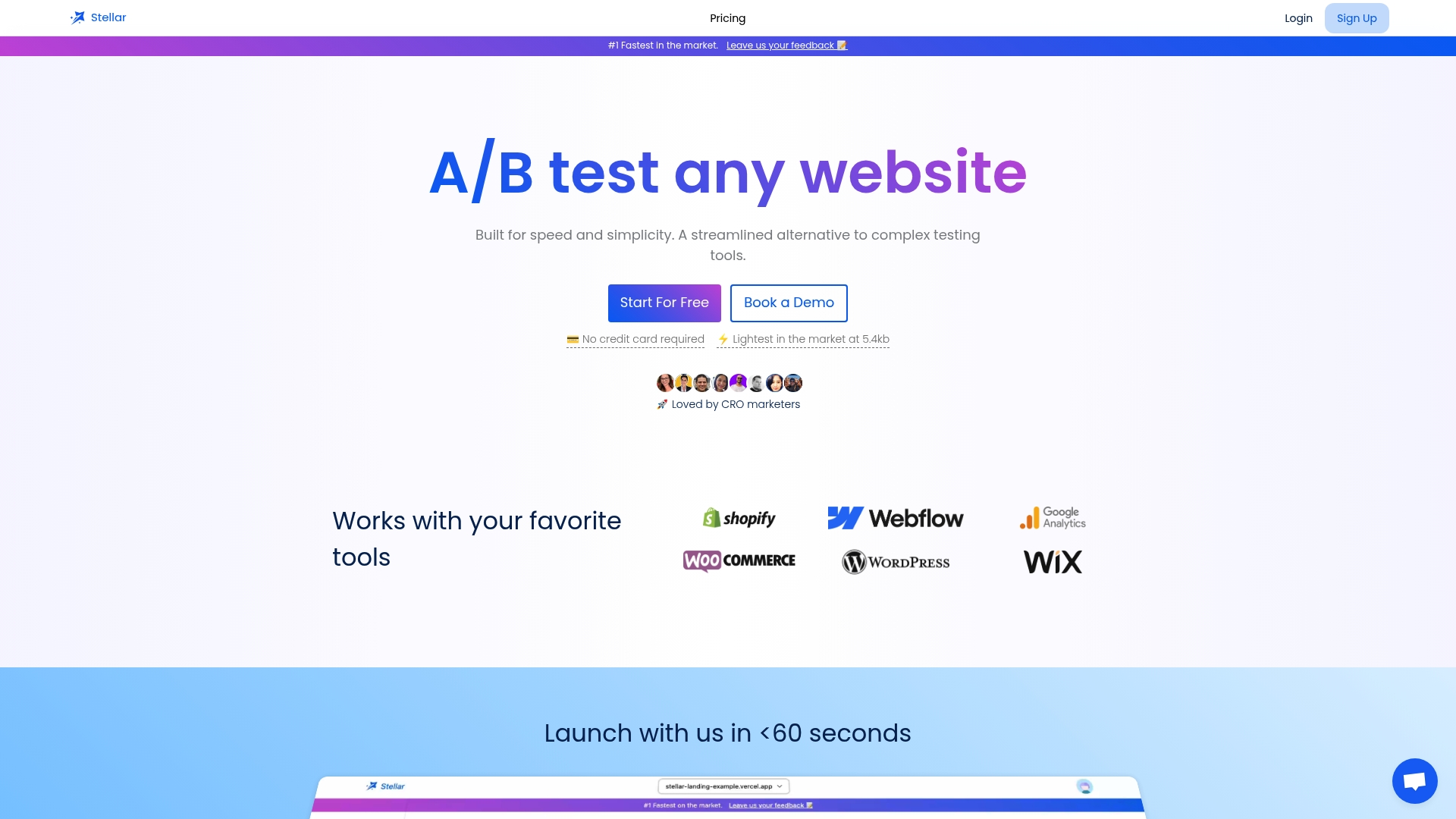
Designed specifically for marketers and growth hackers at small to medium-sized businesses, Stellar combines powerful features with user-friendly interfaces that eliminate technical barriers. Real-time analytics provide immediate insights, while advanced goal tracking ensures you measure what matters. Our free plan supports businesses with under 25,000 monthly tracked users, making professional-grade testing accessible regardless of budget. Explore our comprehensive A/B testing guide to see how quickly you can start optimizing campaigns independently.
Frequently asked questions
What is no-code marketing and what are its benefits?
No-code marketing refers to platforms and tools that enable marketers to create, launch, and optimize campaigns without writing code or depending on developers. These solutions use visual interfaces, drag-and-drop editors, and pre-built templates to make sophisticated marketing tactics accessible to non-technical users. Benefits include faster campaign deployment, greater team autonomy, reduced technical resource requirements, and the ability to test and iterate more frequently. For small to medium-sized businesses especially, no-code tools democratize advanced marketing capabilities previously available only to organizations with large technical teams.
How does no-code A/B testing differ from traditional testing?
Traditional A/B testing requires developers to write code, implement variations, and deploy changes through technical workflows that can take weeks. No-code A/B testing eliminates this dependency through visual editors where marketers point, click, and publish tests independently, often within hours. The statistical methodology and experimental rigor remain identical, but implementation speed and accessibility improve dramatically. No-code platforms abstract technical complexity behind user-friendly interfaces, allowing marketers to focus on hypothesis formation and result analysis rather than code implementation.
What types of digital assets can I A/B test?
You can A/B test mobile apps, email subject lines, ad creatives, pricing models, and even offline content like product packaging. Website elements including headlines, images, call-to-action buttons, form fields, and page layouts represent the most common testing scenarios. Email marketing benefits from testing subject lines, preview text, send times, and content variations. Paid advertising platforms support testing ad copy, images, targeting parameters, and landing page destinations. The methodology applies universally across channels, making A/B testing a versatile optimization approach for any customer touchpoint.
What skills do I need to use no-code testing tools effectively?
No-code tools require marketing knowledge and analytical thinking rather than technical coding skills. You need to understand your target audience, formulate testable hypotheses based on customer insights, and interpret statistical results to guide decisions. Familiarity with basic web concepts like page elements, conversion funnels, and user flows helps you design meaningful tests. Most importantly, you need discipline to follow testing best practices including running tests to completion, changing one variable at a time, and basing decisions on data rather than opinions. The technical implementation is handled entirely by the platform.
How does no-code A/B testing improve marketing ROI?
No-code testing improves ROI by accelerating the optimization cycle and enabling more frequent experimentation. When marketers can launch tests independently without developer bottlenecks, they iterate faster and discover winning approaches sooner. This speed compounds over time, as each successful test informs the next hypothesis, creating a continuous improvement engine. Companies with mature testing cultures see 30% higher ROI on digital spend because they systematically optimize every element of their marketing rather than relying on best guesses. The reduced technical costs of no-code platforms also improve ROI by eliminating developer time requirements for routine testing activities.
What are the best practices for designing no-code A/B tests?
Set clear hypotheses before creating variations, ensuring each test has a specific learning objective tied to business outcomes. Understanding statistical significance, sample sizes, and test duration ensures your results are reliable rather than random fluctuations. Focus on measurable outcomes that directly impact business performance, avoiding vanity metrics that look impressive but do not drive revenue or growth. Test one variable at a time to isolate what drives performance changes, and let tests run to completion even when early results look promising. Document every test with hypotheses, variations, results, and insights to build institutional knowledge that prevents repeating failed experiments and accelerates future optimization efforts.
Recommended
- A/B Testing Without Dev Support: The Marketer's Handbook
- Benefits of No-Code Testing for Modern Marketers
- How to Validate Marketing Ideas for Effective A/B Testing
- 7 A/B Testing Best Practices Every Marketer Must Know
- Demystifying Conversion Rate Optimisation: A Comprehensive Guide for SME Success | Kickass Online
Published: 3/14/2026