
Optimizely CMS: Guide to smarter A/B testing and growth
TL;DR:
- Optimizely CMS integrates content management and experimentation into a single platform for SMB teams.
- The platform offers a 446% ROI with increased conversion rates and productivity savings.
- SMBs should assess their traffic, resources, and needs before investing in enterprise-tier experimentation tools.
Most SMB marketing teams assume enterprise-grade A/B testing is out of their reach. The tools sound too technical, the pricing sounds astronomical, and the setup sounds like a six-month IT project. Optimizely CMS challenges that assumption directly. Feature Experimentation integrated into the CMS UI means marketers can run component-level tests without filing a developer ticket for every change. But "can" and "should" are very different questions. This guide breaks down what Optimizely CMS actually offers, where the ROI is real, and where SMBs need to watch their step.
Table of Contents
- What is Optimizely CMS and why marketers care
- Features and ROI: What makes Optimizely stand out
- Experimentation: Managing tests and understanding results
- Challenges, costs, and common pitfalls for SMBs
- Why Optimizely CMS works and when it is not worth it
- Ready to experiment smarter? Take your next step
- Frequently asked questions
Key Takeaways
| Point | Details |
|---|---|
| Enterprise-grade features | Optimizely CMS brings advanced A/B and multivariate testing to marketing teams in an easy-to-use UI. |
| High ROI potential | Businesses can achieve major conversion and productivity gains, with substantial documented ROI over three years. |
| Pricing challenges | Optimizely CMS's value is strong but its true cost may be prohibitive for many small businesses. |
| Smart testing strategy | Focus on tests that directly impact your goals to maximize ROI and avoid unnecessary complexity as you scale. |
| Understand limitations | Technical complexities and pricing models require close attention, especially for SMBs planning long-term. |
What is Optimizely CMS and why marketers care
Optimizely CMS is a cloud-based content management and digital experience platform built for teams that want to manage content and run experiments from one place. It is not just a publishing tool. The real draw for growth-focused marketers is that experimentation lives inside the same interface where content gets created, edited, and published.
Here is what that means in practice. Instead of building a page in your CMS, exporting it, passing it to a developer, waiting for a test variant to be coded, and then pushing it live, you stay in one workflow. You build content, select a component, set up a test variant, and launch. This kind of component-level testing inside the CMS UI is a meaningful productivity unlock for marketing teams that are used to operating in disconnected tool stacks.
The platform's underlying experimentation engine uses the React SDK alongside Feature Experimentation. For marketers, this means you are not working with a surface-level split URL test. You are targeting specific page components, content blocks, and features with precise control. For developers on your team, this is also familiar territory rather than a proprietary black box.
Key benefits that marketing and growth teams value most:
- Unified content and experimentation workflow in a single platform, eliminating handoffs
- Visual editing tools that allow non-technical marketers to build and modify test variants
- Component-level targeting that makes tests more precise than simple page-swap approaches
- Integrated analytics that keep results inside the same system as your content decisions
- Cross-functional collaboration between marketing, product, and engineering without separate logins
For growth teams running on lean resources, the productivity gain is the headline story. For more context on how experimentation fits into a broader strategy, the Optimizely digital experimentation guide is a useful starting point.
Features and ROI: What makes Optimizely stand out
With a basic understanding of Optimizely CMS established, it's time to look at the specific features and numbers that matter most for marketing effectiveness and ROI.
The evidence on ROI is unusually strong for an enterprise platform. A Forrester Total Economic Impact study found that Optimizely One delivers 446% ROI over three years, with an NPV of $5.8M and an 8% average lift in conversions that translated to $40.3M in incremental revenue for the composite study organization. These numbers come from real customer data, not hypothetical models.
"The ability to run tests on individual page components rather than entire pages changes the pace of experimentation entirely. You can isolate variables, move faster, and generate cleaner data." — Optimizely enterprise customer, Forrester study
The productivity gains are just as telling. Developers see 40% gains through flexible CMS templates, while content marketers see 35% productivity improvements. Over three years, consolidating tools into the Optimizely platform saves organizations an average of $800K compared to maintaining separate point solutions for CMS, experimentation, personalization, and analytics.
Here is how those ROI components break down:
| Benefit category | Reported impact |
|---|---|
| 3-year ROI | 446% |
| Net present value | $5.8M |
| Conversion lift | 8% average |
| Incremental revenue | $40.3M |
| Developer productivity gain | 40% |
| Content marketer productivity gain | 35% |
| Tool consolidation savings | $800K over 3 years |
For SMBs trying to improve website conversions on a limited budget, the consolidation argument is compelling. Paying for one platform that replaces four or five is a real cost argument, even if the sticker price looks high at first glance. Improving your content engagement strategies becomes considerably easier when your content management and testing data live in the same system.

Pro Tip: Before you calculate ROI for your own team, map out every tool you currently pay for that Optimizely could replace. CMS, A/B testing software, personalization engine, analytics overlay. The total cost of your current stack may surprise you, and it makes the Optimizely price feel very different.
Experimentation: Managing tests and understanding results
You now know why the ROI is compelling. Here is how the actual experimentation process works and what tools are available inside the CMS.
Optimizely CMS supports several types of testing, and choosing the right one for your situation matters. The platform includes stats engine, MVT, multi-armed bandits, and feature flags, each suited to different stages of your experimentation program.
| Test type | Best use case | Traffic requirement | Complexity |
|---|---|---|---|
| A/B test | Simple variant comparisons (headlines, CTAs, images) | Low to moderate | Low |
| Multivariate (MVT) | Testing multiple element combinations simultaneously | High (10,000+ visitors) | Medium to high |
| Multi-armed bandit | Dynamic traffic allocation toward winning variant | Moderate | Medium |
| Feature flags | Gradual rollouts, targeting specific user segments | Flexible | Medium |
A/B testing is the right starting point for most SMB teams. It is straightforward: one control, one variant, one key metric. You can test a headline rewrite, a button color, a CTA placement, or a pricing message. The sample size requirements are manageable, and the results are easy to interpret.
MVT is more powerful but demands more traffic. If your site gets 50,000 monthly visitors or fewer, MVT results may take weeks or months to reach statistical significance, which defeats the purpose of fast iteration. Feature flags are underused by many marketing teams but extremely valuable for no-code A/B testing scenarios where you want to roll out changes to a subset of users before full deployment.
Setting up and interpreting a test inside Optimizely CMS follows a clear process:
- Define your hypothesis. State what you expect to change, why, and what metric will prove it. "Changing the hero CTA from 'Learn more' to 'Start free trial' will increase sign-up clicks by 15% because intent is clearer."
- Select the component. Use the visual editor to select exactly which page element you are testing. This is not a URL redirect, it is a component swap.
- Set your audience and traffic split. Decide who sees the test and in what proportion. Most tests start at a 50/50 split.
- Choose your primary metric and guardrail metrics. Your primary metric is what you are optimizing for. Guardrail metrics catch unintended negative effects elsewhere.
- Run the test until statistical significance is reached. Optimizely's stats engine calculates this continuously, but resist the urge to call winners too early.
- Document results and next actions. Whether you win, lose, or see inconclusive results, every test teaches you something. Capture the learning, not just the outcome.
For more tactical guidance on getting results from your experimentation program, the A/B testing tips resource covers common setups in detail.
Pro Tip: Always run tests long enough to capture at least one full business cycle. If your audience behavior changes significantly on weekends or at month-end, a five-day test will give you misleading data. Two full weeks is usually the minimum for most SMB traffic levels.
Challenges, costs, and common pitfalls for SMBs
Effective experimentation is powerful, but it is critical to understand the risks and real costs before committing, especially for SMB teams working with limited resources.
The most frequently cited barrier is pricing. Optimizely's pricing tiers range from $25K to over $180K per year, structured around traffic volumes and feature access. Revenue-share models are part of some contracts, meaning your costs can scale upward as your business grows, which sounds appealing until you realize you are paying more precisely when your margins are tightest. Auto-renewal clauses are standard in enterprise SaaS contracts and have caught SMB teams off guard when they assumed a pause or downgrade was possible mid-term.
Beyond pricing, there are real technical edge cases that marketing teams often discover after signing. Content nesting slowdowns, Graph schema issues, and breaking changes during platform migrations can cause significant disruption. These are not hypothetical concerns. They show up in community forums, support tickets, and technical reviews with enough frequency to warrant advance planning.
Common pitfalls for SMB teams to avoid:
- Over-scoping the initial deployment. Trying to migrate your entire content operation and launch your first ten tests simultaneously creates chaos. Phase the rollout.
- Underestimating technical lift. Even with no-code tools, setting up the CMS properly requires developer time upfront. Budget for it.
- Ignoring auto-renewal dates. Calendar your contract renewal 90 days ahead of time. Enterprise renewals require lead time to negotiate or exit.
- Running too many tests with too little traffic. Splitting already-thin traffic across multiple simultaneous tests means none of them reach significance.
- Treating feature flags as just an IT tool. Feature flags are a marketing asset when used for audience segmentation and gradual rollouts.
"Many SMBs enter enterprise CMS contracts with optimism about the roadmap and underestimate the ongoing cost of keeping the platform configured, trained, and integrated with their stack." — DXP Scorecard analysis
For a clearer picture of what you will actually pay, see the Optimizely pricing details breakdown. If you are still evaluating fit, the Optimizely experimentation guide for SMBs covers the decision framework in practical terms.
Why Optimizely CMS works and when it is not worth it
Here is the honest editorial view, which is rarely discussed in vendor-sponsored content.
Optimizely CMS genuinely earns its price for teams that meet a specific profile. You need significant traffic to make experimentation statistically meaningful. You need enough content velocity to justify a unified CMS and experimentation platform. And you need either in-house developer resources or a dedicated implementation partner to configure and maintain the platform properly. When those conditions exist, the Forrester-validated ROI benchmarks are not marketing fiction. They reflect real outcomes.
But here is the contrarian take: for a large portion of SMBs, those conditions do not exist yet. A 20,000-visitor-per-month site does not have the traffic to run MVT tests at any reasonable speed. A four-person marketing team does not have the bandwidth to manage a complex CMS migration while also running a testing program. The DXP Scorecard analysis notes high total cost of ownership and steep learning curves for teams without enterprise-scale support structures. These are legitimate concerns, not just vendor bias.
The uncomfortable truth is that starting with a simpler, more affordable A/B testing tool often produces better learning outcomes in the early stages of an experimentation program. You build the habit of testing, develop internal expertise, and accumulate enough data to make informed decisions. Then, when your traffic and complexity justify it, moving to a platform like Optimizely CMS delivers a true return on the investment. Skipping that foundation and jumping straight into enterprise tooling tends to produce expensive, underutilized contracts.
Where Optimizely genuinely wins is at the intersection of content-heavy operations, feature flag management, and advanced A/B testing strategies that require precise audience targeting across multiple page components simultaneously. If that describes your current reality, the platform is worth a serious evaluation. If you are still running 5,000 visitors per month through a single landing page, simpler tools will serve you better right now and position you to graduate upward when the time is right.
The strategic advice here is to match your tool to your maturity level, not to your aspirations. Both things can be true: Optimizely CMS is an excellent platform, and it is not the right platform for every SMB at every stage.
Ready to experiment smarter? Take your next step
If this guide has clarified one thing, it is that smarter experimentation is genuinely accessible, but only when your tools match your actual scale and resources. Enterprise platforms deliver real results for teams with the traffic, budget, and technical resources to support them. But for SMBs in growth mode, the path to meaningful experimentation often starts simpler.
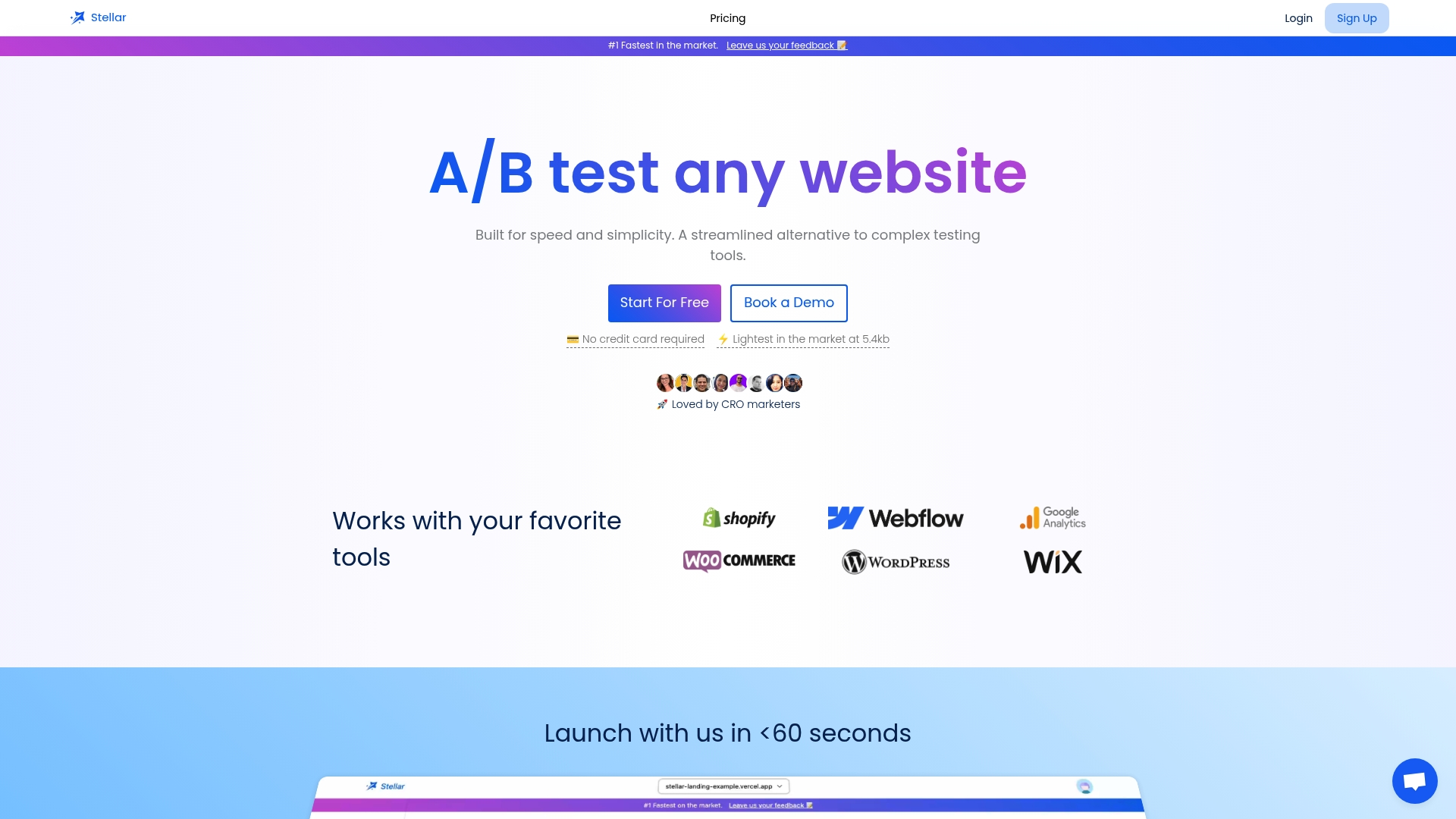
That is exactly what Stellar was built for. Stellar is a lightweight, no-code A/B testing platform designed specifically for SMB marketers who want fast, clean experimentation without the complexity or cost of enterprise tooling. With a script that adds only 5.4KB to your page load, a visual editor that requires zero developer involvement, real-time analytics, and a free plan for sites under 25,000 monthly users, Stellar lets you build an experimentation habit today. Get started with GoStellar and see how fast testing can actually be.
Frequently asked questions
How does Optimizely CMS support A/B testing without developer help?
Optimizely CMS lets marketers set up A/B and multivariate tests directly in the UI through no-code visual components, enabling component-level experiments without writing code. Most variant creation and audience targeting can be handled by marketers through the visual editor.
Is Optimizely CMS too expensive for small businesses?
Pricing ranges from $25K to over $180K annually, with traffic-based tiers and revenue-share models that make costs difficult to predict. Many SMBs find the value is real but the price requires significant justification based on traffic and content volume.
What is the difference between MVT and A/B testing in Optimizely CMS?
A/B testing compares one control against one variant, while MVT tests multiple element combinations at once across the same page. MVT requires high traffic and carries higher costs due to the statistical requirements of reaching significance across many variable combinations.
What productivity gains can marketers expect from Optimizely CMS?
Content marketers gain up to 35% in productivity through unified workflows, while organizations consolidating tools on the platform save approximately $800K over three years. Developers see an even higher 40% productivity improvement through reusable CMS templates.
Are there any technical risks with Optimizely CMS?
Yes. Content nesting, Graph schema changes, and migration breaking changes are documented edge cases that can disrupt production environments. Teams without dedicated technical resources should factor in implementation and maintenance support when evaluating the total cost of ownership.
Recommended
- Optimizely guide: smarter experimentation for SMBs
- The Ultimate Guide to eCommerce Optimization
- Ecommerce optimization guide: boost conversions with A/B testing
- Unlocking the Optimizely Meaning: Your Comprehensive Guide to Digital Experimentation
- Effective CMS features for SaaS content teams in 2026 | Rule27 Design
Published: 4/30/2026