
Optimizely guide: smarter experimentation for SMBs
TL;DR:
- Optimizely is now accessible for SMBs, offering AI-powered experimentation and personalization tools.
- Proper setup, segmentation, and discipline are crucial for high-impact experiments and trustworthy results.
- SMB marketers should weigh Optimizely’s cost and complexity against alternatives like GoStellar for smaller-scale testing.
Most SMB marketers assume platforms like Optimizely are built for companies with massive engineering teams and seven-figure budgets. That assumption is costing them real growth. AI-powered experimentation is no longer reserved for Fortune 500 brands. Optimizely has evolved into a platform that ambitious small and mid-sized teams can use to run high-impact experiments, personalize experiences, and make confident decisions backed by data. This guide covers core features, how the experimentation engine works, best practices, honest cost comparisons, and the most common mistakes SMB marketers make when getting started.
Table of Contents
- What makes Optimizely the industry leader?
- How Optimizely's experimentation works (and why it matters for SMBs)
- Best practices for running high-impact experiments
- Is Optimizely the best choice for your business? (comparison & SMB alternatives)
- Our take: what SMB marketers get wrong (and right) about Optimizely
- Maximize your experimentation with the right support
- Frequently asked questions
Key Takeaways
| Point | Details |
|---|---|
| AI-powered experimentation | Optimizely’s AI agents automate ideation and QA, streamlining experimentation for marketers. |
| Efficiency through CUPED | Using CUPED enables faster, more reliable A/B testing with up to 50% fewer samples needed. |
| Scale versus simplicity | Optimizely delivers ROI at scale but simpler tools may suit SMBs just starting out. |
| Best practices matter | Pre-planning, segmentation, and disciplined execution prevent biased or invalid experiment results. |
What makes Optimizely the industry leader?
With that foundation, let's look more closely at why Optimizely stands out in today's crowded experimentation market.
Optimizely is not just an A/B testing tool. It is a full digital experience platform built to connect experimentation, personalization, content management, and commerce under one roof. That breadth is what separates it from point solutions that only handle split tests. The platform's AI layer, called Opal, ties everything together by helping teams generate test ideas, run quality assurance checks, and surface deeper insights without requiring a data science background.
Here is what the core platform covers:
- Web and feature experimentation for front-end and back-end tests
- Personalization that adapts experiences to individual user segments
- CMS and commerce modules for content and product teams
- Opal AI agent orchestration that supports A/B testing and personalization across the entire workflow
- No-code experimentation options that reduce reliance on developers
The business case for Optimizely is hard to ignore. A Forrester TEI study found a 446% ROI, $5.8M net present value, and an 8% conversion lift over three years for companies using the platform. Payback period averaged under six months. Those are not marketing numbers. They are audited outcomes from real deployments.
Adoption is accelerating too. Over 300,000 experiments were run on Optimizely in 2025 alone. That volume matters because it means the platform's statistical models are trained on enormous real-world data, making its recommendations sharper than what most SMBs could generate independently. If your team is serious about growing through experimentation rather than gut instinct, Optimizely gives you infrastructure that scales with that ambition.
How Optimizely's experimentation works (and why it matters for SMBs)
Understanding what Optimizely does leads to the next key question: how does its experimentation engine actually work, and why does that matter for SMB teams?
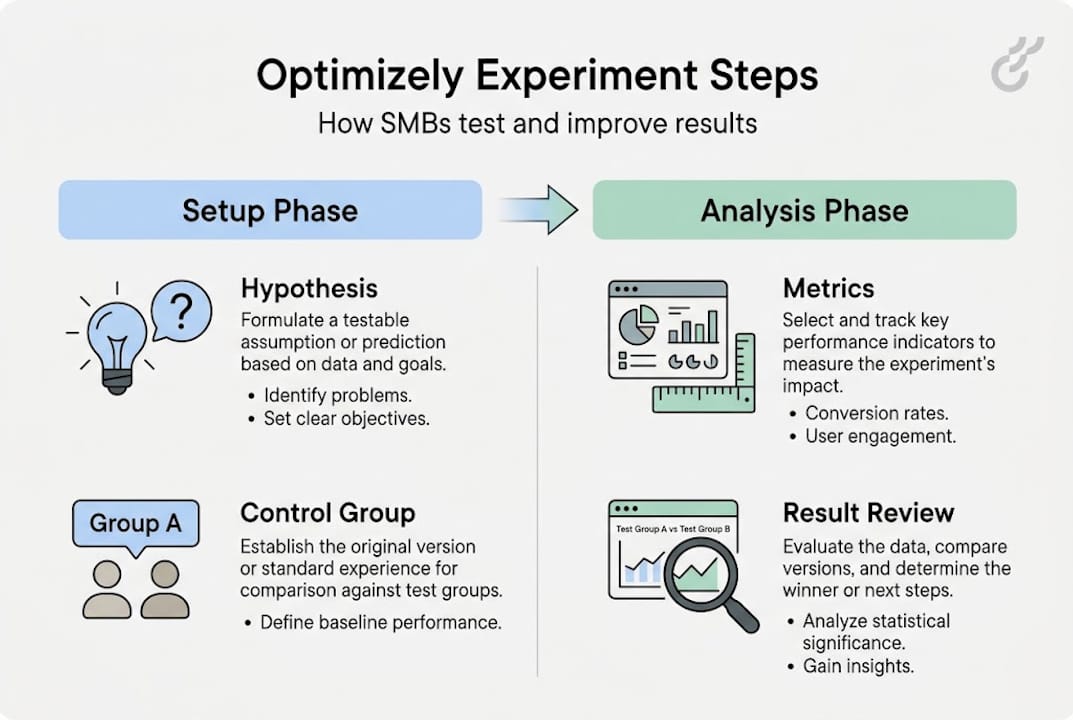
At its core, every A/B test in Optimizely follows a structured cycle. You define a hypothesis, set up a control and a variant, let the platform bucket visitors into each group, and then measure outcomes using the Stats Engine. The Stats Engine uses sequential testing, which means you can check results continuously without inflating your false positive rate. That alone removes one of the most common mistakes teams make with basic testing tools.

One technical feature worth understanding is CUPED (Controlled-experiment Using Pre-Experiment Data). It sounds complex, but the practical benefit is simple. By using data from before the experiment starts, CUPED reduces variance in your results, which means you need 30 to 50% fewer users to reach statistical significance. For SMBs with moderate traffic, that is a meaningful advantage.
Here is how the experiment methodology breaks down step by step:
- Write a clear hypothesis tied to a specific user behavior and expected outcome
- Define your segments before launching, not after you see early data
- Set your sample size using Optimizely's built-in calculator based on proper statistical methods
- Run the test without making changes until it reaches significance
- Analyze results using the Stats Engine, broken down by segment and device
| Step | Tool used | ROI impact |
|---|---|---|
| Hypothesis setup | Opal AI suggestions | Reduces wasted tests |
| Visitor bucketing | Stats Engine | Ensures fair distribution |
| Variance reduction | CUPED method | 30-50% fewer users needed |
| Segment analysis | Results dashboard | Reveals hidden reversals |
| Decision making | Real-time reporting | Faster iteration cycles |
Pro Tip: Always choose relative metrics (like percentage change in conversion rate) rather than absolute numbers when comparing variants. Then segment results by device type. Mobile and desktop users often behave completely differently, and pooling them together can mask a winning variant on one device.
If you are new to this process, brushing up on A/B testing basics before your first Optimizely launch will save you significant time. You can also find actionable tips specific to running successful Optimizely campaigns.
Best practices for running high-impact experiments
Armed with an understanding of mechanics, let's hone in on best practices and potential pitfalls SMBs must watch for to extract Optimizely's full value.
Most failed experiments are not caused by bad ideas. They are caused by poor setup. The good news is that most setup errors are entirely preventable with a short checklist before you launch.
Pre-launch best practice checklist:
- Define your hypothesis in writing before touching the editor
- Identify your primary and secondary metrics upfront
- Segment your audience by device, traffic source, or user type before launch
- Set a fixed test duration based on your sample size calculation
- Run a QA check on both the control and variant across browsers
- Document your expected direction of change to avoid post-hoc rationalization
Segmentation is where many SMB teams leave money on the table. Pre-registration of tests and segmentation by device can reveal result reversals that would otherwise go undetected. A classic example is Simpson's Paradox, where a variant appears to win overall but actually loses on mobile, which is your highest-converting segment. Without segmentation, you would ship the wrong version.
Pro Tip: Register your hypothesis and target segments in a shared document before the test goes live. This prevents the temptation to redefine success after you see early results, a form of bias called p-hacking that quietly destroys the reliability of your testing program.
"One of the most damaging things a team can do is change a running experiment. It invalidates the statistical assumptions behind the test and makes your results untrustworthy, no matter how good they look."
Changing a running test, even something as small as adjusting the variant copy, resets the statistical clock and introduces bias. Treat your live experiments as locked. If you spot a problem, stop the test, fix it, and restart. Never edit mid-flight.
Avoiding common pitfalls in experimentation is just as important as following A/B testing best practices. The difference between a testing culture and a testing theater is discipline in execution.
Is Optimizely the best choice for your business? (comparison & SMB alternatives)
With best practices covered, you may be wondering: is Optimizely the right fit for your business, or are there better options for your needs and budget?
Let's be direct. Optimizely is not cheap. Enterprise pricing starts around $36,000 per year, requires developer involvement for advanced features, and has a learning curve that can slow down small teams. That context matters when you are evaluating whether the platform fits your stage of growth.
| Feature | Optimizely | VWO | Google Optimize |
|---|---|---|---|
| Starting price | ~$36,000/yr | ~$199/mo | Sunset (2023) |
| No-code editor | Yes | Yes | Yes |
| AI features | Advanced (Opal) | Basic | None |
| Stats engine | Sequential testing | Bayesian | Frequentist |
| G2 rating | 4.2/5 | 4.2/5 | N/A |
| Best for | Growth-focused SMBs | Budget-conscious teams | No longer available |
Who should choose Optimizely:
- SMBs with significant monthly traffic (100,000+ sessions) that need reliable statistical power
- Teams running more than 20 experiments per year who need a structured program
- Companies where personalization and CMS are part of the same workflow
- Organizations with a dedicated growth or product team that can own the platform
Who benefits more from SMB-focused tools:
- Early-stage businesses with limited traffic and tight budgets
- Marketers who need quick wins without developer support
- Teams running fewer than 10 tests per year who do not need enterprise-grade infrastructure
For a detailed A/B testing tool comparison across platforms, including lighter-weight options built specifically for SMBs, it is worth reviewing your traffic levels and testing frequency before committing. Optimizely's ROI numbers are real, but they require the right foundation to materialize.
Our take: what SMB marketers get wrong (and right) about Optimizely
Stepping back, here is what most SMB marketers miss, and what they should do instead, based on years of working with Optimizely and similar platforms.
The most common mistake is chasing volume. Teams celebrate running 50 experiments in a year without asking whether any of them moved a meaningful metric. Quantity feels like progress. It rarely is. The SMBs that see outsized returns from Optimizely are the ones running 10 high-leverage experiments per year, each tied to a clear business objective, with proper segmentation and enough traffic to reach significance.
Optimizely's AI is genuinely useful for ideation. Opal can surface test ideas you would not have thought of. But the AI does not replace the discipline of writing a strong hypothesis or defining your segments before launch. Teams that treat AI suggestions as ready-to-run experiments skip the thinking that makes results trustworthy.
The nuance most people miss is that Optimizely rewards process, not just tooling. The platform gives you the infrastructure. You still have to show up with rigor.
Pro Tip: If your traffic is too low to reach significance on macro conversions like purchases, run tests on micro conversions like button clicks or form starts. Use those directional trends to prioritize your next big test rather than waiting for perfect conditions.
For teams still working through which ideas are worth testing, validating A/B test ideas before building them out saves significant time and budget.
Maximize your experimentation with the right support
Ready to translate high-impact experimentation into better marketing results? Here is where to start.
Optimizely is a powerful platform, but it is not the only path to running rigorous, results-driven experiments. If your team is earlier in the experimentation journey or working with tighter traffic and budget constraints, you need a tool that meets you where you are.
The GoStellar experimentation platform is built specifically for SMB marketers who want the rigor of enterprise testing without the complexity or cost. With a no-code visual editor, real-time analytics, and a 5.4KB script that keeps your site fast, GoStellar makes it easy to run clean, reliable experiments from day one. Explore A/B testing best practices to build your testing program on a foundation that actually scales.
Frequently asked questions
How does CUPED help Optimizely users get results faster?
CUPED reduces variance by up to 41%, which means you can reach statistical significance with 30 to 50% fewer test participants and in less time than traditional methods require.
Is Optimizely worth the cost for SMBs compared to cheaper A/B testing tools?
For SMBs with higher traffic and growth ambitions, Optimizely's analytics depth and AI features can justify the investment, but pricing starting at $36,000 per year makes simpler tools a smarter fit for teams with limited budgets or traffic.
What are Optimizely's best features for marketers?
The Stats Engine, Opal AI agent, and integrated CMS and commerce modules are standout strengths that let marketing teams run personalized, high-confidence experiments without heavy developer involvement.
What mistakes should marketers avoid with Optimizely?
Never change a running experiment, always pre-register your segments before launch, and define success metrics upfront to avoid bias and protect the integrity of your results.
Recommended
Published: 4/12/2026