
Psychology Behind Conversions: Boosting A/B Test Success
Every conversion-focused marketer knows the frustration when seemingly logical website tweaks barely move the needle. That’s because consumer decisions are often shaped by complex emotional and psychological factors, not just rational analysis. Understanding the intricate mechanisms driving consumer behavior lets you run A/B tests that truly influence purchase intent and engagement. This guide uncovers actionable principles from marketing psychology, giving you a deeper edge in designing tests that align with the real forces behind higher conversion rates.
Table of Contents
- Defining Conversion Psychology In Marketing
- Cognitive Triggers Driving Online Decisions
- Persuasive Elements That Influence User Action
- Common Conversion Pitfalls And Misconceptions
- Ethical Approaches To Persuasive Testing
Key Takeaways
| Point | Details |
|---|---|
| Understanding Psychological Mechanisms | Marketers must recognize how emotional and cognitive processes shape consumer decisions to optimize conversion strategies. |
| Leveraging Cognitive Triggers | Integrating psychological triggers like scarcity and social proof can enhance decision-making and drive conversions. |
| Avoiding Conversion Pitfalls | Recognizing common misconceptions, such as the rational appeal fallacy, is crucial for developing effective marketing approaches. |
| Adopting Ethical Marketing Practices | Balancing persuasion techniques with respect for consumer autonomy ensures trust and fosters long-term customer relationships. |
Defining Conversion Psychology in Marketing
Marketing psychology represents a sophisticated intersection between human behavior and strategic communication. By understanding the intricate mechanisms driving consumer decisions, marketers can craft more compelling strategies that resonate deeply with target audiences.
At its core, marketing psychology explores how psychological principles shape consumer behavior. Interdisciplinary research in consumer behavior reveals that purchasing decisions are rarely purely rational, but instead driven by complex emotional and cognitive processes. These insights help marketers develop strategies that tap into fundamental psychological triggers.
Key components of conversion psychology include:
- Understanding emotional decision-making processes
- Recognizing cognitive biases that influence choices
- Analyzing perceptual frameworks that guide consumer perspectives
- Identifying motivational drivers behind purchasing behavior
Consumers frequently make choices based on psychological factors beyond simple product features. Emotions, social proof, perceived value, and subconscious mental shortcuts play significant roles in determining whether someone will convert. Successful marketers learn to craft messaging and experiences that align with these underlying psychological mechanisms.
Psychological models like the Theory of Planned Behavior provide frameworks for understanding how intentions translate into actual consumer actions. These models help marketers predict and potentially influence decision-making patterns by addressing psychological barriers and motivational structures.
Pro tip: Conduct regular psychological profiling of your target audience to continuously refine your understanding of their subconscious decision-making processes.
Cognitive Triggers Driving Online Decisions
Understanding the psychological mechanisms that influence online decision-making is crucial for marketers seeking to optimize conversion rates. Cognitive triggers represent powerful mental shortcuts that consumers unconsciously use when navigating digital experiences and making purchasing decisions.
Cognitive biases significantly impact online consumer behavior by creating predictable patterns of decision-making. These psychological mechanisms help consumers process complex information quickly and efficiently, often bypassing rational analysis in favor of emotional and instinctive responses.
Key cognitive triggers that drive online decisions include:
- Scarcity effect: Creating perception of limited availability
- Social proof: Demonstrating widespread acceptance of a product
- Loss aversion: Highlighting potential risks of not taking action
- Authority bias: Leveraging expert endorsements and credibility signals
- Reciprocity: Offering value before requesting commitment
Consumers are particularly susceptible to psychological triggers that create emotional urgency. The fear of missing out (FOMO) and time-sensitive offers can dramatically accelerate decision-making processes, pushing potential customers toward conversion more effectively than purely rational arguments.

Successful digital strategies integrate these cognitive triggers seamlessly into user experience design. By understanding how psychological mechanisms influence perception and choice, marketers can craft more compelling digital interactions that naturally guide users toward desired actions.
Pro tip: Develop a comprehensive psychological profile of your target audience to strategically deploy cognitive triggers that resonate with their specific emotional and decision-making patterns.
Persuasive Elements That Influence User Action
Marketing success hinges on understanding the intricate psychological mechanisms that drive human decision-making. Persuasive elements are strategic tools that transform passive website visitors into active, engaged customers by tapping into fundamental cognitive and emotional processes.
Psychological triggers strategically guide consumer behavior through carefully constructed user experiences that address both rational and emotional decision-making pathways. These triggers work by creating predictable patterns of engagement that feel intuitive and compelling to potential customers.
Key persuasive elements include:
- Emotional resonance: Connecting with users' core feelings and aspirations
- Social validation: Leveraging testimonials and peer experiences
- Reduced cognitive load: Simplifying choice architecture
- Perceived value: Demonstrating tangible benefits and outcomes
- Trust signals: Using credibility markers and expert endorsements
Language plays a crucial role in persuasion, with specific linguistic framing capable of dramatically shifting user perception. Sensory triggers and contextual cues can subtly guide users toward desired actions, making the conversion process feel natural and intuitive rather than manipulative.
Successful persuasive strategies integrate multiple psychological principles, creating a holistic approach that addresses users' underlying motivations and barriers. By understanding the nuanced interplay of cognitive and emotional drivers, marketers can design experiences that feel genuinely helpful and compelling.
Pro tip: Conduct in-depth user research to map the emotional journey of your target audience, identifying precise psychological triggers that resonate most powerfully with their specific needs and desires.
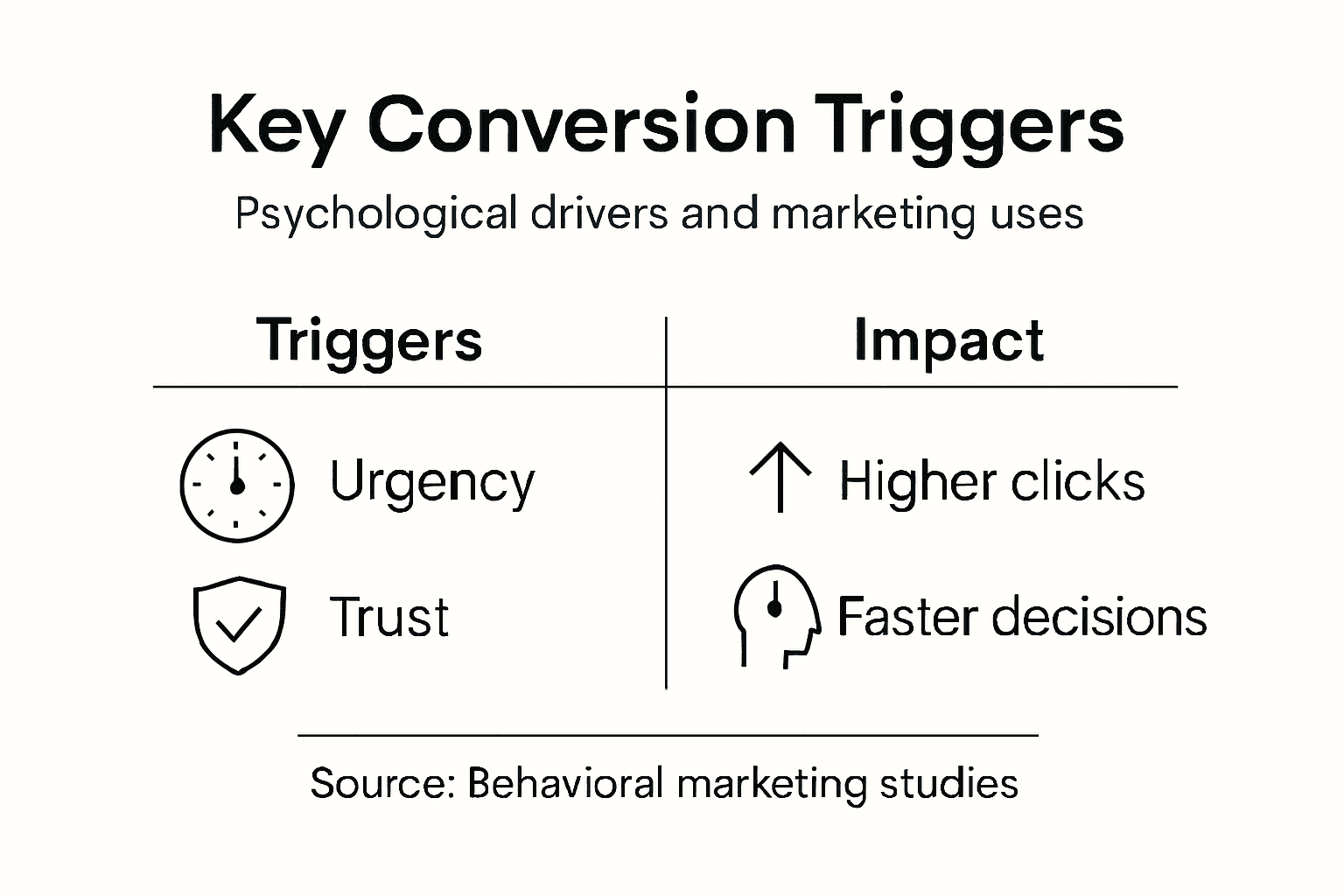
Here's a comparison of cognitive triggers and persuasive elements in digital marketing:
| Psychological Trigger | Typical Application | Impact on Conversion Rates |
|---|---|---|
| Scarcity effect | Limited-time offers | Higher urgency and faster decisions |
| Social proof | User testimonials and reviews | Increased trust and social validation |
| Emotional resonance | Values-based messaging | Enhanced emotional connection |
| Perceived value | Benefit-focused product copy | Stronger buyer motivation |
| Trust signals | Displaying certifications | Greater credibility and reduced hesitation |
Common Conversion Pitfalls and Misconceptions
Marketing teams frequently stumble into predictable traps that undermine their conversion optimization efforts. Conversion misconceptions can transform potentially successful strategies into expensive, ineffective campaigns that fail to deliver meaningful results.
Marketers often overlook critical behavioral insights when designing conversion strategies, defaulting to superficial design modifications instead of understanding deeper psychological mechanisms that drive user decisions.
Common conversion pitfalls include:
- Rational appeal fallacy: Assuming logical arguments always win
- Design myopia: Focusing exclusively on visual elements
- Demographic oversimplification: Treating audience as monolithic group
- Confirmation bias: Interpreting data to support existing beliefs
- Ignoring emotional drivers: Undervaluing psychological motivations
Successful conversion strategies require a nuanced understanding of human behavior. Marketers must recognize that decision-making is rarely a purely rational process, but instead involves complex emotional and cognitive interactions that transcend simple logical reasoning.
Most conversion optimization attempts fail because they treat users as abstract data points rather than complex human beings with intricate psychological landscapes. By developing empathy and deep psychological insights, marketers can create more authentic, compelling experiences that genuinely resonate with their target audience.
Pro tip: Develop comprehensive user personas that go beyond demographic data and explore the emotional, psychological, and motivational landscape of your target audience.
Ethical Approaches to Persuasive Testing
Ethical marketing represents a critical intersection between effective persuasion and human dignity. Persuasive testing requires a nuanced approach that respects consumer autonomy while delivering meaningful insights for businesses seeking genuine engagement.
Ethical marketing decisions integrate consumer psychology with rigorous analytical frameworks that prioritize transparency and individual agency. This approach transforms traditional conversion optimization from manipulative tactics into genuine, trust-building interactions.
Key ethical considerations in persuasive testing include:
- Informed consent: Ensuring users understand data collection processes
- Transparent methodologies: Clearly communicating testing objectives
- Data privacy protection: Safeguarding individual information
- Minimizing psychological manipulation: Respecting cognitive boundaries
- Voluntary participation: Allowing genuine opt-out mechanisms
Successful ethical persuasion recognizes that consumers are intelligent, autonomous individuals rather than mere data points. Marketing strategies must balance psychological insights with fundamental respect for human decision-making processes, avoiding exploitative techniques that undermine user trust.
Companies committed to ethical persuasive testing create long-term relationships by demonstrating genuine care for consumer well-being. This approach transforms marketing from a transactional interaction into a collaborative, mutually beneficial dialogue that respects individual agency and psychological complexity.
Pro tip: Develop a comprehensive ethical framework that treats user data as a sacred trust, not a commodity to be exploited.
This table summarizes ethical considerations versus common pitfalls in conversion optimization:
| Factor | Ethical Best Practice | Common Pitfall |
|---|---|---|
| Data privacy | Secure user data, clear consent | Unclear data policies |
| Motivational insight | Empathy-centered user personas | Overly rational audience profiling |
| Testing transparency | Explain test intent to participants | Hidden or misleading studies |
| Emotional engagement | Respect user autonomy and emotions | Ignore emotional drivers |
Unlock Higher Conversion Rates with Smart A/B Testing Tools
The article highlights the critical role of psychological triggers and persuasive elements in boosting conversion success. You understand that effective A/B testing goes beyond simple design tweaks and requires a deep grasp of consumer behavior to tap into emotional and cognitive decision-making. That is exactly where Stellar comes in. Our A/B Testing Tool is purpose-built for marketers and growth hackers who want to seamlessly integrate psychological insights into fast, impactful experiments. With a lightweight 5.4KB script and a no-code visual editor, Stellar helps you test emotional resonance, scarcity effects, and social proof without slowing down your website.
Ready to harness the power of conversion psychology in your A/B testing? Discover how our Advanced Goal Tracking and Real-Time Analytics give you immediate feedback on the subtle psychological triggers that influence your audience. Visit https://gostellar.app now and start optimizing with confidence before your competitors do.
Frequently Asked Questions
What is conversion psychology in marketing?
Conversion psychology in marketing refers to the understanding of psychological principles that influence consumer behavior, enabling marketers to create strategies that resonate with target audiences and enhance conversion rates.
How do cognitive triggers affect online decision-making?
Cognitive triggers are mental shortcuts that consumers use to make quick decisions online. They shape how users perceive products and can lead to higher conversion rates by creating emotional urgency and simplifying choices.
What persuasive elements should be integrated into marketing strategies?
Key persuasive elements include emotional resonance, social validation, reduced cognitive load, perceived value, and trust signals. These elements help create intuitive experiences that encourage user engagement and conversion.
What are common pitfalls in conversion optimization?
Common pitfalls include the rational appeal fallacy, design myopia, demographic oversimplification, confirmation bias, and ignoring emotional drivers. These can lead to ineffective marketing efforts if not addressed properly.
Recommended
- 7 Key Performance Indicators 2025 for A/B Testing Success
- Split Testing Product Pages: Boost Conversions in 2025
- Top 10 AB Testing Examples for CRO Marketers in 2025
- A B Testing Meaning: Uncover Data-Driven Insights for Better Conversions
- Rol van data in e-commerce – Sturen op groei en conversie – Synwave Studio
- Lead Generation with Artificial Intelligence for Higher ROI | Artificial Intelligence
Published: 2/7/2026