
Real-Time Analytics in Marketing: Driving Smart Decisions
Every marketing manager knows the frustration of waiting weeks for campaign results that might already be outdated. In the fast-moving world of e-commerce, immediate data matters more than ever for staying ahead of shifting trends and customer expectations. By harnessing real-time analytics, your team can make smarter decisions on the spot, run responsive A/B tests, and build deeper engagement with every customer interaction.
Table of Contents
- Defining Real-Time Analytics And Common Myths
- Major Types And Technologies In Marketing
- How Real-Time Analytics Powers A/B Testing
- Practical Applications For E-Commerce Growth
- Risks, Pitfalls, And How To Avoid Them
Key Takeaways
| Point | Details |
|---|---|
| Real-Time Analytics Enables Immediate Decision Making | Businesses can leverage real-time data to track behaviors, detect trends, and make informed decisions instantly. |
| Common Myths Limit Adoption | Understanding that real-time analytics is beneficial for all business sizes and enhances, rather than replaces, human decision-making is crucial. |
| Various Analytics Types Enhance Marketing Strategies | Utilizing descriptive, predictive, and prescriptive analytics empowers organizations to optimize marketing efforts effectively. |
| Awareness of Risks is Essential | Implementing strategies for data quality, interpretation, and compliance helps mitigate risks associated with real-time analytics. |
Defining Real-Time Analytics and Common Myths
Real-time analytics represents a dynamic approach to data processing where information is analyzed instantaneously as it is generated. Unlike traditional batch processing methods, this approach enables businesses to make immediate, informed decisions based on current data streams.
At its core, real-time data analysis involves processing information immediately as events occur, providing organizations with unprecedented insights into ongoing operational dynamics. This means marketing teams can track customer behaviors, detect trends, and respond to changes within milliseconds, transforming how strategic decisions are made.
Several common myths surround real-time analytics that can prevent businesses from fully leveraging its potential:
-
Myth 1: Real-Time Analytics is Only for Large Corporations
- Small and medium businesses can also benefit significantly
- Cost-effective tools now make real-time insights accessible
- Scalable solutions exist for different business sizes
-
Myth 2: Real-Time Data is Always 100% Accurate
- Data can have inherent limitations and potential biases
- Continuous validation and context are crucial
- Interpretation matters as much as raw numbers
-
Myth 3: Real-Time Analytics Replaces Human Decision Making
- Analytics provide insights, not absolute directives
- Human expertise remains critical for strategic interpretation
- Technology augments rather than eliminates human judgment
Understanding these nuances helps businesses approach real-time analytics more effectively, recognizing both its immense potential and realistic implementation challenges.
Pro tip: Start small with real-time analytics by selecting one key performance metric to track continuously, allowing your team to build confidence and expertise gradually.
Major Types and Technologies in Marketing
Marketing analytics represents a sophisticated approach to understanding and leveraging data-driven insights across business strategies. Marketing analytics incorporates statistical techniques that help organizations transform raw data into actionable intelligence, enabling more precise decision-making processes.
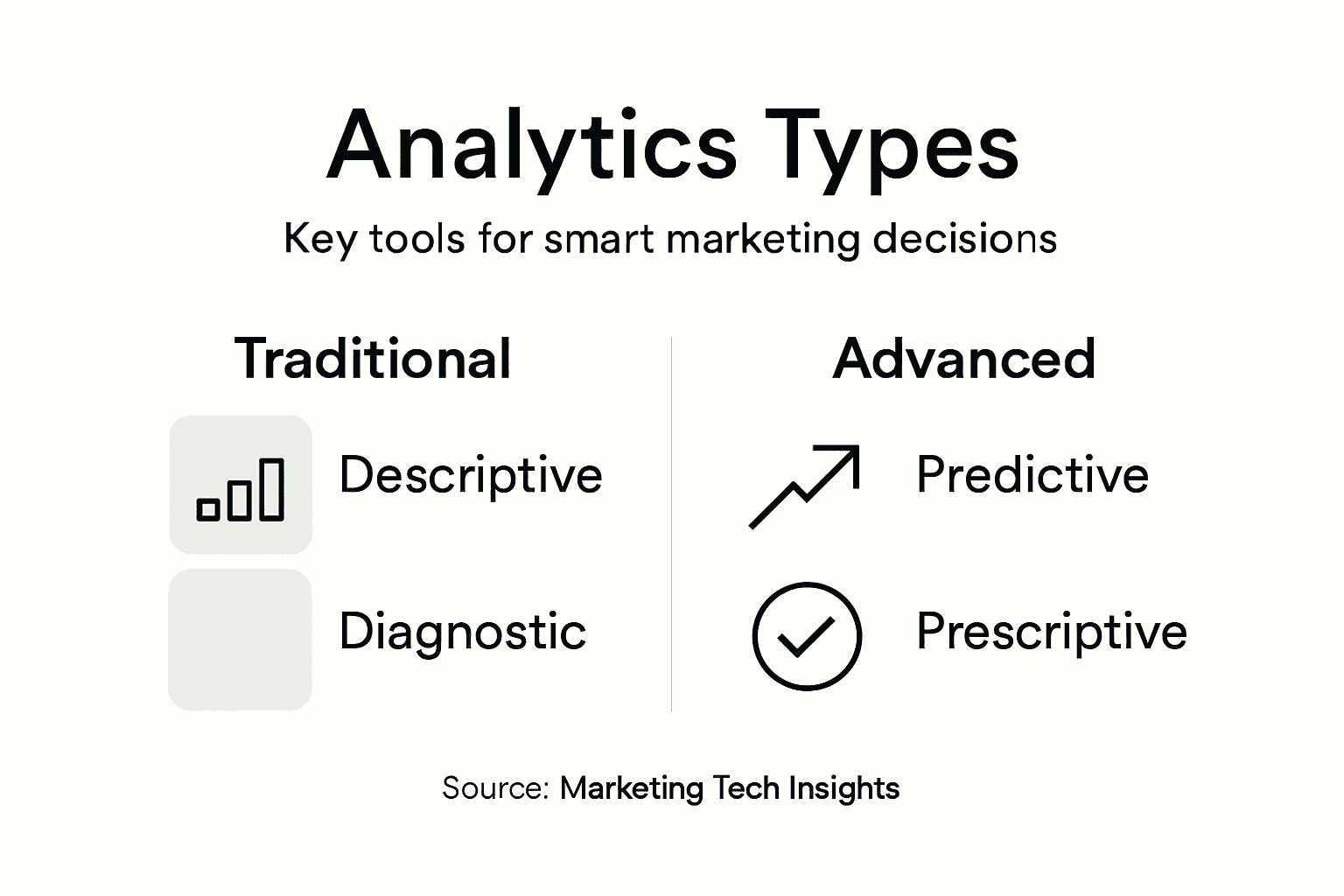
The landscape of marketing technologies can be categorized into several critical types of analytics:
-
Descriptive Analytics
- Summarizes historical marketing performance
- Provides insights into past campaign effectiveness
- Uses data visualization and reporting tools
-
Predictive Analytics
- Forecasts future customer behaviors
- Utilizes machine learning algorithms
- Helps anticipate market trends and consumer preferences
-
Prescriptive Analytics
- Recommends specific actions based on data insights
- Combines predictive modeling with optimization strategies
- Supports strategic marketing decision-making
Machine learning and artificial intelligence have revolutionized marketing technologies, enabling more sophisticated data modeling and consumer segmentation. These advanced technologies allow marketers to create highly personalized experiences by analyzing complex behavioral patterns and predicting individual customer needs with unprecedented accuracy.

Modern marketing technologies leverage multiple data sources, including web analytics, social media interactions, customer relationship management (CRM) systems, and emerging platforms that provide granular insights into consumer behavior.
Here's a comparison of analytics types used in marketing and their main benefits:
| Analytics Type | Main Purpose | Core Technology | Business Benefit |
|---|---|---|---|
| Descriptive | Examine past trends | Visualization tools | Understand campaign effectiveness |
| Predictive | Forecast customer behavior | Machine learning | Anticipate market shifts |
| Prescriptive | Recommend actions | Optimization models | Guide strategic decisions |
Pro tip: Implement a comprehensive analytics strategy by starting with descriptive analytics and gradually integrating predictive and prescriptive techniques to enhance your marketing decision-making capabilities.
How Real-Time Analytics Powers A/B Testing
Real-time analytics has transformed A/B testing from a slow, resource-intensive process into a dynamic, instantaneous decision-making tool. Controlled experiments reveal critical performance insights by comparing variations and identifying what truly drives better business outcomes.
The core mechanisms of real-time A/B testing involve several key technological capabilities:
-
Immediate Data Collection
- Captures user interactions millisecond by millisecond
- Tracks granular behavioral changes
- Eliminates delayed reporting lags
-
Statistical Significance Tracking
- Calculates confidence levels in real-time
- Determines winning variations instantly
- Reduces time to actionable insights
-
Adaptive Experimentation
- Dynamically adjusts test parameters
- Minimizes resource waste
- Enables continuous optimization
Autonomous testing technologies are now emerging that push the boundaries of traditional experimentation. Simulated user interaction systems can now generate complex behavioral models, allowing marketers to run sophisticated tests without requiring massive live traffic.
By leveraging machine learning and advanced statistical modeling, real-time analytics transforms A/B testing from a passive observation tool into an active optimization engine that continuously refines marketing strategies.
Pro tip: Configure your A/B testing platform to automatically stop and declare a winner when statistical significance is reached, preventing unnecessary resource expenditure and accelerating decision-making.
Practical Applications for E-Commerce Growth
Data analytics has become the cornerstone of strategic decision-making in modern e-commerce, transforming how businesses understand and engage with their customers. Data-driven strategies optimize critical business operations, enabling companies to make precise, targeted improvements across multiple dimensions.
Key practical applications of real-time analytics in e-commerce include:
-
Customer Personalization
- Tracks individual browsing and purchasing behaviors
- Generates tailored product recommendations
- Creates dynamic, individualized shopping experiences
-
Inventory Management
- Predicts stock requirements with high accuracy
- Minimizes overstock and stockout scenarios
- Optimizes supply chain efficiency
-
Pricing Optimization
- Implements dynamic pricing strategies
- Adjusts prices based on real-time market conditions
- Maximizes revenue through intelligent pricing
Predictive modeling technologies are revolutionizing e-commerce by enabling sophisticated demand forecasting and proactive business strategies. These advanced analytical approaches allow companies to anticipate customer needs, detect potential fraud, and create more responsive, adaptive online retail environments.
By leveraging comprehensive data analysis, e-commerce businesses can transform raw information into actionable insights that drive growth, improve customer satisfaction, and create competitive advantages in an increasingly complex digital marketplace.
Pro tip: Implement a centralized analytics dashboard that integrates multiple data sources, allowing real-time visibility into key performance metrics and enabling faster, more informed decision-making.
Risks, Pitfalls, and How to Avoid Them
Real-time analytics presents powerful opportunities for businesses, but navigating its complexities requires strategic awareness of potential risks. Common mistakes can compromise data reliability, making it crucial to understand and proactively mitigate potential challenges.
Key risks and mitigation strategies include:
-
Data Quality Challenges
- Implement rigorous data validation protocols
- Establish automated data cleaning processes
- Regularly audit data collection methodologies
-
Interpretation Errors
- Train teams in statistical reasoning
- Use multiple analytical perspectives
- Avoid drawing causation from correlation
-
Privacy and Compliance Risks
- Develop robust data governance frameworks
- Ensure transparent data usage policies
- Maintain strict adherence to regulatory standards
Organizational readiness plays a critical role in successfully implementing real-time decision-making strategies. Successful companies create integrated environments that balance technological capabilities with human expertise, ensuring that data insights drive meaningful action without creating unintended consequences.
By understanding these potential pitfalls, businesses can develop more resilient, accurate, and valuable analytical approaches that transform data into genuine competitive advantages.
The table below summarizes key risks in real-time analytics and practical mitigation strategies:
| Risk Area | Common Issue | Mitigation Strategy |
|---|---|---|
| Data Quality | Inaccurate records | Automated validation checks |
| Interpretation | False conclusions | Team training sessions |
| Compliance | Regulatory breaches | Regular policy updates |
Pro tip: Create a cross-functional analytics review team that includes data scientists, domain experts, and compliance professionals to provide comprehensive oversight of your real-time analytics initiatives.
Unlock Real-Time Marketing Success with Stellar
Real-time analytics drives smarter, faster decisions but it can be complex for small to medium-sized businesses to implement effectively. This article highlights common challenges like balancing quick data interpretation and executing precise A/B tests without overwhelming resources or sacrificing website performance. If you want to harness the power of real-time insights and streamline your experimentation process with intuitive tools you have to explore Stellar's SaaS platform. It offers a lightning-fast A/B testing tool with a lightweight 5.4KB script that keeps your site speed intact while delivering instant data on campaign performance.

Ready to transform your marketing with real-time analytics powered by a no-code visual editor dynamic keyword insertion and advanced goal tracking Begin with Stellar today and experience how effortless optimizing your campaigns can be. Check out the full capabilities of our platform at Stellar's homepage and discover how we tailor our solutions specifically for marketers and growth hackers in small to medium businesses. Start accelerating your growth by signing up now for a plan that fits your traffic and feature needs at https://gostellar.app. Make every marketing decision count with speed clarity and confidence.
Frequently Asked Questions
What is real-time analytics in marketing?
Real-time analytics in marketing refers to the instant processing and analysis of data as it is generated, allowing businesses to make immediate decisions based on current consumer behavior and trends.
How does real-time analytics improve A/B testing?
Real-time analytics enhances A/B testing by providing immediate data collection, calculating statistical significance on-the-fly, and allowing for adaptive experimentation, which helps marketers make quick, informed decisions about which variations perform best.
What are the main types of marketing analytics?
The main types of marketing analytics include descriptive analytics (examines past performance), predictive analytics (forecasts future behaviors), and prescriptive analytics (recommends actions based on insights).
What are the risks associated with real-time analytics?
Common risks of real-time analytics include data quality challenges, interpretation errors, and privacy/compliance risks. Implementing rigorous data validation, training teams in statistical reasoning, and establishing data governance frameworks can help mitigate these risks.
Recommended
- Real-time analytics uitleg: Begrijp de essentie
- Real-Time Analytics: Alles Over De Voordelen
- Real-Time Analytics for Websites: Complete Guide
- Understanding Integrating Analytics Tools for Marketing Success
- Understanding Predictive Analytics Marketing for Businesses - seo analytic
- How Companies Are Leveraging Artificial Intelligence in Marketing and Advertising
Published: 1/31/2026