
Sample Size in A/B Testing: Impact on Results
Most American marketers risk wasting budget or missing critical insights when their A/B test sample size falls short of statistical power. Every decision to launch a new website variant or tweak a funnel depends on results you can trust. This straightforward guide gives growth marketers and CRO specialists practical clarity on how to define reliable sample sizes that cut through doubt and drive confident, data-backed outcomes.
Table of Contents
- Defining Sample Size For A/B Testing
- Key Factors Influencing Sample Size
- Calculating Statistically Valid Sample Sizes
- Common Pitfalls And How To Avoid Them
- How Sample Size Choices Affect Business Outcomes
Key Takeaways
| Point | Details |
|---|---|
| Determine Sample Size Carefully | A/B testing requires the correct sample size to ensure statistically significant results, impacting the validity of outcomes. |
| Balance Statistical Power and Practical Constraints | Consider factors such as expected conversion rate changes and available web traffic when calculating the sample size. |
| Avoid Common Pitfalls | Be aware of errors like premature test termination and misinterpretation of statistical measures to maintain the integrity of test results. |
| Implement Standardized Procedures | Establish protocols for sample size calculations to ensure consistent and reliable testing methodologies across all experiments. |
Defining Sample Size for A/B Testing
A/B testing sample size represents the number of website visitors or users required to generate statistically significant results. Determining the right sample size is crucial because it directly impacts the reliability and validity of your experiment's outcomes. Online A/B testing statistical frameworks demonstrate that insufficient sample sizes can lead to misleading conclusions about user behavior and conversion performance.
The core challenge in defining sample size involves balancing statistical power with practical constraints. Marketers must consider several key factors including expected conversion rate difference, current baseline performance, desired statistical significance level, and available web traffic. Smaller differences between variants require larger sample sizes to detect meaningful changes. Professional A/B testing approaches recommend measuring effect size precisely to optimize sample allocation.
Typical sample size calculations involve complex statistical formulas that factor in multiple variables. Researchers typically use methods like power analysis to determine minimum viable sample sizes. These calculations help predict the probability of detecting a true difference between experiment variations. Key parameters include significance level (usually set at 0.05), statistical power (recommended 80%), and expected effect magnitude.
Pro tip: Before launching an A/B test, use online sample size calculators to estimate the minimum number of visitors needed for statistically reliable results, preventing premature or inconclusive experiments.
Key Factors Influencing Sample Size
Sample size determination involves several critical factors that directly impact the statistical validity of A/B testing experiments. Comprehensive sampling methodologies highlight the complex interplay between research objectives and statistical considerations. The most fundamental elements include current conversion rates, expected effect magnitude, statistical power, and desired confidence levels.
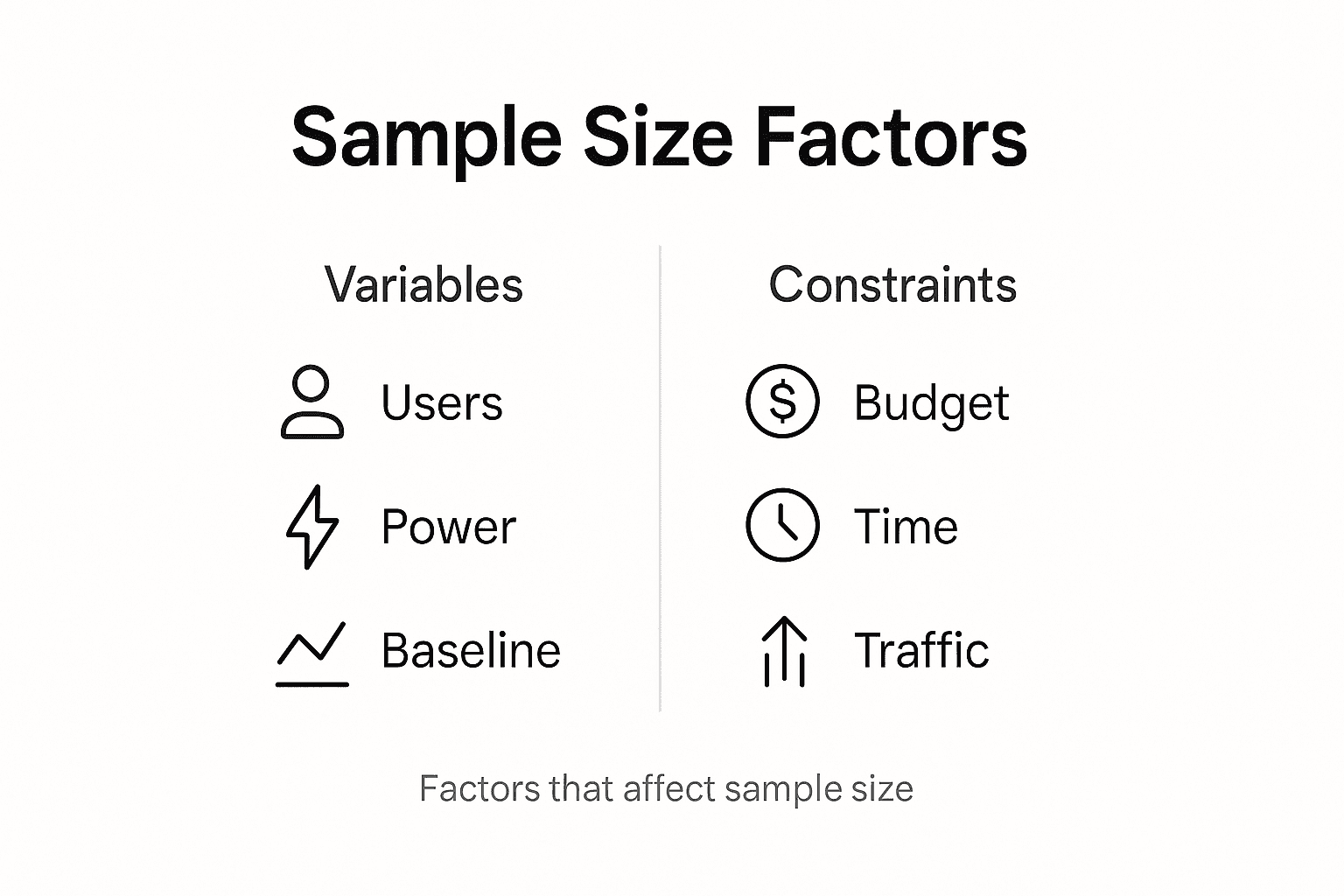
Conversion rate variability plays a significant role in sample size calculation. Marketers must assess the baseline performance metric and anticipate potential improvement percentages. Smaller expected differences between test variations demand larger sample sizes to detect statistically meaningful changes. For instance, a modest 2% conversion rate improvement requires substantially more visitors compared to a more substantial 10% anticipated uplift. Statistical parameters like significance level (typically set at 0.05) and statistical power (recommended 80%) further refine these calculations.
Resource constraints and practical considerations also substantially influence sample size decisions. Web traffic volume, experiment duration, and potential opportunity costs must be carefully balanced against statistical requirements. Researchers need to evaluate the trade-offs between comprehensive testing and operational efficiency. Practical guidelines for sample size determination recommend avoiding both under-powered and overly extended experiments that consume excessive resources without generating meaningful insights.
Pro tip: Always calculate minimum detectable effect ranges before launching an A/B test to ensure your sample size provides statistically robust results without unnecessarily prolonging the experiment.
Calculating Statistically Valid Sample Sizes
Statistical sample size calculation represents a precise mathematical approach to determining the optimal number of participants required for robust A/B testing. Advanced statistical methods for experimental design reveal complex considerations beyond simple numerical calculations. Marketers must navigate multiple statistical parameters to ensure their experiments generate meaningful, actionable insights.

The primary components of sample size determination include significance level, statistical power, expected effect size, and baseline conversion rates. Researchers typically use power analysis formulas that balance the probability of detecting true differences while minimizing false positive results. Most professional A/B testing frameworks recommend setting significance at 0.05 (5% error rate) and statistical power at 0.80 (80% chance of detecting a meaningful effect), which provides a robust statistical foundation for experimental conclusions.
Practical sample size calculations involve several strategic steps. First, identify the current baseline conversion rate for the metric being tested. Next, estimate the minimum detectable effect size you want to identify. Then, determine acceptable levels of statistical significance and power. Complex mathematical formulas combine these variables to generate precise sample size recommendations. Advanced statistical techniques now account for nuanced factors like correlated data, contextual variations, and potential experimental interactions that traditional methods might overlook.
Here's how the main components of A/B test sample size calculation influence reliability:
| Component | Role in Calculation | Business Impact |
|---|---|---|
| Baseline Conversion Rate | Sets starting metric expectations | Ensures relevance of test results |
| Expected Effect Size | Determines needed sensitivity | Balances resource use vs. insight depth |
| Significance Level | Controls chance of false positives | Reduces risk of making wrong changes |
| Statistical Power | Improves detection of real effects | Increases confidence in findings |
Pro tip: Always utilize online statistical calculators that can quickly compute recommended sample sizes based on your specific conversion rate, expected effect size, and desired statistical parameters.
Common Pitfalls and How to Avoid Them
Widespread misconceptions in A/B testing analysis can dramatically undermine experimental validity and lead to incorrect business decisions. Many marketers unknowingly compromise their test results by making critical errors that seem minor but can significantly skew statistical interpretations. Understanding these common pitfalls is crucial for generating reliable, actionable insights from A/B testing experiments.
One of the most significant errors is premature test termination, where marketers stop experiments too early based on initial promising results. Statistical significance requires consistent performance over time and a sufficient sample size. Another critical mistake involves misinterpreting p-values and confidence intervals, which can lead to false conclusions about true performance differences. Researchers must maintain rigorous statistical standards, ensuring that observed variations are not simply random fluctuations but genuine, meaningful changes in user behavior.
External factors often introduce additional complexity into A/B testing scenarios. Seasonal variations, unexpected market shifts, or concurrent marketing campaigns can inadvertently influence test results. Sophisticated A/B testing approaches demand comprehensive context tracking, careful segmentation, and robust statistical controls to minimize these potential contaminating influences. Marketers should establish clear metrics, define precise experimental parameters, and implement thorough post-test review processes that critically examine both quantitative results and underlying contextual dynamics.
Pro tip: Always document your experimental hypotheses, methodology, and potential external variables before launching an A/B test to create a transparent, accountable framework for result interpretation.
How Sample Size Choices Affect Business Outcomes
Sample size selection critically impacts organizational decision-making processes by determining the reliability and actionability of experimental results. Small sample sizes introduce substantial statistical uncertainty, potentially leading to misguided strategic choices that can cost businesses significant resources. Conversely, overly large samples waste valuable time and computational energy without proportional increases in insights.
The financial implications of sample size decisions extend far beyond immediate testing costs. Inadequate sample sizes can trigger false positive or false negative results, which might prompt companies to implement ineffective product changes or overlook genuinely impactful modifications. For instance, a marketing team might prematurely launch a website redesign based on statistically weak evidence, potentially alienating users and reducing conversion rates. Alternatively, they might discard a promising feature because an undersized test failed to capture its true potential.
Strategic sample size determination requires balancing multiple organizational priorities. Companies must consider factors like available web traffic, testing duration, potential opportunity costs, and the specific metric's variability. Advanced statistical techniques now enable more nuanced sampling approaches that account for complex interactions between variables. By implementing rigorous sample size calculations, businesses can transform A/B testing from a speculative exercise into a precise, data-driven decision-making tool that minimizes risk and maximizes strategic insights.
The following table compares sample size risks and benefits for different business scenarios:
| Scenario | Risk of Small Sample | Risk of Large Sample | Best Practice |
|---|---|---|---|
| Fast Experiment | High error rate | Slower decisions | Use power analysis for balance |
| High Cost per User | Missed effects | Wasted budget | Detect minimum viable change |
| Limited Traffic | Inconclusive results | Test too long | Prioritize high-impact tests |
Pro tip: Create a standardized internal protocol for sample size calculations that includes minimum detectable effect thresholds, ensuring consistent and reliable experimental methodologies across all organizational testing efforts.
Master Your A/B Testing Sample Size with Stellar
Determining the right sample size is critical to avoid misleading results and wasted resources in A/B testing. If you want to eliminate guesswork around statistical power, baseline conversion rates, and effect size, our A/B Testing Tool offers a fast and reliable solution specifically designed for marketers and growth hackers. With Stellar's no-code visual editor and real-time analytics, you can precisely plan and execute tests that deliver actionable insights without complicated formulas or premature test conclusions.

Take control of your experiments today by visiting https://gostellar.app to start your free trial. Quickly estimate your needed sample size, monitor your tests in real time, and make confident decisions that drive measurable growth. Don’t leave your test outcomes to chance—streamline your testing strategy with Stellar and see results you can trust.
Frequently Asked Questions
What is sample size in A/B testing?
Sample size in A/B testing refers to the number of users or visitors required to achieve statistically significant results in an experiment. It helps ensure the reliability and validity of findings regarding user behavior and conversion rates.
How do I calculate the required sample size for my A/B test?
To calculate the required sample size for an A/B test, consider the current baseline conversion rate, expected effect size, significance level (usually 0.05), and desired statistical power (typically 80%). Using these parameters in a power analysis will provide the minimum number of participants needed.
What factors influence sample size in A/B testing?
The main factors influencing sample size include the baseline conversion rates, expected improvement percentage, desired statistical significance level, and available web traffic. Smaller expected differences necessitate larger sample sizes for accurate detection of changes.
What are common pitfalls when determining A/B testing sample size?
Common pitfalls include premature test termination, misinterpreting statistical values like p-values, and not accounting for external variables that can skew results. It’s crucial to maintain rigorous statistical standards and document your testing framework to avoid these mistakes.
Recommended
Published: 12/26/2025