
Security Testing for Web Applications: 2026 Guide
TL;DR:
- Effective web application security testing combines a structured six-phase methodology with both automated tools and manual analysis to comprehensively identify vulnerabilities. It emphasizes testing APIs, authenticated areas, and business logic flaws, while providing detailed reports with proof, severity ratings, and specific remediation guidance. Relying solely on automated scans is insufficient, as manual testing uncovers complex exploits and chained vulnerabilities critical for accurate risk assessment and compliance.
Security testing for web applications is the proactive evaluation of a web app's defenses by simulating attacks to uncover exploitable vulnerabilities before real attackers do. The industry standard framework for this work is the OWASP Web Security Testing Guide (WSTG), which organizes testing into 12 core areas and 91 test cases covering identity management, authentication, APIs, and business logic. Tools like Burp Suite and OWASP ZAP are the workhorses of the trade, but they only deliver results when applied within a structured methodology. Security testing is not the same as vulnerability scanning or code review. It combines manual analysis with automated tools to find what each method alone cannot.
What are the key phases of web application security testing?
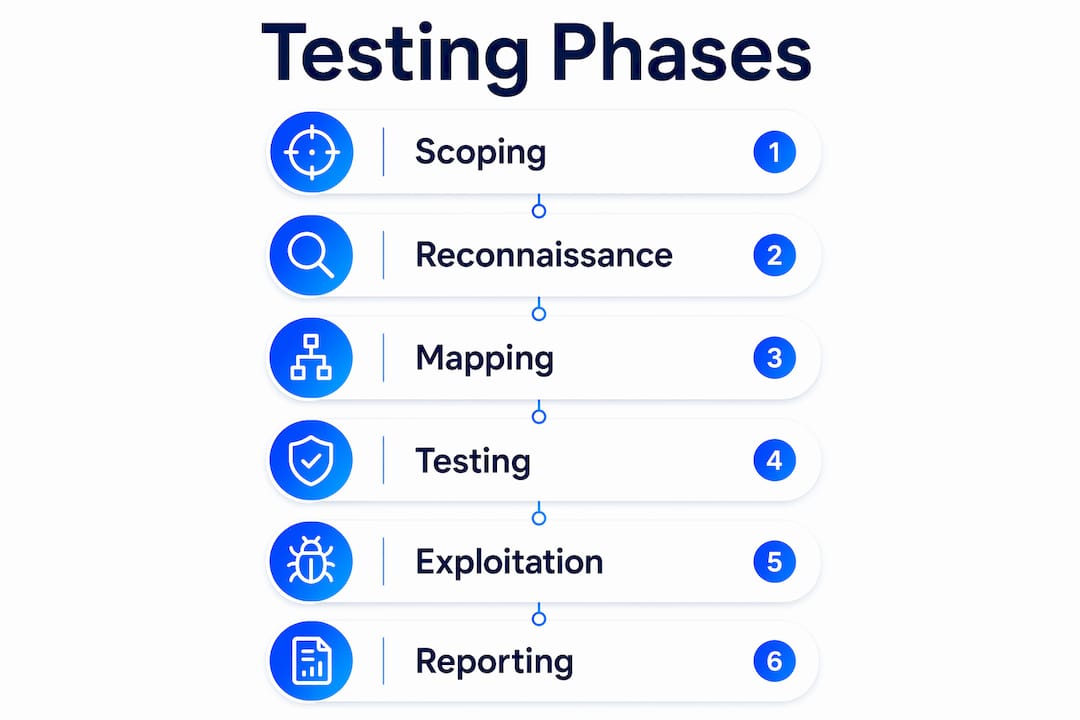
A repeatable, documented methodology is the foundation of any credible web application security audit. Without it, you miss entire attack surfaces and cannot defend your findings to developers, auditors, or executives. The six-phase approach below reflects current industry practice and aligns with the OWASP WSTG framework.
-
Scoping and authorization. Define exactly what is in scope: specific URLs, subdomains, API endpoints, and user roles. Get written authorization before touching anything. This protects you legally and sets clear expectations with the client or internal team.
-
Reconnaissance. Gather information about the target without triggering alerts. Passive reconnaissance uses public sources like DNS records, certificate transparency logs, and job postings to map the technology stack. Active reconnaissance involves direct interaction with the application to enumerate endpoints, parameters, and server responses.
-
Attack surface mapping. Document every input vector: forms, headers, cookies, API calls, file uploads, and WebSocket connections. This step determines what gets tested and prevents gaps. A missed endpoint is a missed vulnerability.
-
Systematic vulnerability testing. Work through the OWASP Top 10 categories methodically: injection flaws, broken authentication, insecure deserialization, security misconfigurations, and more. Use both automated scans and manual probing. Automated tools handle repetitive checks at speed; manual testing catches what scanners cannot interpret.
-
Exploitation and impact proof. When you find a vulnerability, demonstrate its real-world impact. A SQL injection that leaks a single row of data is a different risk level than one that dumps an entire user database. Vulnerability chaining shows how multiple low-risk issues combine into a critical exploit path, and documenting these chains is what separates a useful report from a list of scanner output.
-
Documentation and reporting. Record every finding with reproduction steps, evidence, and remediation guidance. A documented, repeatable methodology ensures thorough coverage and gives you the defensibility to explain findings to any stakeholder.
Pro Tip: Always test authenticated sections under multiple user roles. Admin panels and privileged user flows are frequently skipped and are consistently where the most severe vulnerabilities hide.
How do automated scanning and manual penetration testing compare?
The debate between automated and manual testing is not about which is better. It is about understanding what each one actually does, and where each one fails.
| Feature | Automated scanning | Manual penetration testing |
|---|---|---|
| Speed | Fast, completes basic checks in under 10 seconds | Slower, hours to days depending on scope |
| Coverage | Broad, catches known vulnerability patterns | Deep, finds logic flaws and chained exploits |
| Business logic flaws | Cannot detect | Primary strength |
| False positives | High | Low with experienced tester |
| Compliance value | Limited for SOC 2, HIPAA | Meets compliance requirements |
| Cost | Low | Higher, reflects expertise |
Automated dynamic application security testing (DAST) tools like Burp Suite's scanner and OWASP ZAP perform fast scans, but DAST tools are invasive and recommended only for non-production environments because of the load they place on live systems. That is a hard constraint many teams ignore, and it creates real risk when scans run against production databases.
Manual penetration testing is critical to discover business logic vulnerabilities, authorization flaws, and multi-step exploit chains that automated scanners miss entirely. A scanner cannot understand that a user should never be able to apply a discount code twice, or that a password reset flow can be manipulated to take over another account. Those are human insights.
Automated scanners cannot reliably identify business logic flaws or context-specific authorization issues critical for compliance frameworks like SOC 2 or HIPAA. If your organization needs to pass a compliance audit, scan-only assessments will not satisfy the requirement. Manual testing is not optional in that context. It is the requirement.
Pro Tip: Run automated scans first to clear the low-hanging fruit, then direct your manual testing hours toward authenticated flows, API endpoints, and business logic. This gives you the best return on testing time.
What critical areas demand focus during web app security testing?
Modern web applications have expanded far beyond simple HTML forms. The attack surface now includes APIs, single-page application frameworks, browser storage, and complex multi-role user systems. A thorough web app security checklist must address each of these areas explicitly.
Authentication and session management are the front door of your application. Tests here cover password policy enforcement, account lockout behavior, multi-factor authentication bypass attempts, and session token entropy. Weak session tokens or tokens that do not expire after logout are among the most common findings in real assessments.

Authorization and access control testing looks for horizontal privilege escalation (accessing another user's data at the same permission level) and vertical privilege escalation (accessing functions reserved for higher-privilege roles). Insecure Direct Object Reference (IDOR) vulnerabilities fall here and remain one of the most frequently exploited classes of web application flaws.
API security deserves its own dedicated testing phase. API security testing must cover REST, GraphQL, and gRPC endpoints, including excessive data exposure, mass assignment vulnerabilities, and broken function-level authorization. The most critical vulnerabilities often accumulate over multiple development cycles in API ecosystems that grow faster than their security controls. Testing the UI alone leaves the API entirely unexamined.
Business logic testing cannot be automated. It requires a tester who understands the application's intended workflow and can identify where that workflow can be abused. Examples include purchasing items at negative prices, skipping required steps in a multi-stage process, or manipulating quantity fields to trigger unintended discounts.
Client-side security covers cross-site scripting (XSS), insecure use of localStorage and sessionStorage, and sensitive data stored in browser memory. XSS remains in the OWASP Top 10 because developers continue to trust user-supplied input in rendering contexts where they should not.
Authenticated areas, admin dashboards, and multi-role user scenarios are often the most vulnerable parts of any web application and must be included in scope to produce a realistic security assessment. Unauthenticated testing alone gives you a fraction of the actual risk picture. For a broader look at how these testing disciplines connect, the types of web testing overview from Gostellar provides useful context on where security fits within a full testing strategy.
What should a high-quality security testing report include?
A penetration testing report is the deliverable that justifies the entire engagement. A report that lists vulnerabilities without context, reproduction steps, or remediation guidance is nearly worthless to the development team that has to fix the findings.
-
Executive summary. Write this for non-technical stakeholders: the CISO, CTO, or board member who needs to understand business risk without reading technical details. Summarize the overall security posture, the most critical findings, and the recommended priority order for remediation.
-
Technical findings with reproduction steps. Each vulnerability gets its own section with a clear description, the exact steps to reproduce it, the affected component, and the potential impact. Developers need to reproduce the issue themselves before they can fix it.
-
Severity ratings using CVSS 4.0. A 2026 pentest report should use CVSS 4.0 for severity ratings, which provides more granular scoring than earlier versions by accounting for environmental and threat context. This gives developers and managers a consistent, defensible way to prioritize fixes.
-
Proof-of-concept evidence. High-quality pentest reports provide proof-of-concept evidence such as screenshots, HTTP request captures, or videos demonstrating exploitability. Without evidence, developers often deprioritize findings they cannot verify independently.
-
Specific remediation guidance. Generic advice like "sanitize inputs" does not help a developer working in a specific framework. Remediation guidance should reference the actual code pattern, library, or configuration change needed. Where possible, include links to framework-specific documentation.
-
Retesting and verification. A report without a retesting phase leaves the engagement incomplete. Confirm that fixes actually resolve the vulnerability rather than just masking it. Incomplete fixes are common, particularly for complex authorization issues.
Key takeaways
Effective security testing for web applications requires combining automated tools with manual penetration testing, structured methodology, and thorough reporting to address the full attack surface.
| Point | Details |
|---|---|
| Use a six-phase methodology | Scoping, recon, surface mapping, testing, exploitation, and reporting prevent coverage gaps. |
| Automate first, then go manual | Run DAST tools in non-production environments, then focus manual hours on APIs and business logic. |
| API and authenticated areas are highest risk | Test REST, GraphQL, and gRPC endpoints alongside admin panels and multi-role user flows. |
| Vulnerability chaining changes severity | Combining low-risk issues can produce critical exploits; document chains for accurate risk assessment. |
| Reports must include proof and remediation | CVSS 4.0 ratings, reproduction steps, and framework-specific fixes make findings actually fixable. |
Why I stopped trusting scan results alone
After years of reviewing security assessments, the pattern I see most often is organizations that run automated scans, get a clean-ish report, and declare the application secure. That conclusion is wrong almost every time.
The scanners are good at what they do. They find known vulnerability signatures fast and consistently. But they have no idea what your application is supposed to do. They cannot tell you that your password reset endpoint accepts any email address and sends a reset link without verifying the account exists. They cannot tell you that your API returns 47 fields when the front end only displays 3, and that 12 of those fields contain data the requesting user has no business seeing.
The areas I see neglected most often are API endpoints added during feature sprints and never formally reviewed, and authenticated test scenarios that require setting up test accounts across multiple user roles. Both are tedious to set up. Both are where the worst vulnerabilities consistently live.
Vulnerability chaining is the technique that changes how you think about severity. A CORS misconfiguration rated medium and a missing HttpOnly flag rated low look manageable in isolation. Combined, they produce a critical account takeover path. If your tester is not actively looking for chains, they are handing you an incomplete risk picture.
The reporting side matters just as much as the testing. I have seen technically excellent assessments fail to drive remediation because the report was written for the tester, not for the developer who has to fix it. Specificity in remediation guidance is not optional. It is what determines whether the finding gets fixed or gets closed as "acknowledged."
For developers and IT managers who want to build secure coding practices into their workflow from the start, the investment pays off in fewer critical findings at assessment time.
— Juan
Take your web application security further with Gostellar
Gostellar's approach to web application testing aligns with OWASP guidelines and combines automated scanning with manual penetration testing to cover the full attack surface, including API endpoints, business logic flows, and authenticated user scenarios. If your team is building or maintaining web applications and needs a structured testing process that goes beyond running a scanner, Gostellar provides the framework and tooling to make that happen. Explore Gostellar's testing resources to see how structured security testing fits into your development and release cycle. For teams managing marketing-driven web applications, the guide on automated website testing covers how to layer security checks into existing workflows without requiring dedicated security engineering resources.
FAQ
What is security testing for web applications?
Security testing for web applications is the systematic process of identifying vulnerabilities in a web app by simulating attacker techniques through manual and automated methods. The OWASP Web Security Testing Guide defines 91 test cases across 12 categories as the industry standard framework.
How often should you run a web application security audit?
A web application security audit should run at minimum annually and after any major feature release or infrastructure change. Applications handling sensitive data under SOC 2 or HIPAA compliance frameworks typically require more frequent assessments.
What is the difference between DAST and manual penetration testing?
DAST tools like OWASP ZAP perform automated scans that identify known vulnerability patterns quickly, while manual penetration testing uncovers business logic flaws, chained exploits, and authorization issues that automated tools cannot interpret. Both are needed for complete coverage.
Why is API security testing separate from standard web testing?
APIs expose different attack vectors than traditional web interfaces, including mass assignment, excessive data exposure, and broken function-level authorization across REST, GraphQL, and gRPC endpoints. These require dedicated test cases beyond what a standard UI-focused assessment covers.
What does CVSS 4.0 add to penetration testing reports?
CVSS 4.0 improves on earlier versions by incorporating environmental context and threat intelligence into severity scoring, giving security teams a more accurate basis for prioritizing remediation. It is the current standard for vulnerability severity ratings in 2026 pentest reports.
Recommended
Published: 6/7/2026