
Segmentation in A/B Testing: Complete Guide
Most A/B tests miss hidden insights when everyone is lumped together, yet segmenting your audience can turn average results into breakthrough wins. Companies using segmented A/B testing report a 37 percent higher ROI than those sticking to plain comparisons. Understanding the real impact of segmentation means seeing how different groups respond in unique ways, making every test smarter and more reliable. Learn how this powerful approach reveals the details that typical tests overlook.
Table of Contents
- Segmentation In A/B Testing Explained
- Key Types Of Segmentation Approaches
- How Segmentation Affects Test Results
- Real-World Applications And Use Cases
- Common Pitfalls And How To Avoid Them
Key Takeaways
| Point | Details |
|---|---|
| Importance of Segmentation | Segmentation allows marketers to divide users into groups based on characteristics, enhancing insights during A/B testing. |
| Key Approaches to Segmentation | Effective segmentation includes demographic, behavioral, contextual, and customer lifecycle factors to uncover user preferences. |
| Impact on Test Results | Segmentation leads to more precise optimizations, reduces statistical noise, and improves ROI by tailoring strategies to distinct audience groups. |
| Avoiding Common Pitfalls | Ensure adequate sample sizes and clear controls to avoid biases and maintain the reliability of A/B testing results. |
Segmentation in A/B Testing Explained
In the realm of digital marketing and conversion rate optimization, segmentation is a powerful technique that transforms A/B testing from a basic comparison into a nuanced strategy. According to VCMO, segmentation involves dividing users into distinct groups based on specific characteristics such as demographics, behavior, or acquisition source. This approach allows marketers to gain deeper insights into how different user groups respond to variations, ultimately leading to more precise and targeted optimizations.
The core principle of segmentation in A/B testing is recognizing that not all users are the same. As Business Adobe explains, this process involves grouping prospective buyers based on their unique wants, needs, and attributes. By evaluating test variations within specific subgroups, marketers can uncover nuanced insights that might be hidden in aggregate data.
Key segments for A/B testing typically include:
- Demographics: Age, gender, location, income level
- Behavioral Data: Past purchase history, website interactions, engagement levels
- Traffic Source: Organic search, paid advertising, social media referrals
- Device Type: Mobile, desktop, tablet users
- Customer Lifecycle Stage: New visitors, returning customers, long-term subscribers
By implementing strategic segmentation, you transform A/B testing from a simple yes-or-no experiment into a sophisticated research methodology that provides granular understanding of user preferences and behaviors. The 7 Smart Strategies for Segmenting Test Audiences Effectively guide offers deeper insights into advanced segmentation techniques that can elevate your experimentation strategy.
Key Types of Segmentation Approaches
Understanding the nuanced approaches to segmentation is crucial for effective A/B testing. According to Business, there are several fundamental segmentation strategies that can dramatically improve testing precision and insights. These approaches allow marketers to slice their audience into meaningful groups that reveal deeper patterns and preferences beyond surface-level analysis.
Behavioral Segmentation represents one of the most powerful techniques in A/B testing. As VCMO explains, this method categorizes users based on their specific on-site actions and interactions. Key behavioral segments might include:
- New vs. returning visitors
- Users who frequently click discount offers
- Engagement levels (high, medium, low interaction)
- Purchase frequency
- Abandoned cart behaviors
Demographic Segmentation provides another critical lens for understanding user variations. This approach breaks down audiences by fundamental characteristics like:
- Age groups
- Gender
- Geographic location
- Income levels
- Professional occupation
When combined with advanced testing strategies, demographic insights can unlock powerful optimization opportunities.
 For deeper exploration of sophisticated segmentation techniques, check out our Advanced A/B Testing Strategies guide, which offers comprehensive insights into leveraging these segmentation approaches effectively.
Beyond traditional segmentation, modern marketers are increasingly focusing on contextual segments that consider multiple dimensions simultaneously. This might involve combining behavioral data with acquisition source, device type, or customer lifecycle stage to create hyper-targeted testing scenarios that reveal nuanced user preferences and conversion triggers.
How Segmentation Affects Test Results
Segmentation transforms A/B testing from a simple binary comparison into a sophisticated analytical approach that reveals nuanced user behavior. According to VCMO, segmentation enhances testing by uncovering how different customer groups uniquely respond to changes, enabling organizations to understand precisely why a particular variant succeeds or fails for specific audience segments.
Performance Impact is where segmentation truly shines. Marketing Hub Daily reports that businesses implementing segmented A/B testing strategies experience remarkable outcomes, with companies reporting a striking 37% higher ROI compared to non-segmented testing approaches. This significant performance boost stems from the ability to tailor content and experiences more precisely to distinct audience groups.
Key ways segmentation influences test results include:
- Granular Insights: Reveals performance variations across different user groups
- Targeted Optimization: Allows for more precise improvements
- Reduced Statistical Noise: Minimizes interference from heterogeneous data
- Personalization Opportunities: Identifies unique preferences within audience segments
To dive deeper into understanding how different visitor segments impact testing outcomes, our Analyzing Split Test Results guide offers advanced techniques for interpreting complex segmentation data. By embracing a segment-driven approach, marketers can move beyond one-size-fits-all testing and unlock more meaningful, actionable insights that drive genuine conversion improvements.
Real-World Applications and Use Cases
Segmentation transforms theoretical marketing strategies into practical, high-impact optimization techniques. Marketing Hub Daily provides a compelling real-world example from Campaign Monitor, where targeted email template testing resulted in a remarkable 127% increase in click-through rates by carefully tailoring approaches to different audience segments.
E-commerce and Conversion Optimization represent prime areas where segmentation delivers tangible results. Online retailers can leverage segmentation to create personalized experiences that dramatically improve user engagement. For instance, segmenting users by:
- Purchase history
- Device type
- Geographical location
- Customer lifetime value
- Browsing behavior
These nuanced approaches allow businesses to craft hyper-targeted experiences that speak directly to specific user needs. According to VCMO, this strategic segmentation enables organizations to allocate resources more effectively, focusing on high-yield customer cohorts and scaling only where proven performance exists.
Some practical segmentation applications include:
- Email Marketing: Personalizing subject lines and content
- Website Personalization: Displaying different hero images or call-to-action buttons
- Product Recommendations: Tailoring suggestions based on user behavior
- Onboarding Flows: Creating unique experiences for different user types
To explore more advanced strategies for implementing these segmentation techniques, check out our Understanding How to Use Test Data Effectively guide. By embracing granular segmentation, marketers can transform generic experiences into precision-targeted interactions that significantly boost engagement and conversion rates.
Common Pitfalls and How to Avoid Them
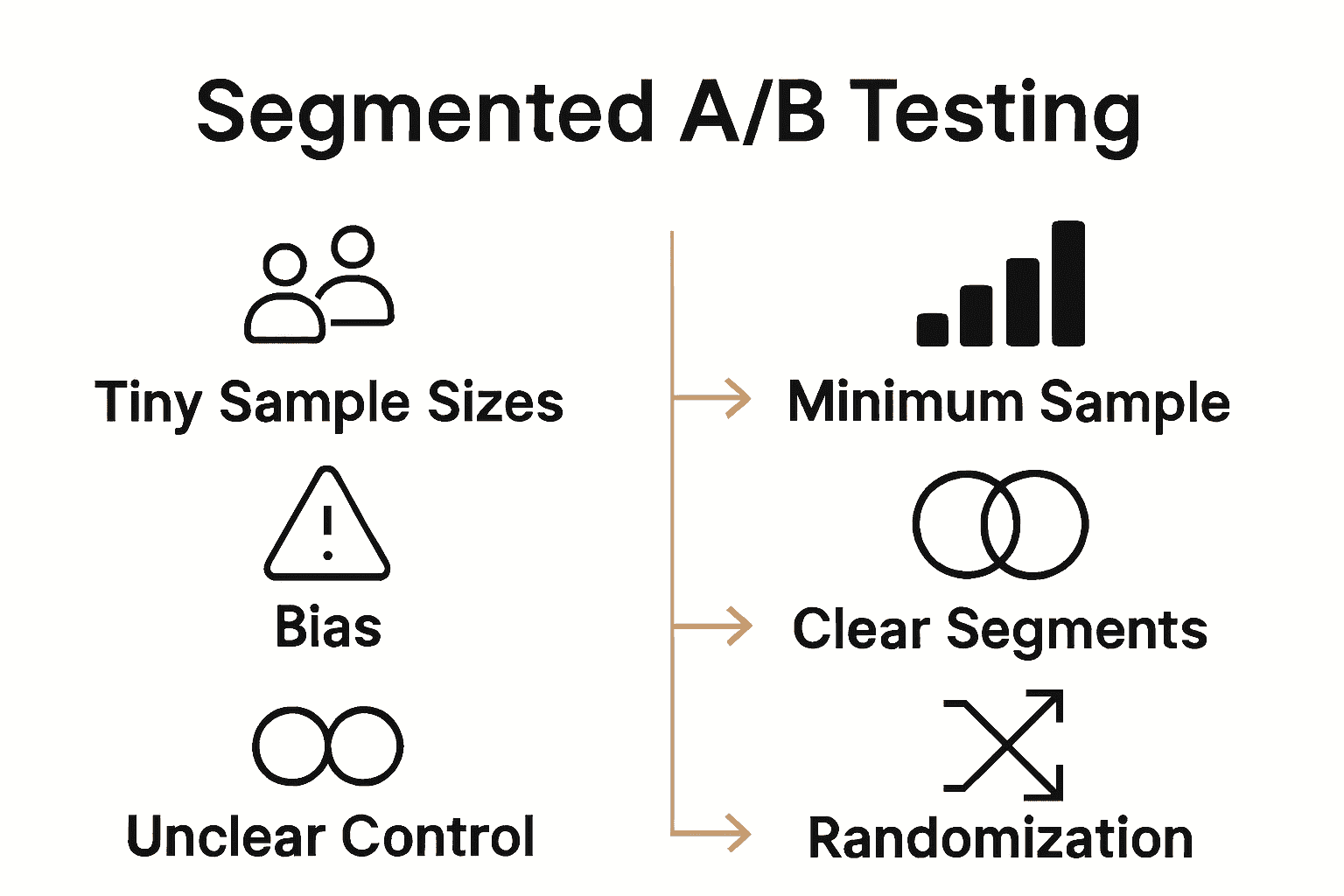
Segmentation in A/B testing can quickly become a minefield of potential errors that compromise your entire experiment. According to IAEME, two fundamental challenges can derail your testing efforts: inadequate sample sizes and the absence of a clear control group. These issues can introduce significant biases that render your results unreliable and potentially misleading.
Statistical Significance Challenges emerge when marketers fail to properly design their segmentation strategy. Critical pitfalls include:
- Segmenting too narrowly, creating statistically insignificant subgroups
- Overlooking potential confounding variables
- Introducing personal bias into segment definitions
- Failing to account for natural variations within segments
- Premature statistical conclusions
To mitigate these risks, implement robust experimental design principles:
- Establish a minimum viable sample size for each segment
- Define clear, objective segment criteria
- Use randomization to minimize selection bias
- Validate segment definitions before launching tests
- Maintain consistency in measurement across all segments
For comprehensive guidance on avoiding these common testing mistakes, explore our Digital Marketing Mistakes: Complete Expert Guide, which provides in-depth strategies for maintaining experimental integrity. Remember, effective segmentation is less about dividing audiences and more about uncovering meaningful insights that drive genuine understanding of user behavior.
Take Your Segmented A/B Testing to the Next Level with Stellar
Understanding segmentation is crucial when you want to uncover real insights and optimize your marketing efforts. The challenges discussed in the guide—such as managing multiple audience groups, ensuring statistically valid sample sizes, and extracting meaningful data from complex segments—can feel overwhelming. You want a solution that simplifies this process, providing the precision and flexibility to test variations across demographics, behaviors, and customer lifecycles without technical headaches.
Stellar is built exactly for marketers and growth hackers who need fast, reliable A/B testing that respects the nuances of segmentation. With our no-code visual editor, you can quickly create and customize segmented tests while our advanced goal tracking and real-time analytics empower you to confidently decode which version performs best for each audience slice. Start experiencing sharper, data-driven decisions today by visiting Stellar. You can also explore how our Advanced Goal Tracking and intuitive Visual Editor support your segmentation strategies seamlessly. Don’t let complex segmentation hold back your growth. Try Stellar now and transform your tests into powerful, actionable insights.
Frequently Asked Questions
What is segmentation in A/B testing?
Segmentation in A/B testing is the process of dividing users into distinct groups based on specific characteristics such as demographics, behavior, or acquisition source to gain more precise insights into how different groups respond to variations.
Why is segmentation important for A/B testing?
Segmentation is important for A/B testing because it allows marketers to uncover nuanced insights about user preferences and behaviors, enabling them to tailor content and experiences more effectively, leading to improved conversion rates.
What are some key types of segmentation approaches in A/B testing?
Key types of segmentation approaches include behavioral segmentation (based on on-site actions), demographic segmentation (based on characteristics like age and gender), and contextual segments that combine multiple data dimensions for hyper-targeted testing scenarios.
How does segmentation affect the results of A/B tests?
Segmentation affects A/B test results by providing granular insights into performance variations across different user groups, enhancing targeted optimization, reducing statistical noise, and identifying unique personalization opportunities within audience segments.
Recommended
- 7 Smart Strategies for Segmenting Test Audiences Effectively
- 7 A/B Testing Best Practices Every Marketer Must Know
- Understanding A/B Testing: Explaining A/B Testing to Teams
- A B Testing Meaning: Uncover Data-Driven Insights for Better Conversions
- blog | siift | Understanding the Difference Between B2B and B2C
Published: 11/9/2025