
SEO Tests Every Marketer Should Run in 2026
TL;DR:
- Most SEO practices are based on assumptions rather than controlled experiments that establish causation.
- Rigorous testing requires controlled groups, sufficient sample size, and appropriate timing to accurately measure the impact of changes.
Most SEO strategies are built on assumptions dressed up as conclusions. You change a title tag, rankings nudge upward a week later, and someone declares the experiment a success. That is not an SEO test. Rigorous seo tests use controlled experiments, isolated variables, and statistical evaluation to determine whether a change actually caused a result. The gap between guessing and knowing is where rankings are won or lost. This article gives you the methodology, the testing types, a comparison framework, and real examples to build an SEO testing practice that actually holds up under scrutiny.
Table of Contents
- Key Takeaways
- 1. Understanding the foundations of good SEO tests
- 2. Split URL testing
- 3. SEO A/B testing with behavioral tracking
- 4. Holdout testing
- 5. Serial testing
- 6. Before-and-after testing
- 7. Multivariate testing
- 8. Comparison of SEO testing methods
- 9. Practical SEO test examples worth running now
- 10. Analyzing results and making confident decisions
- My honest take on the state of SEO testing
- Run better SEO tests with Gostellar
- FAQ
Key Takeaways
| Point | Details |
|---|---|
| Control groups matter | Always compare variant pages against a stable control group to avoid misreading external ranking shifts. |
| Match the method to the traffic | Low-traffic sites should use serial or before-and-after testing; split URL tests need substantial page volumes to reach significance. |
| Timing is not optional | Most SEO tests need 2 to 4 weeks minimum, and Core Web Vitals results lag even longer due to 28-day rolling field data. |
| Test the right metrics | Clicks, CTR, and rankings tell different stories. Define your primary metric before you start, not after you see the data. |
| AI readiness is now in scope | Modern SEO testing includes evaluating answer engine visibility, not just traditional ranking positions. |
1. Understanding the foundations of good SEO tests
Before you run a single test, you need to understand what separates a real experiment from a before-and-after shrug. SEO split testing isolates variables by comparing a variant group of pages against a control group, so external factors like algorithm updates or seasonal swings hit both groups equally and do not distort your reading.
Here is what every valid SEO test requires before launch:
- Control group: Pages that remain unchanged throughout the test period, matched as closely as possible to your variant pages in terms of authority, traffic, and content type.
- Sample size calculation: Use baseline metrics, a minimum detectable effect, an alpha of 0.05, and statistical power of 0.80 as your standard inputs. Running a test on 12 pages when you need 80 is a common and expensive mistake.
- Metric selection: Clicks and rankings measure different things. Core Web Vitals, CTR, and conversion rates each add a layer. Choose your primary metric before the test starts, or you will find yourself hunting for whichever number looks best afterward.
- Test duration: Tests need at least 2 to 4 weeks, and low-traffic pages require even longer windows. Three months is typically the outer limit before seasonal confounders start distorting results.
- Technical readiness: Your staging environment must closely mirror production to avoid skewed speed metrics. A slower staging server will make your page look worse than it actually performs in the real world.
Pro Tip: Never test during a known Google algorithm rollout period. The signal noise from a core update will swallow your test results whole, and you will have no way to separate what you did from what Google did.
2. Split URL testing
Split URL testing is the closest SEO analog to a proper controlled experiment. You create two distinct URLs with the same content structure but different on-page elements, then direct organic traffic across both. Google crawls one version per URL, which keeps cloaking and duplicate content risks low. This method works especially well for testing structural changes like heading hierarchy, schema markup, or internal link placement.
The main drawback is that you need significant traffic volume. Splitting traffic across URLs means each version gets half your organic visits, which doubles the time required to reach statistical significance on low-volume pages. This method is best suited for sites with hundreds of similar-structure pages, like e-commerce category pages or large blog archives.
3. SEO A/B testing with behavioral tracking
Traditional A/B testing shows different page variants to different visitors, which works well for conversion rate optimization but creates complications for SEO. Google crawls only one version of a page, so visitor-level variation does not change what the crawler indexes. This makes pure user-side A/B tests ineffective for measuring ranking impacts.
What works better is pairing behavioral data with page-level SEO metrics. Use visitor behavior data to assess engagement signals like time on page, scroll depth, and bounce rate, and compare those signals against organic rank changes measured separately. Check the SEO A/B strategies guide for how to layer these two measurement approaches without conflating them.
4. Holdout testing
Holdout testing is the method most teams overlook, and it is particularly useful when you are making site-wide changes. You apply a change to the majority of your site and hold out a carefully selected subset of pages as a control. The held-out pages receive no change throughout the test period.

This approach measures cumulative or systemic SEO impacts, like the effect of a new internal linking structure or a global schema template rollout. Because you are measuring site-level signals against a stable baseline, holdout testing catches effects that page-level tests miss entirely. It is technically more complex to set up correctly, but for large-scale changes it is the most reliable method available.
5. Serial testing
Serial testing is straightforward: change one variable at a time, wait for the data to settle, then move to the next change. No control group, no traffic splitting. Just careful, sequential experimentation.
This is the most practical method for teams with limited traffic. Because you are not splitting pages or visitors, your full traffic volume drives each test to significance faster. The risk is that external events like algorithm updates or seasonality can interfere, since there is no concurrent control to absorb those shifts. Document everything with timestamps, and cross-reference your results against Google Search Console performance data and known update dates from reliable third-party trackers.
6. Before-and-after testing
Before-and-after testing involves applying a change and comparing performance in the period before against the period after. It sounds simple, and it is. It is also the method most prone to false conclusions.
The reason before-and-after tests mislead teams is that they have no concurrent control. If organic traffic drops after a change, you cannot know whether your change caused it or whether a broad ranking update hit your site. These tests are best used for significant changes that are difficult to split test, like a full site redesign or a CMS migration. Treat results as directional rather than definitive, and corroborate them with other data sources.
7. Multivariate testing
Multivariate testing allows you to test multiple variables simultaneously, which sounds appealing until you realize how much traffic it requires. To test three on-page elements with two variants each, you need enough traffic to achieve significance across all combinations. For most sites, that means months of data collection.
Use multivariate testing sparingly and only when you have both high traffic volume and a very specific research question that requires understanding interactions between variables. For most marketers, running sequential serial tests produces cleaner, faster results with far less statistical complexity.
8. Comparison of SEO testing methods
Understanding which method fits your situation matters more than knowing all of them exist. Here is a side-by-side view:
| Method | Traffic needed | Risk level | Complexity | Best use case |
|---|---|---|---|---|
| Split URL | High (hundreds of pages) | Low | Medium | Large sites, structural changes |
| SEO A/B with behavior | Medium | Low | Medium | Engagement metrics alongside rankings |
| Holdout | High (site-wide) | Medium | High | Site-wide rollouts, template changes |
| Serial | Low | Medium | Low | Small sites, single variable changes |
| Before-and-after | Any | High | Low | Major migrations, full redesigns |
| Multivariate | Very high | Medium | Very high | Multi-variable interaction research |
The pattern here is clear. Lower traffic forces simpler methods with higher interpretation risk. Higher traffic opens up more rigorous approaches with cleaner signals.
9. Practical SEO test examples worth running now
These are the tests that consistently produce usable results without requiring enterprise-level resources:
- Title tag variations: Testing early keyword placement versus question-based formats can yield 5 to 10% CTR improvements, which translates to meaningful click volume at scale. Run these as serial tests with 30-day windows.
- Meta description rewrites: Meta descriptions do not directly affect rankings, but they shape CTR. Test emotional hooks against feature-focused descriptions and measure click rate in Search Console.
- Schema markup additions: Adding FAQ or HowTo schema to a set of pages and comparing impressions and click data against a control group is a clean, low-risk test with measurable outputs.
- Internal anchor text changes: Internal linking tests are more complex than they appear because changes affect both source and target pages. Plan for multi-group measurement from the start.
- Page speed improvements: Core Web Vitals changes take time to surface in field data. CrUX data updates on a 28-day rolling window, so test results appear weeks after lab scores improve.
- AI answer engine readiness: SEO testing now includes evaluating answer engine optimization, checking whether structured content surfaces in AI-generated answers and citation boxes. An AI SEO audit tool can complement manual experiments here.
Pro Tip: Avoid running internal linking and title tag tests simultaneously on the same page cluster. The signals intertwine and you will not be able to attribute any movement to a single cause.
10. Analyzing results and making confident decisions
Once your test window closes, resist the urge to declare a winner based on directional movement alone. Here is how to read results properly:
- Check statistical significance first. A 3% CTR lift means nothing if the confidence interval includes zero. Use a chi-square test for CTR data and a t-test for ranking or traffic comparisons.
- Account for external factors. Cross-check your test window against known Google algorithm updates. A traffic drop during a broad core update tells you nothing about your test variable.
- Segment before generalizing. A title tag test that worked on product pages may fail on informational blog posts. Results are often page-type specific, not site-wide truths.
- Decide with a framework. If results are statistically significant and positive, implement the change. If results are inconclusive, extend the test or redesign it. If results are negative, discard the change and document why, which itself becomes a valuable data point.
For deeper guidance on reading and applying test data, the split test results analysis guide from Gostellar covers interpretation frameworks that work across both SEO and CRO contexts.
My honest take on the state of SEO testing
I have reviewed hundreds of "SEO tests" that teams were proud of, and the majority were not tests at all. They were change logs with a ranking report stapled to them. The pattern is always the same: someone makes a change, traffic goes up the next month, and the correlation gets written up as proof of success.
What I have learned is that teams mistake correlation for causation constantly, and the SEO industry has historically been too comfortable with that. Real testing is slower and less exciting. You run a serial test, wait three weeks, find a 4% lift that is just barely significant, and move on. There is no dramatic reveal.
The other thing I have watched happen is the rush toward AI readiness testing without any methodological rigor. AI search readiness audits are genuinely useful as diagnostic tools, but they are not controlled experiments. If you change your content structure to target AI answer boxes and your citation rate goes up, you still need a control group of unchanged pages to make any causal claim. The tools are getting smarter. The discipline around using them has not caught up yet.
My advice: build your testing cadence before you need the data. Teams that establish testing infrastructure during stable periods get far better answers than teams scrambling to measure the effects of a change already deployed.
— Juan
Run better SEO tests with Gostellar
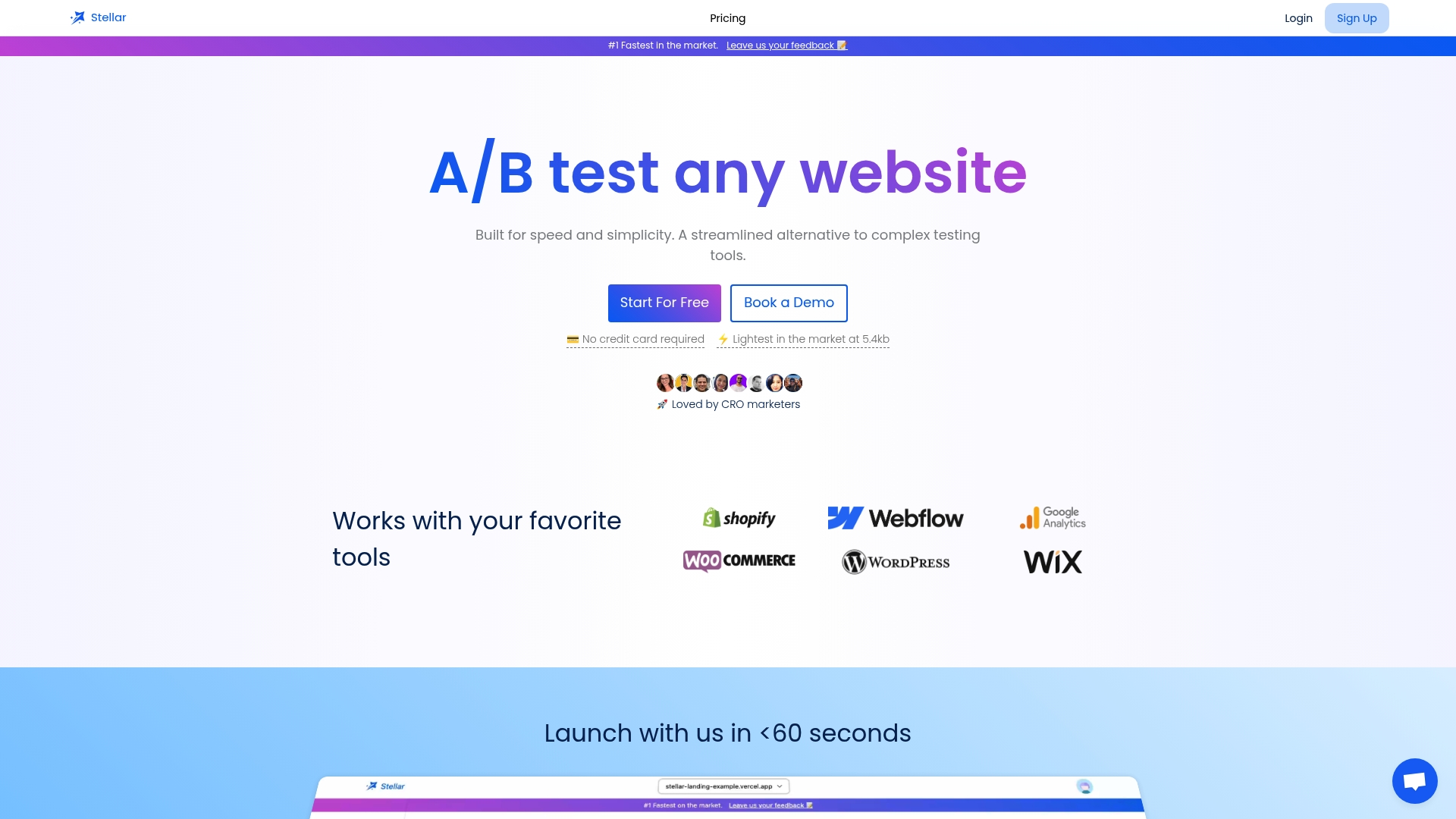
If setting up controlled SEO experiments has felt like a manual, spreadsheet-heavy process, Gostellar was built to change that. The platform's 5.4KB lightweight script runs without dragging down your page speed scores, which matters when you are testing Core Web Vitals improvements and cannot afford testing overhead to distort your data.
Gostellar's no-code visual editor lets you build and launch page variants without developer support, and real-time analytics surface results as they accumulate so you can catch underperforming tests early. The advanced goal tracking connects SEO signals directly to conversion outcomes, giving you a cleaner picture of whether a ranking improvement actually moved business metrics. Plans start with a free tier for sites under 25,000 monthly tracked users. Start experimenting without the guesswork.
FAQ
What is SEO testing?
SEO testing is the practice of running controlled experiments on website pages to measure how specific changes affect organic search performance, including rankings, clicks, and CTR. Unlike informal observation, proper SEO tests use control groups and statistical evaluation to establish causation rather than correlation.
How long should an SEO test run?
Most SEO tests require at least 2 to 4 weeks to generate reliable data, with low-traffic pages needing longer windows. Three months is generally the maximum before seasonal shifts and algorithm changes introduce too much noise.
What metrics should I track in SEO tests?
The right metrics depend on your test objective. CTR and clicks suit title tag and meta description tests. Rankings and impressions work for structural or schema changes. Core Web Vitals are the primary metric for speed-related tests, though field data lags by up to 28 days.
What is the difference between SEO split testing and CRO A/B testing?
SEO split testing modifies subsets of pages rather than showing different versions to individual visitors, because Google indexes one version per URL. CRO A/B testing targets visitor behavior and does not directly affect what search engines crawl or rank.
Do small sites have enough traffic to run SEO tests?
Small sites should stick to serial testing or before-and-after comparisons, which do not require splitting traffic across page groups. Split URL and multivariate testing require high page and traffic volumes to reach statistical significance within a reasonable time frame.
Recommended
Published: 5/26/2026