
Split URL vs On-Page Tests: Choosing the Right Experiment
Most American businesses rely on data-driven experiments to shape better digital experiences. With over 80 percent of marketers using A/B testing strategies, choosing between split URL and on-page methods can impact everything from conversion rates to user satisfaction. Understanding how these two approaches differ gives you the insight to match your goals with the right testing strategy and avoid the common traps that slow down progress.
Table of Contents
- Defining Split URL And On-Page A/B Tests
- How Each Testing Approach Works In Practice
- Key Differences In Implementation And Results
- Performance Impact And User Experience
- Choosing The Best Method For Your Goals
- Common Pitfalls And How To Avoid Them
Key Takeaways
| Point | Details |
|---|---|
| Method Selection | Choose split URL testing for significant redesigns and on-page A/B testing for minor adjustments. |
| Resource Allocation | Split URL tests require more development resources compared to the lighter on-page A/B testing. |
| Performance Monitoring | Always monitor page load times and user metrics to ensure testing does not negatively impact user experience. |
| Statistical Rigor | Define clear success metrics and ensure sufficient sample sizes to obtain reliable insights from your experiments. |
Defining Split URL and On-Page A/B Tests
When optimizing digital experiences, marketers have two primary strategies for conducting experiments: split URL testing and on-page A/B testing. These approaches help teams understand user behavior and improve conversion rates by systematically comparing different webpage variations.
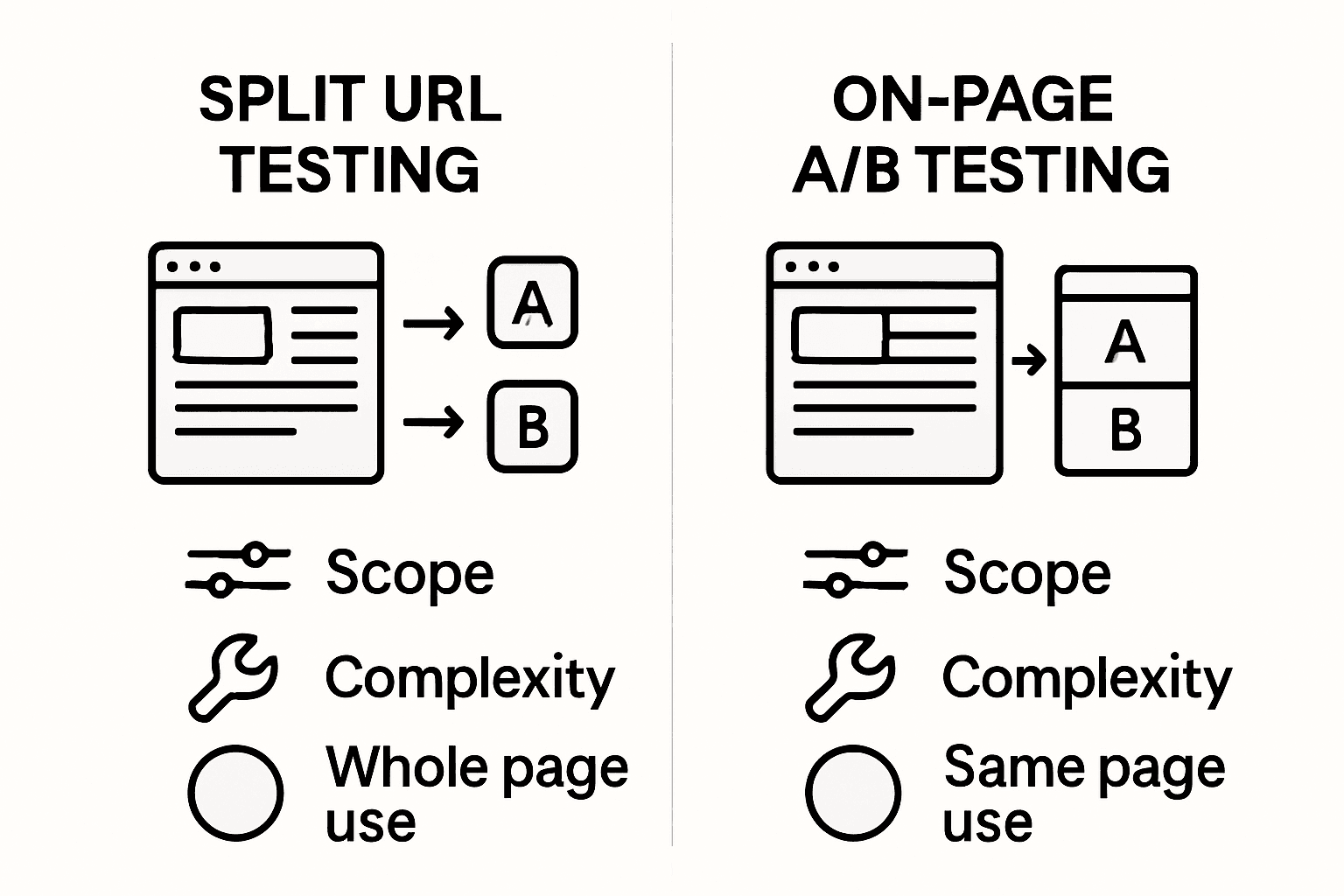
Split URL testing involves creating entirely separate web pages with distinct designs, then randomly directing traffic between these versions to determine which performs better. In this method, you generate complete alternative page versions with unique URLs, allowing for more radical design changes and comprehensive layout experiments. For instance, you might test a completely redesigned checkout page against your current version, tracking metrics like conversion rate, average order value, and user engagement.
On-Page A/B testing, by contrast, focuses on making incremental modifications within the same webpage URL. These experiments typically involve small, targeted changes such as adjusting button colors, headline text, image placements, or call-to-action wording. Marketers can quickly implement these tests using visual editor tools that allow dynamic content manipulation without requiring extensive coding skills.
The key difference between these approaches lies in their scope and implementation complexity. Split URL tests support more dramatic transformations but require more development resources, while on-page tests enable rapid, lightweight experimentation with minimal technical overhead.
Here's a side-by-side comparison of split URL and on-page A/B testing:
| Aspect | Split URL Testing | On-Page A/B Testing |
|---|---|---|
| Scope of Changes | Major, structural redesigns | Minor, element-level tweaks |
| Technical Resources | High, requires full development | Low, simple visual edits |
| Experiment Speed | Longer setup and analysis | Quick setup and rapid results |
| Impact on Site Performance | May increase page load times | Minimal effect on performance |
Pro Tip - Experiment Strategy: Start with on-page A/B tests for quick insights, then progress to split URL testing as you develop more comprehensive optimization hypotheses about your digital experience.
How Each Testing Approach Works in Practice
In the realm of digital optimization, understanding the practical mechanics of split URL and on-page A/B testing helps marketers make strategic experimentation decisions. While both methods aim to improve user experience and conversion rates, their implementation strategies differ significantly.
Split URL Testing fundamentally involves creating separate web addresses for different page variations. This approach allows for more substantial changes that go beyond simple element modifications. When running a split URL test, you generate completely distinct web pages, each with its own unique URL, and then randomly distribute incoming traffic across these variations. This method proves particularly powerful when you want to test radical redesigns or evaluate dramatically different page layouts.

On the technical side, split URL testing requires more upfront development work. Your development team will need to create entire alternate page versions, which means investing more time and resources compared to on-page testing. The traffic allocation is typically managed through server-side redirects, ensuring that users are consistently shown the same variation throughout their session. This approach provides robust data about comprehensive design changes and allows for more extensive backend modifications that might be impossible within a single page framework.
In contrast, on-page A/B testing focuses on making targeted, incremental changes within a single webpage. These experiments involve subtle modifications like adjusting button colors, repositioning elements, or tweaking headline text. Marketers can implement these tests quickly using visual editor tools that enable dynamic content manipulation without extensive coding. The primary advantage of this method is its agility - you can launch and analyze experiments rapidly, making it ideal for fine-tuning specific page elements.
Pro Tip - Experiment Selection: Match your testing approach to your optimization goal - use split URL tests for major redesigns and on-page tests for incremental improvements.
Key Differences in Implementation and Results
Understanding the nuanced differences between split URL and on-page A/B testing requires a deep dive into their implementation strategies, technical requirements, and potential outcomes. These testing approaches diverge significantly in their execution and the type of insights they can generate for digital optimization.
Implementation Complexity becomes a critical differentiator. Split URL testing fundamentally differs from traditional A/B testing in where variations are hosted, requiring entire separate web pages for each experimental version. This approach demands more comprehensive development resources, involving full page recreations rather than simple element modifications. Development teams must essentially build complete alternative page designs, which means higher upfront investment and more complex technical infrastructure.
The scope of changes represents another key distinction. On-page A/B tests typically involve incremental modifications - subtle adjustments to colors, button placements, or headline text that can be made within a single webpage framework. Split URL tests, conversely, support radical transformations that go beyond minor tweaks. These extensive changes might include complete layout redesigns, fundamental user experience restructuring, or significant backend modifications that cannot be accomplished through simple visual editing tools.
From a results perspective, these testing methods yield different types of insights. On-page tests excel at fine-tuning specific page elements, providing granular understanding of how minor changes impact user behavior. Split URL tests offer broader, more comprehensive performance evaluations, allowing marketers to compare dramatically different page concepts and gather holistic data about user preferences and conversion potential.
Pro Tip - Testing Strategy: Choose your testing approach based on the depth of change you want to evaluate - use on-page tests for refinement and split URL tests for revolutionary redesigns.
Performance Impact and User Experience
Online controlled experiments have become critical for understanding digital product performance, particularly when evaluating how testing methodologies impact user engagement and website functionality. Both split URL and on-page A/B testing approaches carry unique implications for site performance and user experience that marketers must carefully consider before implementation.
In split URL testing, the potential performance risks are more pronounced. Creating entirely separate web pages introduces additional server-side complexity, which can incrementally increase page load times. Each variation requires independent hosting, potentially increasing latency and computational overhead. This means that while you gain the ability to test radical design changes, you might simultaneously introduce slight performance degradations that could negatively impact user experience and conversion rates.
On-page A/B testing, by contrast, offers a more lightweight approach with minimal performance overhead. By making changes within the same webpage framework, these tests typically preserve the original page's core infrastructure. The modifications are often client-side adjustments that do not significantly alter server response times or page rendering speeds. This method allows for rapid experimentation with minimal risk to site performance, making it an attractive option for teams prioritizing speed and user experience continuity.
Ultimately, the performance impact extends beyond technical metrics into user perception and engagement. Personalized digital interactions require nuanced experimentation strategies that balance technical efficiency with meaningful user insights. Marketers must carefully weigh the potential performance trade-offs against the potential conversion improvements when selecting their testing methodology.
Pro Tip - Performance Testing: Measure page load times and user interaction metrics during your experiments to ensure that your testing approach does not compromise overall site performance.
Choosing the Best Method for Your Goals
Selecting the appropriate testing methodology requires a strategic approach that aligns with your specific optimization objectives, technical capabilities, and resource constraints. Each testing method offers unique advantages that can significantly impact your conversion optimization efforts.
Split URL testing becomes ideal when planning substantial website transformations that extend beyond superficial modifications. This approach is perfectly suited for scenarios involving comprehensive redesigns, fundamental user experience restructuring, or complex backend functionality changes. Marketers and product teams might choose split URL testing when contemplating significant shifts like completely reimagining checkout flows, navigation structures, or introducing radical interface paradigms that cannot be implemented through simple on-page adjustments.
On-page A/B testing emerges as the preferred method for teams seeking incremental, low-risk improvements with minimal technical overhead. This approach excels in scenarios requiring nuanced optimization - such as refining call-to-action button placement, experimenting with headline variations, adjusting color schemes, or making subtle user interface tweaks. The lightweight nature of on-page testing allows for rapid experimentation, enabling marketers to quickly validate hypotheses and iterate based on real-time user interaction data.
Decision-making between these methods should ultimately depend on three critical factors: the scope of proposed changes, available technical resources, and the potential performance impact. While split URL testing offers comprehensive transformation capabilities, it demands more significant development investment. Conversely, on-page testing provides agility and minimal disruption but limits the extent of potential modifications.
Pro Tip - Experimental Alignment: Match your testing approach to your optimization maturity - start with on-page tests to build confidence, then progress to split URL experiments as your team's experimentation capabilities evolve.
Common Pitfalls and How to Avoid Them
Online experiments can present complex challenges in accurately measuring performance metrics, requiring marketers to approach A/B testing with strategic precision and careful methodology. Both split URL and on-page testing methodologies harbor potential pitfalls that can undermine experimental integrity and lead to misleading conclusions.
In split URL testing, one of the most significant risks involves performance degradation and increased latency. Developers often underestimate the technical complexity of creating multiple page variations, which can inadvertently introduce site speed issues. These performance variations can skew experimental results, making it difficult to distinguish between design impact and technical performance differences. Teams must rigorously monitor page load times, server response metrics, and user interaction speeds across all test variations to ensure data reliability.
On-page A/B testing presents its own set of potential challenges, primarily related to statistical significance and experimental design. Marketers frequently make the mistake of ending tests prematurely or drawing conclusions from insufficient sample sizes. Advanced experimentation frameworks recommend comprehensive user sampling strategies that account for potential variability and ensure robust, statistically valid insights. This means allowing tests to run long enough to generate meaningful data, accounting for potential time-based variations like day-of-week or seasonal effects.
Both testing approaches require meticulous attention to experimental controls, randomization techniques, and clear hypothesis definition. Common errors include confirmation bias, where teams unconsciously interpret data to support preexisting assumptions, and failing to establish clear, measurable success metrics before launching the experiment. Successful testing demands objective, systematic evaluation that prioritizes statistical rigor over intuitive expectations.
Common pitfalls to avoid for each testing method:
| Testing Method | Typical Pitfall | How to Avoid It |
|---|---|---|
| Split URL Testing | Performance slowdowns confuse results | Monitor and optimize server speed |
| On-Page A/B Testing | Drawing conclusions from small samples | Ensure adequate test duration |
Pro Tip - Experimental Integrity: Always define precise success metrics before launching your test, and commit to making decisions based on statistically significant data rather than gut feelings or premature interpretations.
Optimize Your Experimentation with Stellar's Fast and Flexible A/B Testing
Choosing between split URL and on-page testing can be overwhelming when deciding how to improve your website's user experience and conversion rates. This article highlights challenges like balancing major redesigns against quick, low-impact tweaks while maintaining site performance. If you want to avoid costly development for radical changes and minimize performance slowdowns during tests, having a tool that adapts to your specific needs is essential. Stellar understands these pain points by offering a lightweight 5.4KB script that ensures your experiments do not compromise site speed or user engagement.
Experience the freedom to run both split URL and on-page A/B tests easily with Stellar's intuitive Visual Editor, perfect for marketers and growth hackers without deep technical skills. Benefit from real-time analytics and advanced goal tracking to gain the precise insights you need for confident decision-making. Whether you aim to make subtle optimizations or launch comprehensive redesigns, Stellar supports your full experimentation journey with a platform designed for efficiency and simplicity.
Ready to choose the right testing approach that fits your goals and resources? Start experimenting smarter today with Stellar at https://gostellar.app. Explore how our A/B Testing Tool can accelerate your growth without weighing down your website or your team.
Frequently Asked Questions
What is the difference between split URL testing and on-page A/B testing?
Split URL testing involves creating entirely separate web pages with unique URLs, allowing for major design changes. On-page A/B testing focuses on minor adjustments within the same webpage, utilizing the same URL for quick, targeted experiments.
When should I use split URL testing over on-page A/B testing?
Use split URL testing for significant redesigns or extensive layout changes that cannot be accomplished through minor tweaks. On-page A/B testing is best for rapid testing of small changes, such as button colors or text adjustments.
What are the implications of each testing method on website performance?
Split URL testing can introduce performance risks due to the complexity of managing multiple pages, potentially increasing load times. On-page A/B testing typically maintains the original site architecture, resulting in minimal performance impact.
How can I ensure the reliability of my A/B test results?
To ensure reliability, monitor key performance metrics closely, use adequate sample sizes, and allow tests to run long enough for statistically significant data. Establish clear success metrics before starting the experiment to maintain objective evaluation.
Recommended
Published: 12/19/2025