
4 Types of Website Testing Every Marketer Should Know
TL;DR:
- A/B testing is most suitable for SMBs due to lower traffic requirements and ease of use.
- Multivariate testing demands high traffic volumes and is less practical for small websites.
- Proper test execution, avoiding early peeks and traffic biases, ensures reliable results.
Choosing the wrong website testing method is one of the quietest conversion killers in digital marketing. You run a test, declare a winner, ship the change — and nothing moves. The problem usually isn't your hypothesis; it's the testing type. A/B, multivariate, split URL, and A/B/n tests each operate under different rules, traffic demands, and conditions. Pick the wrong one and you're either waiting forever for statistical significance or drawing conclusions from data that was never reliable to begin with. This guide cuts through the noise and gives you a clear framework for selecting the right method — fast.
Table of Contents
- The main website testing methods explained
- No-code A/B testing solutions for SMB marketers
- Benchmarks: What results can you expect?
- Pitfalls and mistakes: What marketers must watch for
- The marketer's shortcut to choosing the right test
- Get started with smarter testing — no code needed
- Frequently asked questions
Key Takeaways
| Point | Details |
|---|---|
| A/B testing is the go-to | For SMBs, A/B tests offer fast, impactful optimization with minimal traffic and resources. |
| No-code tools save time | Modern visual editors empower marketers to test site changes without developer help. |
| Headlines and forms drive gains | Testing high-impact elements like headlines and forms yields substantial conversion lifts. |
| Beware statistical pitfalls | Avoid false positives by following rigorous test procedures and validating results. |
The main website testing methods explained
Now that we've set the stage, let's break down the main types of website testing marketers can harness.
A/B testing is the workhorse of conversion optimization. You split traffic between two page versions — one control, one variant — changing a single element like a headline, button color, or form layout. It's clean, interpretable, and manageable even for smaller sites. A/B testing basics are worth revisiting if you want to build a strong foundation before running your first experiment.

A/B/n testing extends the same logic to multiple variants of one element tested simultaneously. Instead of A vs. B, you run A vs. B vs. C vs. D. This saves calendar time but requires proportionally more traffic since you're splitting visitors across more buckets.
Multivariate testing (MVT) takes it further. You're testing multiple elements and their combinations at the same time — say, three headlines, two images, and two CTA buttons. That's 12 combinations to evaluate. MVT surfaces interaction effects that A/B misses, but the traffic requirements are demanding: you typically need 100,000+ monthly visitors to reach reliable conclusions, compared to around 10,000+ for standard A/B.
Split URL testing is different in structure. Instead of changing elements on one URL, you route traffic to two entirely separate page URLs. This is the go-to for major redesigns where you want to test a completely different layout or page concept without touching the live version.
Here's a quick comparison:
| Test type | Traffic needed | Best for | Risk level |
|---|---|---|---|
| A/B | 10,000+/mo | Single element changes | Low |
| A/B/n | 20,000+/mo | Multiple variants, one element | Medium |
| MVT | 100,000+/mo | Multi-element interactions | High |
| Split URL | 10,000+/mo | Full page redesigns | Low to medium |
According to Adobe's testing overview, A/B and split URL tests are the most accessible starting points for teams with limited traffic budgets. MVT, while powerful, is frequently misapplied. If your site gets fewer than 100k monthly visitors, MVT will leave you with inconclusive data more often than not.
Key decisions when choosing your method:
- Traffic volume — your biggest constraint
- Number of elements you want to test simultaneously
- How fast you need results
- Your team's ability to interpret complex data outputs
Follow testing best practices from the start, and you'll avoid the painful mistake of over-engineering a test your traffic can't support. Per AB vs multivariate testing analysis, the vast majority of SMB wins come from simple, well-structured A/B tests.
No-code A/B testing solutions for SMB marketers
With an understanding of testing methods, it's time to focus on practical tools that make testing fast and easy for SMB marketers.
The old barrier to A/B testing was developer dependency. Writing code, deploying variants, managing QA — it could take weeks before a single test went live. No-code visual editors changed that. Today, a marketer can point, click, edit text or swap images, and publish a live experiment in under an hour.
Top no-code tools like VWO, Convert Experiences, Optimizely, and others offer visual editors that work directly on your live site. According to a detailed tool roundup, platforms like CausalFunnel, CROLabs, and Sigmize also cater to teams looking for lightweight entry points without enterprise price tags.
Here's a snapshot of popular options:
| Tool | Pricing (starting) | Visual editor | No-code friendly |
|---|---|---|---|
| Stellar | Free (under 25k users) | Yes | Yes |
| VWO | ~$199/mo | Yes | Yes |
| Convert Experiences | ~$199/mo | Yes | Yes |
| Optimizely | Custom pricing | Yes | Partial |
| Qualaroo | ~$69/mo | Limited | Yes |
For SMB teams, the biggest benefits of no-code testing tools are speed and autonomy. You don't need to file a ticket, wait for sprint planning, or explain A/B testing to a developer who has other priorities. You just build the test. This A/B testing without developers approach is how lean growth teams punch well above their weight.
The most impactful elements to test with visual editors:
- Headlines — the highest-leverage element on any page
- CTA button copy and color
- Form fields — fewer fields almost always convert better
- Hero images and social proof placement
- Pricing page layouts
Reviewing A/B tool reviews across platforms shows that ease of setup and real-time reporting are the top criteria SMB marketers care about. Not advanced segmentation. Not multi-touch attribution. Just: can I launch a test today and understand the results without a data analyst?
Pro Tip: Before committing to any platform, confirm it works with your site's tech stack. Some tools have limited support for single-page applications (SPAs) built on React or Vue. Test the snippet on a staging environment first. No-code A/B tools vary significantly in how they handle JavaScript-heavy sites.
Benchmarks: What results can you expect?
Knowing what results to expect from website testing helps plan and prioritize your efforts.
Before you run your first test, calibrate your expectations. Most marketers expect massive wins. Reality is more nuanced — and actually more useful once you understand the real numbers.
Global landing page conversion rates sit at a median of 2.35% to 6.6%, depending on the industry. E-commerce lands between 1.8% and 3.34%. B2B SaaS averages around 4.7%. Legal services outperform most verticals at 6.4%. These numbers matter because they set your baseline — and your benchmark for what a successful test actually looks like.
"60% of A/B tests produce lifts under 20%. Expecting a single test to double conversions is the exception, not the rule."
That's not discouraging; it's clarifying. It means you need a testing program, not just a single test. Compounding small wins — a 12% lift here, a 9% lift there — adds up to a fundamentally different conversion curve over 12 months.
Elements with the strongest documented impact:
- Headlines — 32% to 34% conversion lifts are reported across strong headline tests
- Forms — removing one field can increase conversions by 12% to 23%
- CTA copy — specificity beats generic ("Get my free audit" outperforms "Submit")
- Social proof placement — above the fold vs. below changes trust signals significantly
Use a landing page testing guide to structure your first round of tests around these high-impact elements. Don't start with button colors. Headlines and forms return faster, larger, more reliable wins. For a deeper pool of high-impact test ideas, prioritize changes that alter the value proposition before changing cosmetic details.
Review A/B testing stats regularly to benchmark your program against industry norms. If your win rate is consistently below 20%, the problem is usually hypothesis quality, not traffic volume.
Pitfalls and mistakes: What marketers must watch for
Armed with benchmarks, it's just as important to avoid the common errors that derail testing results.
Website testing fails more often from execution errors than bad ideas. The good news is these mistakes are entirely preventable once you know what to look for.
-
Peeking at results early. This is the most common trap. Stopping tests early inflates your false positive rate to between 26% and 30%. You think you have a winner. You don't. Let your test run to the predetermined sample size before drawing any conclusions.
-
Multiple comparisons without correction. Tracking five metrics in a single test pushes your false positive risk to 22%. Every additional metric you add without a statistical correction (like Bonferroni) increases the chance you'll declare a winner that isn't real.
-
Sample Ratio Mismatch (SRM). SRM happens when the actual traffic split doesn't match your intended split — say, you set 50/50 but the tool delivers 55/45. This contaminates your data and invalidates results. Always check traffic distribution before reading outcomes.
-
Polluted or biased traffic. Bots, internal team members, and paid traffic from different campaigns can all skew results. Filter your own IP and bot traffic from the start.
-
Ignoring seasonality. Running a test exclusively over a holiday weekend or a flash sale period introduces day-of-week and calendar bias that won't replicate in normal conditions.
Pro Tip: Run an A/A test before launching your first real experiment. An A/A test sends traffic to two identical versions of a page. If it shows a statistically significant difference, your testing setup has a problem. Fix it before you waste weeks of real test data. Use a testing checklist to verify every setup step. For more on validating testing ideas before launch, build a pre-test validation habit into your process.
For a thorough breakdown of common A/B testing mistakes, including technical edge cases that trip up even experienced teams, treat mistake prevention as seriously as test ideation.
The marketer's shortcut to choosing the right test
With mistakes and benchmarks in mind, here's a practical shortcut — rooted in real-world SMB testing — for maximizing results.
Here's the uncomfortable truth most testing content won't say directly: for most SMBs, multivariate testing is a distraction. The math doesn't lie. Running MVT on a site with 30,000 monthly visitors means you'll wait four to six months for a single conclusive test — if you ever get one. Meanwhile, a well-structured A/B test can reach significance in two to three weeks on the same traffic volume.
The smarter framework is simple: match test complexity to your traffic reality. If you have under 50,000 monthly visitors, A/B is your only reliable option. Use a no-code testing platform to move fast. Pre-calculate your sample size before every test — tools like Stellar make this part of the setup flow. Prioritize in this order: headlines first, then forms, then CTAs. According to Convert's tool research, SMBs that follow a structured A/B-first approach with no-code tools consistently outperform teams running ad hoc or overly complex tests.
Run tests for a minimum of two weeks, even if significance appears earlier. Speed feels productive. Patience produces accurate data.
Get started with smarter testing — no code needed
Ready to put these insights into action and unlock conversion gains?
Stellar is built specifically for marketers and growth hackers who want to run reliable A/B tests without pulling in a developer every time. The platform's 5.4KB script won't slow your site down, and the visual editor lets you create, launch, and monitor tests in minutes — not days.
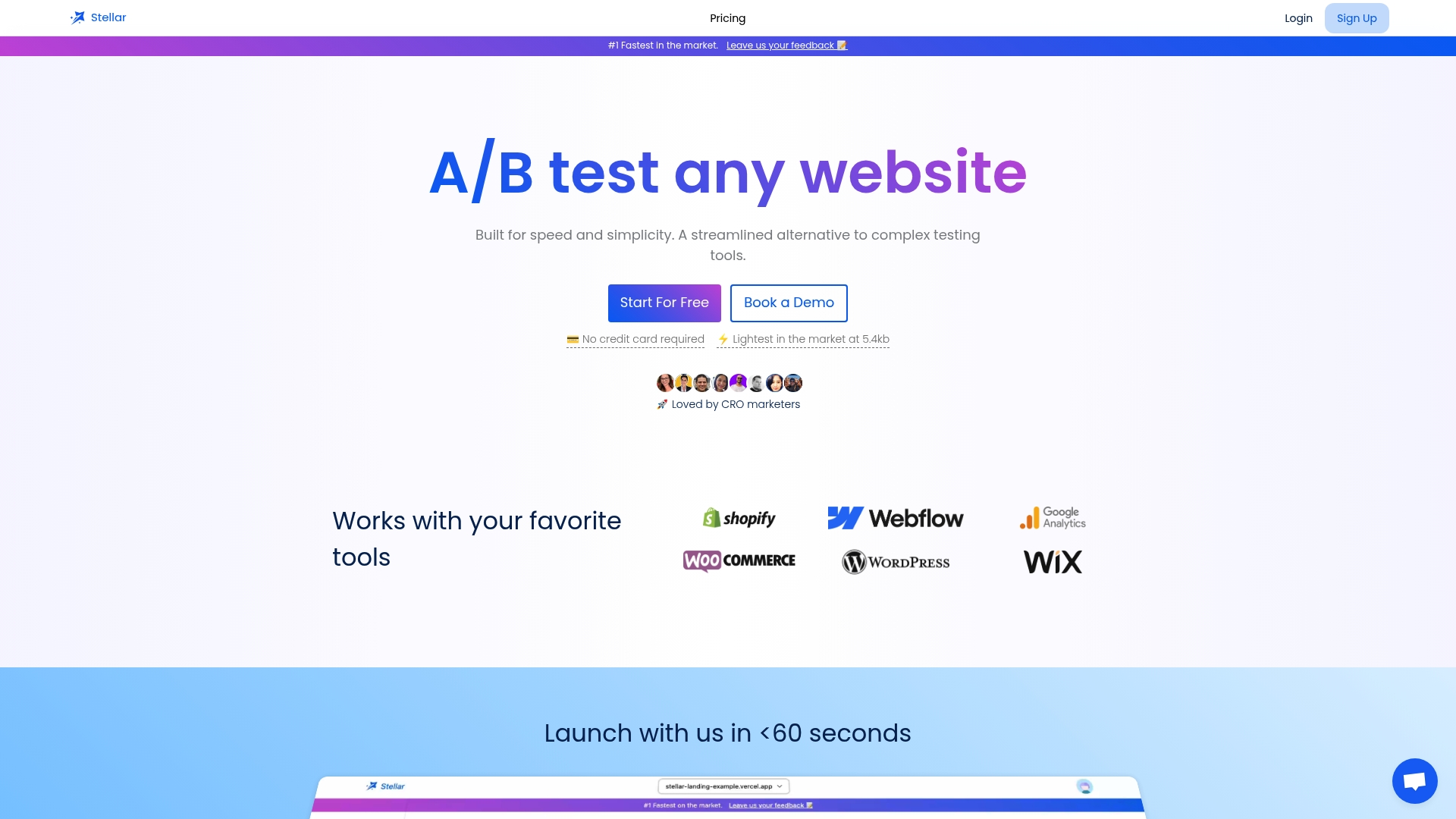
With no-code marketing solutions built into every step of the workflow, Stellar removes the friction that keeps most SMB teams from testing consistently. Real-time analytics surface results you can act on immediately, and a free plan covers businesses with up to 25,000 monthly tracked users. Visit gostellar.app to start your first test today — no credit card, no developer, no waiting.
Frequently asked questions
What type of website testing is best for small businesses?
A/B testing is typically best for SMBs because it requires only 10,000+ monthly visitors and can be implemented quickly using no-code visual editors without engineering support.
How much traffic do you need for multivariate testing?
Multivariate testing needs at least 100,000 monthly visitors to reliably detect interaction effects between multiple elements — far beyond most SMB traffic levels.
Which website elements should marketers test first?
Start with headlines and forms — headline tests deliver lifts of 32% to 34%, and reducing form fields by even one can increase conversions by 12% to 23%.
How do I avoid false positives in A/B tests?
Never stop a test early; peeking inflates false positives to 26% to 30%. Also correct for multiple comparisons and run an A/A test to confirm your setup is working accurately before any live experiment.
Recommended
Published: 4/22/2026