
UX User Research Methods and Trends for 2026
TL;DR:
- UX user research systematically studies user needs and behaviors to improve product design and avoid guesswork. It involves generative and evaluative methods, with careful participant recruitment, especially for diverse and inclusive samples. Emerging trends like AI and democratization accelerate insights but require balanced roles to maintain objectivity and rigor.
UX user research is the systematic study of user needs, behaviors, and motivations to directly inform product design decisions. Done well, it separates products that users love from products that confuse them. This article covers the core user experience methodologies, how to recruit the right participants, the 2026 trends reshaping research workflows, and the pitfalls that quietly undermine even experienced teams. Whether you are a dedicated user experience researcher or a designer running your own studies, these frameworks will sharpen how you work.
What is UX user research and why does it drive better design?
UX user research is the structured practice of gathering evidence about real users before, during, and after product development. It answers questions that assumptions cannot. Without it, design decisions rest on guesswork dressed up as intuition.

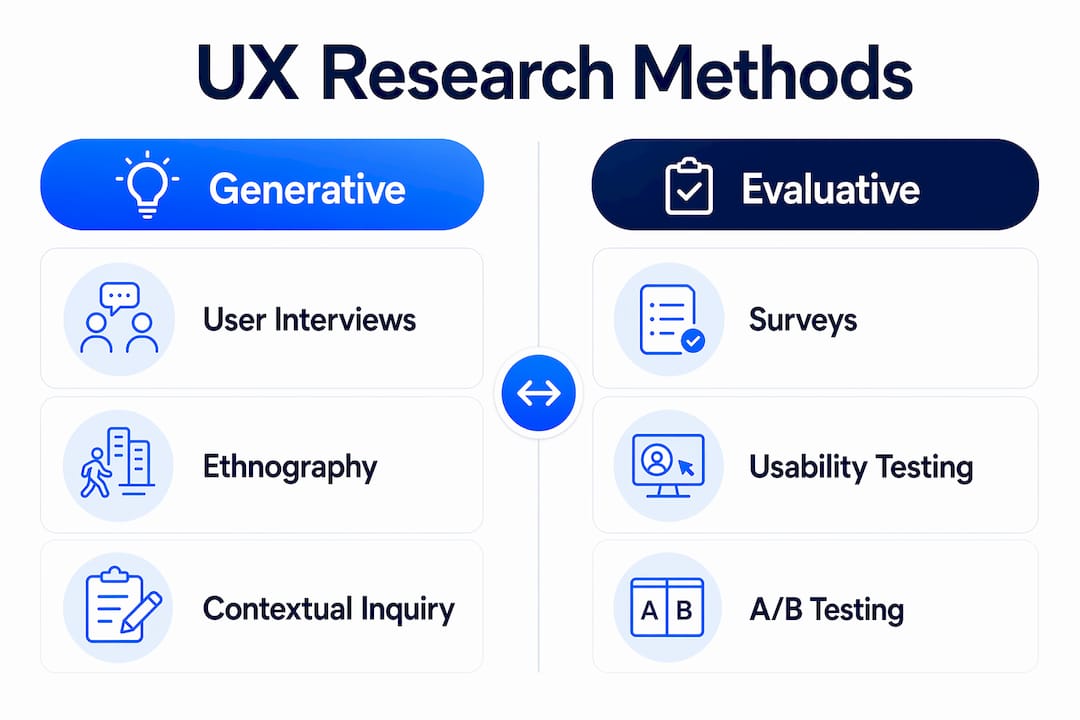
The field divides into two broad categories. Generative research explores unknown territory. It uncovers user goals, mental models, and unmet needs before a single wireframe exists. Evaluative research tests what you have already built. It measures whether your design works as intended. Both are necessary. Skipping generative research means building the wrong thing well. Skipping evaluative research means shipping problems you could have caught.
What is user experience research in practice? It is the combination of methods, participants, analysis, and synthesis that produces reliable insight. A user experience researcher designs studies, recruits participants, facilitates sessions, and translates raw data into design direction. That role requires both scientific rigor and the ability to communicate findings to product teams who need to act on them fast.
What are the core UX research methods and when to use them?
Choosing UX research methods should be principled and based on specific research questions, not habit. Nielsen Norman Group maps 20 UX methods along three axes: attitudinal versus behavioral, qualitative versus quantitative, and context of use. That framework prevents teams from defaulting to surveys when they actually need observation.
The table below maps the most common user research methods to their best use cases.
| Method | Type | Best Used When |
|---|---|---|
| User interviews | Qualitative, attitudinal | Exploring motivations, mental models, and unmet needs |
| Usability testing | Qualitative, behavioral | Evaluating task completion and identifying friction points |
| Surveys | Quantitative, attitudinal | Measuring attitudes at scale across a large user base |
| Field studies | Qualitative, behavioral | Observing users in their natural environment |
| Card sorting | Qualitative, behavioral | Designing or validating information architecture |
| Tree testing | Quantitative, behavioral | Testing navigation structure without visual design influence |
User interviews are the workhorse of generative research. A 60-minute session with a well-recruited participant surfaces more nuance than a 500-response survey. Usability testing is the standard for user experience testing because it shows you what users actually do, not what they say they would do. Field studies go further by capturing behavior in context, which lab settings cannot replicate.
Surveys scale well but measure only what users can articulate. They work best after qualitative research has already defined the right questions to ask.
Pro Tip: Before choosing a method, write your research question in one sentence. If the answer requires observation, use a behavioral method. If it requires scale, use a quantitative one. Never pick the method first.
How do you determine sample size and recruit the right participants?
Qualitative UX research studies generally recommend 10–30 participants to identify patterns and generate hypotheses effectively. That range reflects the concept of saturation: the point at which additional sessions stop producing new insights. Saturation is your operational stopping rule, not a fixed number.
For usability testing, five participants per distinct user segment often surfaces the majority of critical issues. For generative research like contextual inquiry or diary studies, you need more participants to capture the full range of behaviors and mental models. The right number depends on how many distinct user segments you are studying and how much variance exists within each.
Recruitment quality matters more than recruitment volume. These are the most common mistakes teams make:
- Overly narrow screener criteria. Requiring users who have performed a specific action in the last 30 days excludes people who represent your actual user base.
- Convenience sampling. Recruiting from your own customer list skews results toward your most engaged, digitally fluent users.
- Excluding non-digital users. Many products serve people with limited tech experience. Leaving them out produces research that does not reflect real-world use.
- Ignoring accessibility needs. Users with disabilities represent a significant portion of most audiences. Research that excludes them produces incomplete findings.
Inclusive user research requires broad recruitment practices to avoid skewed samples and truly reflect diverse user needs. Default recruiting tends to favor English-speaking, urban, digitally confident participants. That bias compounds over time and produces products that work well for a narrow slice of the intended audience.
Pro Tip: Build your screener around behaviors and contexts, not demographics. Ask what tools participants use, what tasks they perform, and what challenges they face. That approach surfaces the right people without introducing demographic bias.
What emerging trends are reshaping UX research workflows in 2026?
Two forces are changing how user experience research gets done: AI adoption and the democratization of research roles. Both are accelerating.
88% of UX researchers cite AI-assisted analysis and synthesis as a top trend in 2026, with 69% actively using AI in their projects. That 69% figure represents a 19-point increase over the previous year. AI is not replacing researchers. It is compressing the time between data collection and insight delivery, which is where most research value gets lost.
"Dedicated researchers focus on generative deep-dives while designers and PMs take on sprint-level evaluative research, forming an effective division of labor." — UX Research for Designers: The Complete 2026 Guide
Research democratization is spreading research responsibilities beyond specialists to product designers and managers, cited by 36% of teams as a core organizational shift. This creates a practical division of labor. Designers run quick evaluative studies during sprints. Dedicated researchers lead the deeper generative work that requires more rigor and time.
| Trend | Impact | Who Drives It |
|---|---|---|
| AI-assisted synthesis | Faster insight delivery from raw data | Researchers and designers |
| Research democratization | More frequent, sprint-level studies | Designers and PMs |
| Micro-studies | Timely directional feedback per sprint | Embedded designers |
| Inclusive recruiting tools | Broader, less biased participant pools | Research ops teams |
Agile teams use micro-studies with 2–3 participants per sprint to provide timely directional feedback during product cycles. These studies are not statistically significant. They are not meant to be. Their value is speed and frequency. A finding from Tuesday's session can change Wednesday's design decision. That is something a quarterly research report cannot do.
AI tools are also changing how researchers handle strategic analysis and synthesis at scale, reducing hours of manual tagging to minutes. The human judgment required to interpret and act on those findings remains irreplaceable.
What are the most common UX research pitfalls and how do you avoid them?
Even experienced teams make research errors that quietly corrupt their findings. Knowing the failure modes is the first step to avoiding them.
-
Confirmation bias. Designers risk confirmation bias when researching their own work because closeness to the design creates unconscious pressure to validate it. The fix is structural: write your hypotheses before any participant contact, and use neutral task scripts that do not lead users toward expected behavior.
-
Trusting the attitudinal-behavioral gap. Attitudinal data often differs from behavioral data. Users say they would use a feature, then never touch it. Prioritize what users do over what they say. Usability testing and analytics close this gap. Surveys alone cannot.
-
Over-generalizing from small samples. Three users who struggled with a feature is a signal worth investigating. It is not a mandate to redesign. Pair qualitative observations with behavioral analytics before committing to major changes.
-
Vague research questions. Starting a study without a clear hypothesis produces unfocused sessions and uninterpretable data. Write a one-sentence research question and a testable hypothesis before you recruit a single participant.
-
Research that sits in a report. Findings that do not reach the design team in time to influence decisions are wasted. Build research synthesis into your sprint cycle, not as a separate deliverable that arrives after decisions are already made.
Pro Tip: Record every session with participant consent and share short highlight clips with your product team. A two-minute video of a user struggling with a flow is more persuasive than a 20-slide deck.
For teams exploring UX testing methods that fit within lean workflows, the key is matching method complexity to the decision at hand.
Key takeaways
Effective UX user research combines the right methods, representative participants, and bias controls to produce findings that actually change design decisions.
| Point | Details |
|---|---|
| Match methods to questions | Choose behavioral or attitudinal methods based on your specific research question, not habit. |
| Use saturation as your stopping rule | Qualitative studies need 10–30 participants; stop when sessions stop producing new insights. |
| Recruit inclusively | Avoid convenience sampling; screeners should capture behaviors and contexts, not just demographics. |
| Embrace AI for synthesis | 69% of researchers actively use AI to compress analysis time without sacrificing judgment. |
| Build bias guardrails early | Write hypotheses and neutral task scripts before any participant contact to reduce confirmation bias. |
Why speed without rigor is the biggest risk in modern UX research
The democratization trend is genuinely exciting. Designers running their own sprint-level studies means research happens more often and closer to the decisions that need it. I have seen teams go from quarterly research reports to weekly insights, and the product quality shows it.
But speed creates a specific risk that most teams underestimate. When designers run their own studies, confirmation bias becomes the default mode. You built the thing. You believe in it. Every session becomes an unconscious search for validation. I have watched talented designers ask leading questions without realizing it, then report back that "users loved it" based on three sessions where they guided every interaction.
The UX researcher role exists precisely because objectivity requires distance. Dedicated researchers bring that distance. When democratization removes the specialist entirely, you lose the check on your own blind spots.
My recommendation: let designers run evaluative micro-studies during sprints, but keep a dedicated researcher in the loop for generative work and for reviewing study designs before they go live. That combination gives you speed and rigor without sacrificing either. Inclusive recruiting is the other area where I see teams cut corners under time pressure. Reaching non-standard users takes more effort. It is worth it every time.
— Juan
How Gostellar supports your research and testing workflow
Running frequent user research means you need a fast feedback loop between insight and implementation. Gostellar's A/B testing platform lets you validate design decisions directly with live traffic, so your research findings translate into measurable outcomes rather than untested assumptions.
With Gostellar's no-code visual editor and real-time analytics, you can set up experiments in minutes and track goal completions without engineering support. The lightweight 5.4KB script means your tests run without slowing down the pages you are testing. For UX designers and researchers who want to close the gap between qualitative insight and quantitative validation, explore Gostellar and see how fast experimentation can work for your team.
FAQ
What is UX user research?
UX user research is the systematic study of user needs, behaviors, and motivations to inform product design. It includes methods like user interviews, usability testing, surveys, and field studies.
How many participants do you need for UX research?
Qualitative UX research studies recommend 10–30 participants to identify patterns effectively, with saturation serving as the practical stopping rule. Usability testing often surfaces critical issues with as few as five participants per user segment.
What is the difference between generative and evaluative research?
Generative research explores unknown user needs before design begins, while evaluative research tests whether an existing design works as intended. Both types are necessary for a complete research practice.
How does AI affect UX research in 2026?
88% of UX researchers cite AI-assisted analysis as a top trend, with 69% actively using it to speed up synthesis and pattern recognition. AI compresses the time between data collection and insight delivery without replacing human judgment.
What is confirmation bias in UX research and how do you prevent it?
Confirmation bias occurs when researchers unconsciously seek evidence that validates their existing design decisions. Writing hypotheses and neutral task scripts before participant contact is the most reliable way to reduce it.
Recommended
Published: 6/13/2026