
Streamline website QA testing for smarter A/B results
TL;DR:
- Skipping website QA can lead to unreliable A/B test results due to broken elements or tracking gaps.
- Practical QA techniques include boundary value analysis, cross-browser testing, and journey mapping.
- Proper QA as a foundation increases test accuracy, saves time, and prevents costly wrong decisions.
Skipping website QA before running A/B tests is like painting a cracked wall and calling it a renovation. Many marketers at small to medium-sized businesses rush straight into split testing, only to collect weeks of data that means nothing because a broken form or a misaligned CTA was quietly distorting results the whole time. QA testing ensures functionality, compatibility, and performance before A/B tests even begin, while A/B testing optimizes engagement after the site is stable. This guide walks you through the essential QA steps, the most common mistakes that wreck test accuracy, and a practical workflow that helps you move faster without sacrificing data quality.
Table of Contents
- Why website QA testing is critical before A/B tests
- Key website QA techniques for marketers
- Common pitfalls: How QA gaps ruin A/B test accuracy
- How to go from QA to A/B: Building a seamless workflow
- The uncomfortable truth: Most A/B tests fail — Here's what actually works
- Supercharge your website QA and testing workflow
- Frequently asked questions
Key Takeaways
| Point | Details |
|---|---|
| QA before A/B | Thorough QA is essential for accurate, actionable A/B test results. |
| Prioritize high-impact fixes | Focusing QA on your most valuable pages and actions boosts test value. |
| Avoid common errors | Most A/B test failures trace back to overlooked site bugs and untested edge cases. |
| Small wins compound | Expect minor improvements from tests—over time, these add up. |
Why website QA testing is critical before A/B tests
Think of QA and A/B testing as two separate jobs. QA is the foundation. A/B testing is the optimization layer you build on top. If the foundation has cracks, everything you build above it is unreliable, no matter how carefully you design your experiments.
When you skip or rush QA, you risk running tests on pages where key elements are already broken. A button that doesn't fire a tracking event, a form that fails on Safari, or a layout that collapses on mobile can all make one variant look like a loser when it was actually performing fine. You end up making decisions based on noise, not signal.
"QA testing ensures functionality, compatibility, and performance before A/B tests, while A/B testing optimizes engagement post-QA." This distinction matters because confusing the two roles leads to wasted budget and missed learning.
Here are the most common QA gaps that damage A/B test results:
- Broken CTAs: A call-to-action that doesn't trigger correctly in one variant skews click and conversion data immediately.
- Display bugs: Layout shifts or overlapping elements on specific screen sizes make one variant look worse than it actually is.
- Form failures: Signup or checkout forms that error out on certain browsers eliminate entire user segments from your data.
- Tracking gaps: Missing or misfiring analytics tags mean your test platform never captures full conversion data.
- Leftover scripts: Old campaign codes or pixels interfere with test cleanliness and can create false results.
Using website checking site tools before you launch any test helps you catch these issues early. The goal is to make sure every user segment, on every device and browser, experiences the page as intended. Only then does your A/B test actually measure what you think it's measuring.
Marketers who treat QA as an optional pre-launch step often discover the hard way that web testing for conversions is not just about finding bugs. It's about protecting the integrity of every experiment you run afterward.
Key website QA techniques for marketers
You don't need a full QA engineering team to run effective pre-test checks. These methods are practical, low-cost, and designed for marketers who need results without heavy dev support.
- Run Boundary Value Analysis (BVA) on input fields. BVA tests the minimum and maximum values a field will accept. For example, check what happens when a user enters one character in a name field, or pastes a 500-character string into a promo code box. Edge cases like boundary values and invalid data are where bugs hide most often.
- Map and test your critical user journeys. Walk through the exact paths your highest-value users take: product search, add to cart, checkout, signup, and any CTA flow you plan to test. If these paths break, your A/B test data is compromised before it starts.
- Check every major browser and device. Chrome, Firefox, Safari, and Edge all render pages differently. Mobile behavior is especially important since many SMB sites see 50% or more of traffic from phones. A bug that only appears on iOS Safari can silently skew your mobile segment results.
- Use equivalence partitioning to reduce test volume. Group similar inputs together and test one representative from each group. This lets you cover more ground without running hundreds of manual checks.
- Prioritize by conversion impact. Not every page needs the same depth of QA. Focus your time on the pages and flows that directly affect revenue or lead generation.
Pro Tip: Before any A/B test launch, run a five-minute spot-check on your top three traffic pages across two browsers and one mobile device. It takes almost no time and catches the majority of critical display bugs.
For teams working with limited resources, affordable QA tools can automate many of these checks. If you want a more structured approach, a step-by-step QA guide tailored to SMBs can help you build a repeatable process without reinventing the wheel each time.
Common pitfalls: How QA gaps ruin A/B test accuracy
Even marketers who understand the value of QA sometimes cut corners under deadline pressure. Here's exactly how those shortcuts backfire.

| QA gap | Impact on A/B test | Example |
|---|---|---|
| Broken CTA in variant B | Variant B appears to underperform | Button click doesn't fire conversion event |
| Mobile layout bug | Mobile segment skews results | Form overlaps on small screens |
| Browser-specific error | Entire browser segment excluded | Safari users hit a JS error and bounce |
| Leftover tracking script | Data contamination | Old pixel double-counts conversions |
| Session timeout issue | User journey incomplete | Checkout abandonment misattributed |
One of the most damaging scenarios is data contamination. When an undetected site issue affects only a portion of your traffic, it creates false positives or false negatives. You might conclude that a new headline drives more signups, when actually a bug was quietly blocking signups on the control variant for Android users.
The real cost isn't just a failed test. It's the wrong decision made with confidence, then scaled.
80 to 90% of A/B tests fail to produce a clear winner, and for SMBs with limited traffic, a contaminated test can waste months of learning time. That's a steep price for skipping a 30-minute QA pass.
Another underrated pitfall is leftover campaign artifacts. If a previous promotion left a discount code script running, or an old heatmap tool is still firing, those elements can interact with your test variants in unpredictable ways. Always audit your page scripts before starting a new experiment.
Learning how to run A/B testing without dev support means taking ownership of these checks yourself. The good news is that most critical QA issues are visible to the naked eye if you know where to look.
How to go from QA to A/B: Building a seamless workflow
Here's a practical sequence you can follow to move from a QA-cleared page to a running, reliable A/B test.
- Identify your highest-impact pages. Start with pages that have the most sessions and the clearest conversion goals. Product pages, landing pages, and checkout flows are the best starting points.
- Run your QA checklist. Cover critical user journeys, edge input cases, cross-browser and mobile checks, and script audits. Document any issues and fix them before proceeding.
- Define one clear test hypothesis. Change one element at a time: a headline, a CTA button, a hero image. Validating A/B test ideas before you build them saves time and sharpens your learning.
- Set up your test with a clear goal metric. Use a platform that tracks your specific conversion event, not just clicks. SMB-friendly tools like Google Optimize and VWO offer free or low-cost entry points.
- Segment your results by device and traffic source. A test that wins on desktop might lose on mobile. Segmenting helps you understand where the improvement actually lives.
- Accept small wins and compound them. Compounding small improvements on high-traffic pages beats chasing dramatic results on low-traffic ones.
Pro Tip: Run your test for at least two full business cycles before calling a winner. Weekday and weekend behavior often differ, and cutting a test short is one of the fastest ways to get a misleading result.
| Phase | Action | Tool examples |
|---|---|---|
| QA | Cross-browser checks, journey testing | BrowserStack, manual spot-checks |
| Test setup | Hypothesis, variant build, goal setting | Stellar, VWO, Google Optimize |
| Analysis | Segment by device, traffic source | Google Analytics, platform dashboards |
| Iteration | Apply winner, form next hypothesis | Internal docs, top A/B testing platforms |
The uncomfortable truth: Most A/B tests fail — Here's what actually works
Here's something most testing guides won't tell you directly: the majority of A/B tests won't produce a clear winner. For SMBs, negative ROI from A/B testing is common, especially when traffic is low and test duration is short. That's not a reason to stop testing. It's a reason to test smarter.
The marketers who get the most out of experimentation are not the ones running the most tests. They're the ones running the right tests on well-prepared pages. QA is the highest-leverage investment you can make before a test. A clean, stable page means every data point you collect is trustworthy.
Our take: stop treating QA as a checkbox and start treating it as a competitive advantage. When your competitors are making decisions on contaminated data and you're not, you win over time even if your individual test win rate looks modest.
AI-assisted tools are genuinely useful for generating test ideas and prioritizing hypotheses, but they can't replace the discipline of solid pre-test QA. Focus your energy on optimizing call-to-action buttons and high-traffic pages first. Nail those, compound the gains, and you'll outperform teams running ten sloppy tests a month.
Supercharge your website QA and testing workflow
A stable, QA-cleared site is the starting line for every reliable A/B test you'll ever run. Without it, you're optimizing guesses instead of results. If you're ready to build a faster, cleaner testing workflow, website QA and A/B testing tools from Stellar are built specifically for marketers who need speed and simplicity without sacrificing accuracy.
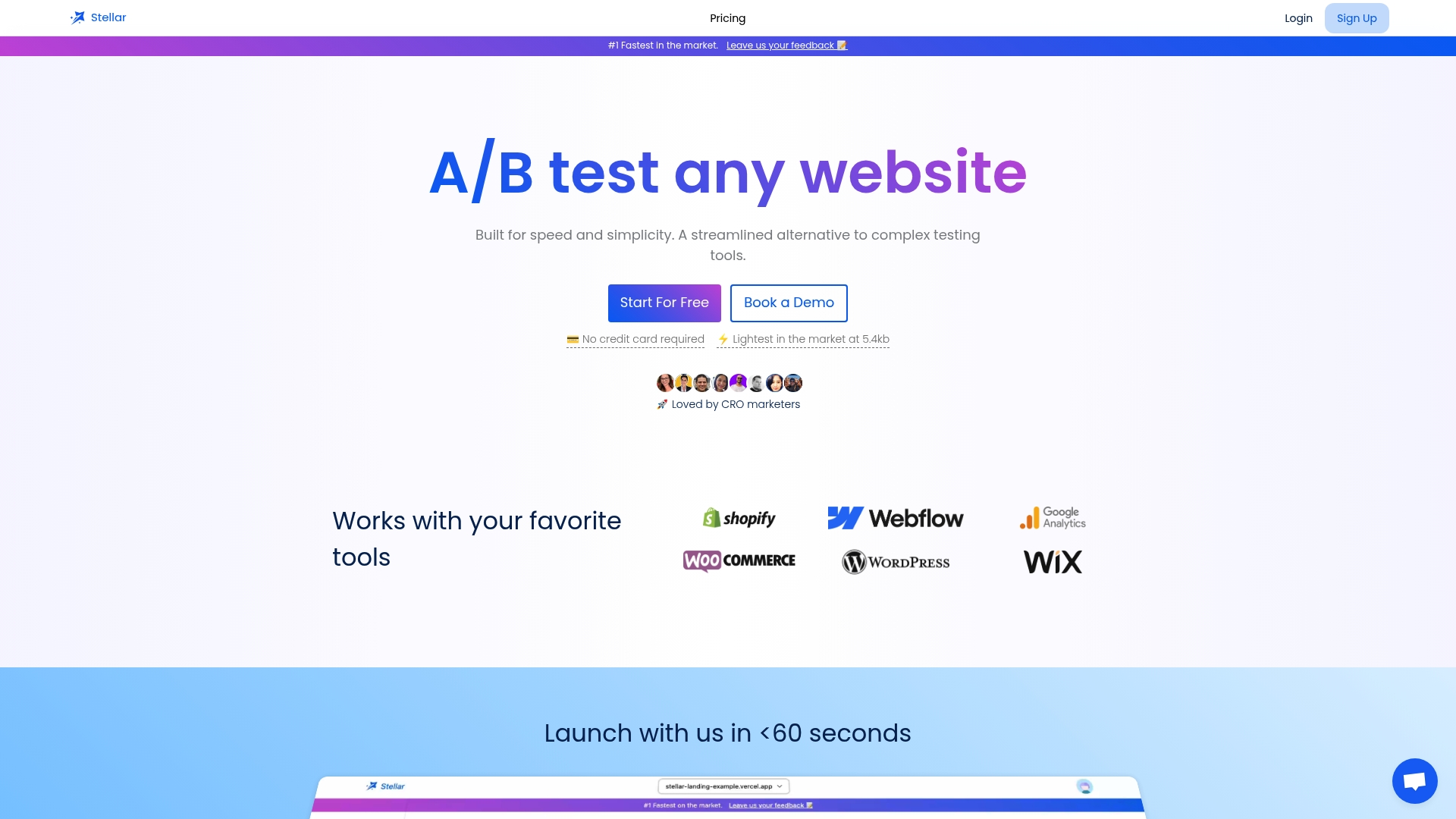
Stellar's lightweight 5.4KB script keeps your site fast while you test, and the no-code visual editor means you don't need a developer to set up or launch experiments. Whether you're on WordPress or another platform, explore WordPress A/B testing options to find the right fit. Start with the free plan and build your QA-to-test workflow today.
Frequently asked questions
What's the difference between website QA testing and A/B testing?
QA testing checks for bugs and stability before you run A/B tests, which measure what actually improves user engagement after the site is stable. Think of QA as the foundation and A/B testing as the optimization layer built on top of it.
How do I prioritize which website parts to QA before running tests?
Focus on pages and flows with the most user sessions and highest conversion impact, like product pages and checkout. Prioritizing by impact means testing boundary values and critical paths where bugs do the most damage.
What tools help SMBs run QA and simple A/B tests?
Platforms like VWO, Google Optimize, and Optimizely are popular for SMBs, with free and easy setups that don't require engineering resources.
Why do most A/B tests show small or no improvements?
SMBs often lack enough traffic and time, so most experiments don't reach statistical significance. 80 to 90% of tests fail to produce a winner, which is why small, cumulative gains on high-traffic pages matter more than home-run bets.
Recommended
- 5 Lightweight A/B Testing Platforms That Won't Slow Your Site
- Website Split Testing Guide 2025: Boosting CRO and Conversions
- Master web testing in 2026: boost conversions 20% faster
- The Best WordPress A/B Testing Tools for Optimizing Your Website
- 7 Essential Steps for Effective Mobile Ad A/B Tests - playablemaker.com 7 Essential Steps for Effective Mobile Ad A/B Tests
Published: 4/13/2026