
Website Speed & Conversions: Complete Guide
Did you know that a website loading in just one second can have a conversion rate up to three times higher than one that lags behind at five seconds? Fast load times can mean the difference between a new customer and a missed opportunity. With users quick to abandon slow pages, even a brief delay can hurt your revenue and online presence. Understanding website speed can transform how visitors interact and help your business excel.
Table of Contents
- What Website Speed Means For Conversions
- Core Metrics And Speed Impact
- How Speed Drives User Behavior
- Key Optimization Techniques
- Speed-Related Risks And Trade‑offs
Key Takeaways
| Point | Details |
|---|---|
| Impact of Speed on Conversions | A 1-second delay can lead to a 7% drop in conversions, emphasizing the importance of fast loading times to maximize user engagement. |
| Core Web Vitals | Metrics like Largest Contentful Paint (LCP), First Input Delay (FID), and Cumulative Layout Shift (CLS) directly influence user experience and should be prioritized for optimization. |
| Psychological Effects | Slow websites induce anxiety and reduce user trust, which can lead to higher abandonment rates and lower conversions. |
| Optimization Techniques | Employ strategies like minimizing HTTP requests, enabling caching, and using adaptive design to enhance website speed without sacrificing functionality. |
What Website Speed Means For Conversions
Website speed isn't just a technical metric - it's a critical conversion driver that can make or break your online business performance. According to Portent, a site that loads in just 1 second has a conversion rate 3x higher than a site that takes 5 seconds to load. This stark difference highlights how profoundly page load time impacts user behavior and bottom-line results.
The consequences of slow website performance are immediate and measurable. Search Influence research reveals that a single additional second in load time can trigger a 7% drop in conversions. Think about that for a moment.
 A mere one-second delay could mean losing nearly one in 14 potential customers who might otherwise have completed a purchase, signed up for a service, or engaged with your content.
What makes website speed so crucial? Modern users have extremely short attention spans and zero tolerance for waiting. When a website loads slowly, visitors experience:
- Increased frustration
- Reduced trust in the brand
Moreover, search engines like Google now factor page speed directly into ranking algorithms. Slow websites get penalized in search results, creating a compounding negative effect on visibility and potential conversions. Understanding the Importance of Page Speed for Marketers provides deeper insights into how performance optimization can transform your digital strategy.
Optimizing website speed isn't just about technical tweaks - it's about creating a smooth, responsive user experience that keeps potential customers engaged and reduces friction in their journey from initial interest to final conversion. Every millisecond counts in today's hyper-competitive digital landscape.
Core Metrics And Speed Impact
When it comes to measuring website performance, understanding the right metrics is crucial for conversion optimization. Google PageSpeed Insights provides a comprehensive framework by assigning scores across four critical categories: Performance, Accessibility, Best Practices, and SEO. These categories offer a holistic view of how your website functions and potential areas for improvement.
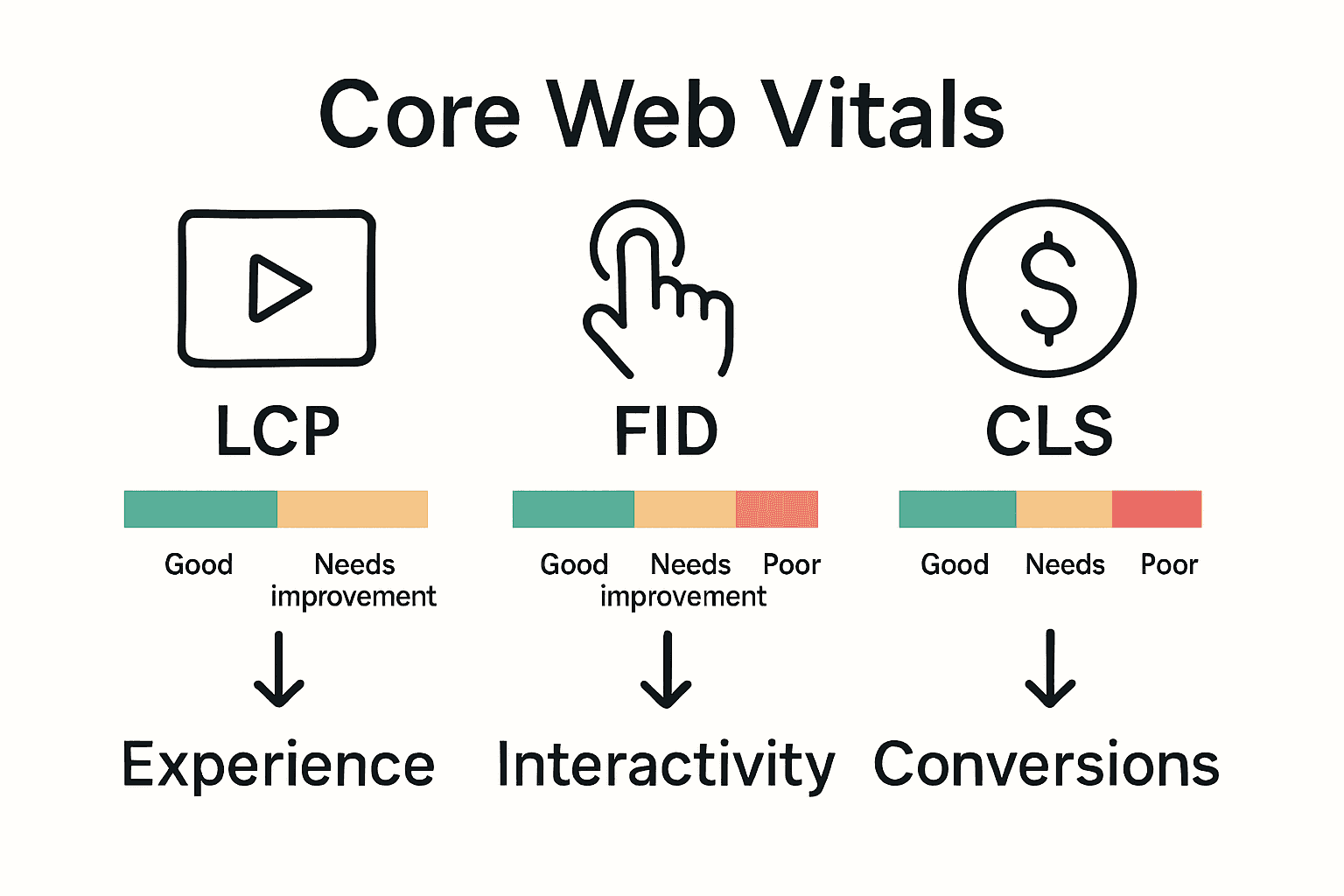
Modern performance measurement goes beyond simple load times. Serotonin highlights Google's Core Web Vitals, a set of specific metrics that directly impact user experience and conversion potential. These include:
- Largest Contentful Paint (LCP): Measures loading performance
- First Input Delay (FID): Evaluates interactivity
- Cumulative Layout Shift (CLS): Assesses visual stability
Each of these metrics provides insight into different aspects of website performance that can dramatically influence user behavior and conversion rates.
 LCP, for instance, tracks how quickly the main content of a page loads, which is critical for keeping potential customers engaged. FID measures how responsive your site feels by tracking the time between a user's first interaction and the browser's response.
Here's a comparison of the core website performance metrics and their direct impact on user experience and conversions:
| Metric | What It Measures | Impact on User Experience | Effect on Conversions |
|---|---|---|---|
| Largest Contentful Paint (LCP) | Loading speed of main content | Faster content visibility | Higher engagement, lower bounce |
| First Input Delay (FID) | Time to first user interaction response | Smoother interactivity | Increased trust, more actions |
| Cumulative Layout Shift (CLS) | Visual stability during load | Fewer unexpected movements | Reduced frustration, more completions |
Breaking the 2-Second Rule: Website Speed Optimization Guide offers deeper insights into transforming these metrics from abstract numbers into actionable improvements. By understanding and optimizing these core performance indicators, businesses can create faster, more responsive websites that not only satisfy users but also significantly boost conversion potential.
How Speed Drives User Behavior
Website speed is a critical psychological trigger that fundamentally shapes user behavior and decision-making. Bidnamic reveals a stark reality: more than half of all website visits are abandoned if a page takes longer than three seconds to load. This demonstrates how incredibly impatient modern digital consumers have become, with milliseconds potentially determining whether a potential customer stays or leaves.
Swift Toolbox highlights that even a minimal 1-second delay can trigger a 7% reduction in conversion rates. This isn't just a technical metric - it's a direct reflection of user psychology. Waiting time creates friction, erodes trust, and signals potential unreliability to users who are constantly evaluating whether to invest their time and attention.
The psychological impact of website speed extends beyond simple impatience. Slow-loading websites trigger several negative cognitive responses:
- Increased anxiety and uncertainty
- Perception of unprofessionalism
- Reduced confidence in the brand
- Diminished perceived value of the product or service
Website Performance Impact: How Speed and UX Drive Results provides deeper insights into how these psychological mechanisms translate into tangible business outcomes. By understanding the intricate connection between speed, user experience, and emotional response, businesses can create digital experiences that not only load quickly but also build immediate trust and engagement.
Key Optimization Techniques
Optimizing website speed requires a multi-faceted approach that goes beyond simple technical adjustments. Wikipedia highlights adaptive web design as a powerful strategy, promoting the creation of multiple web page versions tailored to different user devices. This approach ensures that regardless of whether a user visits from a smartphone, tablet, or desktop, they receive an optimized experience that loads quickly and looks perfect.
Another critical strategy is progressive enhancement, a technique that prioritizes web content accessibility. By focusing on delivering core content and functionality first, websites can ensure that users with varying device capabilities and internet speeds can still access essential information. This approach not only improves perceived speed but also creates a more inclusive digital experience.
Key optimization techniques include:
- Minimizing HTTP requests
- Enabling browser caching
- Compressing images and media files
- Utilizing content delivery networks (CDNs)
- Implementing lazy loading for images and videos
Increasing Landing Page Speed: Proven Tactics for 2025 provides deeper insights into implementing these strategies effectively. By combining technical optimizations with user-centric design principles, businesses can create lightning-fast websites that not only load quickly but also provide a seamless, engaging user experience across all devices and connection speeds.
Speed-Related Risks And Trade‑offs
Website optimization is a delicate balance between performance and functionality. arXiv warns that the excessive use of marketing components can lead to an inferior user experience, potentially causing user churn due to growing intrusiveness. This highlights the critical challenge of maintaining a fast, engaging website without overwhelming visitors with too many visual elements or complex interactive features.
The pursuit of speed is not without its strategic considerations. arXiv reveals that optimization is frequently employed to determine web page content, with the primary goals of maximizing conversions on landing pages and improving click-through rates. However, this optimization process involves careful trade-offs between loading speed, visual appeal, and functional complexity.
Key risks and trade-offs in website speed optimization include:
- Potential loss of rich media content
- Reduced visual complexity
- Simplified design to improve performance
- Potential compromise of advanced interactive features
- Limited dynamic content
The Ultimate Website Optimization Checklist for 2025 offers comprehensive guidance on navigating these complex trade-offs. Successful website performance requires a nuanced approach that carefully balances technical optimization with user experience, ensuring that speed enhancements don't come at the cost of engaging, informative content that truly serves user needs.
Boost Your Conversions with Lightning-Fast A/B Testing
The article makes it clear that website speed can make or break your conversion rates. Slow loading times increase frustration and reduce trust while forcing you to sacrifice valuable web traffic. If you are struggling with user engagement due to page load delays or want to optimize critical metrics like Largest Contentful Paint and First Input Delay without slowing your site down, you need a tool designed for speed and simplicity. Stellar’s lightweight A/B testing platform, boasting only a 5.4KB script, empowers you to run effective experiments that boost conversions without any complex setup or performance drag.
Ready to slash bounce rates and raise engagement by testing impactful changes quickly and easily Use the Stellar A/B Testing Tool with its no-code visual editor and advanced goal tracking to improve your website’s speed-related performance factors. Explore our intuitive features and real-time analytics at https://gostellar.app now and start converting visitors before they lose patience.
Frequently Asked Questions
How does website speed affect conversion rates?
Website speed significantly impacts conversion rates; for example, a site that loads in 1 second can have a conversion rate 3 times higher than one that takes 5 seconds. Even a 1-second delay can result in a 7% drop in conversions.
What are Core Web Vitals, and why are they important?
Core Web Vitals are specific metrics established by Google, including Largest Contentful Paint (LCP), First Input Delay (FID), and Cumulative Layout Shift (CLS). They are crucial for measuring user experience and serve as indicators of how quickly and smoothly users can interact with your website.
What key optimization techniques can improve website speed?
Key techniques to improve website speed include minimizing HTTP requests, enabling browser caching, compressing images and media files, using content delivery networks (CDNs), and implementing lazy loading for images and videos.
What are the risks of prioritizing website speed over user experience?
Prioritizing speed may lead to trade-offs like the potential loss of rich media content, reduced visual complexity, and simplified design. This can compromise advanced interactive features and limit the dynamism of the website, which could ultimately affect user engagement.
Recommended
- Understanding the Importance of Page Speed for Marketers
- Website Performance Impact: How Speed and UX Drive Results
- 7 Conversion Rate Optimization Tools That Prioritize Speed
- Ecommerce Conversion Techniques That Don't Sacrifice Speed
- How to Boost Website Speed in 2025: Proven Tips for SMBs & Marketers
Published: 11/3/2025