
What Is AB Tasty? A Marketer's 2026 Overview
TL;DR:
- AB Tasty is an AI-powered platform that unifies A/B testing, personalization, and feature deployment for marketing and product teams. It supports both client-side and server-side experimentation, enabling coordinated workflows and reducing deployment risks. The 2026 merger with Wingify enhances its global reach and operational scale for high-volume experimentation.
AB Tasty is defined as an AI-powered digital experience optimization platform that combines A/B testing, personalization, and feature rollouts in a single unified workflow. Founded in 2009 and headquartered in Paris, France, the platform serves global brands including L'Oréal, McDonald's, Ulta Beauty, Disneyland Paris, and LVMH. In January 2026, AB Tasty merged with Wingify to form a combined entity generating over $100M in annual revenue and serving more than 4,000 customers worldwide. For marketers and business professionals evaluating A/B testing tools, understanding what AB Tasty does means understanding how experimentation, personalization, and controlled feature deployment work together to drive measurable conversion gains.

What is AB Tasty and what does it actually do?
AB Tasty is an AI-powered optimization platform that gives marketing and product teams a single place to run experiments, personalize digital experiences, and manage feature releases. Most platforms force you to choose between a marketer-friendly testing tool and a developer-grade feature management system. AB Tasty positions itself as both, which is what makes its AB Tasty overview worth examining carefully before you commit to any experimentation stack.
At its core, the platform enables A/B testing, which is the controlled comparison of two or more versions of a webpage or app to determine which drives better conversions or engagement. AB Tasty extends this foundation into a broader set of capabilities that cover the full experimentation lifecycle, from hypothesis to deployment.
Core AB Tasty features at a glance
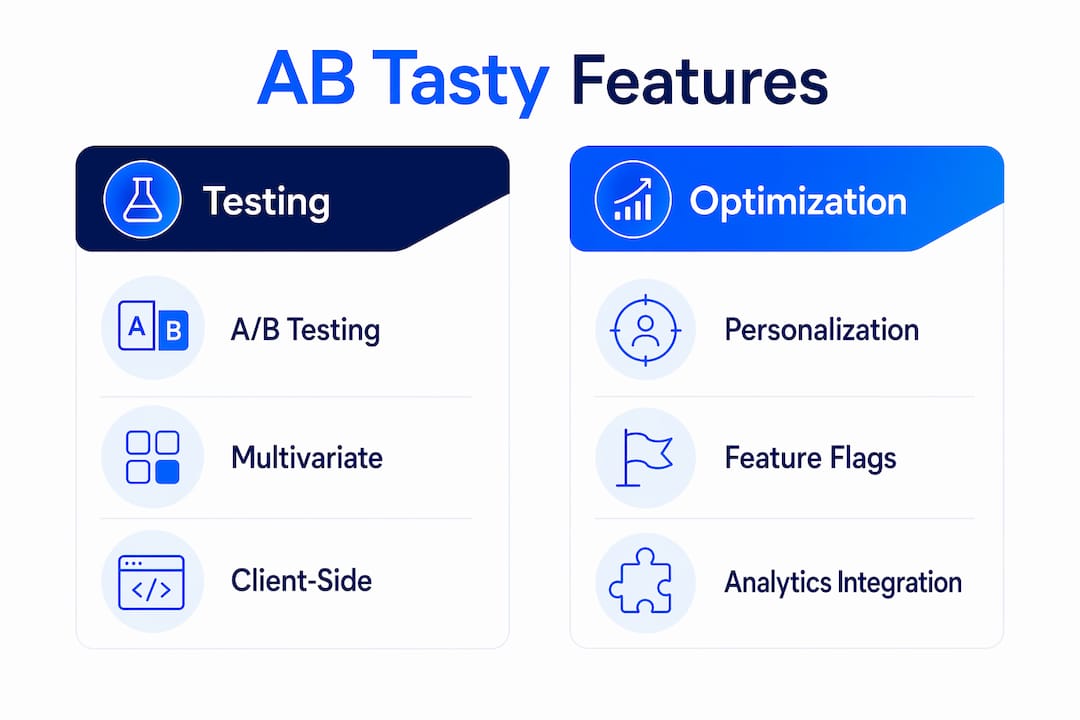
AB Tasty features span four primary capability areas:
- A/B, multivariate, and split testing. Run classic two-variant tests or more complex multivariate experiments across web and mobile surfaces without writing code.
- Personalization and audience segmentation. Deliver targeted experiences based on behavioral signals, geolocation, device type, and AI-driven emotion-based segmentation that adapts to user intent in real time.
- Feature flags and progressive rollouts. Deploy code independently from feature activation, then release to a controlled percentage of users before going fully live.
- Server-side experimentation. Run experiments that touch business logic, pricing, recommendation engines, or backend systems without the performance penalties of client-side DOM manipulation.
- AI-driven recommendations. Use machine learning to surface winning variations faster and identify audience segments most likely to respond to specific experiences.
Integration with analytics platforms like Google Analytics 4, Segment, and Mixpanel connects experiment data to your existing reporting stack. This means you are not working in an isolated testing silo. Every experiment result flows into the same dashboards your team already uses to measure business performance.
Pro Tip: If your team runs more than ten experiments per quarter, AB Tasty's unified platform pays for itself in coordination time alone. Marketing, product, and engineering can all operate from the same experiment backlog instead of managing separate tools.
How does AB Tasty's testing architecture work?
AB Tasty supports two distinct testing architectures, and choosing the wrong one for your use case is the most common mistake teams make when they first set up the platform.
| Architecture | How it works | Best for | Trade-offs |
|---|---|---|---|
| Client-side testing | JavaScript modifies the DOM after the page loads in the browser | Marketer-led visual changes, copy tests, CTA experiments | Potential flicker; limited impact on backend logic |
| Server-side testing | Experiment logic runs on the server before content is delivered | Pricing tests, recommendation engines, app logic | Requires engineering involvement; longer setup time |
Client-side testing is easier to implement and gives marketers direct control. You can change a headline, reorder page sections, or test a new CTA color without touching your codebase. The trade-off is a brief visual flicker as the page loads and the variation renders, which can affect perceived performance on slower connections.
Server-side testing eliminates the flicker problem entirely because the variation is determined before the page is assembled. It also opens up experiments that client-side testing cannot touch: checkout flow logic, dynamic pricing, personalized product rankings, and any feature that lives in your application layer rather than your front-end templates. The downside is that your engineering team must be involved in setup, which adds lead time to every experiment.
Mature experimentation programs typically use both architectures in parallel. Marketing owns client-side tests for conversion rate optimization on landing pages and content. Product and engineering own server-side experiments for feature validation and business logic changes. AB Tasty's unified platform makes this division of labor practical because both teams work from the same experiment management interface.
Pro Tip: Start with client-side testing to build your experimentation culture and generate early wins. Introduce server-side testing once your team has a repeatable process for hypothesis generation, statistical analysis, and result documentation.
What are the benefits of AB Tasty for conversion optimization?
The benefits of AB Tasty extend well beyond running individual tests. The platform changes how teams make decisions about digital experiences at an organizational level.
AB Tasty reduces silos between marketing, product, and development by giving all three teams a shared workspace for experimentation. This matters because the most impactful conversion improvements often require coordinated changes across front-end content, application logic, and user flow design. When those teams operate in separate tools, experiments get delayed, results get misattributed, and learnings stay siloed.
Specific benefits that marketers and business professionals report from using the platform include:
- Reduced deployment risk. Feature flags decouple deployment from release, so engineering can ship code to production without activating it for users. Marketing or product then controls the rollout timing and audience percentage, which eliminates the all-or-nothing risk of traditional feature launches.
- Faster iteration cycles. No-code testing tools let marketers run experiments without waiting for developer sprints. A hypothesis that would have taken three weeks to test can be live in hours.
- Personalization at scale. AI-driven segmentation identifies which audience segments respond to which experiences, then serves the right variation automatically. Brands like L'Oréal and Disneyland Paris use this capability to deliver localized, behavior-driven experiences across millions of sessions.
- Data-driven decision making. Every experiment generates statistical evidence for or against a hypothesis. Over time, this builds an institutional knowledge base that replaces opinion-driven design decisions with tested findings.
- Improved user engagement. Personalized experiences consistently outperform generic ones in engagement metrics. AB Tasty's segmentation tools make personalization accessible to teams without dedicated data science resources.
The platform's value compounds as your experiment volume grows. Early tests answer tactical questions about button colors and headlines. Later tests answer strategic questions about pricing models, onboarding flows, and product positioning.
How does AB Tasty integrate into your marketing tech stack?
Integrating AB Tasty into an existing digital marketing stack follows a predictable sequence, and getting the integration right from the start prevents attribution headaches later.
- Install the AB Tasty script. Add the JavaScript tag to your site via Google Tag Manager or direct implementation. The tag loads asynchronously to minimize performance impact.
- Connect your analytics platform. Link AB Tasty to GA4, Segment, or your preferred analytics tool. Maintaining campaign and variation identifiers via first-party cookies across pages and subdomains is what makes attribution reliable in multi-page user journeys. Without this step, you cannot accurately measure how a variation on page one affects conversions on page three.
- Define your goals and events. Set up conversion goals that map to your business KPIs: purchases, sign-ups, time on page, scroll depth, or custom events. AB Tasty's goal tracking pulls from your analytics event layer, so you are measuring the same actions your business already tracks.
- Configure audience segments. Build segments based on traffic source, device type, behavioral history, or custom attributes passed from your CRM or data layer. The more specific your segments, the more precise your personalization.
- Use request interception for QA. HTTP request interception tools allow engineering and QA teams to validate experiment conditions and personalization rules without repeatedly modifying client-side code. This approach significantly improves testing reliability and reduces the time spent debugging variation delivery.
The integration depth you need scales with your experimentation maturity. A small marketing team running landing page tests needs steps one through three. An enterprise product team running server-side experiments across a multi-region platform needs all five, plus API-level integration with their feature management pipeline.
Key takeaways
AB Tasty is the most capable unified experimentation platform for teams that need both marketer-led A/B testing and developer-grade feature management in a single system.
| Point | Details |
|---|---|
| Unified platform design | AB Tasty combines A/B testing, personalization, and feature flags so marketing and product teams share one workflow. |
| Two testing architectures | Client-side suits marketer-led visual tests; server-side suits business logic experiments requiring engineering involvement. |
| Feature flag advantage | Decoupling deployment from release reduces launch risk and gives non-technical teams control over rollout timing. |
| Analytics integration | Connecting AB Tasty to GA4 via first-party cookies is required for accurate attribution across multi-page journeys. |
| Enterprise adoption signal | Brands like L'Oréal, McDonald's, and LVMH use AB Tasty, which signals platform reliability at high traffic volumes. |
Why AB Tasty's unified model changes how I think about experimentation tools
I have spent years watching marketing teams buy separate tools for A/B testing, personalization, and feature management, then spend more time synchronizing data between those tools than actually running experiments. AB Tasty's single-platform approach solves a real operational problem, not just a theoretical one.
What I find most underappreciated in most AB Tasty overviews is the feature flag capability. Most marketers think of AB Tasty purely as a testing tool. But the ability to deploy code and activate features independently is what lets fast-moving teams ship continuously without gambling on every release. That is a product engineering practice that AB Tasty has made accessible to marketing-led organizations, and it changes the risk calculus of experimentation entirely.
My honest recommendation: if you are a marketer at a mid-size company running fewer than five experiments per month, AB Tasty may be more platform than you need right now. The learning curve for server-side testing and feature flag management is real. But if your team is serious about building a repeatable A/B testing practice and you need marketing and engineering to collaborate without friction, AB Tasty is one of the few platforms that actually delivers on that promise. The 2026 merger with Wingify adds further scale and geographic reach, which matters if you operate across multiple markets.
The teams that get the most out of AB Tasty are the ones that treat it as an operating system for decision-making, not just a tool for running the occasional headline test.
— Juan
Ready to start testing smarter?
Understanding what AB Tasty does is the first step. The next step is building the experimentation habits that turn individual test results into compounding conversion gains.
If you are exploring A/B testing tools and want to start running experiments without the complexity of an enterprise platform, Gostellar is built for exactly that. With a 5.4KB script that loads faster than any competing tool, a no-code visual editor, and real-time analytics, Gostellar gives marketers at small and medium-sized businesses everything they need to run high-impact tests from day one. There is a free plan for sites with under 25,000 monthly tracked users, so you can validate your first experiments before committing to a paid tier. Start optimizing with Gostellar and see what data-driven decisions actually look like in practice.
FAQ
What is AB Tasty used for?
AB Tasty is used for A/B testing, multivariate experimentation, website personalization, and feature flag management. It helps marketing and product teams improve conversion rates and user engagement through controlled, data-driven experiments.
How does AB Tasty differ from a basic A/B testing tool?
AB Tasty goes beyond simple split testing by combining client-side and server-side experimentation, AI-driven personalization, and feature rollout controls in one platform. Basic A/B testing tools typically handle only front-end visual changes without touching application logic or deployment workflows.
Who owns AB Tasty in 2026?
AB Tasty was acquired by Wingify in January 2026, forming a combined digital experience optimization platform with over $100M in annual revenue and more than 4,000 customers globally.
Does AB Tasty require coding knowledge to use?
AB Tasty offers a no-code visual editor for marketers running client-side tests, so basic experimentation requires no coding. Server-side testing and feature flag management do require engineering involvement for initial setup and integration.
How does AB Tasty integrate with Google Analytics?
AB Tasty integrates with GA4 by passing variation identifiers through first-party cookies and session parameters, which allows accurate attribution of experiment results across multi-page user journeys within your existing analytics reporting.
Recommended
Published: 5/31/2026