
What is an ecommerce platform? A marketer's guide to growth
TL;DR:
- Modern ecommerce platforms serve as growth engines by supporting experimentation, personalization, and data analysis.
- Effective A/B testing requires careful planning, proper tools, and awareness of pitfalls like early stopping and low traffic.
- Success depends more on team discipline and testing culture than on the specific platform chosen.
Most marketers treat their ecommerce platform as a storefront and nothing more. Pick a template, upload products, connect a payment processor, and ship. But that mindset leaves enormous revenue on the table. Modern ecommerce platforms have evolved into full-scale growth engines, built to support experimentation, personalization, and data-driven decision-making at every stage of the customer journey. An ecommerce platform is a software solution that enables businesses to build, manage, and optimize online stores, integrating tools for product catalogs, inventory management, payments, orders, customer support, and A/B testing for sales optimization. This guide breaks down what that actually means for you.
Table of Contents
- What is an ecommerce platform?
- Essential features of modern ecommerce platforms
- How ecommerce platforms power A/B testing for growth
- Critical pitfalls in ecommerce experimentation (and how to avoid them)
- Why focusing on experimentation transforms ecommerce growth (beyond just choosing a platform)
- Unlock more growth with guided ecommerce experimentation
- Frequently asked questions
Key Takeaways
| Point | Details |
|---|---|
| Definition clarified | Ecommerce platforms are all-in-one systems for building, managing, and optimizing online stores. |
| Growth features | Modern platforms offer tools like A/B testing and analytics to help marketers boost sales and conversion rates. |
| Experimentation matters | Consistent, smart A/B testing on your platform drives better results than a set-it-and-forget-it approach. |
| Common pitfalls | Watch for mistakes such as early test stopping and underpowered experiments to ensure accurate findings. |
What is an ecommerce platform?
Think of your ecommerce platform as the command center for your entire online business. Every transaction, every customer interaction, every product update flows through it. But the platforms doing the most for growth-focused teams in 2026 go well beyond order management. They orchestrate data, marketing, and experimentation in one unified environment.
At its core, an ecommerce platform gives you:
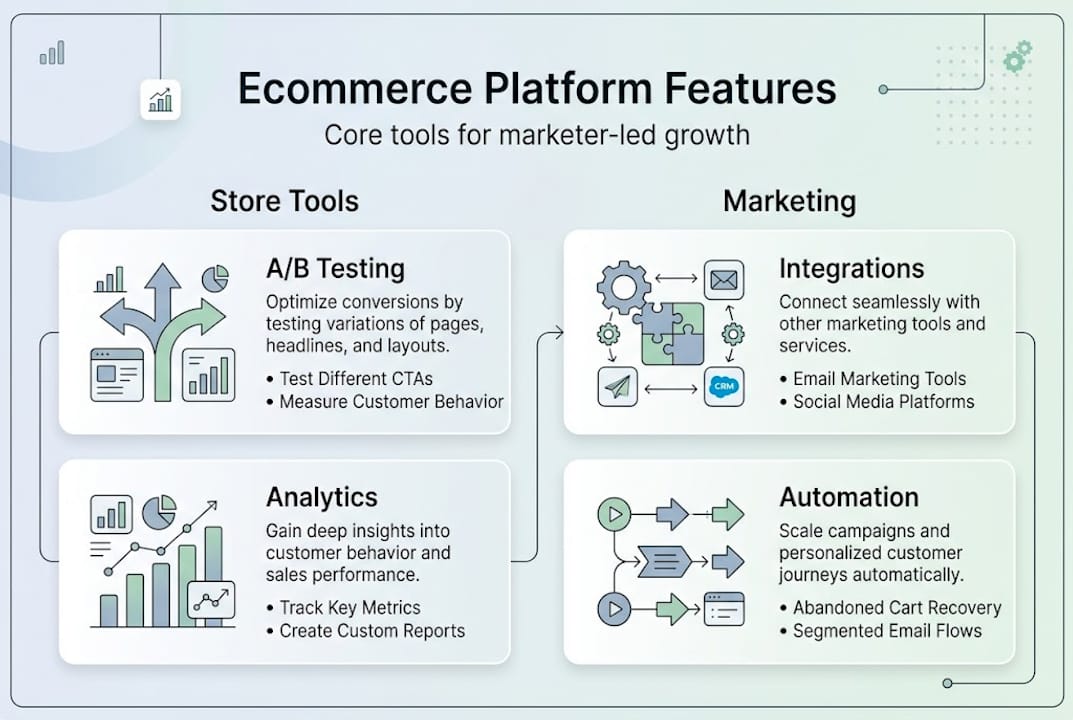
- Product catalog management: Upload, categorize, and update product listings with variants, descriptions, and images.
- Inventory tracking: Monitor stock levels across warehouses, locations, or fulfillment partners in real time.
- Payment processing: Accept credit cards, digital wallets, buy-now-pay-later options, and international currencies.
- Order and fulfillment management: Automate picking, packing, shipping notifications, and returns workflows.
- Customer support tools: Manage tickets, live chat, and order history from a centralized dashboard.
- Analytics and reporting: Track revenue, conversion rates, average order value, and customer lifetime value.
- Marketing and experimentation tools: Run email campaigns, personalize landing pages, and test variations to improve results.
That last point is where the real growth potential lives. Most marketers focus so heavily on the first five categories that they underuse or completely ignore the testing and experimentation layer. Understanding ecommerce optimization basics helps you see how each platform feature feeds into a broader strategy for improving sales performance.
"An ecommerce platform is no longer just a transaction tool. It's a living system that connects your products, customers, and data into a feedback loop that can either accelerate or stall your growth depending on how you use it."
Modern platforms are built on APIs (application programming interfaces, which let different software systems talk to each other), making them highly extensible. You can connect third-party tools for email marketing, customer reviews, loyalty programs, or specialized A/B testing software without rebuilding your store from scratch. This flexibility is what separates a growth platform from a simple web store builder.
The distinction matters enormously for marketers. When your platform supports integrations with testing tools, personalization engines, and analytics dashboards, you can run experiments across every touchpoint, from the first product page visit to the post-purchase email sequence. That iterative improvement cycle is what compounds over time into measurable revenue growth.
Essential features of modern ecommerce platforms
Not all platforms are created equal. When you're evaluating options for your store, the feature list can feel overwhelming. Let's cut through the noise and focus on what actually moves the needle for marketers and growth specialists.
Here's how three of the most widely used platforms compare across the features that matter most for optimization:
| Feature | Shopify | BigCommerce | WooCommerce |
|---|---|---|---|
| Native A/B testing | Via apps | Via integrations | Via plugins |
| Built-in analytics | Yes | Yes | Limited |
| Checkout customization | Limited (Plus only) | Flexible | Full control |
| API extensibility | High | High | High |
| Headless commerce support | Yes | Yes | Yes |
| Payment gateway options | 100+ | 65+ | 100+ |
| Marketing integrations | Extensive | Strong | Moderate |
| Ease of use | High | Medium | Lower |
The table tells an important story. None of these platforms deliver native A/B testing out of the box in a robust way. They all rely on apps, integrations, or plugins. That's not a flaw; it's actually an opportunity. It means you can choose a best-in-class testing tool that fits your traffic volume and testing goals, rather than settling for a watered-down native feature.
When comparing platforms for your specific growth needs, prioritize these capabilities:
- Storefront flexibility: Can you change page layouts, hero images, and calls to action without a developer?
- Integration ecosystem: Does the platform connect with your email tool, CRM, and analytics stack?
- Experimentation support: Can you run A/B tests on themes, pricing, content, and checkout flows without writing code?
- Performance: How fast does the platform load pages, and does adding testing scripts degrade that speed?
- Reporting depth: Can you track micro-conversions, not just final sales?
The last bullet is critical for growth teams. If you can only see top-level revenue data, you're flying blind. You need to understand where in the funnel visitors are dropping off before you can run meaningful experiments to fix it. Reading a solid conversion optimization guide before you finalize your platform choice will save you from costly switching decisions later.
Pro Tip: Before committing to a platform, run a lightweight test. Set up a free trial, connect your preferred A/B testing tool, and check whether the integration adds more than 10KB to your page load. Bloated scripts can tank your conversion rate before you even start experimenting.
How ecommerce platforms power A/B testing for growth
A/B testing (also called split testing) is the practice of showing two or more versions of a page or element to different visitors simultaneously, then measuring which version drives more of the outcome you care about, whether that's clicks, add-to-carts, or completed purchases. When done consistently, it's one of the most reliable ways to grow revenue without increasing ad spend.
Here's how to actually set up and run experiments on a modern ecommerce platform:
- Define your hypothesis. Start with a specific, testable idea. "Changing the product image on the hero banner from lifestyle to product-only will increase add-to-cart rate by 10%." Vague hypotheses produce vague learnings.
- Identify the test element. Decide exactly what you're changing: a headline, button color, price display format, checkout step, or entire page layout.
- Choose your testing tool. Platforms like Shopify support testing tools such as Intelligems for pricing tests, Shoplift for theme and content tests, and Shogun for landing page experiments. For general-purpose use across platforms, VWO and Optimizely are widely trusted.
- Set your sample size and duration. Use a statistical power calculator to determine how much traffic you need before results are meaningful. Running a test for less than two weeks almost always produces unreliable data.
- Launch and monitor. Don't check results daily. Set a check-in schedule and resist the urge to call a winner early.
- Analyze and apply. Once statistical significance is reached, implement the winner and document your learnings for future test design.
The types of tests you can run on most platforms include theme and layout variations, pricing strategies (free shipping thresholds, bundle pricing), product description formats, checkout page copy, and email subject lines for abandoned cart flows. The breadth of A/B testing strategies available means there's rarely a shortage of ideas; the challenge is prioritizing which tests will have the highest impact given your current traffic and conversion bottlenecks.

One often-overlooked factor is page speed. Every testing script you add to your site carries a performance cost. Tools that run on lightweight scripts (under 6KB, for example) let you experiment continuously without harming the user experience that you're simultaneously trying to improve. The relationship between site speed and A/B testing for revenue growth is tighter than most marketers realize.
Pro Tip: If you're running fewer than 5,000 monthly sessions on a key landing page, focus on multivariate qualitative research first (heatmaps, session recordings, user surveys) before investing heavily in A/B testing. You need enough traffic to reach statistical significance in a reasonable time frame, or your test results will be meaningless.
Critical pitfalls in ecommerce experimentation (and how to avoid them)
A/B testing looks simple on the surface. But the gap between running tests and running good tests is wider than most teams expect. Here are the mistakes that consistently derail ecommerce experimentation programs.
| Pitfall | Why it happens | How to fix it |
|---|---|---|
| Early stopping | Results look promising after a few days | Set a fixed end date before launching |
| Low traffic tests | Not enough visitors per variant | Calculate minimum detectable effect upfront |
| P-hacking | Checking results repeatedly until they're "significant" | Pre-register your hypothesis and analysis plan |
| Ignoring segments | Aggregate results hide opposing effects | Analyze results by device, traffic source, and customer type |
| Simpson's paradox | Segment-level results contradict overall results | Always check for confounding variables |
| Testing too many things | Unclear which change drove results | Test one variable at a time when possible |
The most damaging of these is early stopping. Early stopping inflates false positives by 30%, meaning you're more likely to implement a "winning" change that actually has no real effect or that actively hurts performance. This wastes development resources and can quietly erode your conversion rate over months.
"The pressure to ship results fast is the biggest enemy of statistically valid experimentation. Speed feels productive; patience produces actual growth."
Here's a prevention checklist every marketer should review before launching any experiment:
- Confirm sample size requirements using a power calculator before starting.
- Set a fixed test duration (minimum 14 days to account for weekly behavioral cycles).
- Lock down your primary metric before the test goes live.
- Avoid running overlapping tests on the same page or user segment.
- Segment your results by device type (mobile vs. desktop often behave very differently).
- Check for external factors that could skew results (promotions, seasonality, traffic source shifts).
Understanding how to master A/B testing pitfalls is just as important as knowing how to set up a test in the first place. If you're newer to experimentation, reviewing A/B testing mistakes and insights from real campaigns will accelerate your learning curve significantly.
Low-traffic stores face a particularly challenging situation. When you have fewer visitors, you need to either increase your minimum detectable effect (the smallest change you expect to see) or accept longer test durations. Many small ecommerce teams skip testing altogether because of this constraint, which is a mistake. There are always testable elements, such as email subject lines, ad copy, and product descriptions, that accumulate enough volume to generate meaningful data even at lower traffic levels.
Why focusing on experimentation transforms ecommerce growth (beyond just choosing a platform)
Here's an uncomfortable truth: the platform you choose matters far less than what you do with it. We've seen teams on entry-level platforms outperform competitors running enterprise solutions, simply because they tested relentlessly and shipped learnings fast.
The marketing world overindexes on platform comparisons. Feature matrices, pricing tiers, integration lists. All useful, none of it decisive. The real growth lever is the culture and discipline your team builds around experimentation. Teams that treat every quarter as a testing roadmap, with structured hypotheses, documented results, and compounding iterations, consistently outperform teams that chose the "right" platform but run experiments sporadically.
The "set it and forget it" mindset is the silent conversion killer. Your best-performing page today will underperform in six months as customer expectations shift, competitors adjust, and traffic sources evolve. Static stores decay. Experimental stores compound.
Practically speaking, this means building A/B test ideas into your monthly planning cycle, not treating testing as a one-off project. It means giving your team permission to run small, fast experiments even when the stakes feel low. Because the habit of testing is what produces the institutional knowledge that eventually creates large, durable gains.
Unlock more growth with guided ecommerce experimentation
Understanding what your ecommerce platform is capable of is the first step. Acting on that understanding is where growth actually happens.
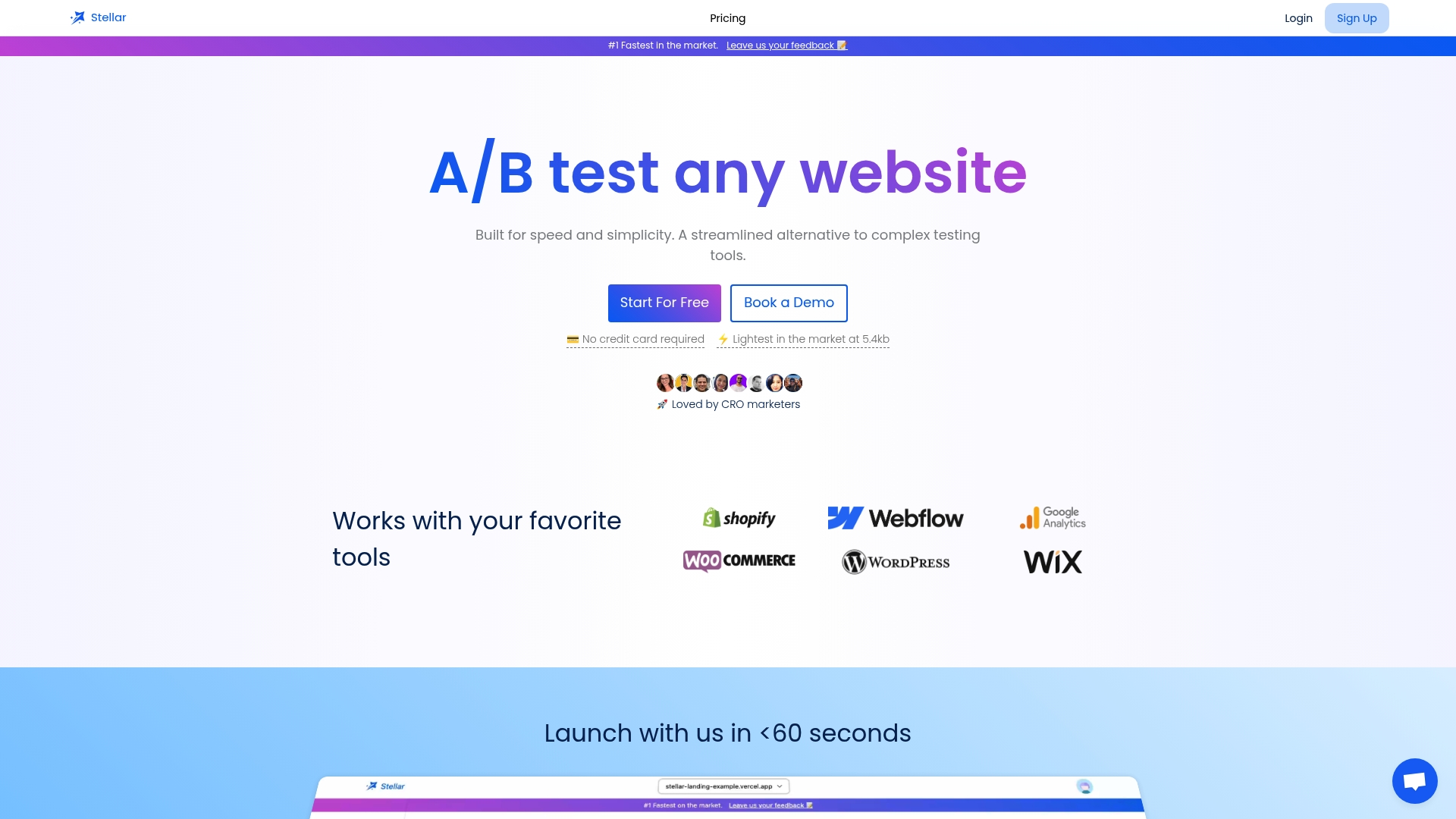
Stellar is built specifically for marketers and growth teams at small to medium-sized e-commerce businesses who want to run fast, reliable A/B tests without depending on developers. With a no-code visual editor, a lightweight 5.4KB script that protects your page speed, real-time analytics, and a free plan for stores with under 25,000 monthly tracked users, Stellar makes continuous experimentation genuinely accessible. If you're ready to move from guessing to growing, explore what Stellar can do for your store and start your first experiment today.
Frequently asked questions
What is an ecommerce platform in simple terms?
An ecommerce platform is software that lets you create, run, and grow an online store by managing products, payments, orders, and customer experiences in one place, with modern platforms also supporting testing and personalization tools that directly improve sales performance.
How do ecommerce platforms help increase sales?
They provide built-in or integrated tools like A/B testing, marketing automations, and detailed analytics that help you understand what's working and optimize the shopping experience based on real data rather than assumptions. Platforms that support A/B testing through apps and integrations make this accessible without custom development.
What's the difference between native and integrated A/B testing in ecommerce platforms?
Native A/B testing is built directly into the platform, while integrated testing relies on external apps or services that connect to your store for more advanced or flexible experiments. Most leading platforms, as noted in Shopify's testing overview, rely on integrations for serious experimentation work.
What common mistakes should marketers avoid in ecommerce A/B testing?
Stopping tests too early and running experiments on pages with insufficient traffic are the most damaging errors. Research shows that early stopping inflates false positives by 30%, so always set a fixed duration and calculate your required sample size before launching any test.
Recommended
Published: 4/26/2026