
What Is Optimizely? A Guide for Marketers in 2026
TL;DR:
- Optimizely is an enterprise digital experience platform that unifies experimentation, content management, commerce, and customer data into one system. It is designed for high-traffic organizations and offers modular, usage-based pricing starting around $36,000 annually. Smaller teams may find its complexity and cost prohibitive, benefiting instead from lighter, purpose-built tools.
Optimizely is a digital experience platform (DXP) that unifies A/B testing, content management, commerce, and customer data into one system for enterprise marketing teams. Founded in 2010 and rebranded from Episerver in 2021, it has grown into a platform serving organizations that need more than a standalone testing tool. If you are a marketing professional or business owner evaluating Optimizely for A/B testing, personalization, or conversion rate optimization, this guide covers what the platform actually does, what it costs, and whether it fits your organization's needs.
What is Optimizely and what does it do?
Optimizely is defined as a comprehensive DXP that combines experimentation, CMS, commerce, and customer data into a single marketing lifecycle platform. The term "digital experience platform" is the recognized industry category here. Optimizely sits at the top of that category, designed for organizations running high-traffic digital properties that need to test, personalize, and publish content at scale.

The platform's core purpose is to eliminate the fragmentation that happens when marketing teams run separate tools for content, analytics, and testing. Optimizely centralizes the marketing lifecycle by connecting content creation, audience segmentation, experimentation, and commerce data in one place. That integration is what separates it from point solutions like a standalone A/B testing tool or a basic CMS.
The most common misconception about Optimizely is treating it as just an A/B testing tool. It is that, but it is also a content management system, a commerce platform, and a customer data hub. Understanding the full scope of what Optimizely does is the first step to evaluating whether the investment makes sense for your team.
What are the main Optimizely features?
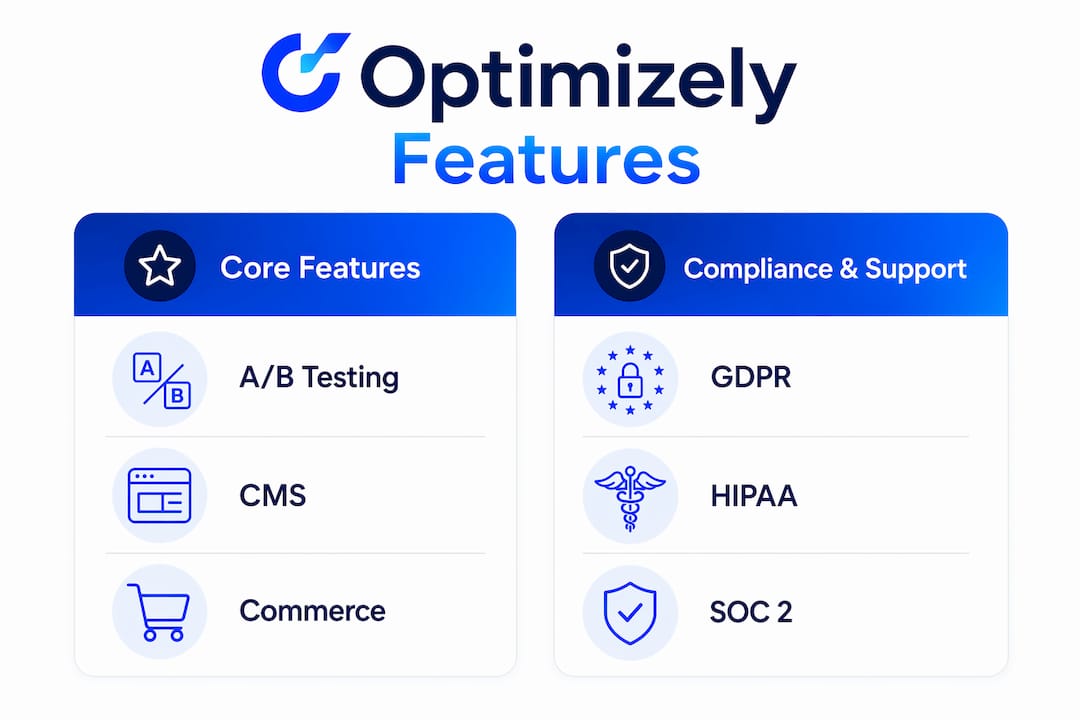
Optimizely's platform is organized into several interconnected modules, each targeting a specific part of the digital marketing workflow.
- Experimentation: Web experimentation, feature flagging, and multivariate testing give marketing and product teams the ability to run controlled tests across web properties and application features. This is the module most people associate with the Optimizely name.
- Content Cloud (CMS): A headless and traditional CMS that supports content personalization, workflow management, and multi-channel publishing. Marketing teams use it to manage and test content variations without relying on developers for every change.
- Commerce Cloud: Digital storefront management with product catalog, order management, and commerce-specific personalization. It connects directly to experimentation so teams can test checkout flows and product pages with real transaction data.
- Customer Data Platform (CDP): Real-time audience segmentation using first-party data. The CDP feeds behavioral signals into personalization and experimentation, so tests are targeted rather than broad.
- Opal (AI assistant): AI-driven features like Opal automate content generation, transcription, and predictive analytics for campaign optimization. This is a recent addition that reduces manual work in content production and experiment analysis.
Pro Tip: If you are evaluating Optimizely features, request a demo that shows the CDP and Experimentation modules working together. That integration is where the platform's real value shows up, not in any single module on its own.
Optimizely also supports GDPR, CCPA, HIPAA, and SOC 2 Type II certifications, which matters for marketing teams in regulated industries like healthcare or financial services. That compliance coverage is built into the platform rather than bolted on, which reduces legal review time during procurement.
How does Optimizely pricing work?
Optimizely pricing is modular and usage-based, not a flat per-seat subscription. Pricing starts at around $36,000 annually for basic web experimentation and can exceed $400,000 per year for full enterprise deployments that include Commerce Cloud and the CDP.
| Module | Approximate Starting Cost | Pricing Driver |
|---|---|---|
| Web Experimentation | ~$36,000/year | Monthly tracked users |
| Content Cloud (CMS) | Custom quote | Page views, content volume |
| Commerce Cloud | Custom quote | Order volume, catalog size |
| Intelligence Cloud (CDP) | Custom quote | Data records, segments |
| Full DXP Bundle | $200,000–$400,000+/year | Combined usage metrics |
The Optimizely cost structure scales by monthly tracked users, order volume, or catalog size depending on which modules you license. Contract negotiations can be complex because each module is gated separately, and usage overages can trigger additional fees mid-contract.
Beyond the license, total cost of ownership often exceeds the base license by 35 to 50% in the first year due to implementation, data migration, training, and staffing. A mid-market company licensing Optimizely at $80,000 per year should budget an additional $28,000 to $40,000 for onboarding alone.
Pro Tip: Before signing any Optimizely contract, get a detailed breakdown of what triggers usage overages. Monthly tracked user counts can spike during campaign launches, and an unexpected overage on a $36,000 base contract can add thousands to your annual bill. See the full Optimizely cost breakdown before you negotiate.
How does Optimizely compare to other platforms?
Optimizely's all-in-one DXP approach is its defining characteristic, and also its biggest limitation for smaller organizations. Optimizely is designed for high-traffic organizations, and teams with low visitor volumes may struggle to reach statistical significance in experiments efficiently. Running an A/B test requires enough traffic to produce reliable results. If your site gets fewer than 50,000 monthly visitors, most experiments will take months to conclude.
| Dimension | Optimizely | Leaner SMB tools |
|---|---|---|
| Scope | Full DXP (CMS, commerce, CDP, experimentation) | Focused on A/B testing and analytics |
| Pricing | $36,000+ annually, modular | Free tiers available, usage-based |
| Setup complexity | High, requires implementation partner | Low to moderate, no-code options |
| Ideal traffic volume | 500,000+ monthly visitors | 10,000–500,000 monthly visitors |
| Compliance certifications | GDPR, CCPA, HIPAA, SOC 2 | Varies by vendor |
Where Optimizely excels is in organizations that have already outgrown point solutions. A retail brand managing 10 million monthly sessions across multiple storefronts, running 50 concurrent experiments, and publishing content in six languages genuinely needs what Optimizely offers. For that organization, the alternative is stitching together five separate tools, each with its own API, data model, and vendor relationship.
Optimizely's advanced capabilities make it overkill for SMBs who need fast, low-overhead experimentation. Smaller teams are better served by tools built specifically for their scale, where setup takes hours rather than months and pricing does not require a procurement team to negotiate.
The right question is not whether Optimizely is better than alternatives. It is whether your organization has the traffic volume, budget, and internal resources to extract value from a full DXP. For a detailed look at no-code experimentation options within the Optimizely ecosystem, the contrast with lighter tools becomes clear quickly.
What practical benefits does Optimizely deliver for marketers?
When Optimizely is implemented correctly, the benefits for marketing teams are concrete and measurable. Here are the primary gains organizations report:
- Faster experiment deployment. With the visual editor and pre-built integrations, marketing teams can launch web experiments without writing code. Campaigns that previously required developer tickets can go live in hours.
- Smarter personalization. The CDP feeds real-time behavioral data into content and experiment targeting. Instead of showing the same homepage to every visitor, teams can serve different experiences based on acquisition channel, purchase history, or session behavior.
- Unified data for decision-making. When content, commerce, and experimentation data live in the same platform, attribution becomes cleaner. Marketers can trace a conversion back through the content touchpoints and experiment variants that influenced it, without exporting data across three tools.
- Cross-team collaboration. Product and marketing teams share the same experiment results, audience segments, and content workflows. That shared context reduces the back-and-forth that slows down campaign iteration.
- Improved conversion rates through systematic testing. Organizations that run continuous experimentation programs consistently outperform those that rely on intuition. Optimizely's A/B testing framework gives teams the infrastructure to make testing a repeatable process rather than a one-off project.
Effective use of Optimizely also requires planning for statistical power and experiment duration. Running too many experiments simultaneously with insufficient traffic dilutes results. The teams that get the most from the platform treat experimentation as a discipline, not a feature they turn on and forget.
Key takeaways
Optimizely is an enterprise-grade DXP that delivers real value only when organizations have the traffic volume, budget, and internal expertise to use it at scale.
| Point | Details |
|---|---|
| Optimizely is a full DXP | It combines A/B testing, CMS, commerce, and CDP in one platform, not just a testing tool. |
| Pricing starts at $36,000/year | Total first-year costs often run 35 to 50% higher than the base license due to implementation. |
| High traffic is required | Teams with fewer than 50,000 monthly visitors will struggle to reach statistical significance. |
| Modular contracts are negotiable | Usage-based pricing scales by tracked users and order volume, so negotiate overages upfront. |
| SMBs need leaner alternatives | Smaller teams benefit more from purpose-built A/B testing tools with lower overhead and faster setup. |
Why Optimizely is powerful but not for everyone
I have spent years watching marketing teams make the same mistake with Optimizely: they buy it for A/B testing and then discover they have also bought a CMS migration project, a CDP implementation, and a six-month onboarding program. The platform is genuinely impressive when it is fully deployed. The problem is that "fully deployed" is a significant undertaking.
The teams I have seen get real ROI from Optimizely share three traits. They have dedicated experimentation programs with someone owning the testing roadmap. They have enough traffic to run experiments that conclude in weeks, not quarters. And they have already felt the pain of managing content, commerce, and analytics in disconnected systems. If those three conditions apply to your organization, Optimizely is worth the investment and the complexity.
If they do not, you are paying enterprise prices for capabilities you will not use. The Optimizely meaning in practice is a platform that rewards organizations ready to commit to it fully. Buying it as a point solution is the most expensive way to run A/B tests on the market.
The trend I am watching in 2026 is AI-assisted experimentation. Opal is a step in the right direction, but the real shift will come when platforms can suggest experiment hypotheses based on behavioral data automatically. Optimizely is positioned to lead that shift. Whether your organization is positioned to benefit from it is a separate question worth answering before you sign a contract.
— Juan
Ready to start experimenting without the enterprise overhead?
If Optimizely's pricing or complexity puts it out of reach for your current stage, you do not have to wait until you are enterprise-scale to run serious experiments.
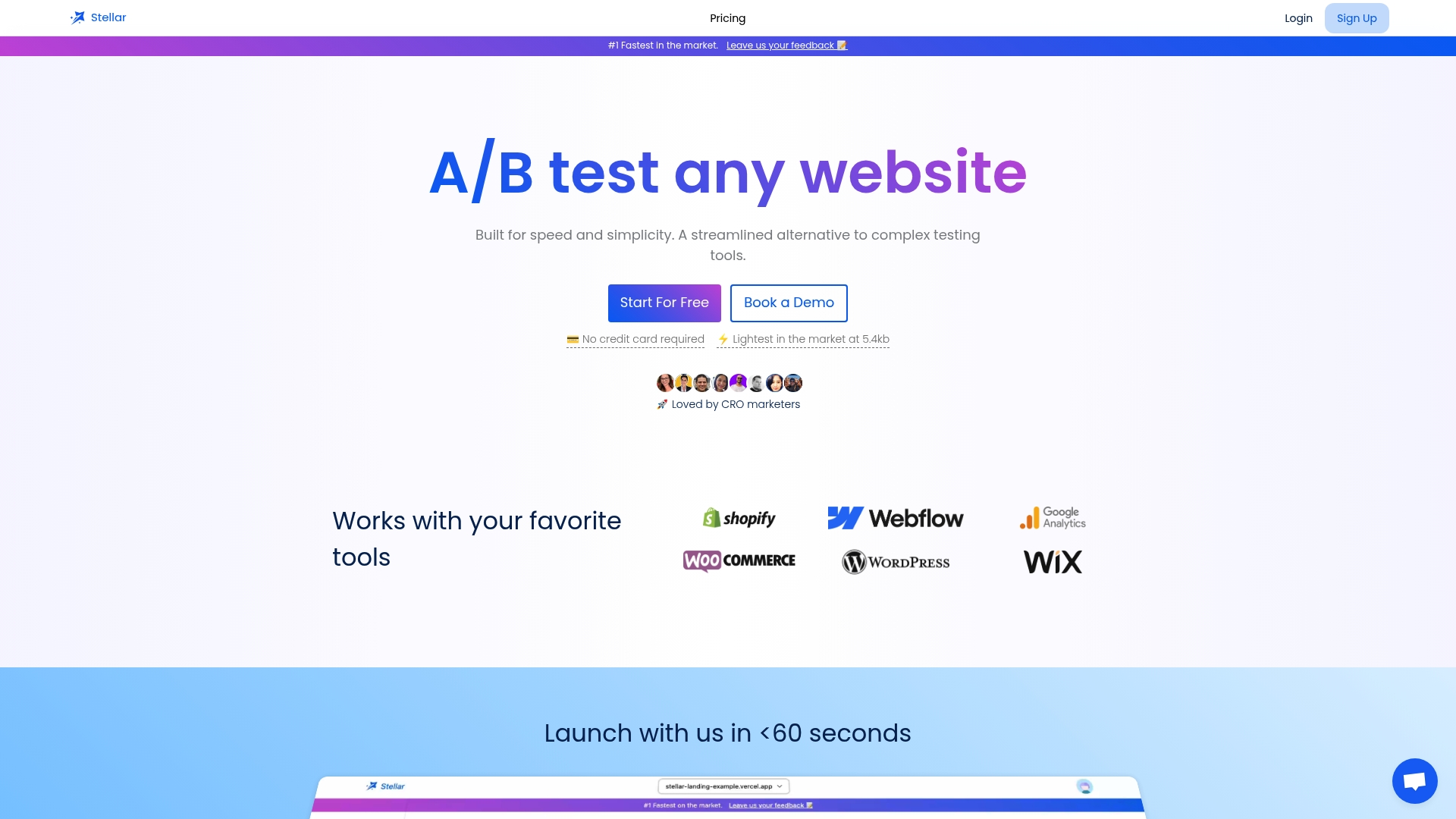
Gostellar is built for marketers and growth teams who need fast, reliable A/B testing without a six-month implementation. With a 5.4KB script that keeps your site performance intact, a no-code visual editor, and real-time analytics, Gostellar lets you start A/B testing the same day you sign up. There is a free plan for sites under 25,000 monthly tracked users, and paid tiers that scale with your traffic without the modular contract complexity. If you want the discipline of systematic experimentation without the enterprise price tag, Gostellar is where to start.
FAQ
What is Optimizely used for?
Optimizely is used for A/B testing, multivariate experimentation, content management, digital commerce, and customer data segmentation within a unified digital experience platform. Enterprise marketing teams use it to personalize digital experiences and improve conversion rates at scale.
How much does Optimizely cost?
Optimizely pricing starts at approximately $36,000 per year for web experimentation and can exceed $400,000 annually for full enterprise deployments. First-year total costs typically run 35 to 50% above the base license when implementation and training are included.
Is Optimizely good for small businesses?
Optimizely is designed for high-traffic enterprise organizations and is generally not the right fit for small businesses. Teams with fewer than 50,000 monthly visitors will find it difficult to reach statistical significance in experiments and will likely pay for capabilities they cannot fully use.
What are the main Optimizely features?
Optimizely's core features include web and feature flag experimentation, a headless CMS, Commerce Cloud for digital storefronts, a Customer Data Platform for real-time segmentation, and Opal, an AI assistant for content generation and predictive analytics.
Does Optimizely support compliance requirements?
Optimizely supports GDPR, CCPA, HIPAA, and SOC 2 Type II certifications, making it suitable for marketing teams in regulated industries such as healthcare and financial services.
Recommended
Published: 6/8/2026