
What Is Website Testing? A 2026 Guide for Marketers
TL;DR:
- Website testing systematically ensures a website's functionality, speed, security, usability, and compatibility across all devices. It protects business outcomes by preventing issues like broken links, slow load times, and accessibility violations and should be performed continuously using both manual and automated methods. Key metrics such as Core Web Vitals guide performance benchmarks, making ongoing testing essential for maintaining high site quality and search rankings.
Website testing is the structured process of systematically checking a website's functionality, speed, usability, security, and compatibility to confirm it performs as intended across all devices and browsers. For marketers, product managers, and business owners, understanding this process is not optional. Performance errors like slow loading and broken links directly harm SEO rankings and user satisfaction. Tools like BrowserStack, Selenium, and Google Lighthouse have made testing more accessible than ever, and Google's Core Web Vitals have turned performance benchmarks into a direct ranking factor. If your site fails a test, your business pays for it.

What is website testing and what does it cover?
Website testing is a structured quality assurance process covering functionality, usability, compatibility, performance, and security to confirm websites work as expected across all devices before launch. The industry term for this practice is web quality assurance (web QA), though "website testing" is the phrase most marketers and product managers use in practice. Both terms refer to the same discipline.
The scope of website testing is broader than most people assume. A single website launch can require checks on dozens of user flows, hundreds of browser and device combinations, and multiple layers of back-end infrastructure. Missing any one of these areas creates real risk: a broken checkout form, a page that loads in six seconds on mobile, or a login screen that fails on Safari can each cost you customers and revenue.
The five core domains of website testing map directly to business outcomes. Functionality testing protects revenue by confirming that forms, payments, and navigation work. Usability testing protects conversion rates by confirming that users can complete tasks without friction. Performance testing protects SEO and engagement. Security testing protects user data and brand trust. Compatibility testing protects reach by confirming your site works for every visitor regardless of device or browser.
What are the main types of website testing and how do they differ?
There are 8 to 10 primary types of website testing, spanning functional, usability, compatibility, performance, security, regression, accessibility, localization, interface, and database testing. Each type targets a different failure mode, so knowing which one applies to your situation saves time and budget.
The six types marketers encounter most
Functional testing verifies that core features like forms, navigation, and interactions behave as expected. If a contact form submits but never sends an email, functional testing catches it. This is the baseline test every site needs before any traffic arrives.

Usability testing evaluates whether real users can complete tasks intuitively. It often involves session recordings, heatmaps, or moderated user sessions. Tools like Hotjar and UserTesting.com are common here. The goal is to find friction before it shows up in your bounce rate.
Performance testing measures speed and stability under load. Benchmarks for 2026 set TTFB under 200ms and LCP under 2.5 seconds as targets for optimal user experience and SEO. Missing these thresholds means Google penalizes your rankings and users abandon your pages.
Security testing scans for vulnerabilities like SQL injection, cross-site scripting, and exposed user data. Tools like OWASP ZAP and Burp Suite are standard here. For any site handling customer data, skipping this test is a liability.
Compatibility testing confirms your site renders and functions correctly across Chrome, Firefox, Safari, and Edge, as well as across iOS, Android, and desktop operating systems. BrowserStack is the most widely used tool for this.
Accessibility testing checks whether your site meets WCAG 2.1 standards so users with disabilities can navigate it. Accessibility is a legal and ethical necessity that most teams still treat as optional, despite the compliance risk and the SEO benefit of accessible markup.
| Testing type | Primary objective | Common tools |
|---|---|---|
| Functional | Verify features work as designed | Selenium, Cypress, TestMu |
| Usability | Identify UX friction and task failures | Hotjar, UserTesting.com |
| Performance | Measure speed and stability | Google Lighthouse, GTmetrix |
| Security | Find and fix vulnerabilities | OWASP ZAP, Burp Suite |
| Compatibility | Confirm cross-browser and device rendering | BrowserStack, LambdaTest |
| Accessibility | Meet WCAG standards and legal requirements | axe, WAVE, Deque |
Pro Tip: Run accessibility testing with axe or WAVE before launch. It takes under 30 minutes and catches issues that affect both compliance and SEO through accessible markup.
How to test a website: manual vs. automated methods
Manual testing and automated testing are not competing approaches. They solve different problems, and the best teams use both. Hybrid testing approaches combining manual and automated methods are considered best practice, balancing human insight for UX with automation efficiency for regression and repetitive tests.
Manual testing excels at catching nuanced UX issues that scripts cannot detect. A human tester notices when a button label feels confusing, when a page layout looks broken at an unusual screen size, or when a checkout flow feels unnecessarily long. These are judgment calls that no automated tool makes reliably. Manual testing is also the right choice for exploratory testing, where the goal is to find unexpected problems rather than verify known behaviors.
Automated testing tools deliver speed, consistency, and scalability, enabling teams to catch bugs early and improve overall website reliability. Selenium and Cypress are the two most widely used frameworks for web automation. For marketers and product managers without engineering resources, no-code platforms like Testim and Reflect offer browser-based test recording without writing a single line of code.
Pros and cons at a glance:
- Manual testing pros: Catches UX nuance, requires no setup, works for exploratory testing
- Manual testing cons: Slow, inconsistent across testers, not scalable for regression
- Automated testing pros: Fast, repeatable, runs overnight or on every deployment
- Automated testing cons: Requires initial setup, misses visual and UX judgment calls
- Hybrid pros: Covers both functional reliability and user experience quality
- Hybrid cons: Requires coordination between QA, product, and marketing teams
Pro Tip: If you have no QA team, start with a free Cypress setup for your five most critical user flows: homepage load, form submission, checkout, login, and search. Automate those five first and add manually tested UX reviews on a monthly cadence.
Key website testing metrics and benchmarks to track
Performance metrics give you a measurable definition of "working correctly." Without them, testing produces observations but no clear pass or fail criteria. The Web Application Performance Testing guide for growth marketers outlines how these metrics connect directly to conversion rates and organic traffic.
Google's Core Web Vitals are the most consequential metrics for marketers in 2026. Largest Contentful Paint (LCP) measures how quickly the main content loads. Interaction to Next Paint (INP) measures how fast the page responds to user input. Cumulative Layout Shift (CLS) measures visual stability. All three are direct Google ranking signals, which means poor scores cost you both users and search visibility.
Lab-based tools like Google Lighthouse offer baseline metrics, but Real User Monitoring (RUM) is required for capturing authentic user experience across diverse conditions. Lighthouse tests your site in a controlled environment. RUM tools like Datadog, New Relic, and SpeedCurve capture what real users actually experience on their devices and connections. The gap between the two numbers is often larger than teams expect.
| Metric | Target | Measurement tool |
|---|---|---|
| Time-to-First-Byte (TTFB) | Under 200ms | WebPageTest, GTmetrix |
| Largest Contentful Paint (LCP) | Under 2.5 seconds | Google Lighthouse, CrUX |
| Interaction to Next Paint (INP) | Under 200ms | Chrome UX Report |
| Cumulative Layout Shift (CLS) | Under 0.1 | PageSpeed Insights |
| Uptime | 99.9% or higher | UptimeRobot, Pingdom |
Pro Tip: Set up UptimeRobot on a free plan to monitor your site every five minutes. You will know about outages before your customers report them, which protects both revenue and brand reputation.
Common challenges in website testing and how to overcome them
Most teams underinvest in testing not because they disagree with its value, but because they run into practical obstacles. Recognizing these obstacles in advance makes them easier to work around.
The most common challenge is resource constraints. Testing takes time, and most marketing and product teams are already stretched. The practical fix is prioritization: test the pages and flows that generate the most revenue first. Your checkout page, your primary landing pages, and your lead capture forms deserve more testing attention than your about page.
Cross-browser and device testing is the second major challenge. Website testing should be a continuous, iterative process rather than a one-time pre-launch activity, and this is especially true for compatibility. New browser versions ship every six weeks. A layout that worked in Chrome 120 may break in Chrome 126. BrowserStack's automated screenshot feature lets you check 20 browser and device combinations in under five minutes.
The third challenge is that security and accessibility testing get skipped entirely. Both feel like "developer problems" to marketing teams, but both have direct marketing consequences. A security breach destroys brand trust. An inaccessible site excludes users and risks legal action. Neither is a developer problem exclusively.
Practical steps to overcome these challenges:
- Automate regression tests for your top five user flows so they run on every deployment
- Use a shared testing checklist across marketing, product, and QA to prevent gaps
- Schedule a monthly accessibility audit using axe or WAVE, not just a pre-launch check
- Integrate Google Search Console to catch crawl errors and Core Web Vitals regressions in real time
- Treat testing as a sprint task, not a separate phase, so it never gets cut when deadlines move
How marketers and product managers can use testing to drive conversions
Website testing is one of the highest-leverage activities a marketing team can own. Usability testing and A/B experiments work together to improve both the experience and the measurable conversion rate of any page.
The most direct application is funnel testing. Run usability sessions on your top landing pages to identify where users hesitate or drop off. Then use A/B testing to validate fixes before rolling them out site-wide. This sequence, observe then test, prevents teams from shipping changes based on assumptions rather than evidence.
Performance testing has a direct line to organic traffic. Pages that meet Core Web Vitals thresholds rank higher, load faster, and retain users longer. A one-second improvement in LCP can meaningfully increase conversion rates on mobile, where the majority of web traffic now originates. Connecting your performance testing process to your SEO reporting makes this relationship visible to stakeholders.
The most effective marketing teams treat testing as a shared responsibility. Product managers own the testing roadmap and prioritization. Marketers own the conversion metrics and user research. QA engineers own the tooling and automation. When these three groups align on what to test and why, the results compound. A fix that improves page speed also improves SEO. A UX change that reduces form abandonment also improves paid campaign ROI. Testing connects all of these outcomes.
Key takeaways
Website testing is the foundation of every high-performing site, requiring continuous coverage across functionality, performance, usability, security, and compatibility to protect both user experience and business outcomes.
| Point | Details |
|---|---|
| Testing covers five core domains | Functionality, usability, performance, security, and compatibility each protect a different business outcome. |
| Hybrid testing is best practice | Combine automated regression tests with manual UX reviews to catch both technical bugs and experience failures. |
| Core Web Vitals are ranking signals | LCP under 2.5s and TTFB under 200ms are the 2026 benchmarks for SEO and user experience. |
| Accessibility testing is non-negotiable | WCAG compliance reduces legal risk and improves SEO through accessible markup. |
| Testing must be continuous | Embedding testing into every deployment cycle prevents regressions and maintains site health over time. |
Why continuous testing is the only approach that actually works
Most of the teams I see struggle with website quality share one pattern: they test heavily before launch, then go quiet for months. The site degrades slowly. A plugin update breaks a form. A new browser version shifts a layout. A content change slows a page. None of it gets caught until a user complains or a metric drops.
The industry has known for years that testing should be a continuous cycle, not a launch gate. But most teams still treat it as a phase. The reason is usually organizational, not technical. Testing feels like a QA responsibility, so marketing and product teams hand it off and move on. That handoff is where quality dies.
The teams that get this right treat every deployment as a testing event. They automate the repetitive checks, run monthly manual reviews, and connect their performance metrics to their business dashboards so regressions are visible immediately. Accessibility is the area I see neglected most consistently, even among teams that are otherwise rigorous. It is also the area with the clearest legal and SEO upside for fixing it.
My honest recommendation: start smaller than you think you need to. Pick your five most critical pages, automate three checks per page, and review the results weekly. That discipline, maintained consistently, will do more for your site quality than any one-time audit ever will.
— Juan
Start testing smarter with Gostellar
If you are ready to move beyond one-off audits and build a real testing practice, Gostellar gives marketing teams the tools to do it without engineering support.
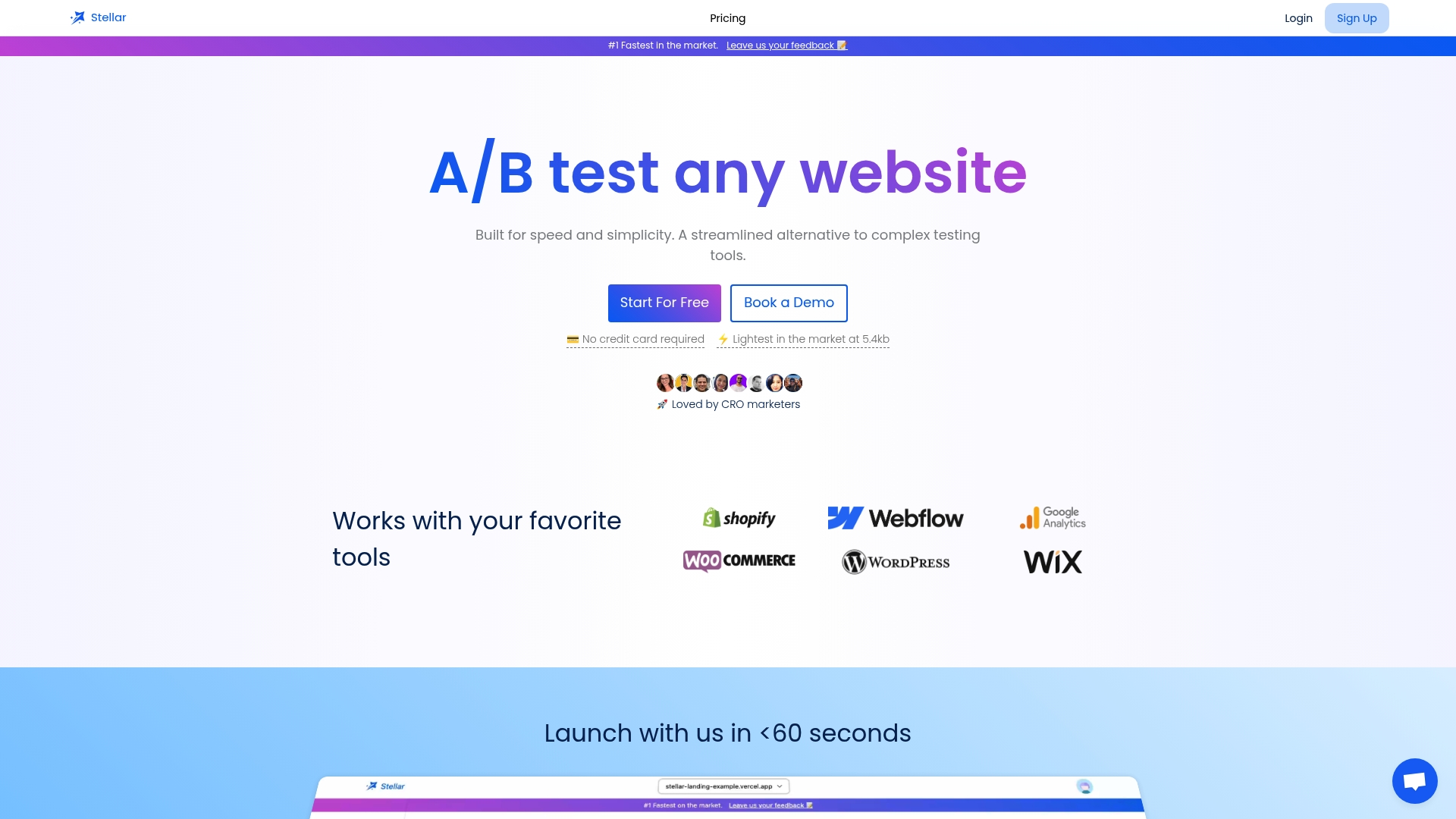
Gostellar's no-code visual editor lets you set up A/B tests and track conversion goals directly on your pages, with a lightweight 5.4KB script that adds zero meaningful load time to your site. Real-time analytics surface results as they happen, so you can make decisions based on actual user behavior rather than assumptions. For teams under 25,000 monthly tracked users, there is a free plan with no time limit. If you are serious about using testing to improve performance and conversions, Gostellar is built for exactly that.
FAQ
What is website testing in simple terms?
Website testing is the process of checking that a website works correctly across all devices, browsers, and user scenarios before and after launch. It covers functionality, speed, usability, security, and compatibility.
What is functional testing on a website?
Functional testing verifies that specific features like forms, navigation, buttons, and checkout flows behave as designed. It is the baseline test that confirms your site does what it is supposed to do.
How often should you test a website?
Website testing should be continuous, not just a pre-launch activity. Best practice is to run automated tests on every deployment and schedule manual reviews monthly to catch regressions and UX issues.
What tools are used for website performance testing?
Google Lighthouse, GTmetrix, and WebPageTest are standard lab-based tools. For real user data, Datadog, New Relic, and SpeedCurve provide Real User Monitoring (RUM) that reflects actual visitor conditions.
Why is accessibility testing important for marketers?
Accessibility testing confirms your site meets WCAG 2.1 standards, which reduces legal compliance risk and improves SEO through accessible markup. It also expands your addressable audience to users with disabilities.
Recommended
Published: 6/10/2026