
6 Essential Tips for Effective WordPress Split Testing
Guessing your way through website changes can be frustrating when you never know what actually moves your needle. You want every tweak on your WordPress site to boost sales, signups, or engagement—not just look good. Good news: split testing transforms wild guesses into data-backed improvements you can count on.
By using split testing tools built for WordPress, you can run real experiments, collect measurable results, and make changes that deliver true results. No coding is needed and you can finally see what your customers actually prefer, one clear test at a time.
Get ready to discover hands-on strategies for choosing the right tools, setting up meaningful tests, and translating data into smarter site decisions. These insights will help you maximize the value of every visitor to your site and grow your business with confidence.
Table of Contents
- Understand The Basics Of WordPress Split Testing
- Choose The Right No-Code Split Testing Tool
- Set Clear Conversion Goals For Each Test
- Implement Dynamic Keyword Insertion Tactics
- Monitor Results With Real-Time Analytics
- Optimize Based On Actionable Split Test Insights
Quick Summary
| Key Insight | Explanation |
|---|---|
| 1. Utilize A/B Testing | Conducting A/B tests helps you make data-driven design decisions, improving conversion rates. |
| 2. Choose No-Code Tools | No-code tools allow quick setup of tests without technical expertise, making experimentation easier. |
| 3. Define Clear Goals | Establish specific conversion goals for each test to focus on meaningful metrics and results. |
| 4. Monitor Results in Real-Time | Using real-time analytics helps you catch issues early and determine winners faster during testing. |
| 5. Implement Actionable Insights | Apply insights from tests to optimize your site continually, turning data into actionable improvements. |
1. Understand the Basics of WordPress Split Testing
WordPress split testing, also called A/B testing, compares two versions of a page to see which one performs better. You show different versions to your audience, track how they engage, and measure which variant drives more conversions.
This approach removes the guesswork from design decisions. Instead of relying on hunches, you use real data to improve your site's performance.
How Split Testing Works
Split testing follows a straightforward process:
- Create two versions of a page element (headline, button color, copy, layout)
- Split your traffic between them randomly
- Track user behavior and conversions for each version
- Analyze which performed better
- Implement the winner
With A/B testing in WordPress, you transform guesswork into data-driven decisions that directly impact your conversion rates.
Why This Matters for Your Business
When you're running an ecommerce store, even small improvements add up. A 2% increase in conversion rate might not sound dramatic, but across thousands of visitors monthly, it means real revenue growth.
Split testing helps you optimize:
- Headline wording and messaging
- Call-to-action button text and color
- Page layout and content arrangement
- Product descriptions and pricing displays
- Form fields and checkout steps
Since Google Optimize shut down in 2023, WordPress plugins like Nelio A/B Testing and Thrive Optimize now handle this responsibility. These tools include visual editors so you don't need coding skills to create test variations.
The Real Benefit
You're not just testing for the sake of testing. Each experiment teaches you something about your customers' preferences. Over time, these insights compound into a measurably better website.
Pro tip: Start with testing your highest-traffic page or your biggest bottleneck (usually checkout or product pages) to see results faster than testing low-traffic pages.
2. Choose the Right No-Code Split Testing Tool
Not all split testing tools are created equal. The wrong choice wastes your time learning a complicated platform, while the right tool lets you run tests in minutes without touching code.
For WordPress users, your tool selection directly impacts how quickly you can test ideas and gather results. You need something that integrates seamlessly with your site, doesn't slow it down, and gives you actionable data.
What Makes a Tool No-Code Friendly
A true no-code tool means you can create test variations using a visual editor. You click, drag, and edit directly on your page without writing any HTML or JavaScript.
The benefits include:
- Set up tests in minutes instead of days
- Make changes without developer help
- Test more frequently and run unlimited experiments
- Reduce your time to insights significantly
Key Features to Look For
When evaluating tools, prioritize WordPress integration. Your tool should live directly in your WordPress dashboard, not force you to jump between platforms.
Next, consider performance impact. Tools that offload computing to cloud servers prevent your site from slowing down when running tests. This matters because page speed affects conversions.
You also want built-in analytics and visitor behavior tracking. Heatmaps and detailed conversion reports help you understand not just which version won, but why visitors engaged with it differently.
Choosing a no-code tool means trading complexity for speed, letting you test more ideas and make data-driven improvements faster than competitors still relying on technical teams.
Real Differences That Matter
Some tools charge per test. Others charge per traffic volume. For small to medium ecommerce businesses, per-traffic pricing often makes more sense when you're running unlimited tests.
Look for tools that let you test any element:
- Headlines and copy
- Button colors and text
- Page layouts
- Form fields
- Product images and descriptions
Tools specifically designed for marketers understand your workflow. They expect you to run multiple tests monthly and have built their pricing and features around that reality.
Pro tip: Start with a free tier or trial before committing, and test the platform's visual editor on one of your actual pages to confirm it handles your specific design elements smoothly.
3. Set Clear Conversion Goals for Each Test
Without clear goals, you're just collecting data without direction. Before you launch any split test, decide exactly what success looks like for that experiment.
Your conversion goal is the specific action you want visitors to take. It could be clicking a button, signing up for your email list, or completing a purchase. Without defining this first, you can't determine which variation actually won.
Why Goals Matter More Than You Think
Imagine testing two headlines on your product page. One gets more clicks. The other gets more actual purchases. Which is the winner? You can't answer that question without a pre-defined goal.
Goals keep your tests focused and your results meaningful. They also prevent you from chasing vanity metrics that don't move your business forward.
Defining Your Test Goals
Start by aligning your test goals with your overall business objectives. If you want more revenue, your goal should track purchases or revenue per visitor, not just traffic.
Common conversion goals include:
- Completed purchases or checkouts
- Email signups or form submissions
- Add-to-cart actions
- Click-through rates on specific buttons
- Video views or content engagement
- Account creation or registrations
Setting clear conversion goals means you'll spend time testing what actually matters to your business, not chasing metrics that sound impressive but drive no revenue.
Measuring conversion goals accurately ensures your winning variation truly improves results. Your WordPress plugin should track these actions automatically once you configure them.
One Variable, One Goal
Here's a critical rule: test one variable at a time while maintaining one primary goal. If you change your headline AND your button color simultaneously, you won't know which change drove results.
This discipline makes results clearer and helps you build a library of winning insights over time. Each test teaches you something specific about your audience's preferences.
Don't get distracted by secondary metrics either. Your primary goal is what matters most for this particular experiment.
Pro tip: Write your conversion goal down before launching the test, so you commit to it and avoid the temptation to change your definition of "winning" after seeing results.
4. Implement Dynamic Keyword Insertion Tactics
Dynamic keyword insertion (DKI) personalizes your landing pages by automatically inserting visitor search terms into your content. This simple tactic makes pages feel custom-built for each user, dramatically improving relevance and engagement.
When someone searches for "red leather boots" and lands on your page, they see "red leather boots" in your headline instead of a generic title. This psychological match increases trust and click-through rates.
How Dynamic Keyword Insertion Works
DKI pulls information from URL parameters or user behavior to inject relevant terms into your page dynamically. You set up rules once, and the system handles the customization automatically.
The process is straightforward:
- A visitor clicks an ad or search result and lands on your page
- The DKI tool reads the search term or parameter from the URL
- That term automatically appears in your page title, headlines, or copy
- The experience feels personalized to that specific visitor
Why This Matters for Split Testing
DKI pairs perfectly with split testing because you can measure whether personalization actually improves conversions. One variation shows generic content. Another uses dynamic keywords. The data reveals which approach drives better results for your audience.
Dynamic keyword insertion transforms generic landing pages into personalized experiences, and split testing lets you prove whether that personalization actually increases your conversion rates.
WordPress plugins like the WP Dynamic Keywords Injector make this implementation no-code. You don't need developers to dynamically customize content across your pages.
Practical Implementation
Start by identifying your top keywords or search terms. Then decide which page elements benefit most from personalization. Usually that's headlines, subheadings, and the first line of copy.
You can test different approaches:
- Generic headlines versus keyword-inserted headlines
- Standard copy versus keyword-specific messaging
- Different headline formats with the same keywords
- Multiple keyword variations using spintax
The key is testing whether your audience responds better to personalized or generic messaging. Some markets love personalization. Others don't notice the difference.
Measure engagement metrics like time on page, scroll depth, and conversion rate. DKI should improve at least one of these if it's working for your audience.
Pro tip: Test DKI on your highest-traffic landing page first, where you'll gather statistically significant results fastest and see real revenue impact.
5. Monitor Results with Real-Time Analytics
You can't improve what you don't measure. Real-time analytics let you watch your test results unfold as they happen, catching problems early and spotting winners faster.
Without live data, you're flying blind. You might kill a winning test too soon or keep a losing one running too long. Real-time visibility keeps you in control.
Why Real-Time Data Changes Everything
Traditional analytics require you to check reports hours or days after traffic occurs. By then, problems could be costing you money. Real-time analytics show conversions, clicks, and traffic splits instantly.
This speed matters for split testing. You can spot technical issues within minutes instead of discovering them after days of poor performance. You'll also notice when one variation dramatically outperforms the other.
What Metrics to Watch
Not all metrics are created equal. Focus on the metrics that directly connect to your conversion goal, which you defined earlier.
Key metrics to monitor include:
- Conversion rate for each variation
- Click-through rates on tested elements
- Traffic distribution between variations
- Form submission completion rates
- Cart abandonment rates
- Revenue per visitor
Real-time analytics transform split testing from a guessing game into an exact science where you watch results unfold and respond immediately to what the data tells you.
Your WordPress testing tool should display visual performance charts directly in your dashboard. You shouldn't need to jump between platforms to see how tests are performing.
Making Decisions From Real-Time Data
Real-time data helps you decide when to stop a test. Most tests need statistical significance before declaring a winner. With live metrics, you can see when you've gathered enough data to make confident decisions.
However, resist the temptation to declare winners too early. A variation might look great after 100 visitors but underperform at 1,000 visitors. Let tests run long enough for reliable patterns to emerge.
Also watch for unusual spikes or drops. A sudden conversion surge might indicate a technical glitch rather than a winning variation. Real-time visibility helps you catch these anomalies immediately.
Use your analytics to:
- Confirm both variations are receiving traffic
- Check that your conversion goal is tracking correctly
- Spot technical issues affecting test accuracy
- Identify clear winners when statistical significance is reached
Pro tip: Don't obsessively check your results multiple times daily as if you're watching a stock ticker. Check once or twice daily to spot issues, but let the test run its full duration before drawing conclusions.
6. Optimize Based on Actionable Split Test Insights
A split test only matters if you actually use the results. The real value comes from taking what you learned and implementing those insights to improve your site permanently.
Too many marketers run tests, see results, and never take action. That's leaving money on the table. Your job is turning data into better website performance.
From Data to Action
Split testing generates clear data about what your visitors prefer. One headline outperformed another. One button color drove more clicks. One checkout layout reduced cart abandonment.
This isn't opinion anymore. It's evidence. You've proved which approach works better for your specific audience. Now implement the winner as your new standard.
What Actually Counts as Actionable
Actionable insights are specific and implementable. "Users prefer simpler pages" is vague. "Removing the sidebar increased conversions by 12%" is actionable.
Your split test data should tell you:
- Which specific elements improved performance
- How much improvement occurred
- Which audience segments responded best
- What factors influenced the winning result
Actionable insights transform split testing from an interesting experiment into a competitive advantage by proving exactly what changes drive real revenue for your business.
The Iteration Cycle
One test rarely optimizes everything. Analyzing split test results reveals patterns that lead to better tests. You implement a winner, then test something else.
This iterative approach compounds improvements over time. A 5% improvement here, a 3% improvement there, and suddenly your conversion rate has doubled in six months.
Implement your winning variations permanently:
- Update your live page to match the winning design
- Roll out the winning copy across relevant pages
- Apply winning patterns to similar pages you haven't tested
- Document what worked so your team remembers
Building on Success
Your test winners become launching points for future tests. If headline A beat headline B, test variations of headline A next time. You're constantly refining based on real data.
However, avoid over-optimizing one element forever. After testing a headline multiple times with diminishing returns, shift focus to testing a different page element.
Also share insights across your team. If you discover that casual language outperforms formal language in your headlines, apply that learning to product descriptions, email subject lines, and ad copy.
Pro tip: Document every test result and winning insight in a shared resource so your entire team learns from each test and avoids repeating experiments that already have clear answers.
Below is a comprehensive table summarizing the main concepts, processes, tools, and strategies of WordPress split testing as discussed throughout the article.
| Topic | Description | Key Insights |
|---|---|---|
| Understand WordPress Split Testing | A method of comparing two versions of a webpage to determine which performs better by analyzing user interactions and conversions. | A data-driven approach allows improvements based on actual user behavior. |
| How Split Testing Works | Create two variations of a page element, split audience traffic between them, analyze results, and implement the optimized version. | Follow a systematic process to achieve precise optimization based on results. |
| Importance for Business | Enhances elements like headlines, CTAs, layouts, product information to boost conversion rates incrementally. | Even minor improvements in conversion rates result in significant revenue growth. |
| No-Code Split Testing Tools | Tools that integrate with WordPress dashboard and allow experimentation without requiring technical expertise. | Speed and simplicity in set-up lead to more frequent testing and insights realization. |
| Conversion Goals | Define specific measurable outcomes such as clicks or purchases to evaluate test success accurately. | Clear objectives ensure meaningful and applicable results. |
| Dynamic Keyword Insertion | Automatically tailor landing page content to visitor search terms for personalization. | Improves relevance and engagement, positively affecting conversion rates. |
| Real-Time Analytics | Monitor split test performance live to identify issues and measure results promptly. | Immediate insights refine testing and decision-making process. |
| Actionable Insights and Optimization | Implement winning test elements and document results for continuous improvement. | Iterative updates compound benefits and enhance overall site performance. |
Take Your WordPress Split Testing to the Next Level With Stellar
Mastering WordPress split testing means overcoming challenges like selecting the right no-code tool, setting clear conversion goals, and monitoring real-time analytics to drive actionable insights. You want to stop guessing and start making data-driven decisions that increase conversions and revenue while keeping your website fast and user-friendly.
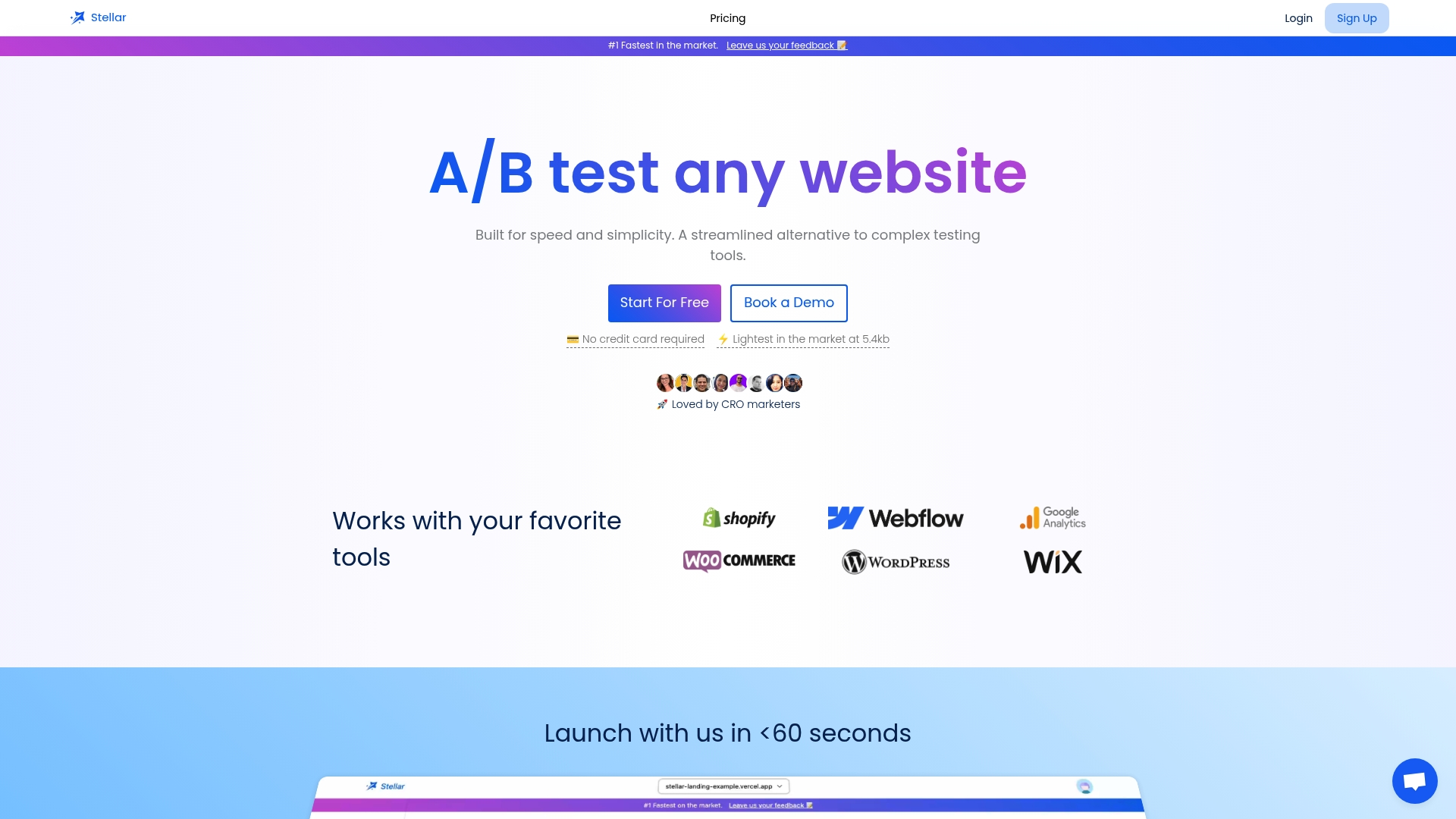
Unlock the power of a lightweight A/B testing platform specially built for marketers and growth hackers at small to medium-sized businesses. With Stellar's no-code visual editor, you can create and launch tests in minutes without technical help. Take advantage of dynamic keyword insertion to personalize landing pages and implement advanced goal tracking to measure exactly what matters. Visit Stellar's homepage now and start your free plan when you are ready to see real-time results and transform your WordPress testing strategy.
Frequently Asked Questions
What is WordPress split testing?
WordPress split testing, also known as A/B testing, is the practice of comparing two versions of a page to see which one performs better. To implement it, create two variations of a webpage element, split your traffic between them, and track user engagement to determine which performs best.
How can I choose the right split testing tool for WordPress?
To choose the right split testing tool, look for one that integrates with your WordPress dashboard and offers a no-code visual editor. Evaluate features like performance impact and built-in analytics to ensure efficient testing and quick results.
What should I define as my conversion goals before starting a split test?
Before starting a split test, define clear conversion goals that align with your business objectives, such as completed purchases or email signups. By doing this, you can focus your testing efforts on what drives real growth for your business.
How can I effectively monitor the results of my split tests?
You can monitor results effectively by using real-time analytics to track key metrics like conversion rates and traffic distribution. Set aside time daily to review the data and look for trends or anomalies, ensuring you have accurate insights for decision-making.
What does it mean to optimize based on split test insights?
Optimizing based on split test insights means implementing changes based on what your tests reveal about visitor preferences. For example, if a new headline increases conversions by 10%, update your live page to reflect this change and document the findings for future learning.
How often should I conduct split testing on my WordPress site?
You should aim to conduct split testing regularly, ideally testing a high-traffic page at least once a month. By continuously running experiments, you'll gather valuable insights over time and steadily improve your site's performance.
Recommended
- 6 Essential Tips for Mastering SEO Split Testing
- 7 Split Tests That Can Double Your Conversion Rate
- The Best WordPress A/B Testing Tools for Optimizing Your Website
- Performance-First Split Testing: Why Every Millisecond Matters
- WordPress web designers | Brainiac Media
- 7 Conversion Rate Optimization Tips for Small Businesses | Ibrandmedia
Published: 2/23/2026