
Testing Website Call-to-Actions for Higher Conversion Rates
Struggling to pinpoint why your website call-to-actions miss their mark can feel frustrating when every click matters in a crowded marketplace. Clear, measurable goals are the backbone of practical A/B testing and help tie efforts directly to transparent results. By embracing the SMART goal framework, you give structure and focus to each experiment, turning guesswork into actionable steps that drive real improvement for your business.
Table of Contents
- Step 1: Define Measurable Goals For Website Call-To-Actions
- Step 2: Set Up A/B Tests Using A Visual Editor
- Step 3: Personalize CTAs With Dynamic Keyword Insertion
- Step 4: Analyze Real-Time Test Results For Insights
- Step 5: Refine Call-To-Actions Based On Performance Data
Quick Summary
| Key Point | Explanation |
|---|---|
| 1. Define SMART goals for CTAs | Establish specific, measurable, achievable, relevant, and time-bound goals to focus your optimization efforts effectively. |
| 2. Utilize visual editors for A/B testing | Use coding-free visual tools to create and test multiple CTA variations easily, enhancing your optimization process. |
| 3. Personalize CTAs with dynamic keywords | Tailor your CTA messaging based on user data and intent to increase relevance and drive higher engagement rates. |
| 4. Analyze A/B test results in real-time | Monitor performance data instantly to make informed adjustments quickly and validate your optimization strategies. |
| 5. Continuously refine CTAs based on data | Regularly assess performance metrics and make strategic adjustments to your CTAs to improve conversion rates over time. |
Step 1: Define measurable goals for website call-to-actions
Defining clear and measurable goals is the critical foundation for effective website call-to-action (CTA) testing. Without precise objectives, your optimization efforts will be unfocused and potentially ineffective.
To establish meaningful CTA goals, leverage the SMART goal framework which ensures your objectives are specific, measurable, acceptable, realistic, and time-bound. Here are strategic steps to create actionable CTA goals:
- Identify specific conversion targets: Determine exactly what user action you want to track
- Set numeric benchmarks: Establish precise percentage increases or numerical targets
- Define measurement timeframes: Specify the duration for evaluating goal performance
- Select relevant performance metrics: Choose indicators directly tied to your business objectives
For example, a measurable CTA goal might look like: "Increase newsletter signup conversion rate by 15% within the next 60 days by optimizing button placement and design."
Here's how the SMART framework compares to traditional goal-setting methods for CTAs:
| Aspect | SMART Goals for CTAs | Traditional Goal-Setting |
|---|---|---|
| Clarity | Highly specific and detailed | Often broad or vague |
| Measurement | Quantifiable results required | Rarely tracked objectively |
| Timeframe | Clear deadline for achievement | Undefined completion window |
| Alignment with Metrics | Direct tie to conversion metrics | May not link to key outcomes |
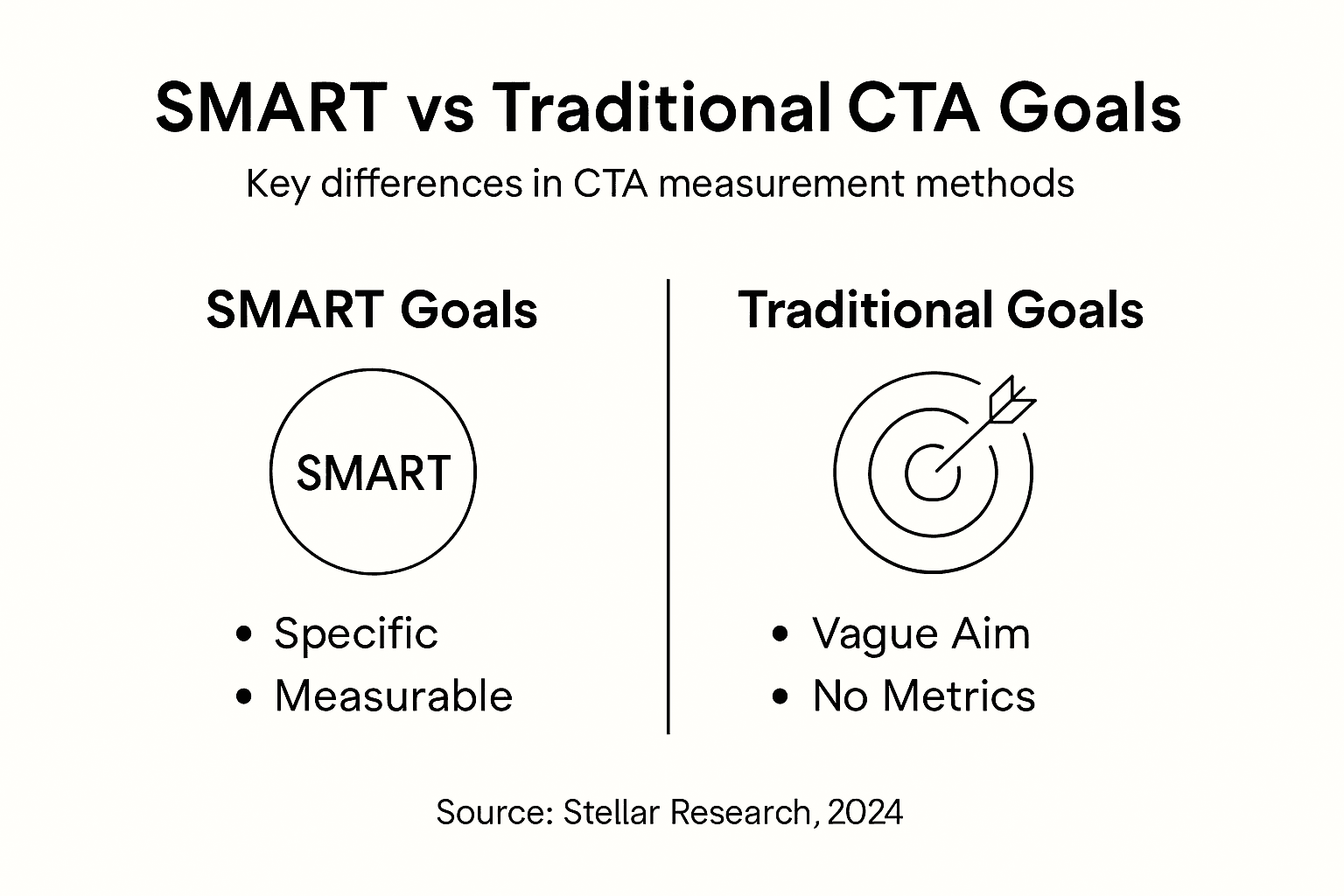
Research emphasizes the importance of systematic goal-setting methods to enhance digital engagement strategies. By creating precise, trackable objectives, marketers can focus their efforts and evaluate test results with greater accuracy.
Pro Tip: Use historical performance data as your baseline when setting CTA goals to ensure realistic and achievable targets.
Step 2: Set up A/B tests using a visual editor
A/B testing your website call-to-actions becomes dramatically simpler with modern visual editing tools that require zero coding expertise. These platforms empower marketers to experiment and optimize conversion strategies without getting tangled in complex technical implementations.
Leveraging visual experiment interfaces, you can quickly modify and test different CTA variations. The process typically involves several strategic steps:
- Access your A/B testing platform's visual editor
- Select the specific webpage or element you want to test
- Create multiple variants of your call-to-action
- Define precise conversion goals
Key features to look for in a visual editor include:
- Drag-and-drop interface for easy modifications
- Real-time preview of proposed changes
- Device responsive view options
- One-click variant creation
- Instant publishing capabilities
The goal is to make testing as frictionless as possible, allowing you to rapidly iterate and improve your conversion strategies.
The visual editor's intuitive design enables you to experiment with elements like button color, text placement, size, and wording without requiring developer intervention. This democratizes optimization, putting powerful testing capabilities directly in marketers' hands.

Pro Tip: Always create a control version alongside your test variants to accurately measure performance improvements.
Step 3: Personalize CTAs with dynamic keyword insertion
Dynamic keyword insertion transforms your call-to-action strategy by creating hyper-personalized experiences that speak directly to individual user intent. This powerful technique allows you to automatically customize CTA text based on specific user search terms or behavioral data.
Innovative CTA variations enable marketers to dramatically increase engagement by tailoring messages that resonate with specific audience segments. The process involves several strategic approaches:
- Match user search queries with precise CTA language
- Incorporate specific product or location keywords
- Adapt messaging based on user browsing history
- Leverage demographic and behavioral data
Personalization is not just a tactic - it's a fundamental shift in how we communicate with potential customers.
Implementing dynamic keyword insertion requires understanding your audience's unique characteristics. Email marketing personalization techniques demonstrate that tailored experiences can significantly boost conversion rates by creating a sense of individual relevance.
When crafting dynamic CTAs, consider psychological triggers like urgency, scarcity, and social proof to enhance their effectiveness. A CTA that reads "Get Your Denver Marketing Guide Now" will feel more compelling to a local user than a generic "Download Guide" message.
Pro Tip: Test multiple keyword variations to discover which personalization strategies generate the highest engagement and conversion rates.
Step 4: Analyze real-time test results for insights
Analyzing A/B test results is a critical skill that transforms raw data into actionable marketing strategies. Real-time insights enable you to make rapid, informed decisions about your call-to-action performance before committing significant resources.
Real-time monitoring techniques allow marketers to track conversion metrics instantly, identifying emerging trends and potential issues with extraordinary precision. By setting up dynamic dashboards, you can:
- Track immediate conversion rate changes
- Detect technical errors quickly
- Monitor traffic distribution
- Validate statistical significance
Your goal is not just collecting data, but transforming that data into meaningful optimization strategies.
Understanding key performance metrics is crucial for interpreting test results effectively. A/B testing analysis involves examining multiple dimensions like:
This table summarizes key performance metrics for analyzing CTA test results:
| Metric | What It Measures | Why It Matters |
|---|---|---|
| Uplift Percentage | Difference between test and control | Shows improvement impact |
| Probability to Be Best | Likelihood a version is superior | Aids confident decisions |
| Segment Performance | Results by user group | Reveals audience insights |
| Secondary Engagement | Actions beyond the main CTA | Informs broader strategy |
- Uplift percentage
- Probability to Be Best
- Audience segment performance
- Secondary engagement metrics
Advanced marketers dig deeper by segmenting results across different user demographics, revealing nuanced insights that generic reporting might miss. A variant performing poorly overall might excel with a specific audience segment.
Pro Tip: Always establish a minimum sample size and confidence level before drawing definitive conclusions about your test results.
Step 5: Refine call-to-actions based on performance data
Refining call-to-actions is a continuous process of strategic optimization driven by performance insights. By carefully analyzing data, you can transform underperforming CTAs into powerful conversion magnets that speak directly to your audience's motivations.
Comprehensive CTA research reveals that systematic refinement involves multiple strategic considerations. Key refinement strategies include:
- Analyze psychological triggers in current CTA design
- Identify friction points in user conversion path
- Test messaging variations systematically
- Adjust design elements incrementally
- Validate changes through statistical significance
Small, calculated modifications can yield substantial improvements in conversion performance.
Understanding the science behind high-performing CTAs requires deep analysis of user interactions. Scientific CTA optimization emphasizes examining:
- Emotional response to current messaging
- Visual hierarchy and design elements
- Clarity of proposed action
- Urgency and motivation triggers
Successful marketers view CTA refinement as an ongoing experiment, continuously learning from user behavior and adapting their approach to meet evolving audience expectations.
Pro Tip: Document each CTA variation and its performance to build a comprehensive knowledge base for future optimization efforts.
Boost Your Conversion Rates with Smarter CTA Testing
Struggling to improve your website's call-to-action performance can be frustrating. This article highlights key challenges like defining measurable goals, running effective A/B tests using a visual editor, and leveraging dynamic keyword insertion to personalize user experiences. If you want to overcome these obstacles with ease and gain real-time insights that drive rapid results, Stellar is built exactly for that purpose.
Discover how Stellar’s lightweight, no-code platform streamlines your entire A/B testing process. From setting precise conversion goals to visually testing variants and personalizing CTAs dynamically, Stellar empowers marketers and growth hackers to optimize faster without technical roadblocks. Don’t wait to transform your testing approach into a high-impact conversion machine. Try Stellar today at Stellar and explore tools like the Visual Editor and Advanced Goal Tracking designed specifically for small to medium-sized business success.
Frequently Asked Questions
What are measurable goals for testing website call-to-actions?
Defining measurable goals for website call-to-actions helps you focus your testing efforts. Establish specific conversion targets, set numeric benchmarks, and define measurement timeframes to evaluate performance effectively.
How do I set up A/B tests for my website call-to-actions?
To set up A/B tests, use a visual editing platform to create and test multiple variations of your call-to-actions. Simply access your A/B testing tool, select the webpage or element, create variants, and define conversion goals for each.
What is dynamic keyword insertion and how can it improve CTAs?
Dynamic keyword insertion customizes your call-to-action text based on user search terms or behavior. Incorporate specific keywords to make your CTAs more relevant, which can significantly increase engagement and conversion rates.
How do I analyze real-time test results for my call-to-actions?
You can analyze real-time test results by monitoring conversion metrics using dynamic dashboards. Keep track of changes in conversion rates, traffic distribution, and experiment validity to make informed decisions about your call-to-actions.
What strategies can I use to refine underperforming call-to-actions?
To refine underperforming call-to-actions, analyze the psychological triggers behind your current design and identify friction points in the user conversion path. Test messaging and design variations incrementally, making small adjustments that could yield significant improvements.
How can I track the performance of my A/B tests effectively?
To track performance effectively, establish clear performance metrics like uplift percentage and audience segment performance. Set a minimum sample size and confidence level before drawing conclusions to ensure accurate assessments of your A/B tests.
Recommended
Published: 2/13/2026